RankRizz

Wave Optics — JEE Main Previous Year Questions

Every Wave Optics question JEE Main has set from 2004–2026, grouped by the idea it tests rather than the order of the syllabus. 198 questions across 6 distinct ideas. Free to read, answer key on every one.

DATA UPDATED

Questions

198

Distinct ideas

6

Share of marks

4.8%

Difficulty

MEDIUM

The ideas inside Wave Optics

A chapter is not one subject — it is a handful of procedures the examiner reuses. These are the ones Wave Optics questions actually test.

Every Wave Optics question

121–140 OF 198 · NEWEST FIRST

JEE MAIN 2020 · 06 SEP S1Wavefronts and Huygens' principle

In the figure below, PP and QQ are two equally intense coherent sources emitting radiation of wavelength 20 m20\,\text{m}. The separation between P and Q is 5 m5\,\text{m} and the phase of P is ahead of that of Q by 90∘90^\circ. A, B and C are three distinct point of observation, each equidistant from the midpoint of PQ. The intensities of radiation at A, B, C will be in the ratio:
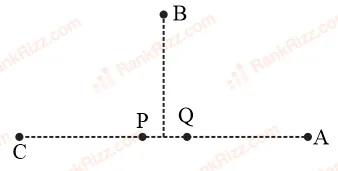
Figure for JEE Main 2020 Physics question on Wavefronts and Huygens' principle
  1. A

    0 : 1 : 4

  2. B

    2 : 1 : 0

  3. C

    0 : 1 : 2

  4. D

    4 : 1 : 0

JEE MAIN 2020 · 06 SEP S2Wavefronts and Huygens' principle

A Young's double-slit experiment is performed using monochromatic light of wavelength λ\lambda. The intensity of light at a point on the screen, where the path difference is λ\lambda, is KK units. The intensity of light at a point where the path difference is λ6\dfrac{\lambda}{6} is given by nK12\dfrac{nK}{12}, where n is an integer. The value of n is___

JEE MAIN 2020 · 04 SEP S1Polarisation: Malus's law and Brewster's law

A beam of plane polarized light of large cross-sectional area and uniform intensity of 3.3 W m−2^{-2} falls normally on a polarizer (cross-sectional area 3×10−43 \times 10^{-4} m2^2), which rotates about its axis with an angular speed of 31.4 rad s−1^{-1}. The energy of light passing through the polarizer per revolution, is close to:

  1. A

    1.0×10−51.0 \times 10^{-5} J

  2. B

    1.0×10−41.0 \times 10^{-4} J

  3. C

    1.5×10−41.5 \times 10^{-4} J

  4. D

    5.0×10−45.0 \times 10^{-4} J

JEE MAIN 2020 · 04 SEP S2Single slit diffraction

Orange light of wavelength 6000×10−106000 \times 10^{-10} m illuminates a single slit of width 0.6×10−40.6 \times 10^{-4} m. The maximum possible number of diffraction minima produced on both sides of the central maximum is __________

JEE MAIN 2020 · 03 SEP S1Wavefronts and Huygens' principle

In a Young's double slit experiment, light of 500 nm is used to produce and interference pattern. When the distance between the slits is 0.05 mm, the angular width (in degree) of the fringes formed on the distance screen is close to:

  1. A

    0.17°

  2. B

    0.57°

  3. C

    1.7°

  4. D

    0.07°

JEE MAIN 2020 · 03 SEP S2Wavefronts and Huygens' principle

Two light waves having the same wavelength λ\lambda in vacuum are in phase initially. Then the first wave travels a path L1L_1 through a medium of refractive index n1n_1 while the second wave travels a path of length L2L_2 through a medium of refractive index n2n_2. After this the phase difference between the two waves is:

  1. A

    2πλ(L2n1−L1n2)\frac{2\pi}{\lambda}\left(\frac{L_2}{n_1} - \frac{L_1}{n_2}\right)

  2. B

    2πλ(L1n1−L2n2)\frac{2\pi}{\lambda}\left(\frac{L_1}{n_1} - \frac{L_2}{n_2}\right)

  3. C

    2πλ(n1L1−n2L2)\frac{2\pi}{\lambda}(n_1L_1 - n_2L_2)

  4. D

    2πλ(n2L1−n1L2)\frac{2\pi}{\lambda}(n_2L_1 - n_1L_2)

JEE MAIN 2020 · 02 SEP S1Wavefronts and Huygens' principle

Interference fringes are observed on a screen by illuminating two thin slits 1 mm apart with a light source (λ=632.8  nm)(\lambda = 632.8 \; nm). The distance between the screen and the slits is 100 cm. If a bright fringe is observed on a screen at distance of 1.27 mm from the central bright fringe, then the path difference between the waves, which are reaching this point from the slits is close to:

  1. A

    1.27 μ\mum

  2. B

    2.87 nm

  3. C

    2 nm

  4. D

    2.05 μ\mum

JEE MAIN 2020 · 02 SEP S2Wavefronts and Huygens' principle

In a Young's double slit experiment, 16 fringes are observed in a certain segment of the screen when light of wavelength 700 nm is used. If the wavelength of light is changed to 400 nm, the number of fringes observed in the same segment of the screen would be:

  1. A

    24

  2. B

    30

  3. C

    18

  4. D

    28

JEE MAIN 2020 · 09 JAN S1Resolving power of microscopes and telescopes

The aperture diameter of a telescope is 55 m. The separation between the moon and the earth is 4×1054 \times 10^5 km. With light of wavelength 55005500 Å, the minimum separation between objects on the surface of moon, so that they are just resolved, is close to:

  1. A

    60 m

  2. B

    20 m

  3. C

    200 m

  4. D

    600 m

JEE MAIN 2020 · 09 JAN S2Young's double slit experiment: fringe width and intensity

In a Young's double slit experiment 15 fringes are observed on a small portion of the screen when light of wavelength 500 nm is used. Ten fringes are observed on the same section of the screen when another light source of wavelength λ\lambda is used. Then the value of λ\lambda is (in nm) ___________.

JEE MAIN 2020 · 08 JAN S2Wavefronts and Huygens' principle

In a double-slit experiment, at a certain point on the screen the path difference between the two interfering waves is 18\frac{1}{8}th of a wavelength. The ratio of the intensity of light at that point to that at the center of a bright fringe is:

  1. A

    0.853

  2. B

    0.672

  3. C

    0.568

  4. D

    0.760

JEE MAIN 2020 · 07 JAN S1Polarisation: Malus's law and Brewster's law

A polarizer - analyser set is adjusted such that the intensity of light coming out of the analyser is just 36% of the original intensity. Assuming that the polarizer - analyser set does not absorb any light, the angle by which the analyser needs to be rotated further, to reduce the output intensity to zero, is (sin⁡−1(35)=37∘\sin^{-1}\left(\frac{3}{5}\right) = 37^\circ)

  1. A

    53∘^\circ

  2. B

    37∘^\circ

  3. C

    90∘^\circ

  4. D

    45∘^\circ

JEE MAIN 2020 · 07 JAN S1Single slit diffraction

Visible light of wavelength 6000×10−86000 \times 10^{-8} cm falls normally on a single slit and produces a diffraction pattern. It is found that the second diffraction minimum is at 60∘^\circ from the central maximum. If the first minimum is produced at θ1\theta_1, then θ1\theta_1 is close to

  1. A

    20∘^\circ

  2. B

    30∘^\circ

  3. C

    25∘^\circ

  4. D

    45∘^\circ

JEE MAIN 2020 · 07 JAN S2Young's double slit experiment: fringe width and intensity

In a Young's double slit experiment, the separation between the slits is 0.15 mm. In the experiment, a source of light of wavelength 589 nm is used and the interference pattern is observed on a screen kept 1.5 m away. The separation between the successive bright fringes on the screen is:

  1. A

    6.9 mm

  2. B

    3.9 mm

  3. C

    5.9 mm

  4. D

    4.9 mm

JEE MAIN 2019 · 12 APR S1Resolving power of microscopes and telescopes

The value of numerical aperture of the objective lens of a microscope is 1.25. If light of wavelength 5000 Å is used, the minimum separation between two points, to be seen as distinct, will be:

  1. A

    0.48 μm

  2. B

    0.24 μm

  3. C

    0.38 μm

  4. D

    0.12 μm

JEE MAIN 2019 · 12 APR S1Young's double slit experiment: fringe width and intensity

In a double slit experiment, when a thin film of thickness t having refractive index μ is introduced in front of one of the slits, the maximum at the centre of the fringe pattern shifts by one fringe width. The value of t is (λ\lambda is the wavelength of the light used):

  1. A

    λ2(μ−1)\frac{\lambda}{2(\mu - 1)}

  2. B

    λ(2μ−1)\frac{\lambda}{(2\mu - 1)}

  3. C

    2λ(μ−1)\frac{2\lambda}{(\mu - 1)}

  4. D

    λ(μ−1)\frac{\lambda}{(\mu - 1)}

JEE MAIN 2019 · 12 APR S2Polarisation: Malus's law and Brewster's law

A system of three polarizers P1_1, P2_2, P3_3 is set up such that the pass axis of P3_3 is crossed with respect to that of P1_1. The pass axis of P2_2 is inclined at 60° to the pass axis of P3_3. When a beam of unpolarized light of intensity I0_0 is incident on P1_1, the intensity of light transmitted by the three polarizers is I. The ratio (I0_0/I) equals (nearly):

  1. A

    5.33

  2. B

    16.00

  3. C

    1.80

  4. D

    10.67

JEE MAIN 2019 · 10 APR S2Wavefronts and Huygens' principle

In a Young's double-slit experiment, the ratio of the slit's width is 4:1. The ratio of the intensity of maxima to minima, close to the central fringe on the screen, will be

  1. A

    25 : 9

  2. B

    9 : 1

  3. C

    (3+1)4(\sqrt{3} + 1)^4 : 16

  4. D

    4 : 1

JEE MAIN 2019 · 09 APR S1Young's double slit experiment: fringe width and intensity

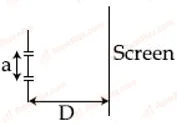
The figure shows a Young's double slit experimental setup. It is observed that when a thin transparent sheet of thickness t and refractive index μ\mu is put in front of one of the slits, the central maximum gets shifted by a distance equal to n fringe width. If the wavelength of light used is λ\lambda then t will be:

Figure for JEE Main 2019 Physics question on Young's double slit experiment: fringe width and intensity
  1. A

    Dλa(μ−1)\frac{D\lambda}{a(\mu - 1)}

  2. B

    nλ(μ−1)\frac{n\lambda}{(\mu - 1)}

  3. C

    2nλ(μ−1)\frac{2n\lambda}{(\mu - 1)}

  4. D

    2Dλa(μ−1)\frac{2D\lambda}{a(\mu - 1)}

JEE MAIN 2019 · 09 APR S2Resolving power of microscopes and telescopes

Diameter of the objective lens of a telescope is 250 cm. For light of wavelength 600 nm coming from a distant object, the limit of resolution of the telescope is close to:

  1. A

    1.5×10−71.5 \times 10^{-7} rad

  2. B

    3.0×10−73.0 \times 10^{-7} rad

  3. C

    2.0×10−72.0 \times 10^{-7} rad

  4. D

    4.5×10−74.5 \times 10^{-7} rad