RankRizz

Wave Optics — JEE Main Previous Year Questions

Every Wave Optics question JEE Main has set from 2004–2026, grouped by the idea it tests rather than the order of the syllabus. 198 questions across 6 distinct ideas. Free to read, answer key on every one.

DATA UPDATED

Questions

198

Distinct ideas

6

Share of marks

4.8%

Difficulty

MEDIUM

The ideas inside Wave Optics

A chapter is not one subject — it is a handful of procedures the examiner reuses. These are the ones Wave Optics questions actually test.

Every Wave Optics question

81–100 OF 198 · NEWEST FIRST

JEE MAIN 2023 · 29 JAN S1Polarisation: Malus's law and Brewster's law

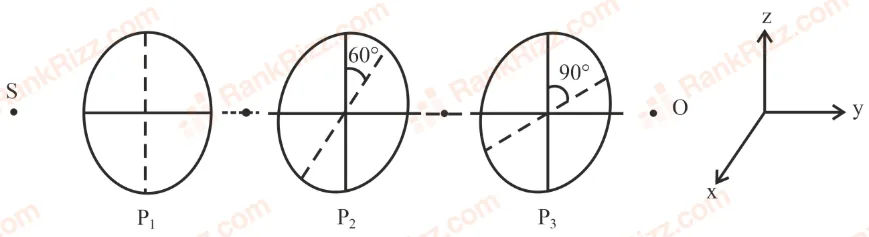
As shown in figures, three identical polaroids P1P_1, P2P_2 and P3P_3 are placed one after another. The pass axis of P2P_2 and P3P_3 are inclined at angle of 60°60° and 90°90° with respect to axis of P1P_1. The source SS has an intensity of 256256 W m−2^{-2}. The intensity of light at point OO is ______ W m−2^{-2}.

Figure for JEE Main 2023 Physics question on Polarisation: Malus's law and Brewster's law
JEE MAIN 2023 · 29 JAN S2Polarisation: Malus's law and Brewster's law

Unpolarised light is incident on the boundary between two dielectric media, whose dielectric constants are 2.82.8 (medium −1-1) and 6.86.8 (medium −2-2), respectively. To satisfy the condition, so that the reflected and refracted rays are perpendicular to each other, the angle of incidence should be tan⁡−1(1+10θ)12\tan^{-1}\left(1 + \frac{10}{\theta}\right)^{\frac{1}{2}}, the value of θ\theta is ______.
(Given for dielectric media, μr=1\mu_r = 1)

JEE MAIN 2023 · 25 JAN S1Young's double slit experiment: fringe width and intensity

In Young's double slits experiment, the position of 5th^{th} bright fringe from the central maximum is 5 cm. The distance between slits and screen is 1 m and wavelength of used monochromatic light is 600 nm. The separation between the slits is:

  1. A

    60 μ\mum

  2. B

    48 μ\mum

  3. C

    12 μ\mum

  4. D

    36 μ\mum

JEE MAIN 2023 · 24 JAN S1Polarisation: Malus's law and Brewster's law

Given below are two statements :
Statement I : If the Brewster's angle for the light propagating from air to glass is θB\theta_B, then Brewster's angle for the light propagating from glass to air is π2−θB\frac{\pi}{2} - \theta_B.
Statement II : The Brewster's angle for the light propagating from glass to air is tan⁡−1μg\tan^{-1}\mu_g, where μg\mu_g is the refractive index of glass.
In the light of the above statements, choose the correct answer from the options given below :

  1. A

    Both Statements I and Statement II are true.

  2. B

    Statement I is true but Statement II is false.

  3. C

    Both Statement I and Statement II are false.

  4. D

    Statement I is false but Statement II is true.

JEE MAIN 2023 · 24 JAN S1Polarisation: Malus's law and Brewster's law

Given below are two statements:
Statement I: If the Brewster's angle for the light propagating from air to glass is θB\theta_B, then Brewster's angle for the light propagating from glass to air is π2−θB\frac{\pi}{2} - \theta_B.
Statement II: The Brewster's angle for the light propagating from glass to air is tan⁡−1μg\tan^{-1} \mu_g, where μg\mu_g is the refractive index of glass.
In the light of the above statements, choose the correct answer from the options given below:

  1. A

    Both Statements I and Statement II are true.

  2. B

    Statement I is true but Statement II is false.

  3. C

    Both Statements I and Statement II are false.

  4. D

    Statement I is false but Statement II is true.

JEE MAIN 2022 · 29 JUL S1Wavefronts and Huygens' principle

Two light beams of intensities 4I and 9I interfere on a screen. The phase difference between these beams on the screen at point A is zero and at point B is π\pi. The difference of resultant intensities, at the point A and B, will be _____ I.

JEE MAIN 2022 · 29 JUL S2Polarisation: Malus's law and Brewster's law

An unpolarised light beam of intensity 2I02I_0 is passed through a polaroid P and then through another polaroid Q which is oriented in such a way that its passing axis makes an angle of 30° relative to that of P. The intensity of the emergent light is

  1. A

    I04\frac{I_0}{4}

  2. B

    I02\frac{I_0}{2}

  3. C

    3I04\frac{3I_0}{4}

  4. D

    3I02\frac{3I_0}{2}

JEE MAIN 2022 · 28 JUL S1Wavefronts and Huygens' principle

In a Young's double slit experiment, a laser light of 560 nm produces an interference pattern with consecutive bright fringes' separation of 7.2 mm. Now another light is used to produce an interference pattern with consecutive bright fringes' separation of 8.1 mm. The wavelength of second light is _____ nm.

JEE MAIN 2022 · 27 JUL S1Resolving power of microscopes and telescopes

A microscope was initially placed in air (refractive index 1). It is then immersed in oil (refractive index 2). For a light whose wavelength in air is λ\lambda, calculate the change of microscope's resolving power due to oil

  1. A

    Resolving power will be 14\dfrac{1}{4} in the oil than it was in the air

  2. B

    Resolving power will be twice in the oil than it was in the air

  3. C

    Resolving power will be four times in the oil than it was in the air

  4. D

    Resolving power will be 12\dfrac{1}{2} in the oil than it was in the air

JEE MAIN 2022 · 27 JUL S1Young's double slit experiment: fringe width and intensity

Two beams of light having intensities II and 4I4I interfere to produce a fringe pattern on a screen. The phase difference between the two beams are π2\dfrac{\pi}{2} and π3\dfrac{\pi}{3} at points AA and BB respectively. The difference between the resultant intensities at the two points is xIxI. The value of xx will be ______.

JEE MAIN 2022 · 27 JUL S2Wavefronts and Huygens' principle

Two coherent sources of light interfere. The intensity ratio of two sources is 1:41 : 4. For this interference pattern if the value of Imax+IminImax−Imin\frac{I_{max}+I_{min}}{I_{max}-I_{min}} is equal to 2α+1β+3\frac{2\alpha+1}{\beta+3}, then αβ\frac{\alpha}{\beta} will be

  1. A

    1.5

  2. B

    2

  3. C

    0.5

  4. D

    1

JEE MAIN 2022 · 26 JUL S1Young's double slit experiment: fringe width and intensity

In Young's double slit experiment, the fringe width is 12 mm12 \text{ mm}. If the entire arrangement is placed in water of refractive index 43\dfrac{4}{3}, then the fringe width becomes (in mm)

  1. A

    1616

  2. B

    99

  3. C

    4848

  4. D

    1212

JEE MAIN 2022 · 29 JUN S1Wavefronts and Huygens' principle

Using Young's double slit experiment, a monochromatic light of wavelength 5000 A produces fringes of fringe width 0.5 mm. If another monochromatic light of wavelength 6000 A is used and the separation between the slits is doubled, then the new fringe width will be

  1. A

    0.5 mm

  2. B

    1.0 mm

  3. C

    0.6 mm

  4. D

    0.3 mm

JEE MAIN 2022 · 29 JUN S2Wavefronts and Huygens' principle

In a double slit experiment with monochromatic light, fringes are obtained on a screen placed at some distance from the plane of slits. If the screen is moved by 5×10⁻²⁵ \times 10^{-2} m towards the slits, the change in fringe width is 3×10⁻³³ \times 10^{-3} cm. If the distance between the slits is 1 mm, then the wavelength of the light will be ______ nm.

JEE MAIN 2022 · 28 JUN S1Resolving power of microscopes and telescopes

The aperture of the objective is 24.424.4 cm. The resolving power of this telescope, if a light of wavelength 24402440 Å is used to see the object will be

  1. A

    8.1×1068.1 \times 10^6

  2. B

    10.0×10710.0 \times 10^7

  3. C

    8.2×1058.2 \times 10^5

  4. D

    1.0×10−81.0 \times 10^{-8}

JEE MAIN 2022 · 28 JUN S2Wavefronts and Huygens' principle

In young's double slit experiment performed using a monochromatic light of wavelength λ\lambda, when a glass plate (μ=1.5\mu = 1.5) of thickness xλx\lambda is introduced in the path of the one of the interfering beams, the intensity at the position where the central maximum occurred previously remains unchanged. The value of xx will be

  1. A

    3

  2. B

    2

  3. C

    1.5

  4. D

    0.5

JEE MAIN 2022 · 28 JUN S2Wavefronts and Huygens' principle

In a Young's double slit experiment, an angular width of the fringe is 0.35° on a screen placed at 2 m away for particular wavelength of 450 nm. The angular width of the fringe, when whole system is immersed in a medium of refractive index 75\frac{7}{5}, is 1α\frac{1}{\alpha}. The value of α\alpha is ______.

JEE MAIN 2022 · 27 JUN S1Wavefronts and Huygens' principle

In Young's double slit experiment the two slits are 0.60.6 mm distance apart. Interference pattern is observed on a screen at a distance 8080 cm from the slits. The first dark fringe is observed on the screen directly opposite to one of the slits. The wavelength of light will be ______ nm.

JEE MAIN 2022 · 26 JUN S2Single slit diffraction

For a specific wavelength 670670 nm of light coming from a galaxy moving with velocity vv, the observed wavelength is 670.7670.7 nm. The value of vv is

  1. A

    3×1083 \times 10^8 m s−1^{-1}

  2. B

    3.13×1053.13 \times 10^5 m s−1^{-1}

  3. C

    3×10103 \times 10^{10} m s−1^{-1}

  4. D

    4.48×1054.48 \times 10^5 m s−1^{-1}

JEE MAIN 2022 · 25 JUN S1Wavefronts and Huygens' principle

The two light beams having intensities II and 9I9I interfere to produce a fringe pattern on a screen. The phase difference between the beams is π2\frac{\pi}{2} at point PP and π\pi at point QQ. Then the difference between the resultant intensities at PP and QQ will be :

  1. A

    2I2I

  2. B

    6I6I

  3. C

    5I5I

  4. D

    7I7I