RankRizz

Wavefronts and Huygens' principle — JEE Main Previous Year Questions

Wavefronts and Huygens' principle has been asked 50 times in JEE Main, in 8 different years between 2010 and 2026, and in 4 of the last five exam years (2022–2026), 29 questions in all. That is 25% of Wave Optics, one of its three most-asked topics. Last asked in JEE Main 28 Jan 2026, Shift 1. 32 are multiple choice and 18 numerical-value; 24 easy and 25 medium by our difficulty labels. All of them are below, newest first, free to read.

Questions

50

Years asked

8

Since

2010

Of the chapter

25%

When JEE Main asked it

Questions on Wavefronts and Huygens' principle in every year it was asked, newest first.

JEE Main questions on Wavefronts and Huygens' principle by year, 2010–2026
YearRelative frequencyQuestions
20264
20256
20249
202210
20218
20207
20195
20101
Total50

Every Wavefronts and Huygens' principle question

1–20 OF 50 · NEWEST FIRST

JEE MAIN 2026 · 28 JAN S1Wavefronts and Huygens' principle

Given below are two statements:
Statement I: A plane wave after passing through prism remains as plane wave but passing through small pin hole may become spherical wave.
Statement II: The curvature of a spherical wave emerging from a slit will increase for increasing slit wridth
In the light of the above statements, choose the correct answer from the options given below

  1. A

    Both Statement I and Statement II are true

  2. B

    Statement I is false but Statement II is true

  3. C

    Statement I is true but Statement II is false

  4. D

    Both Statement I and Statement II are false
JEE MAIN 2026 · 24 JAN S2Wavefronts and Huygens' principle

In the Young's double slit experiment the intensity produced by each one of the individual slits is Io.I_{o}. The distance between two slits is 2 mm . The distance of screen from slits is 10 m. The wavelength of light is 6000A∘6000_A^\circ. The intensity of light on the screen in front of one of the slits is __________.

  1. A

    2I∘2I_{\circ}

  2. B

    I∘2\frac{I_{\circ}}{2}

  3. C

    I∘I_{\circ}

  4. D

    4I∘4I_{\circ}

JEE MAIN 2026 · 22 JAN S2Wavefronts and Huygens' principle

The wavelength of light, while it is passing through water is 540 nm. The refractive index of water is 43\frac{4}{3}. The wavelength of the same light when it is passing through a transparent medium having refractive index of 32\frac{3}{2} is ____________nm.

  1. A

    840

  2. B

    380

  3. C

    480

  4. D

    540

JEE MAIN 2026 · 21 JAN S2Wavefronts and Huygens' principle

Given below are two statements :
Statement I : In a Young's double slit experiment, the angular separation of fringes will increase as the screen is moved away from the plane of the slits
Statement II: In a Young's double slit experiment, the angular separation of fringes will increase when monochromatic source is replaced by another monochromatic source of higher wavelength
In the light of the above statements, choose the correct answer from the options given below :

  1. A

    Both Statement I and Statement II are true

  2. B

    Statement I is false but Statement II is true

  3. C

    Both Statement I and Statement II are false

  4. D

    Statement I is true but Statement II is false

JEE MAIN 2025 · 03 APR S2Wavefronts and Huygens' principle

A monochromatic light of frequency 5×10145 \times 10^{14} Hz travelling through air, is incident on a medium of refractive index '2'. Wavelength of the refracted light will be:

  1. A

    300 nm

  2. B

    600 nm

  3. C

    400 nm

  4. D

    500 nm

JEE MAIN 2025 · 24 JAN S2Wavefronts and Huygens' principle

Young's double slit inteference apparatus is immersed in a liquid of refractive index 1.44. It has slit separation of 1.5 mm . The slits are illuminated by a parallel beam of light whose wavelength in air is 690 nm . The fringe-width on a screen placed behind the plane of slits at a distance of 0.72 m , will be :

  1. A

    0.23 mm

  2. B

    0.33 mm

  3. C

    0.63 mm

  4. D

    0.46 mm

JEE MAIN 2025 · 23 JAN S2Wavefronts and Huygens' principle

The width of one of the two slits in Young's double slit experiment is d while that of the other slit is xx d. If the ratio of the maximum to the minimum intensity in the interference pattern on the screen is 9:4 then what is the value of xx ? (Assume that the field strength varies according to the slit width.)

  1. A

    4

  2. B

    5

  3. C

    3

  4. D

    2

JEE MAIN 2025 · 22 JAN S1Wavefronts and Huygens' principle

Given below are two statements : one is labelled as Assertion (A) and the other is labelled as Reason (R).
Assertion-(A) : If Young's double slit experiment is performed in an optically denser medium than air, then the consecutive fringes come closer. Reason-(R) : The speed of light reduces in an optically denser medium than air while its frequency does not change. In the light of the above statements, choose the most appropriate answer from the options given below :

  1. A

    Both (A) and (R) are true but (R) is not the correct explanation of (A)

  2. B

    Both (A) and (R) are true and (R) is the correct explanation of (A)

  3. C

    (A) is true but (R) is false

  4. D

    (A) is false but (R) is true

JEE MAIN 2025 · 22 JAN S2Wavefronts and Huygens' principle

A transparent film of refractive index, 2.0 is coated on a glass slab of refractive index, 1.45. What is the minimum thickness of transparent film to be coated for the maximum transmission of Green light of wavelength 550 nm . [Assume that the light is incident nearly perpendicular to the glass surface.]

  1. A

    137.5 nm

  2. B

    275 nm

  3. C

    94.8 nm

  4. D

    68.7 nm

JEE MAIN 2025 · 22 JAN S2Wavefronts and Huygens' principle

Given below are two statements. One is labelled as Assertion (A) and the other is labelled as Reason (R). Assertion (A) : In Young's double slit experiment, the fringes produced by red light are closer as compared to those produced by blue light. Reason (R): The fringe width is directly proportional to the wavelength of light. In the light of the above statements, choose the correct answer from the options given below :

  1. A

    Both (A) and (R) are true but (R) is NOT the correct explanation of (A)

  2. B

    (A) is true but (R) is false

  3. C

    Both (A) and (R) are true and (R) is the correct explanation of (A)

  4. D

    (A) is false but (R) is true

JEE MAIN 2024 · 09 APR S2Wavefronts and Huygens' principle

Monochromatic light of wavelength 500 nm500 \text{ nm} is used in Young's double slit experiment. An interference pattern is obtained on a screen. When one of the slits is covered with a very thin glass plate (refractive index =1.5= 1.5), the central maximum is shifted to a position previously occupied by the 4th4^{th} bright fringe. The thickness of the glass-plate is ______ μm\mu m.

JEE MAIN 2024 · 08 APR S2Wavefronts and Huygens' principle

Two slits are 1 mm apart and the screen is located 1 m away from the slits. A light of wavelength 500 nm is used. The width of each slit to obtain 10 maxima of the double slit pattern within the central maximum of the single slit pattern is _____ ×10−4\times 10^{-4} m.

JEE MAIN 2024 · 06 APR S2Wavefronts and Huygens' principle

Two coherent monochromatic light beams of intensities I and 4I are superimposed. The difference between maximum and minimum possible intensities in the resulting beam is xIxI. The value of xx is ___________.

JEE MAIN 2024 · 05 APR S1Wavefronts and Huygens' principle

Light emerges out of a convex lens when a source of light kept at its focus. The shape of wavefront of the light is :

  1. A

    both spherical and cylindrical

  2. B

    plane

  3. C

    spherical

  4. D

    cylindrical

JEE MAIN 2024 · 04 APR S1Wavefronts and Huygens' principle

Two wavelengths λ1\lambda_1 and λ2\lambda_2 are used in Young's double slit experiment. λ1=450 nm\lambda_1 = 450\ nm and λ2=650 nm\lambda_2 = 650\ nm. The minimum order of fringe produced by λ2\lambda_2 which overlaps with the fringe produced by λ1\lambda_1 is n. The value of n is _____.

JEE MAIN 2024 · 04 APR S2Wavefronts and Huygens' principle

The width of one of the two slits in a Young's double slit experiment is 4 times that of the other slit. The ratio of the maximum of the minimum intensity in the interference pattern is:

  1. A

    1:11 : 1

  2. B

    4:14 : 1

  3. C

    9:19 : 1

  4. D

    16:116 : 1

JEE MAIN 2024 · 01 FEB S2Wavefronts and Huygens' principle

In Young's double slit experiment, monochromatic light of wavelength 5000 Å is used. The slits are 1.0 mm apart and screen is placed at 1.0 m away from slits. The distance from the centre of the screen where intensity becomes half of the maximum intensity for the first time is ______ ×10−6\times 10^{-6} m.

JEE MAIN 2024 · 31 JAN S1Wavefronts and Huygens' principle

Two waves of intensity ratio 1:91 : 9 cross each other at a point. The resultant intensities at the point, when (a) Waves are incoherent is I1I_1 (b) Waves are coherent is I2I_2 and differ in phase by 60°60°. If I1I2=10x\frac{I_1}{I_2} = \frac{10}{x}, then xx = _________.

JEE MAIN 2024 · 29 JAN S1Wavefronts and Huygens' principle

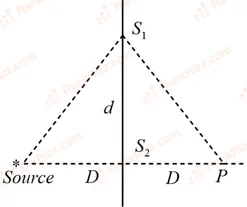
In a double slit experiment shown in figure, when light of wavelength 400400 nm is used, dark fringe is observed at PP. If D=0.2D = 0.2 m, the minimum distance between the slits S1S_1 and S2S_2 is α\alpha mm. Write the value of 10α10\alpha to the nearest integer.

Figure for JEE Main 2024 Physics question on Wavefronts and Huygens' principle
JEE MAIN 2022 · 29 JUL S1Wavefronts and Huygens' principle

Two light beams of intensities 4I and 9I interfere on a screen. The phase difference between these beams on the screen at point A is zero and at point B is π\pi. The difference of resultant intensities, at the point A and B, will be _____ I.

Wavefronts and Huygens' principle: common questions

How many Wavefronts and Huygens' principle questions have come in JEE Main?
Wavefronts and Huygens' principle has been asked 50 times in JEE Main, in 8 different years between 2010 and 2026. It came up in 4 of the last five exam years (2022–2026), 29 questions in all.
Is Wavefronts and Huygens' principle important for JEE Main?
It is one of the three most-asked topics in Wave Optics: 50 of the chapter's 198 JEE Main questions (25%). It came up in 4 of the last five exam years (2022–2026), 29 questions in all.
When was Wavefronts and Huygens' principle last asked in JEE Main?
Most recently in JEE Main 28 Jan 2026, Shift 1. Questions on this page are newest first, so the latest ones are at the top.
What kind of Wavefronts and Huygens' principle questions does JEE Main ask?
32 are multiple choice and 18 numerical-value; 24 easy and 25 medium by our difficulty labels. Each question shows its answer key and worked solution where we have them.