A beam of unpolarised light of intensity is passed through a polaroid and then through another polaroid which is oriented so that its principal plane makes an angle of relative to that of . The intensity of emergent light is:
- A
- B
- C
- D
Every Wave Optics question JEE Main has set from 2004–2026, grouped by the idea it tests rather than the order of the syllabus. 198 questions across 6 distinct ideas. Free to read, answer key on every one.
DATA UPDATED
Questions
198
Distinct ideas
6
Share of marks
4.8%
Difficulty
MEDIUM
A chapter is not one subject — it is a handful of procedures the examiner reuses. These are the ones Wave Optics questions actually test.
61–80 OF 198 · NEWEST FIRST
A beam of unpolarised light of intensity is passed through a polaroid and then through another polaroid which is oriented so that its principal plane makes an angle of relative to that of . The intensity of emergent light is:
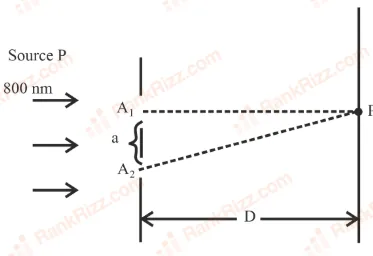
In a double slit experiment shown in figure, when light of wavelength nm is used, dark fringe is observed at . If m, the minimum distance between the slits and is mm. Write the value of to the nearest integer.

In Young's double slit experiment, light from two identical sources are superimposing on a screen. The path difference between the two lights reaching at a point on the screen is . The ratio of intensity of fringe at this point with respect to the maximum intensity of the fringe is:
In a single slit diffraction pattern, a light of wavelength is used. The distance between the first and third minima in the diffraction pattern is found to be mm when the screen is placed cm away from slits. The width of the slit is ______ m.
When a polaroid sheet is rotated between two crossed polaroids then the transmitted light intensity will be maximum for a rotation of :
60°
30°
90°
45°
A parallel beam of monochromatic light of wavelength 5000 is incident normally on a single narrow slit of width 0.001 mm. The light is focused by convex lens on screen, placed on its focal plane. The first minima will be formed for the angle of diffraction of _____ (degree).
A single slit of width is illuminated by a monochromatic light of wavelength nm. The value of for which first minimum appears at on the screen will be :
m
m
m
m
In a Young's double slit experiment, the ratio of amplitude of light coming from slits is . The ratio of the maximum to minimum intensity in the interference pattern is
Unpolarised light of intensity 32 W m passes through the combination of three polaroids such that the pass axis of the last polaroid is perpendicular to that of the pass axis of first polaroid. If intensity of emerging light is 3 W m, then the angle between pass axis of first two polaroids is _______ .
The ratio of intensities at two points P and Q on the screen in a Young's double slit experiment where phase difference between two waves of same amplitude are and , respectively are
2 : 3
1 : 3
3 : 1
3 : 2
The width of fringe is 2 mm on the screen in a double slit experiment for the light of wavelength of 400 nm. The width of the fringe for the light of wavelength 600 nm will be:
4 mm
2 mm
1.33 mm
3 mm
Given below are two statements: one is labelled as Assertion A and the other is labelled as Reason R
Assertion A: The phase difference of two light waves change if they travel through different media having same thickness, but different indices of refraction.
Reason R: The wavelengths of waves are different in different media.
In the light of the above statements, choose the most appropriate answer from the options given below
Both A and R are correct but R is NOT the correct explanation of A
A is not correct but R is correct
A is correct but R is not correct
Both A and R are correct and R is the correct explanation of A
A beam of light consisting of two wavelengths 7000 and 5500 is used to obtain interference pattern in Young's double slit experiment. The distance between the slits is 2.5 mm and the distance between the plane of slits and the screen is 150 cm. The least distance from the central fringe, where the bright fringes due to both the wavelengths coincide, is m. The value of is ______.
'' polarizing sheets are arranged such that each makes an angle 45° with the proceeding sheet. An unpolarized light of intensity is incident into this arrangement. The output intensity is found to be . The value of will be:
3
6
5
4
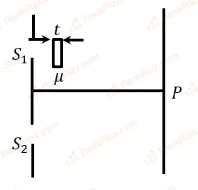
As shown in the figure, in Young's double slit experiment, a thin plate of thickness m and refractive index is inserted infront of slit . The experiment is conducted in air () and uses a monochromatic light of wavelength nm. Due to the insertion of the plate, central maxima is shifted by a distance of . is the fringe-width before the insertion of the plate. The value of is ______.

Two polaroids and are placed in such a way that the pass-axis of polaroids are perpendicular to each other. Now, another polaroid is placed between and bisecting angle between them. If intensity of unpolarised light is then intensity of transmitted light after passing through polaroid will be:
Zero
Two light waves of wavelengths 800 and 600 nm are used in Young's double slit experiment to obtain interference fringes on a screen placed 7 m away from plane of slits. If the two slits are separated by 0.35 mm, then shortest distance from the central bright maximum to the point where the bright fringes of the two wavelength coincide will be ______ mm.
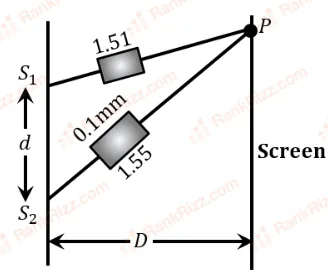
In Young's double slit experiment, two slits and are distance apart and the separation from slits to screen is (as shown in figure). Now if two transparent slabs of equal thickness mm but refractive index and are introduced in the path of beam from and respectively. The central bright fringe spot will shift by ______ number of fringes.

In a Young's double slit experiment, the intensities at two points, for the path difference and ( being the wavelength of light used) are and respectively. If denotes the intensity produced by each one of the individual slits, then ______.
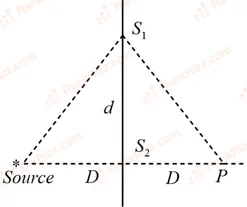
In a Young's double slit experiment, two slits are illuminated with a light of wavelength nm. The line joining is perpendicular to as shown in the figure. If the first minimum is detected at , the value of slits separation will be:
The distance of screen from slits cm. Answer in mm.
0.4 mm
0.5 mm
0.2 mm
0.1 mm
JEE Advanced has set 21 Wave Optics questions too. Wave Optics JEE Advanced PYQs →
OTHER PHYSICS CHAPTERS