RankRizz

Laws of Motion & Friction — JEE Main Previous Year Questions

Every Laws of Motion & Friction question JEE Main has set from 2004–2026, grouped by the idea it tests rather than the order of the syllabus. 151 questions across 7 distinct ideas. Free to read, answer key on every one.

DATA UPDATED

Questions

151

Distinct ideas

7

Share of marks

3%

Difficulty

MEDIUM

The ideas inside Laws of Motion & Friction

A chapter is not one subject — it is a handful of procedures the examiner reuses. These are the ones Laws of Motion & Friction questions actually test.

Every Laws of Motion & Friction question

101–120 OF 151 · NEWEST FIRST

JEE MAIN 2021 · 17 MAR S2Static and kinetic friction

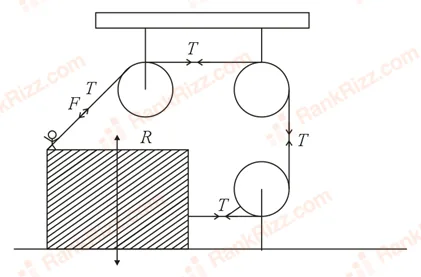
A boy of mass 4 kg is standing on a piece of wood having mass 5 kg. If the coefficient of friction between the wood and the floor is 0.5, the maximum force that the boy can exert on the rope so that the piece of wood does not move from its place is ________ N. (Round off to the Nearest Integer) [Take g=10g = 10 m s−2^{-2}]

Figure for JEE Main 2021 Physics question on Static and kinetic friction
JEE MAIN 2021 · 16 MAR S1Static and kinetic friction

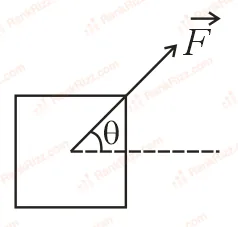
A block of mass mm slides along a floor while a force of magnitude FF is applied to it at an angle θ\theta as shown in figure. The coefficient of kinetic friction is μK\mu_K. Then, the block's acceleration aa is given by: (gg is acceleration due to gravity)

Figure for JEE Main 2021 Physics question on Static and kinetic friction
  1. A

    −Fmcos⁡θ−μK(g−Fmsin⁡θ)-\frac{F}{m}\cos\theta - \mu_K\left(g - \frac{F}{m}\sin\theta\right)

  2. B

    Fmcos⁡θ−μK(g−Fmsin⁡θ)\frac{F}{m}\cos\theta - \mu_K\left(g - \frac{F}{m}\sin\theta\right)

  3. C

    Fmcos⁡θ−μK(g+Fmsin⁡θ)\frac{F}{m}\cos\theta - \mu_K\left(g + \frac{F}{m}\sin\theta\right)

  4. D

    Fmcos⁡θ+μK(g−Fmsin⁡θ)\frac{F}{m}\cos\theta + \mu_K\left(g - \frac{F}{m}\sin\theta\right)

JEE MAIN 2021 · 16 MAR S2Newton's laws, free-body diagrams and equilibrium of a particle

A body of mass 2 kg moves under a force of (2i^+3j^+5k^)\left(2\hat{i} + 3\hat{j} + 5\hat{k}\right) N. It starts from rest and was at the origin initially. After 4 s, its new coordinates are (8,b,20)(8, b, 20). The value of bb is ________. (Round off to the Nearest Integer)

JEE MAIN 2021 · 26 FEB S2Spring force and spring combinations in dynamics

Two masses AA and BB, each of mass MM are fixed together by a massless spring. A force acts on the mass BB as shown in figure. If the mass AA starts moving away from mass BB with acceleration aa, then the acceleration of mass BB will be:

Figure for JEE Main 2021 Physics question on Spring force and spring combinations in dynamics
  1. A

    MFF+Ma\frac{MF}{F + Ma}

  2. B

    F+MaM\frac{F + Ma}{M}

  3. C

    Ma−FM\frac{Ma - F}{M}

  4. D

    F−MaM\frac{F - Ma}{M}

JEE MAIN 2021 · 24 FEB S1Static and kinetic friction

The coefficient of static friction between a wooden block of mass 0.5 kg and a vertical rough wall is 0.2. The magnitude of the horizontal force that should be applied on the block to keep it adhere to the wall will be ______ N. g=10g = 10 m s−2^{-2}

JEE MAIN 2021 · 24 FEB S1Static and kinetic friction

An inclined plane is bent in such a way that the vertical cross-section is given by y=x24y = \frac{x^2}{4} where yy is in vertical and xx in horizontal direction. If the upper surface of this curved plane is rough with coefficient of friction μ=0.5\mu = 0.5, the maximum height in cm at which a stationary block will not slip downward is ______ cm.

JEE MAIN 2021 · 24 FEB S2Newton's laws, free-body diagrams and equilibrium of a particle

A particle is projected with velocity v0v_0 along xx-axis. A damping force is acting on the particle which is proportional to the square of the distance from the origin i.e. ma=−αx2ma = -\alpha x^2. The distance at which the particle stops:

  1. A

    (2v03α)13\left(\frac{2v_0}{3\alpha}\right)^{\frac{1}{3}}

  2. B

    (3mv022α)13\left(\frac{3mv_0^2}{2\alpha}\right)^{\frac{1}{3}}

  3. C

    (3v022α)12\left(\frac{3v_0^2}{2\alpha}\right)^{\frac{1}{2}}

  4. D

    (2v023α)12\left(\frac{2v_0^2}{3\alpha}\right)^{\frac{1}{2}}

JEE MAIN 2020 · 06 SEP S1Static and kinetic friction

An insect is at the bottom of a hemispherical ditch of radius 1 m1\,\text{m}. It crawls up the ditch but starts slipping after it is at height hh from the bottom. If the coefficient of friction between the ground and the insect is 0.750.75, then hh is: (g=10 m s−2)(g = 10\,\text{m s}^{-2})

  1. A

    0.20 m

  2. B

    0.45 m

  3. C

    0.60 m

  4. D

    0.80 m

JEE MAIN 2020 · 06 SEP S2Newton's laws, free-body diagrams and equilibrium of a particle

A particle moving in the xy-plane experiences a velocity dependent force F⃗=k(vyi^+vxj^)\vec{F} = k(v_y\hat{i} + v_x\hat{j}), where vxv_x and vyv_y are the x and y components of its velocity v⃗\vec{v}. If a⃗\vec{a} is the acceleration of the particle, then which of the following statements is true for the particle?

  1. A

    quantity v⃗×a⃗\vec{v} \times \vec{a} is constant in time

  2. B

    F⃗\vec{F} arises due to a magnetic field

  3. C

    kinetic energy of particle is constant in time

  4. D

    quantity v⃗⋅a⃗\vec{v} \cdot \vec{a} is constant in time

JEE MAIN 2020 · 04 SEP S2Newton's laws, free-body diagrams and equilibrium of a particle

A small ball of mass mm is thrown upward with velocity uu from the ground. The ball experiences a resistive force mkv2mkv^2 where vv is its speed. The maximum height attained by the ball is:

  1. A

    12ktan⁡−1ku2g\frac{1}{2k}\tan^{-1}\frac{ku^2}{g}

  2. B

    1kln⁡(1+ku22g)\frac{1}{k}\ln\left(1 + \frac{ku^2}{2g}\right)

  3. C

    1ktan⁡−1ku22g\frac{1}{k}\tan^{-1}\frac{ku^2}{2g}

  4. D

    12kln⁡(1+ku2g)\frac{1}{2k}\ln\left(1 + \frac{ku^2}{g}\right)

JEE MAIN 2020 · 07 JAN S2Newton's laws, free-body diagrams and equilibrium of a particle

A mass of 10 kg is suspended by a rope of length 4 m, from the ceiling. A force F is applied horizontally at the mid-point of the rope such that the top half of the rope makes an angle of 45∘^\circ with the vertical. Then F equals: (Take g = 10 m s−2^{-2} and the rope to be massless)

  1. A

    100 N

  2. B

    90 N

  3. C

    70 N

  4. D

    75 N

JEE MAIN 2019 · 12 APR S2Static and kinetic friction

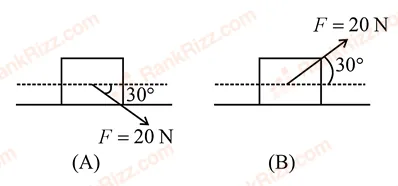
A block of mass 5 kg is (i) pushed in case (A) and (ii) pulled in case (B), by a force F = 20 N, making an angle of 30° with the horizontal, as shown in the figures. The coefficient of friction between the block and floor is μ\mu = 0.2. The difference between the accelerations of the block, in case (B) and case (A) will be: (g = 10 m s−2^{-2})

Figure for JEE Main 2019 Physics question on Static and kinetic friction
  1. A

    3.2 m s−2^{-2}

  2. B

    0 m s−2^{-2}

  3. C

    0.8 m s−2^{-2}

  4. D

    0.4 m s−2^{-2}

JEE MAIN 2019 · 12 APR S2Spring force and spring combinations in dynamics

A spring whose unstretched length is ll has a force constant k. The spring is cut into two pieces of unstretched lengths l1l_1 and l2l_2 where, l1=nl2l_1 = nl_2 and n is an integer. The ratio k1/k2k_1/k_2 of the corresponding force constants, k1_1 and k2_2 will be:

  1. A

    1n2\frac{1}{n^2}

  2. B

    n2n^2

  3. C

    n

  4. D

    1n\frac{1}{n}

JEE MAIN 2019 · 10 APR S1Newton's laws, free-body diagrams and equilibrium of a particle

A ball is thrown upward with an initial velocity V0V_0 from the surface of the earth. The motion of the ball is affected by a drag force equal to mγv2m\gamma v^2 (where m is the mass of the ball, vv is its instantaneous velocity and γ\gamma is a constant). Time taken by the ball to rise to its zenith is:

  1. A

    1γgln⁡(1+γgV0)\frac{1}{\sqrt{\gamma g}}\ln\left(1 + \sqrt{\frac{\gamma}{g}}V_0\right)

  2. B

    1γgtan⁡−1(γgV0)\frac{1}{\sqrt{\gamma g}}\tan^{-1}\left(\sqrt{\frac{\gamma}{g}}V_0\right)

  3. C

    1γgsin⁡−1(γgV0)\frac{1}{\sqrt{\gamma g}}\sin^{-1}\left(\sqrt{\frac{\gamma}{g}}V_0\right)

  4. D

    12γgtan⁡−1(2γgV0)\frac{1}{\sqrt{2\gamma g}}\tan^{-1}\left(\sqrt{\frac{2\gamma}{g}}V_0\right)

JEE MAIN 2019 · 10 APR S2Newton's laws, free-body diagrams and equilibrium of a particle

A bullet of mass 20 g has an initial speed of 1 m s−1^{-1}, just before it starts penetrating a mud wall of thickness 20 cm. If the wall offers a mean resistance of 2.5×10−22.5 \times 10^{-2} N, the speed of the bullet after emerging from the other side of the wall is close to:

  1. A

    0.7 m s−1^{-1}

  2. B

    0.3 m s−1^{-1}

  3. C

    0.1 m s−1^{-1}

  4. D

    0.4 m s−1^{-1}

JEE MAIN 2019 · 10 APR S2Friction in multi-block systems

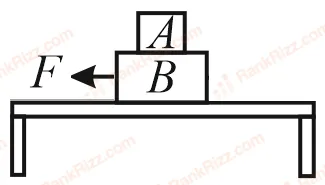
Two blocks A and B of masses mA_A = 1 kg and mB_B = 3 kg are kept on the table as shown in figure. The coefficients of friction between A and B is 0.2 and between B and the surface of the table is also 0.2. The maximum force F that can be applied on B horizontally, so that the block A does not slide over the block B is:
[Take g = 10 m/s2^2]

Figure for JEE Main 2019 Physics question on Friction in multi-block systems
  1. A

    16 N

  2. B

    12 N

  3. C

    40 N

  4. D

    8 N

JEE MAIN 2019 · 12 JAN S2Static and kinetic friction

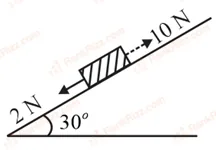
A block kept on a rough inclined plane, as shown in the figure, remains at rest upto a maximum force 2N down the inclined plane. The maximum external force up the inclined plane that does not move the block is 10N. The coefficient of static friction between the block and the plane is: [Take g=10g = 10 m/s2^2]

Figure for JEE Main 2019 Physics question on Static and kinetic friction
  1. A

    34\frac{\sqrt{3}}{4}

  2. B

    23\frac{2}{3}

  3. C

    12\frac{1}{2}

  4. D

    32\frac{\sqrt{3}}{2}

JEE MAIN 2019 · 09 JAN S1Static and kinetic friction

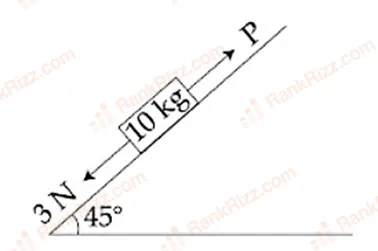
A block of mass 10 kg is kept on a rough inclined plane as shown in the figure. A force of 3 N is applied on the block. The coefficient of static friction between the plane and the block is 0.6. What should be the minimum value of force P, such that the block does not move downward? (take g=10  ms−2g = 10 \; ms^{-2})

Figure for JEE Main 2019 Physics question on Static and kinetic friction
  1. A

    23 N

  2. B

    25 N

  3. C

    18 N

  4. D

    32 N

JEE MAIN 2019 · 09 JAN S2Newton's laws, free-body diagrams and equilibrium of a particle

A mass of 10 kg is suspended vertically by a rope from the roof. When a horizontal force is applied on the rope at some point, the rope deviated at an angle of 45∘^{\circ} at the roof point. If the suspended mass is at equilibrium, the magnitude of the force applied is (g=10g = 10 m s−2^{-2})

  1. A

    100 N

  2. B

    200 N

  3. C

    140 N

  4. D

    70 N

JEE MAIN 2018 · 15 APR S1Static and kinetic friction

A given object takes n times more time to slide down a 45∘^\circ rough inclined plane as it takes to slide down a perfectly smooth 45∘^\circ incline. The coefficient of kinetic friction between the object and the incline is:

  1. A

    1−1n2\sqrt{1 - \frac{1}{n^2}}

  2. B

    1−1n21 - \frac{1}{n^2}

  3. C

    12−n2\frac{1}{2-n^2}

  4. D

    11−n2\sqrt{\frac{1}{1-n^2}}