JEE MAIN 2022 · 26 JUN S2Connected bodies, pulleys and constraint relations
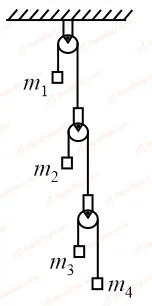
In the arrangement shown in figure and are the accelerations of masses and respectively. Which of the following relation is true for this arrangement?
- A
- B
- C
- D
Every Laws of Motion & Friction question JEE Main has set from 2004–2026, grouped by the idea it tests rather than the order of the syllabus. 151 questions across 7 distinct ideas. Free to read, answer key on every one.
DATA UPDATED
Questions
151
Distinct ideas
7
Share of marks
3%
Difficulty
MEDIUM
A chapter is not one subject — it is a handful of procedures the examiner reuses. These are the ones Laws of Motion & Friction questions actually test.
81–100 OF 151 · NEWEST FIRST
In the arrangement shown in figure and are the accelerations of masses and respectively. Which of the following relation is true for this arrangement?
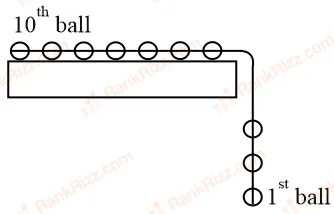
A system to 10 balls each of mass kg are connected via massless and unstretchable string. The system is allowed to slip over the edge of a smooth table as shown in figure. Tension on the string between the and ball is ______ N when ball just leaves the table.
A uniform chain of m length is placed on a table such that a part of its length is hanging over the edge of the table. The system is at rest. The co-efficient of static friction between the chain and the surface of the table is , the maximum length of the chain hanging from the table is ______ m.
A force on an object of mass g is N. The position of that object at s is m after starting from rest. The value of will be ______.
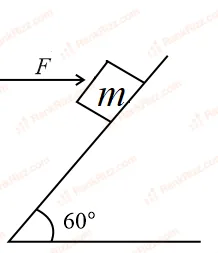
A block of mass g is kept stationary on a smooth inclined plane by applying a minimum horizontal force N as shown in figure. The value of = ______.
A block of mass kg starts sliding on a surface with an initial velocity of ms. The coefficient of friction between the surface and block is . The distance covered by the block before coming to rest is : [use ms]
9.8 m
4.9 m
12.5 m
19.6 m
An object of mass kg is thrown vertically upwards from the ground. The air resistance produces a constant retarding force of N throughout the motion. The ratio of time of ascent to the time of descent will be equal to : [Use m s]
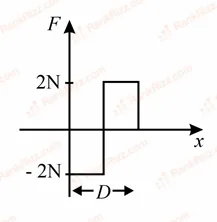
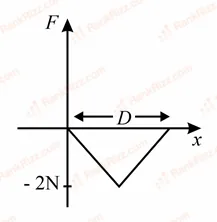
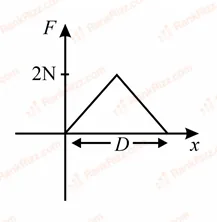
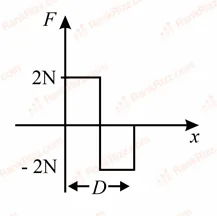
An object of mass is being moved with a constant velocity under the action of an applied force of 2 N along a frictionless surface with following surface profile.
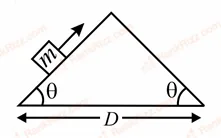
The correct applied force vs distance graph will be:
A block of mass slides on the wooden wedge, which in turn slides backward on the horizontal surface. The acceleration of the block with respect to the wedge is:
Given kg, kg
Assume all the surfaces shown in the figure to be frictionless.
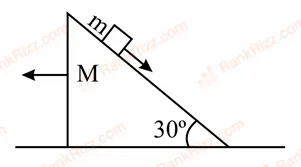
g
g
g
g
When a body slides down from rest along a smooth inclined plane making an angle of 30° with the horizontal, it takes time . When the same body slides down from rest along a rough inclined plane making the same angle and through the same distance, it takes time , where is a constant greater than 1. The co-efficient of friction between the body and the rough plane is where = _________.
A car is moving on a plane inclined at 30° to the horizontal with an acceleration of 10 m s parallel to the plane upward. A bob is suspended by a string from the roof of the car. The angle in degrees which the string makes with the vertical is _________. (Take m s)
Statement I: If three forces , and are represented by three sides of a triangle and , then these three forces are concurrent forces and satisfy the condition for equilibrium.
Statement II: A triangle made up of three forces , and as its sides were taken in the same order, satisfies the condition for translatory equilibrium.
In the light of the above statements, choose the most appropriate answer from the options given below:
Both Statement I and Statement II are true.
Statement I is true but Statement II is false.
Both Statement I and Statement II are false.
Statement I is false but Statement II is true.
The boxes of masses 2 kg and 8 kg are connected by a massless string passing over smooth pulleys. Calculate the time taken by box of mass 8 kg to strike the ground starting from rest. (g = 10 m s)
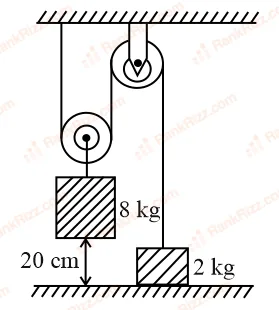
0.25 s
0.34 s
0.2 s
0.4 s
The coefficient of static friction between two blocks is 0.5 and the table is smooth. The maximum horizontal force that can be applied to move the blocks together is _________ N (take m s)
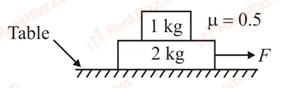
A particle of mass originally at rest is subjected to a force whose direction is constant but magnitude varies with time according to the relation where and are constants. The force acts only for the time interval . The velocity of the particle after time is:
A force N acts on a body of mass 5 kg. If the body starts from rest, its position vector at time s will be
m
m
m
m
A steel block of 10 kg rests on a horizontal floor as shown. When three iron cylinders are placed on it as shown, the block and cylinders go down with an acceleration 0.2 m s. The normal reaction by the floor if mass of the iron cylinders are equal and of 20 kg each is (in N), [Take m s and ]
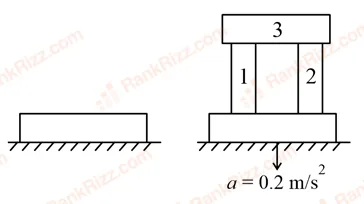
716
686
714
684
A body of mass is launched up on a rough inclined plane making an angle of 30 with the horizontal. The coefficient of friction between the body and plane is if the time of ascent is half of the time of descent. The value of is ___.
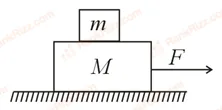
Two blocks ( kg and kg) are arranged on a horizontal frictionless table as shown in the figure. The coefficient of static friction between the two blocks is . Then the maximum horizontal force that can be applied on the larger block so that the blocks move together is . (Round off to the Nearest Integer) [Take as 9.8 m s]
A body of mass 1 kg rests on a horizontal floor with which it has a coefficient of static friction . It is desired to make the body move by applying the minimum possible force N. The value of will be ________. (Round off to the Nearest Integer) [Take m s]
JEE Advanced has set 18 Laws of Motion & Friction questions too. Laws of Motion & Friction JEE Advanced PYQs →
OTHER PHYSICS CHAPTERS