Laws of Motion & Friction JEE Main PYQs with answer key
PHYSICS · 151 PAST QUESTIONS · 7 TOPICS · 2004–2026
HOW TO USE THIS SHEET
Every JEE Main Laws of Motion & Friction question we hold, grouped by topic, most-asked topic first and newest first inside each. The answer key is at the end (150 of 151 questions have a checked key); the worked solution is on each question’s page, printed beside it.
Newton's laws, free-body diagrams and equilibrium of a particle 53
At , a body of mass g starts moving under the influence of a force N. After s, its position is m. The ratio is ______.
- (A)
- (B)
- (C)
- (D)
rr2.rankrizz.com/jee-main/physics/laws-of-motion/q/4-apr-2026-s2-q28
- (A)
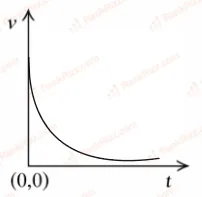
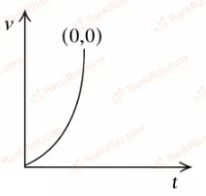
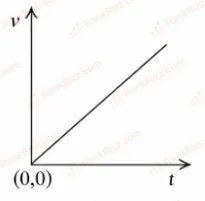
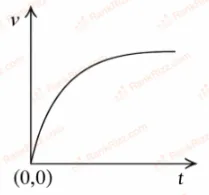
A particle of mass m falls from rest through a resistive medium having resistive force, F = -kv, where v is the velocity of the particle and k is a constant. Which of the following graphs represents velocity (v) versus time (t)?
- (A)
- (B)
- (C)
- (D)
rr2.rankrizz.com/jee-main/physics/laws-of-motion/q/28-jan-2026-s1-q33
- (A)
A flexible chain of mass m hangs between two fixed points at the same level. The inclination of the chain with the horizontal at the two points of support is . Considering the equilibrium of each half of the chain, the tension of the chain at the lowest point is __________.
- (A)
- (B)
mg
- (C)
- (D)
rr2.rankrizz.com/jee-main/physics/laws-of-motion/q/24-jan-2026-s2-q38
- (A)
A 4 kg mass moves under the influence of a force where t is the time in second. If mass starts from origin at t= 0, the velocity and position after t= 2 s will be:
- (A)
- (B)
- (C)
- (D)
rr2.rankrizz.com/jee-main/physics/laws-of-motion/q/21-jan-2026-s1-physics-q12
- (A)
A body of mass 2 kg moving with velocity of ms enters into a constant force field of 6N directed along positive z-axis. If the body remains in the field for a period of seconds, then velocity of the body when it emerges from force field is
- (A)
- (B)
- (C)
- (D)
rr2.rankrizz.com/jee-main/physics/laws-of-motion/q/2025-apr-8-s2-q40
- (A)
An object with mass 500 g moves along x-axis with speed m/s. The force acting on the object is :
- (A)
8 N
- (B)
5 N
- (C)
6 N
- (D)
4 N
rr2.rankrizz.com/jee-main/physics/laws-of-motion/q/2025-apr-7-s2-q43
- (A)
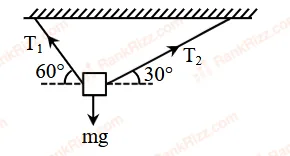
A body of mass m is suspended by two strings making angles and with the horizontal ceiling with tensions and simultaneously. and are related by . The angles and are
- (A)
, with
- (B)
, with
- (C)
, with
- (D)
, with
rr2.rankrizz.com/jee-main/physics/laws-of-motion/q/2025-apr-4-s1-q37
- (A)
A body of mass 1 kg is suspended with the help of two strings making angles as shown in figure. Magnitude of tensions and , respectively, are (in N) :
- (A)
- (B)
- (C)
- (D)
rr2.rankrizz.com/jee-main/physics/laws-of-motion/q/2025-apr-02-s2-q41
- (A)
A balloon and its content having mass is moving up with an acceleration 'a'. The mass that must be released from the content so that the balloon starts moving up with an acceleration '3a' will be (Take ' g ' as acceleration due to gravity)
- (A)
- (B)
- (C)
- (D)
rr2.rankrizz.com/jee-main/physics/laws-of-motion/q/28-jan-2025-s2-q41
- (A)
A mass is suspended from the ceiling by a rope of length . A horizontal force '' is applied at the mid point of the rope so that the rope makes an angle of with respect to the vertical axis as shown in figure.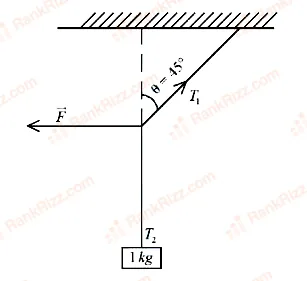
The magnitude of is : (Assume that the system is in equilibrium and )
- (A)
- (B)
- (C)
- (D)
rr2.rankrizz.com/jee-main/physics/laws-of-motion/q/9-apr-2024-s2-q3
- (A)
A player caught a cricket ball of mass moving at a speed of . If the catching process is completed in , the magnitude of force exerted by the ball on the hand of the player is:
- (A)
- (B)
- (C)
- (D)
rr2.rankrizz.com/jee-main/physics/laws-of-motion/q/8-apr-2024-s1-q6
- (A)
A body of weight is suspended from a tree branch through a chain of mass . The branch pulls the chain by a force equal to (if ) :
- (A)
- (B)
- (C)
- (D)
rr2.rankrizz.com/jee-main/physics/laws-of-motion/q/6-apr-2024-s2-q3
- (A)
A wooden block of mass rests on a soft horizontal floor. When an iron cylinder of mass is placed on the top of the block, the floor yields and the block and the cylinder together go down with an acceleration of . The action force of the system on the floor is equal to:
- (A)
- (B)
- (C)
- (D)
rr2.rankrizz.com/jee-main/physics/laws-of-motion/q/5-apr-2024-s1-q4
- (A)
A particle moves in plane under the influence of a force such that its linear momentum is . If is constant, the angle between and will be :
- (A)
- (B)
- (C)
- (D)
rr2.rankrizz.com/jee-main/physics/laws-of-motion/q/05-apr-2024-s2-q1
- (A)
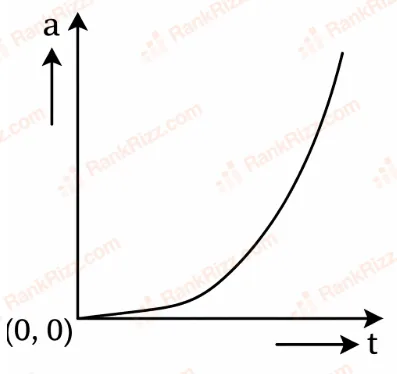
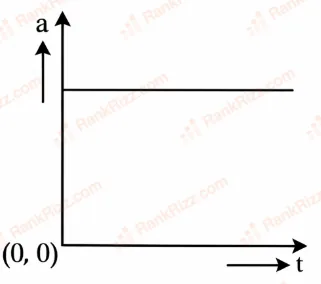
A wooden block, initially at rest on the ground, is pushed by a force which increases linearly with time t. Which of the following curve best describes acceleration of the block with time:
- (A)
- (B)
- (C)
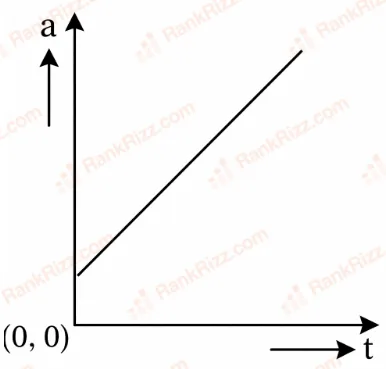
- (D)
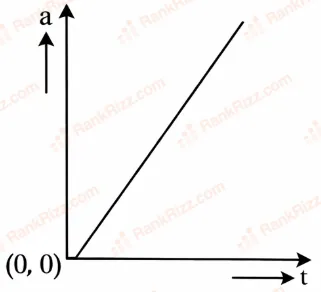
rr2.rankrizz.com/jee-main/physics/laws-of-motion/q/04-apr-2024-s1-q5
- (A)
A cricket player catches a ball of mass 120 g moving with speed. If the catching process is completed in 0.1 s then the magnitude of force exerted by the ball on the hand of player will be (in SI unit):
- (A)
24
- (B)
12
- (C)
25
- (D)
30
rr2.rankrizz.com/jee-main/physics/laws-of-motion/q/01-feb-2024-s2-q3
- (A)
A body of mass 4 kg experiences two forces and . The acceleration acting on the body is:
- (A)
- (B)
- (C)
- (D)
rr2.rankrizz.com/jee-main/physics/laws-of-motion/q/01-feb-2024-s2-q4
- (A)
The position vector of a particle related to time is given by m. The direction of net force experienced by the particle is :
- (A)
Positive -axis
- (B)
In plane
- (C)
Positive -axis
- (D)
Positive -axis
rr2.rankrizz.com/jee-main/physics/laws-of-motion/q/15-apr-2023-s1-q4
- (A)
Three forces N, N, N are acting on a particle of mass 5 kg. The forces and are applied perpendicularly so that particle remains at rest. If the force is removed, then the acceleration of the particle is
- (A)
m s
- (B)
m s
- (C)
m s
- (D)
m s
rr2.rankrizz.com/jee-main/physics/laws-of-motion/q/12-apr-2023-s1-q1
- (A)
A body of mass 500 g moves along -axis such that it's velocity varies with displacement according to the relation m s. The force acting on the body is:
- (A)
125 N
- (B)
25 N
- (C)
166 N
- (D)
5 N
rr2.rankrizz.com/jee-main/physics/laws-of-motion/q/11-apr-2023-s2-q4
- (A)
At any instant the velocity of a particle of mass 500 g is m s. If the force acting on the particle at s is N. Then the value of will be:
- (A)
3
- (B)
4
- (C)
2
- (D)
6
rr2.rankrizz.com/jee-main/physics/laws-of-motion/q/8-apr-2023-s1-q5
- (A)
As shown in figure, a 70 kg garden roller is pushed with a force of N at an angle of 30° with horizontal. The normal reaction on the roller is (Given m s)
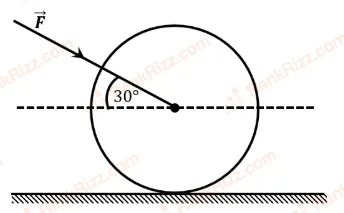
- (A)
N
- (B)
600 N
- (C)
800 N
- (D)
N
rr2.rankrizz.com/jee-main/physics/laws-of-motion/q/31-jan-2023-s1-q3
- (A)
A block of kg is attached to a string whose other end is attached to the wall. An unknown force is applied so that the string makes an angle of with the wall. The tension is: (Given m s)
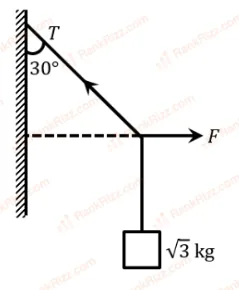
- (A)
N
- (B)
N
- (C)
N
- (D)
N
rr2.rankrizz.com/jee-main/physics/laws-of-motion/q/30-jan-2023-s2-q4
- (A)
Force acts for s on a body of mass kg, starting from rest, after which the force ceases and then body describes m in the next s. The value of force will be:
- (A)
N
- (B)
N
- (C)
N
- (D)
N
rr2.rankrizz.com/jee-main/physics/laws-of-motion/q/29-jan-2023-s2-q4
- (A)
A balloon has mass of 10 g in air. The air escapes from the balloon at a uniform rate with velocity 4.5 cm s. If the balloon shrinks in 5 s completely. Then, the average force acting on that balloon will be (in dyne).
- (A)
3
- (B)
9
- (C)
12
- (D)
18
rr2.rankrizz.com/jee-main/physics/laws-of-motion/q/28-jul-2022-s1-q3
- (A)
A monkey of mass climbs on a rope which can withstand the tension () of . If monkey initially climbs down with an acceleration of and then climbs up with an acceleration of . Choose the correct option ()
- (A)
while climbing upward
- (B)
while going downward
- (C)
Rope will break while climbing upward
- (D)
Rope will break while going downward
rr2.rankrizz.com/jee-main/physics/laws-of-motion/q/26-jul-2022-s1-q3
- (A)
Four forces are acting at a point in equilibrium as shown in figure. The ratio of force to is where ______.
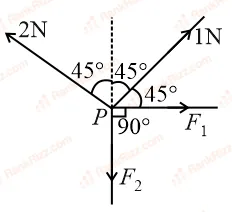
Answer: ____________
rr2.rankrizz.com/jee-main/physics/laws-of-motion/q/25-jul-2022-s1-q22
For a free body diagram shown in the figure, the four forces are applied in the '' and '' directions. What additional force must be applied and at what angle with positive -axis so that the net acceleration of body is zero?
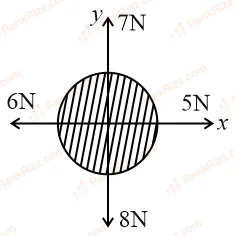
- (A)
- (B)
- (C)
- (D)
rr2.rankrizz.com/jee-main/physics/laws-of-motion/q/25-jul-2022-s2-q3
- (A)
A block of metal weighing 2 kg is resting on a frictionless plane (as shown in figure). It is struck by a jet releasing water at a rate of 1 kg s and at a speed of 10 m s. Then, the initial acceleration of the block, in m s, will be
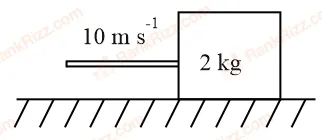
- (A)
3
- (B)
6
- (C)
5
- (D)
4
rr2.rankrizz.com/jee-main/physics/laws-of-motion/q/29-jun-2022-s1-q4
- (A)
A mass of kg is suspended vertically by a rope of length m from the roof. A force of N is applied at the middle point of rope in horizontal direction. The angle made by upper half of the rope with vertical is . The value of is ______.
(Given, m s)Answer: ____________
rr2.rankrizz.com/jee-main/physics/laws-of-motion/q/27-jun-2022-s2-q21
A force on an object of mass g is N. The position of that object at s is m after starting from rest. The value of will be ______.
Answer: ____________
rr2.rankrizz.com/jee-main/physics/laws-of-motion/q/25-jun-2022-s1-q22
A block of mass g is kept stationary on a smooth inclined plane by applying a minimum horizontal force N as shown in figure. The value of = ______.
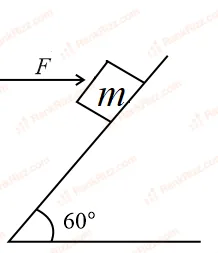
Answer: ____________
rr2.rankrizz.com/jee-main/physics/laws-of-motion/q/25-jun-2022-s2-q23
An object of mass kg is thrown vertically upwards from the ground. The air resistance produces a constant retarding force of N throughout the motion. The ratio of time of ascent to the time of descent will be equal to : [Use m s]
- (A)
- (B)
- (C)
- (D)
rr2.rankrizz.com/jee-main/physics/laws-of-motion/q/24-jun-2022-s2-q2
- (A)
Statement I: If three forces , and are represented by three sides of a triangle and , then these three forces are concurrent forces and satisfy the condition for equilibrium.
Statement II: A triangle made up of three forces , and as its sides were taken in the same order, satisfies the condition for translatory equilibrium.
In the light of the above statements, choose the most appropriate answer from the options given below:- (A)
Both Statement I and Statement II are true.
- (B)
Statement I is true but Statement II is false.
- (C)
Both Statement I and Statement II are false.
- (D)
Statement I is false but Statement II is true.
rr2.rankrizz.com/jee-main/physics/laws-of-motion/q/31-aug-2021-s2-q1
- (A)
A particle of mass originally at rest is subjected to a force whose direction is constant but magnitude varies with time according to the relation where and are constants. The force acts only for the time interval . The velocity of the particle after time is:
- (A)
- (B)
- (C)
- (D)
rr2.rankrizz.com/jee-main/physics/laws-of-motion/q/27-jul-2021-s2-q3
- (A)
A force N acts on a body of mass 5 kg. If the body starts from rest, its position vector at time s will be
- (A)
m
- (B)
m
- (C)
m
- (D)
m
rr2.rankrizz.com/jee-main/physics/laws-of-motion/q/25-jul-2021-s2-q6
- (A)
A body of mass 2 kg moves under a force of N. It starts from rest and was at the origin initially. After 4 s, its new coordinates are . The value of is ________. (Round off to the Nearest Integer)
Answer: ____________
rr2.rankrizz.com/jee-main/physics/laws-of-motion/q/16-mar-2021-s2-q21
A particle is projected with velocity along -axis. A damping force is acting on the particle which is proportional to the square of the distance from the origin i.e. . The distance at which the particle stops:
- (A)
- (B)
- (C)
- (D)
rr2.rankrizz.com/jee-main/physics/laws-of-motion/q/24-feb-2021-s2-q2
- (A)
A particle moving in the xy-plane experiences a velocity dependent force , where and are the x and y components of its velocity . If is the acceleration of the particle, then which of the following statements is true for the particle?
- (A)
quantity is constant in time
- (B)
arises due to a magnetic field
- (C)
kinetic energy of particle is constant in time
- (D)
quantity is constant in time
rr2.rankrizz.com/jee-main/physics/laws-of-motion/q/6-sep-2020-s2-q1
- (A)
A small ball of mass is thrown upward with velocity from the ground. The ball experiences a resistive force where is its speed. The maximum height attained by the ball is:
- (A)
- (B)
- (C)
- (D)
rr2.rankrizz.com/jee-main/physics/laws-of-motion/q/4-sep-2020-s2-q3
- (A)
A mass of 10 kg is suspended by a rope of length 4 m, from the ceiling. A force F is applied horizontally at the mid-point of the rope such that the top half of the rope makes an angle of 45 with the vertical. Then F equals: (Take g = 10 m s and the rope to be massless)
- (A)
100 N
- (B)
90 N
- (C)
70 N
- (D)
75 N
rr2.rankrizz.com/jee-main/physics/laws-of-motion/q/7-jan-2020-s2-q3
- (A)
A ball is thrown upward with an initial velocity from the surface of the earth. The motion of the ball is affected by a drag force equal to (where m is the mass of the ball, is its instantaneous velocity and is a constant). Time taken by the ball to rise to its zenith is:
- (A)
- (B)
- (C)
- (D)
rr2.rankrizz.com/jee-main/physics/laws-of-motion/q/10-apr-2019-s1-q2
- (A)
A bullet of mass 20 g has an initial speed of 1 m s, just before it starts penetrating a mud wall of thickness 20 cm. If the wall offers a mean resistance of N, the speed of the bullet after emerging from the other side of the wall is close to:
- (A)
0.7 m s
- (B)
0.3 m s
- (C)
0.1 m s
- (D)
0.4 m s
rr2.rankrizz.com/jee-main/physics/laws-of-motion/q/10-apr-2019-s2-q2
- (A)
A mass of 10 kg is suspended vertically by a rope from the roof. When a horizontal force is applied on the rope at some point, the rope deviated at an angle of 45 at the roof point. If the suspended mass is at equilibrium, the magnitude of the force applied is ( m s)
- (A)
100 N
- (B)
200 N
- (C)
140 N
- (D)
70 N
rr2.rankrizz.com/jee-main/physics/laws-of-motion/q/9-jan-2019-s2-q4
- (A)
A body of mass kg is moving in a medium and experiences a frictional force . Its initial speed is m s. After 10 s its kinetic energy is , then the value of will be:
- (A)
kg m s
- (B)
kg m
- (C)
kg m s
- (D)
kg m
rr2.rankrizz.com/jee-main/physics/laws-of-motion/q/2-apr-2017-offline-q4
- (A)
A particle of mass is acted upon by a force given by the empirical law . If this law is to be tested experimentally by observing the motion starting from rest, the best way is to plot
- (A)
against
- (B)
against
- (C)
against
- (D)
against
rr2.rankrizz.com/jee-main/physics/laws-of-motion/q/10-apr-2016-online-q3
- (A)
A body of mass 5 kg under the action of constant force has velocity at t = 0 s as m/s and at t = 10 s as m/s. The force is:
- (A)
N
- (B)
N
- (C)
N
- (D)
N
rr2.rankrizz.com/jee-main/physics/laws-of-motion/q/11-apr-2014-online-q3
- (A)
Water is flowing at a speed of 1.5 m s through a horizontal tube of cross-sectional area m and you are trying to stop the flow by your palm. Assuming that the water stops immediately after hitting the palm, the minimum force that you must exert should be (density of water = kg m)
- (A)
33.7 N
- (B)
45 N
- (C)
15 N
- (D)
22.5 N
rr2.rankrizz.com/jee-main/physics/laws-of-motion/q/9-apr-2014-online-q3
- (A)
A uniform sphere of weight W and radius 5 cm is being held by a string as shown in the figure. The tension in the string will be :
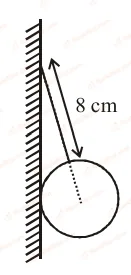
- (A)
- (B)
- (C)
- (D)
rr2.rankrizz.com/jee-main/physics/laws-of-motion/q/9-apr-2013-online-q4
- (A)
A particle of mass is at rest at the origin at time . It is subjected to a force in the direction. Its speed is depicted by which of the following curves?
- (A)
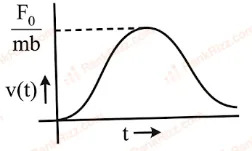
- (B)
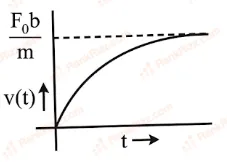
- (C)
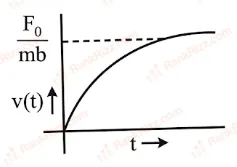
- (D)
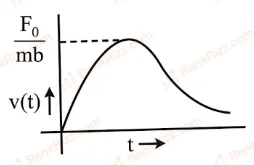
rr2.rankrizz.com/jee-main/physics/laws-of-motion/q/2012-physics-499021
- (A)
A car of mass 1000 kg is moving at a speed of . Brakes are applied to bring the car to rest. If the net retarding force is , the car comes to stop after travelling m in s. Then
- (A)
- (B)
- (C)
- (D)
rr2.rankrizz.com/jee-main/physics/laws-of-motion/q/2012-physics-499103
- (A)
This question has Statement 1 and Statement 2. Of the four choices given after the Statements, choose the one that best describes the two Statements.
Statement 1: If you push on a cart being pulled by a horse so that it does not move, the cart pushes you back with an equal and opposite force.
Statement 2: The cart does not move because the force described in statement 1 cancel each other.
- (A)
Statement 1 is true, Statement 2 is true, Statement 2 is the correct explanation of Statement 1.
- (B)
Statement 1 is false, Statement 2 is true.
- (C)
Statement 1 is true, Statement 2 is false.
- (D)
Statement 1 is true, Statement 2 is true, Statement 2 is not the correct explanation of Statement 1.
rr2.rankrizz.com/jee-main/physics/laws-of-motion/q/2012-physics-499158
- (A)
A body weighing 13 kg is suspended by two strings 5 m and 12 m long, their other ends being fastened to the extremities of a rod 13 m long. If the rod be so held that the body hangs immediately below the middle point. The tensions in the strings are
- (A)
12 kg and 13 kg
- (B)
5 kg and 5 kg
- (C)
5 kg and 12 kg
- (D)
5 kg and 13 kg
rr2.rankrizz.com/jee-main/physics/laws-of-motion/q/2007-physics-499745
- (A)
Static and kinetic friction 41
A block takes time to slide down a plane inclined at 45° to the horizontal. If the surface is made smooth (frictionless), the block takes time to slide down the plane. The coefficient of friction between the block and the inclined plane is . The value of is __________.
Answer: ____________
rr2.rankrizz.com/jee-main/physics/laws-of-motion/q/6-apr-2026-s2-q46
The time taken by a block of mass to slide down from the highest point to the lowest point on a rough inclined plane is 50% more compared to the time taken by the same block on identical inclined smooth plane. Both inclined planes are at with the horizontal. The coefficient of kinetic friction between the rough inclined surface and block is :
- (A)
- (B)
- (C)
- (D)
rr2.rankrizz.com/jee-main/physics/laws-of-motion/q/4-apr-2026-s1-q28
- (A)
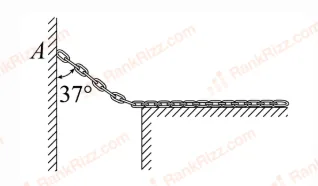
A uniform chain of length l\ has one of its end attached to the wall a point A, while of the length of the chain is lying on table as shown in figure. Find the minimum co-efficient of friction between table and chain so that chain remains in equilibrium is.
- (A)
- (B)
- (C)
- (D)
rr2.rankrizz.com/jee-main/physics/laws-of-motion/q/2026-physics-516364
- (A)
A given object takes n times the time to slide down rough inclined plane as it takes the time to slide down an identical perfectly smooth inclined plane. The coefficient of kinetic friction between the object and the surface of inclined plane is :
- (A)
- (B)
- (C)
- (D)
rr2.rankrizz.com/jee-main/physics/laws-of-motion/q/8-apr-2024-s2-q3
- (A)
A heavy box of mass kg is moving on a horizontal surface. If co-efficient of kinetic friction between the box and horizontal surface is 0.3 then force of kinetic friction is :
- (A)
N
- (B)
N
- (C)
N
- (D)
N
rr2.rankrizz.com/jee-main/physics/laws-of-motion/q/05-apr-2024-s2-q4
- (A)
A block of mass is placed on a surface having vertical cross section given by . If coefficient of friction is 0.5, the maximum height above the ground at which block can be placed without slipping is:
- (A)
m
- (B)
m
- (C)
m
- (D)
m
rr2.rankrizz.com/jee-main/physics/laws-of-motion/q/30-jan-2024-s2-q4
- (A)
Given below are two statements :
Statement (I) : The limiting force of static friction depends on the area of contact and independent of materials.
Statement (II) : The limiting force of kinetic friction is independent of the area of contact and depends on materials.
In the light of the above statements, choose the most appropriate answer from the options given below :- (A)
Statement I is correct but Statement II is incorrect
- (B)
Statement I is incorrect but Statement II is correct
- (C)
Both Statement I and Statement II are incorrect
- (D)
Both Statement I and Statement II are correct
rr2.rankrizz.com/jee-main/physics/laws-of-motion/q/27-jan-2024-s2-q3
- (A)
A block of mass 5 kg is placed at rest on a table of rough surface. Now, if a force of 30 N is applied in the direction parallel to surface of the table, the block slides through a distance of 50 m in an interval of time 10 s. Coefficient of kinetic friction is (given, m s):
- (A)
0.60
- (B)
0.75
- (C)
0.50
- (D)
0.25
rr2.rankrizz.com/jee-main/physics/laws-of-motion/q/01-feb-2023-s1-q4
- (A)
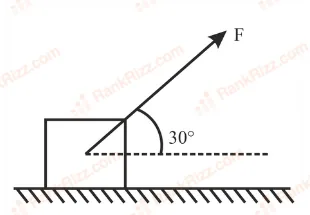
As shown in the figure a block of mass 10 kg lying on a horizontal surface is pulled by a force F acting at an angle , with horizontal. For , the block will just start to move for the value of : [Given ms]
- (A)
N
- (B)
N
- (C)
N
- (D)
N
rr2.rankrizz.com/jee-main/physics/laws-of-motion/q/01-feb-2023-s2-q2
- (A)
A body of mass 10 kg is moving with an initial speed of 20 m s. The body stops after 5 s due to friction between body and the floor. The value of the coefficient of friction is: (Take acceleration due to gravity m s)
- (A)
0.2
- (B)
0.3
- (C)
0.5
- (D)
0.4
rr2.rankrizz.com/jee-main/physics/laws-of-motion/q/31-jan-2023-s2-q4
- (A)
A block of mass slides down the plane inclined at angle with an acceleration . The value of coefficient of kinetic friction will be:
- (A)
- (B)
- (C)
- (D)
rr2.rankrizz.com/jee-main/physics/laws-of-motion/q/29-jan-2023-s1-q4
- (A)
The time taken by an object to slide down rough inclined plane is times as it takes to slide down a perfectly smooth incline plane. The coefficient of kinetic friction between the object and the incline plane is:
- (A)
- (B)
- (C)
- (D)
rr2.rankrizz.com/jee-main/physics/laws-of-motion/q/29-jan-2023-s2-q3
- (A)
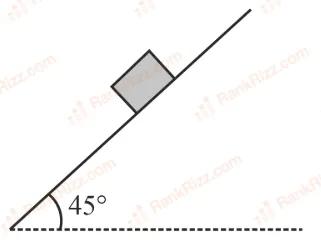
Consider a block kept on an inclined plane (inclined at 45°) as shown in the figure. If the force required to just push it up the incline is 2 times the force required to just prevent it from sliding down, the coefficient of friction between the block and inclined plane () is equal to:
- (A)
0.33
- (B)
0.60
- (C)
0.25
- (D)
0.50
rr2.rankrizz.com/jee-main/physics/laws-of-motion/q/25-jan-2023-s2-q4
- (A)
A bag is gently dropped on a conveyor belt moving at a speed of . The coefficient of friction between the conveyor belt and bag is . Initially, the bag slips on the belt before it stops due to friction. The distance travelled by the bag on the belt during slipping motion is: [Take ]
- (A)
- (B)
- (C)
- (D)
rr2.rankrizz.com/jee-main/physics/laws-of-motion/q/27-jul-2022-s1-q3
- (A)
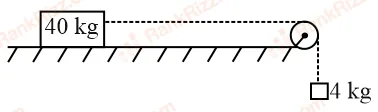
A block of mass 40 kg slides over a surface, when a mass of 4 kg is suspended through an inextensible massless string passing over frictionless pulley as shown below. The coefficient of kinetic friction between the surface and block is 0.02. The acceleration of block is: (Given m s.)
- (A)
m s
- (B)
1 m s
- (C)
m s
- (D)
m s
rr2.rankrizz.com/jee-main/physics/laws-of-motion/q/29-jun-2022-s2-q3
- (A)
A uniform chain of m length is placed on a table such that a part of its length is hanging over the edge of the table. The system is at rest. The co-efficient of static friction between the chain and the surface of the table is , the maximum length of the chain hanging from the table is ______ m.
Answer: ____________
rr2.rankrizz.com/jee-main/physics/laws-of-motion/q/25-jun-2022-s1-q21
A block of mass kg starts sliding on a surface with an initial velocity of ms. The coefficient of friction between the surface and block is . The distance covered by the block before coming to rest is : [use ms]
- (A)
9.8 m
- (B)
4.9 m
- (C)
12.5 m
- (D)
19.6 m
rr2.rankrizz.com/jee-main/physics/laws-of-motion/q/24-jun-2022-s1-q4
- (A)
When a body slides down from rest along a smooth inclined plane making an angle of 30° with the horizontal, it takes time . When the same body slides down from rest along a rough inclined plane making the same angle and through the same distance, it takes time , where is a constant greater than 1. The co-efficient of friction between the body and the rough plane is where = _________.
Answer: ____________
rr2.rankrizz.com/jee-main/physics/laws-of-motion/q/1-sep-2021-s2-q23
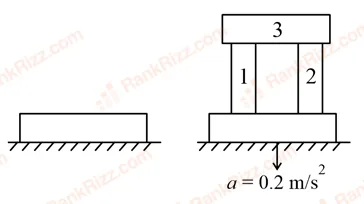
A steel block of 10 kg rests on a horizontal floor as shown. When three iron cylinders are placed on it as shown, the block and cylinders go down with an acceleration 0.2 m s. The normal reaction by the floor if mass of the iron cylinders are equal and of 20 kg each is (in N), [Take m s and ]
- (A)
716
- (B)
686
- (C)
714
- (D)
684
rr2.rankrizz.com/jee-main/physics/laws-of-motion/q/20-jul-2021-s1-q4
- (A)
A body of mass is launched up on a rough inclined plane making an angle of 30 with the horizontal. The coefficient of friction between the body and plane is if the time of ascent is half of the time of descent. The value of is ___.
Answer: ____________
rr2.rankrizz.com/jee-main/physics/laws-of-motion/q/20-jul-2021-s2-q21
A body of mass 1 kg rests on a horizontal floor with which it has a coefficient of static friction . It is desired to make the body move by applying the minimum possible force N. The value of will be ________. (Round off to the Nearest Integer) [Take m s]
Answer: ____________
rr2.rankrizz.com/jee-main/physics/laws-of-motion/q/17-mar-2021-s2-q21
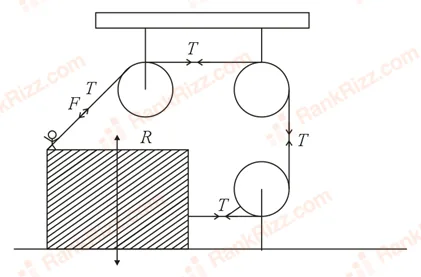
A boy of mass 4 kg is standing on a piece of wood having mass 5 kg. If the coefficient of friction between the wood and the floor is 0.5, the maximum force that the boy can exert on the rope so that the piece of wood does not move from its place is ________ N. (Round off to the Nearest Integer) [Take m s]
Answer: ____________
rr2.rankrizz.com/jee-main/physics/laws-of-motion/q/17-mar-2021-s2-q22
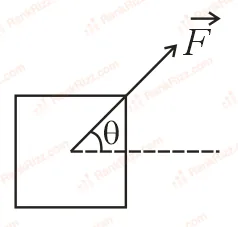
A block of mass slides along a floor while a force of magnitude is applied to it at an angle as shown in figure. The coefficient of kinetic friction is . Then, the block's acceleration is given by: ( is acceleration due to gravity)
- (A)
- (B)
- (C)
- (D)
rr2.rankrizz.com/jee-main/physics/laws-of-motion/q/16-mar-2021-s1-q3
- (A)
The coefficient of static friction between a wooden block of mass 0.5 kg and a vertical rough wall is 0.2. The magnitude of the horizontal force that should be applied on the block to keep it adhere to the wall will be ______ N. m s
Answer: ____________
rr2.rankrizz.com/jee-main/physics/laws-of-motion/q/24-feb-2021-s1-q21
An inclined plane is bent in such a way that the vertical cross-section is given by where is in vertical and in horizontal direction. If the upper surface of this curved plane is rough with coefficient of friction , the maximum height in cm at which a stationary block will not slip downward is ______ cm.
Answer: ____________
rr2.rankrizz.com/jee-main/physics/laws-of-motion/q/24-feb-2021-s1-q22
An insect is at the bottom of a hemispherical ditch of radius . It crawls up the ditch but starts slipping after it is at height from the bottom. If the coefficient of friction between the ground and the insect is , then is:
- (A)
0.20 m
- (B)
0.45 m
- (C)
0.60 m
- (D)
0.80 m
rr2.rankrizz.com/jee-main/physics/laws-of-motion/q/6-sep-2020-s1-q2
- (A)
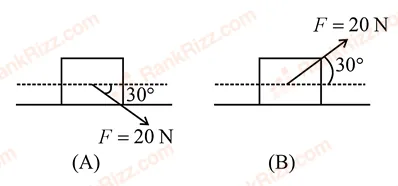
A block of mass 5 kg is (i) pushed in case (A) and (ii) pulled in case (B), by a force F = 20 N, making an angle of 30° with the horizontal, as shown in the figures. The coefficient of friction between the block and floor is = 0.2. The difference between the accelerations of the block, in case (B) and case (A) will be: (g = 10 m s)
- (A)
3.2 m s
- (B)
0 m s
- (C)
0.8 m s
- (D)
0.4 m s
rr2.rankrizz.com/jee-main/physics/laws-of-motion/q/12-apr-2019-s2-q3
- (A)
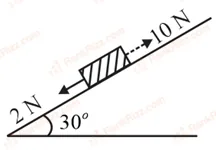
A block kept on a rough inclined plane, as shown in the figure, remains at rest upto a maximum force 2N down the inclined plane. The maximum external force up the inclined plane that does not move the block is 10N. The coefficient of static friction between the block and the plane is: [Take m/s]
- (A)
- (B)
- (C)
- (D)
rr2.rankrizz.com/jee-main/physics/laws-of-motion/q/12-jan-2019-s2-q3
- (A)
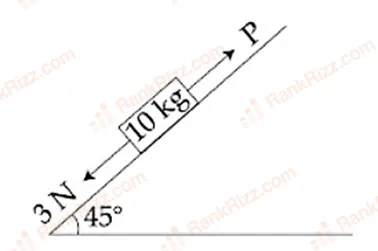
A block of mass 10 kg is kept on a rough inclined plane as shown in the figure. A force of 3 N is applied on the block. The coefficient of static friction between the plane and the block is 0.6. What should be the minimum value of force P, such that the block does not move downward? (take )
- (A)
23 N
- (B)
25 N
- (C)
18 N
- (D)
32 N
rr2.rankrizz.com/jee-main/physics/laws-of-motion/q/9-jan-2019-s1-q3
- (A)
A given object takes n times more time to slide down a 45 rough inclined plane as it takes to slide down a perfectly smooth 45 incline. The coefficient of kinetic friction between the object and the incline is:
- (A)
- (B)
- (C)
- (D)
rr2.rankrizz.com/jee-main/physics/laws-of-motion/q/15-apr-2018-s1-q4
- (A)
A body of mass 2 kg slides down with an acceleration of 3 m/s on a rough inclined plane having a slope of 30. The external force required to take the same body up the plane with the same acceleration will be: (g = 10 m/s)
- (A)
4 N
- (B)
14 N
- (C)
6 N
- (D)
20 N
rr2.rankrizz.com/jee-main/physics/laws-of-motion/q/15-apr-2018-s2-q3
- (A)
A heavy box is to be dragged along a rough horizontal floor. To do so, the person A pushes it at an angle 30° from the horizontal and requires a minimum force , while the person B pulls the box at an angle 60° from the horizontal and needs minimum force . If the coefficient of friction between the box and the floor is , the ratio is:
- (A)
- (B)
- (C)
- (D)
rr2.rankrizz.com/jee-main/physics/laws-of-motion/q/19-apr-2014-online-q2
- (A)
A block of mass is placed on a surface with a vertical cross section given by . If the coefficient of friction is 0.5, the maximum height above the ground at which the block can be placed without slipping is:
- (A)
m
- (B)
m
- (C)
m
- (D)
m
rr2.rankrizz.com/jee-main/physics/laws-of-motion/q/6-apr-2014-offline-q3
- (A)
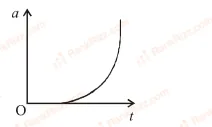
A block is placed on a rough horizontal plane. A time dependent horizontal force acts on the block, where k is a positive constant. The acceleration - time graph of the block is :
- (A)
- (B)
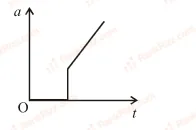
- (C)
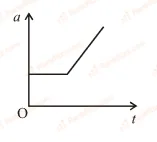
- (D)
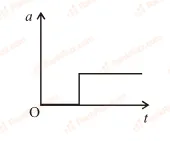
rr2.rankrizz.com/jee-main/physics/laws-of-motion/q/25-apr-2013-online-q1
- (A)
A body starts from rest on a long inclined plane of slope 45°. The coefficient of friction between the body and the plane varies as , where x is distance travelled down the plane. The body will have maximum speed (for m/s) when =
- (A)
9.8 m
- (B)
27 m
- (C)
12 m
- (D)
3.33 m
rr2.rankrizz.com/jee-main/physics/laws-of-motion/q/22-apr-2013-online-q4
- (A)
A block of weight rests on a horizontal floor with coefficient of static friction . It is desired to make the block move by applying minimum amount of force. The angle from the horizontal at which the force should be applied and magnitude of the force are respectively.
- (A)
- (B)
- (C)
- (D)
rr2.rankrizz.com/jee-main/physics/laws-of-motion/q/2012-physics-499260
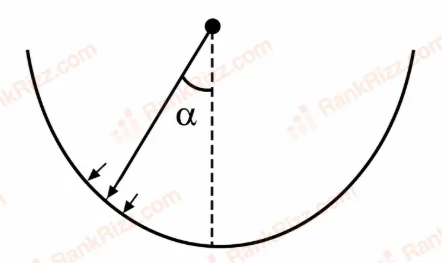
- (A)
An insect crawls up a hemispherical surface very slowly. The coefficient of friction between the insect and the surface is . If the line joining the centre of the hemispherical surface to the insect makes an angle with the vertical, the maximum possible value of so that the insect does not slip is given by
- (A)
- (B)
- (C)
- (D)
rr2.rankrizz.com/jee-main/physics/laws-of-motion/q/2012-physics-499381
- (A)
A smooth block is released at rest on a incline and then slides a distance . The time taken to slide is times as much to slide on rough incline than on a smooth incline. The coefficient of friction is
- (A)
- (B)
- (C)
- (D)
rr2.rankrizz.com/jee-main/physics/laws-of-motion/q/2005-physics-500127
- (A)
The upper half of an inclined plane with inclination is perfectly smooth while the lower half is rough. A body starting from rest at the top will again come to rest at the bottom if the coefficient of friction for the lower half is given by
- (A)
- (B)
- (C)
- (D)
rr2.rankrizz.com/jee-main/physics/laws-of-motion/q/2005-physics-500128
- (A)
Consider a car moving on a straight road with a speed of m/s. The distance at which car can be stopped is
- (A)
m
- (B)
m
- (C)
m
- (D)
m
rr2.rankrizz.com/jee-main/physics/laws-of-motion/q/2005-physics-500131
- (A)
A block rests on a rough inclined plane making an angle of with the horizontal. The coefficient of static friction between the block and the plane is . If the frictional force on the block is N, the mass of the block (in kg) is (take )
- (A)
- (B)
- (C)
- (D)
rr2.rankrizz.com/jee-main/physics/laws-of-motion/q/2004-physics-500157
- (A)
Connected bodies, pulleys and constraint relations 23
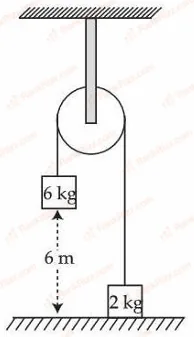
The velocity at which 6 kg mass (shown in figure) strikes the ground when it is released from a height of 6 m above the ground is __________ m/s. Assume pulley is massless and string is light and inextensible. (Take m/s)
- (A)
7.74
- (B)
7.20
- (C)
6.55
- (D)
4.50
rr2.rankrizz.com/jee-main/physics/laws-of-motion/q/6-apr-2026-s2-q44
- (A)
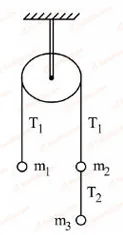
Three masses kg, kg and kg are suspended from a fixed smooth frictionless pully as shown in the figure below. The value of is _______. (take m/s)
- (A)
5/3
- (B)
2/3
- (C)
3/5
- (D)
2/5
rr2.rankrizz.com/jee-main/physics/laws-of-motion/q/5-apr-2026-s1-q29
- (A)
A light unstretchable string passing over a smooth light pulley connects two blocks of masses and . If the acceleration of the system is , then the ratio of the masses is :
- (A)
- (B)
- (C)
- (D)
rr2.rankrizz.com/jee-main/physics/laws-of-motion/q/9-apr-2024-s1-q3
- (A)
A light string passing over a smooth light pulley connects two blocks of masses and (where ). If the acceleration of the system is , then the ratio of the masses is:
- (A)
- (B)
- (C)
- (D)
rr2.rankrizz.com/jee-main/physics/laws-of-motion/q/6-apr-2024-s1-q4
- (A)
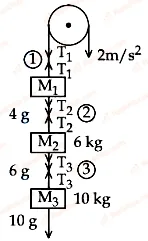
Three blocks having masses and respectively are hanging from a smooth pulley using rope 1, 2 and 3 as shown in figure. The tension in the rope 1, when they are moving upward with acceleration of is ______ N (if ).
Answer: ____________
rr2.rankrizz.com/jee-main/physics/laws-of-motion/q/5-apr-2024-s1-q22
Consider a block and trolley system as shown in figure. If the coefficient of kinetic friction between the trolley and the surface is , the acceleration of the system in m s is: (Consider that the string is massless and unstretchable and the pulley is also massless and frictionless):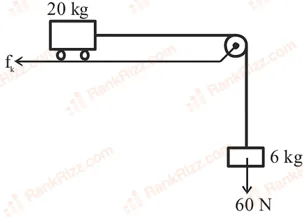
- (A)
- (B)
- (C)
- (D)
rr2.rankrizz.com/jee-main/physics/laws-of-motion/q/01-feb-2024-s1-q4
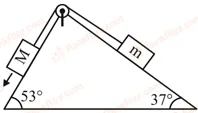
- (A)
In the given arrangement of a doubly inclined plane two blocks of masses and are placed. The blocks are connected by a light string passing over an ideal pulley as shown. The coefficient of friction between the surface of the plane and the blocks is . The value of , for which kg will move down with an acceleration of , is: (take and )
- (A)
9 kg
- (B)
4.5 kg
- (C)
6.5 kg
- (D)
2.25 kg
rr2.rankrizz.com/jee-main/physics/laws-of-motion/q/31-jan-2024-s1-q5
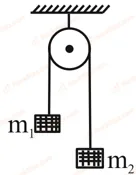
- (A)
A light string passing over a smooth light fixed pulley connects two blocks of masses and . If the acceleration of the system is , then the ratio of masses is
- (A)
- (B)
- (C)
- (D)
rr2.rankrizz.com/jee-main/physics/laws-of-motion/q/31-jan-2024-s2-q3
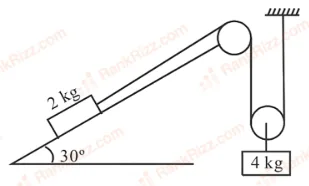
- (A)
All surfaces shown in figure are assumed to be frictionless and the pulleys and the string are light. The acceleration of the block of mass is
- (A)
- (B)
- (C)
- (D)
rr2.rankrizz.com/jee-main/physics/laws-of-motion/q/30-jan-2024-s1-q3
- (A)
Three blocks , and are pulled on a horizontal smooth surface by a force of 80 N as shown in figure. The tensions and in the string are respectively:

- (A)
40N, 64N
- (B)
60N, 80N
- (C)
88N, 96N
- (D)
80N, 100N
rr2.rankrizz.com/jee-main/physics/laws-of-motion/q/30-jan-2024-s2-q3
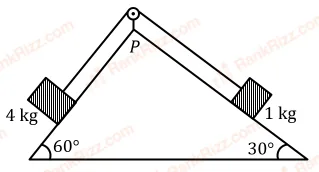
- (A)
As per given figure, a weightless pulley is attached on a double inclined frictionless surface. The tension in the string (massless) will be (if )
- (A)
N
- (B)
N
- (C)
N
- (D)
N
rr2.rankrizz.com/jee-main/physics/laws-of-motion/q/24-jan-2023-s1-q3
- (A)
As per given figure, a weightless pulley is attached on a double inclined frictionless surface. The tension in the string (massless) will be (if m s)
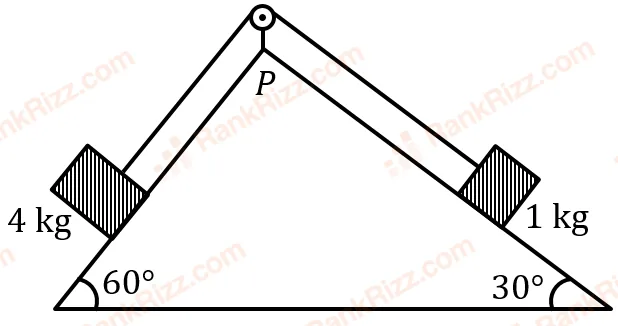
- (A)
N
- (B)
N
- (C)
N
- (D)
N
rr2.rankrizz.com/jee-main/physics/laws-of-motion/q/24-jan-2023-s1-q3-494263
- (A)
Two bodies of masses kg and kg are connected by a light string going over a smooth light pulley on a smooth inclined plane as shown in the figure. The system is at rest. The force exerted by the inclined plane on the body of mass will be: [Take m s]
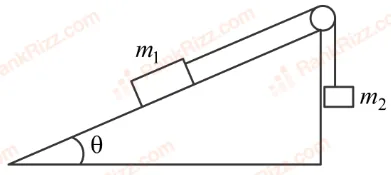
- (A)
30 N
- (B)
40 N
- (C)
50 N
- (D)
60 N
rr2.rankrizz.com/jee-main/physics/laws-of-motion/q/29-jul-2022-s2-q4
- (A)
A uniform metal chain of mass and length passes over a massless and frictionless pulley. It is released from rest with a part of its length is hanging on one side and rest of its length is hanging on the other side of the pulley. At a certain point of time, when , the acceleration of the chain is . The value of is
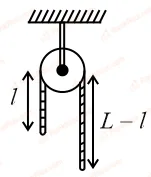
- (A)
6
- (B)
2
- (C)
1.5
- (D)
4
rr2.rankrizz.com/jee-main/physics/laws-of-motion/q/28-jul-2022-s2-q3
- (A)
Three masses , and are arranged in a system as shown in figure. All the surfaces are frictionless and strings are inextensible and weightless. The pulleys are also weightless and frictionless. A force is applied on the system so that the mass moves upward with an acceleration of . The value of is (Take )
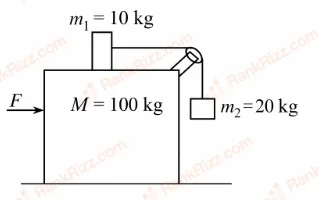
- (A)
- (B)
- (C)
- (D)
rr2.rankrizz.com/jee-main/physics/laws-of-motion/q/26-jul-2022-s1-q2
- (A)
Two masses and are tied together at the two ends of a light inextensible string that passes over a frictionless pulley. When the mass is twice that of , the acceleration of the system is . When the mass is thrice that of , the acceleration of the system is . The ratio will be
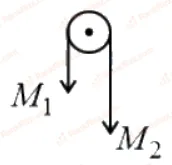
- (A)
- (B)
- (C)
- (D)
rr2.rankrizz.com/jee-main/physics/laws-of-motion/q/26-jul-2022-s2-q2
- (A)
A hanging mass is connected to a four times bigger mass by using a string pulley arrangement, as shown in the figure. The bigger mass is placed on a horizontal ice-slab and being pulled by force. In this situation, tension in the string is for ______. Neglect mass of the string and friction of the block (bigger mass) with ice slab.
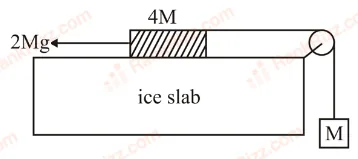
Answer: ____________
rr2.rankrizz.com/jee-main/physics/laws-of-motion/q/28-jun-2022-s1-q21
In the arrangement shown in figure and are the accelerations of masses and respectively. Which of the following relation is true for this arrangement?
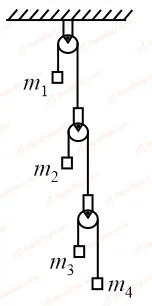
- (A)
- (B)
- (C)
- (D)
rr2.rankrizz.com/jee-main/physics/laws-of-motion/q/26-jun-2022-s2-q2
- (A)
A system to 10 balls each of mass kg are connected via massless and unstretchable string. The system is allowed to slip over the edge of a smooth table as shown in figure. Tension on the string between the and ball is ______ N when ball just leaves the table.
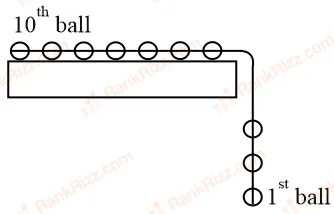
Answer: ____________
rr2.rankrizz.com/jee-main/physics/laws-of-motion/q/26-jun-2022-s2-q22
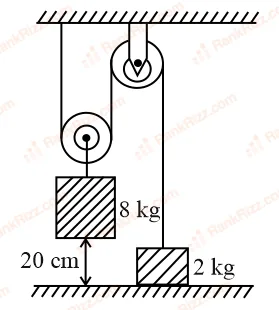
The boxes of masses 2 kg and 8 kg are connected by a massless string passing over smooth pulleys. Calculate the time taken by box of mass 8 kg to strike the ground starting from rest. (g = 10 m s)
- (A)
0.25 s
- (B)
0.34 s
- (C)
0.2 s
- (D)
0.4 s
rr2.rankrizz.com/jee-main/physics/laws-of-motion/q/27-aug-2021-s2-q5
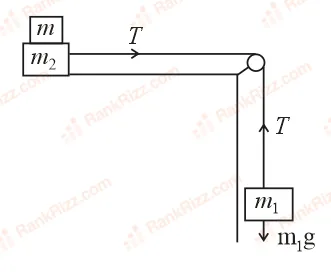
- (A)
Two masses kg and kg, connected by an inextensible string over a frictionless pulley, are moving as shown in the figure. The coefficient of friction of horizontal surface is 0.15. The minimum weight m that should be put on top of to stop the motion is:
- (A)
10.3 kg
- (B)
18.3 kg
- (C)
27.3 kg
- (D)
43.3 kg
rr2.rankrizz.com/jee-main/physics/laws-of-motion/q/8-apr-2018-offline-q3
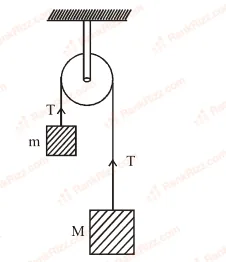
- (A)
Two blocks of masses m and M are connected by means of a metal wire of cross-sectional area A passing over a frictionless fixed pulley as shown in the figure. The system is then released. If M = 2m, then the stress produced in the wire is:
- (A)
- (B)
- (C)
- (D)
rr2.rankrizz.com/jee-main/physics/laws-of-motion/q/25-apr-2013-online-q5
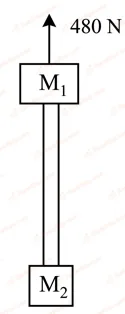
- (A)
Two blocks of mass kg and kg are connected by a metal rod of mass 8 kg. The system is pulled vertically up by applying a force of 480 N as shown. The tension at the mid-point of the rod is:
- (A)
144 N
- (B)
96 N
- (C)
240 N
- (D)
192 N
rr2.rankrizz.com/jee-main/physics/laws-of-motion/q/22-apr-2013-online-q3
- (A)
Motion on inclined planes and wedges 14
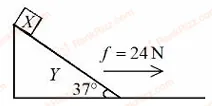
A wedge Y with mass of 10 kg and all frictionless surfaces and the inclined surface making 37° with horizontal. A block X with mass 2 kg is placed at the highest point of the wedge as shown in figure is at rest. At wedge (Y) is pulled toward right with constant force () of 24 N. Taking the block X at rest at , the time taken by it to slide down 8.8 m on the slope, while Y is on the move, is _______ s. (take and m/s)
- (A)
- (B)
- (C)
- (D)
rr2.rankrizz.com/jee-main/physics/laws-of-motion/q/5-apr-2026-s1-q30
- (A)
A block of mass 5 kg is moving on an inclined plane which makes an angle of 30° with the horizontal. Friction coefficient between the block and inclined plane surface is . The force to be applied on the block so that the block will move down without acceleration is _______N
- (A)
15
- (B)
12.5
- (C)
25
- (D)
7.5
rr2.rankrizz.com/jee-main/physics/laws-of-motion/q/28-jan-2026-s1-q43
- (A)
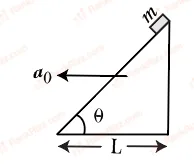
A small block of mass m slides down from the top of a frictionless inclined surface, while the inclined plane is moving towards left with constant acceleration . The angle between the inclined plane and ground is θ and its base length is L. Assuming that initially the small block is at the top of the inclined plane, the time it takes to reach the lowest point of the inclined plane is ___ .
- (A)
- (B)
- (C)
- (D)
rr2.rankrizz.com/jee-main/physics/laws-of-motion/q/28-jan-2026-s2-q27
- (A)
A block is sliding down on an inclined plane of slope and at an instant t = 0 this block is given an upward momentum so that it starts moving up on the inclined surface with velocity u. The distance (S) travelled by the block before its velocity become zero, is ______.
(g = gravitational acceleration)- (A)
- (B)
- (C)
- (D)
rr2.rankrizz.com/jee-main/physics/laws-of-motion/q/23-jan-2026-s2-q42
- (A)
A cubic block of mass m is sliding down on an inclined plane at with an acceleration of , the value of coefficient of kinetic friction is
- (A)
- (B)
- (C)
- (D)
rr2.rankrizz.com/jee-main/physics/laws-of-motion/q/2025-apr-7-s1-q39
- (A)
A kg brick begins to slide over a surface which is inclined at an angle of with respect to horizontal axis. The co-efficient of static friction between their surfaces is:
- (A)
- (B)
- (C)
- (D)
rr2.rankrizz.com/jee-main/physics/laws-of-motion/q/04-apr-2024-s2-q3
- (A)
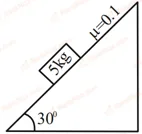
A block of mass 5 kg is placed on a rough inclined surface as shown in the figure. If is the force required to just move the block up the inclined plane and is the force required to just prevent the block from sliding down, then the value of is: [Use m s]
- (A)
N
- (B)
N
- (C)
N
- (D)
10 N
rr2.rankrizz.com/jee-main/physics/laws-of-motion/q/31-jan-2024-s2-q4
- (A)
A block of mass slides down on a rough inclined plane with constant velocity. The angle made by the incline plane with horizontal is . The magnitude of the contact force will be :
- (A)
- (B)
- (C)
- (D)
rr2.rankrizz.com/jee-main/physics/laws-of-motion/q/27-jul-2022-s2-q4
- (A)
A block takes 2 s to slide down a frictionless incline of and length , kept inside a lift going up with uniform velocity . If the incline is changed to , the time taken by the block, to slide down the incline, will be approximately:
- (A)
2.66 s
- (B)
0.83 s
- (C)
1.68 s
- (D)
0.70 s
rr2.rankrizz.com/jee-main/physics/laws-of-motion/q/27-jul-2022-s2-q5
- (A)
Two inclined planes are placed as shown in figure.
A block is projected from the Point A of inclined plane AB along its surface with a velocity just sufficient to carry it to the top Point B at a height 10 m. After reaching the Point B the block slides down on inclined plane BC. Time it takes to reach to the point C from point A is s. The value of t is _____ (use )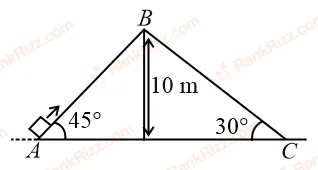
Answer: ____________
rr2.rankrizz.com/jee-main/physics/laws-of-motion/q/27-jul-2022-s2-q21
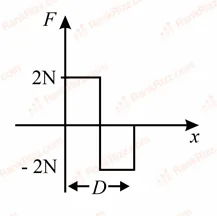
An object of mass is being moved with a constant velocity under the action of an applied force of 2 N along a frictionless surface with following surface profile.
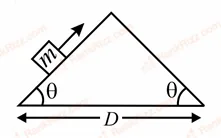
The correct applied force vs distance graph will be:- (A)
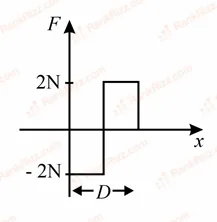
- (B)
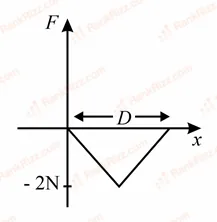
- (C)
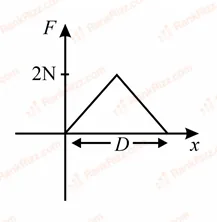
- (D)
rr2.rankrizz.com/jee-main/physics/laws-of-motion/q/1-sep-2021-s2-q2
- (A)
A block of mass slides on the wooden wedge, which in turn slides backward on the horizontal surface. The acceleration of the block with respect to the wedge is:
Given kg, kg
Assume all the surfaces shown in the figure to be frictionless.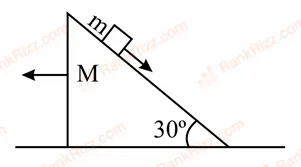
- (A)
g
- (B)
g
- (C)
g
- (D)
g
rr2.rankrizz.com/jee-main/physics/laws-of-motion/q/1-sep-2021-s2-q4
- (A)
Two fixed frictionless inclined plane making an angle and with the vertical are shown in the figure. Two block and are placed on the two planes. What is the relative vertical acceleration of with respect to ?
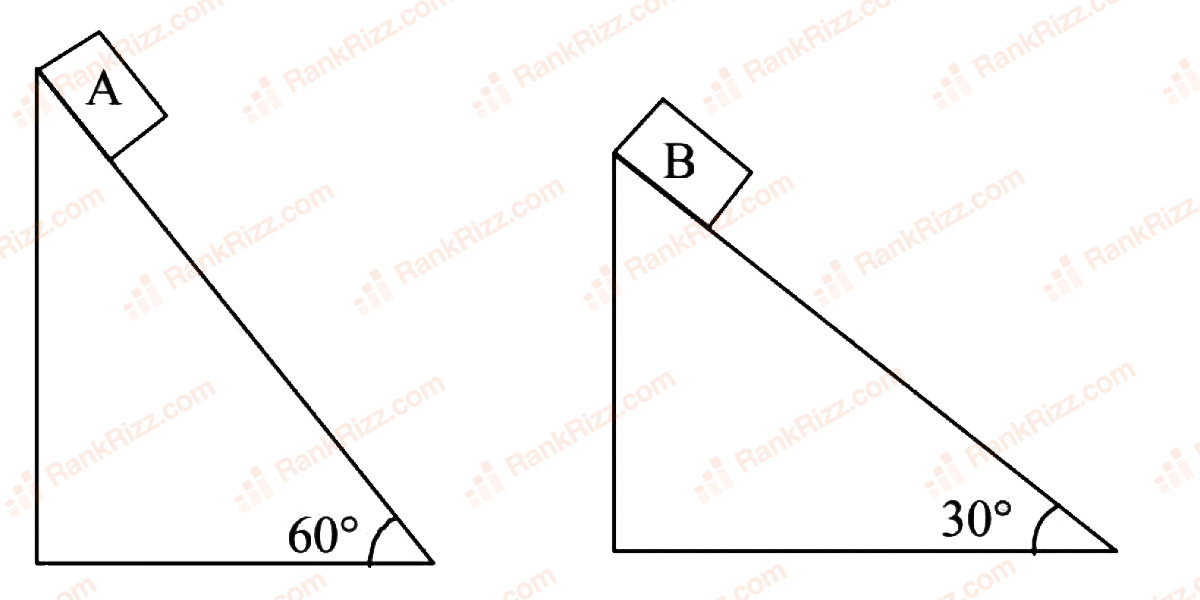
- (A)
ms in horizontal direction
- (B)
ms in vertical direction
- (C)
zero
- (D)
ms in vertical direction
rr2.rankrizz.com/jee-main/physics/laws-of-motion/q/2010-physics-499615
- (A)
A block is kept on a frictionless inclined surface with angle of inclination . The incline is given an acceleration to keep the block stationary. Then is equal to?
- (A)
- (B)
- (C)
- (D)
rr2.rankrizz.com/jee-main/physics/laws-of-motion/q/2005-physics-500129
- (A)
Pseudo force: lifts and accelerating frames 8
Two blocks (P and Q) with respectively masses 2 kg and 1.5 kg are joined by a massless thread. These blocks are mounted on a frictionless pully which is fixed on the edge of a cube (S), as shown in the figure below. Block P is positioned on the top surface which has no friction and block Q is in contact with side-surface, having coefficient friction . The cube (S) moves towards the right with acceleration of , where g is gravitational acceleration. During this movement the block P and Q remain stationary. The value of is _______.
(take g = 10 m/s)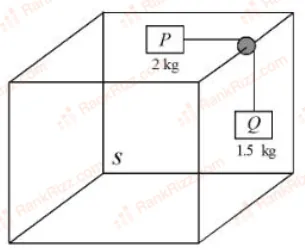
- (A)
0.33
- (B)
0.67
- (C)
1
- (D)
0.5
rr2.rankrizz.com/jee-main/physics/laws-of-motion/q/6-apr-2026-s1-q29
- (A)
Given below are two statements:
Statement-I: An elevator can go up or down with uniform speed when its weight is balanced with the tension of its cable.
Statement-II: Force exerted by the floor of an elevator on the foot of a person standing on it is more than his/her weight when the elevator goes down with increasing speed.
In the light of the above statements, choose the correct answer from the options given below:- (A)
Both Statement I and Statement II are false
- (B)
Statement I is true but Statement II is false
- (C)
Both Statement I and Statement II are true
- (D)
Statement I is false but Statement II is true
rr2.rankrizz.com/jee-main/physics/laws-of-motion/q/24-jan-2023-s1-q4
- (A)
Given below are two statements:
Statement-I: An elevator can go up or down with uniform speed when its weight is balanced with the tension of its cable.
Statement-II: Force exerted by the floor of an elevator on the foot of a person standing on it is more than his/her weight when the elevator goes down with increasing speed.
In the light of the above statements, choose the correct answer from the options given below:- (A)
Both Statement I and Statement II are false
- (B)
Statement I is true but Statement II is false
- (C)
Both Statement I and Statement II are true
- (D)
Statement I is false but Statement II is true
rr2.rankrizz.com/jee-main/physics/laws-of-motion/q/24-jan-2023-s1-q4-494019
- (A)
A block of mass placed inside a box descends vertically with acceleration . The block exerts a force equal to one-fourth of its weight on the floor of the box. The value of '' will be
- (A)
- (B)
- (C)
- (D)
rr2.rankrizz.com/jee-main/physics/laws-of-motion/q/29-jun-2022-s2-q4
- (A)
A person is standing in an elevator. In which situation, he experiences weight loss?
- (A)
When the elevator moves upward with constant acceleration
- (B)
When the elevator moves downward with constant acceleration
- (C)
When the elevator moves upward with uniform velocity
- (D)
When the elevator moves downward with uniform velocity
rr2.rankrizz.com/jee-main/physics/laws-of-motion/q/26-jun-2022-s1-q2
- (A)
A car is moving on a plane inclined at 30° to the horizontal with an acceleration of 10 m s parallel to the plane upward. A bob is suspended by a string from the roof of the car. The angle in degrees which the string makes with the vertical is _________. (Take m s)
Answer: ____________
rr2.rankrizz.com/jee-main/physics/laws-of-motion/q/31-aug-2021-s1-q21
A rocket is fired vertically from the earth with an acceleration of 2g, where g is the gravitational acceleration. On an inclined plane inside the rocket, making an angle with the horizontal, a point object of mass m is kept. The minimum coefficient of friction between the mass and the inclined surface such that the mass does not move is:
- (A)
- (B)
- (C)
- (D)
rr2.rankrizz.com/jee-main/physics/laws-of-motion/q/9-apr-2016-online-q2
- (A)
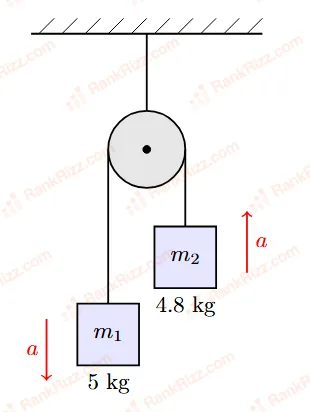
Two masses kg and kg tied to a string are hanging over a light frictionless pulley. What is the acceleration of the masses when lift free to move ?
- (A)
- (B)
- (C)
- (D)
rr2.rankrizz.com/jee-main/physics/laws-of-motion/q/2004-physics-500155
- (A)
Friction in multi-block systems 7
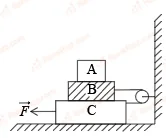
In the given figure, the blocks A, B and C weigh 4 kg, 6 kg and 8 kg, respectively. The coefficient of sliding friction between any two surfaces is 0.5. The force F required to slide the block C with constant speed is __ N. (Use )
Answer: ____________
rr2.rankrizz.com/jee-main/physics/laws-of-motion/q/24-jan-2026-s1-q46
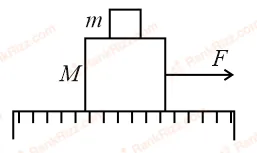
A system of two blocks of masses kg and kg is placed on a smooth table as shown in figure. The coefficient of static friction between two blocks is . The maximum horizontal force that can be applied to the block of mass so that the blocks move together will be m s
- (A)
N
- (B)
N
- (C)
N
- (D)
N
rr2.rankrizz.com/jee-main/physics/laws-of-motion/q/27-jun-2022-s1-q4
- (A)
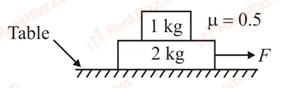
The coefficient of static friction between two blocks is 0.5 and the table is smooth. The maximum horizontal force that can be applied to move the blocks together is _________ N (take m s)
Answer: ____________
rr2.rankrizz.com/jee-main/physics/laws-of-motion/q/26-aug-2021-s2-q22
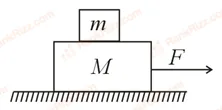
Two blocks ( kg and kg) are arranged on a horizontal frictionless table as shown in the figure. The coefficient of static friction between the two blocks is . Then the maximum horizontal force that can be applied on the larger block so that the blocks move together is . (Round off to the Nearest Integer) [Take as 9.8 m s]
Answer: ____________
rr2.rankrizz.com/jee-main/physics/laws-of-motion/q/17-mar-2021-s1-q21
Two blocks A and B of masses m = 1 kg and m = 3 kg are kept on the table as shown in figure. The coefficients of friction between A and B is 0.2 and between B and the surface of the table is also 0.2. The maximum force F that can be applied on B horizontally, so that the block A does not slide over the block B is:
[Take g = 10 m/s]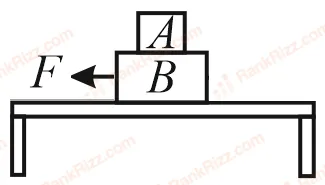
- (A)
16 N
- (B)
12 N
- (C)
40 N
- (D)
8 N
rr2.rankrizz.com/jee-main/physics/laws-of-motion/q/10-apr-2019-s2-q4
- (A)
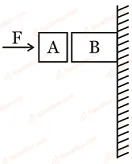
Given in the figure are two blocks A and B of weight 20 N and 100 N, respectively. These are being pressed against a wall by a force F and kept in equilibrium as shown. If the coefficient of friction between the blocks is 0.1 and between block B and the wall is 0.15, the frictional force applied by the wall on block B is:
- (A)
150 N
- (B)
100 N
- (C)
80 N
- (D)
120 N
rr2.rankrizz.com/jee-main/physics/laws-of-motion/q/4-apr-2015-offline-q3
- (A)
A block A of mass 4 kg is placed on another block B of mass 5 kg, and the block B rests on a smooth horizontal table. If the minimum force that can be applied on A so that both the blocks move together is 12 N, the maximum force that can be applied on B for the blocks to move together will be:
- (A)
0 N
- (B)
25 N
- (C)
48 N
- (D)
27 N
rr2.rankrizz.com/jee-main/physics/laws-of-motion/q/9-apr-2014-online-q4
- (A)
Spring force and spring combinations in dynamics 5
A massless spring gets elongated by amount under a tension of 5 N . Its elongation is under the tension of 7 N . For the elongation of ,the tension in the spring will be,
- (A)
39 N
- (B)
15 N
- (C)
11 N
- (D)
20 N
rr2.rankrizz.com/jee-main/physics/laws-of-motion/q/23-jan-2025-s2-q30
- (A)
Two masses and , each of mass are fixed together by a massless spring. A force acts on the mass as shown in figure. If the mass starts moving away from mass with acceleration , then the acceleration of mass will be:

- (A)
- (B)
- (C)
- (D)
rr2.rankrizz.com/jee-main/physics/laws-of-motion/q/26-feb-2021-s2-q6
- (A)
A spring whose unstretched length is has a force constant k. The spring is cut into two pieces of unstretched lengths and where, and n is an integer. The ratio of the corresponding force constants, k and k will be:
- (A)
- (B)
- (C)
n
- (D)
rr2.rankrizz.com/jee-main/physics/laws-of-motion/q/12-apr-2019-s2-q4
- (A)
A block of mass '' is connected to another block of mass '' by a spring (massless) of spring constant ''. The blocks are kept on a smooth horizontal plane. Initially the blocks are at rest and the spring is unstretched. Then a constant force '' starts acting on the block of mass '' to pull it. Find the force on the block of mass ''
- (A)
- (B)
- (C)
- (D)
rr2.rankrizz.com/jee-main/physics/laws-of-motion/q/2007-physics-499743
- (A)
A particle of mass kg is subjected to a force with N/m. What will be its initial acceleration if it is released from a point cm away from the origin?
- (A)
m/s
- (B)
m/s
- (C)
m/s
- (D)
m/s
rr2.rankrizz.com/jee-main/physics/laws-of-motion/q/2005-physics-500130
- (A)
Answer key
- 01 D
- 02 D
- 03 D
- 04 C
- 05 B
- 06 D
- 07 B
- 08 B
- 09 A
- 10 A
- 11 D
- 12 C
- 13 B
- 14 C
- 15 D
- 16 D
- 17 C
- 18 C
- 19 D
- 20 B
- 21 A
- 22 C
- 23 A
- 24 B
- 25 B
- 26 C
- 27 3
- 28 A
- 29 C
- 30 3
- 31 2
- 32 12
- 33 B
- 34 A
- 35 C
- 36 C
- 37 12
- 38 B
- 39 A
- 40 D
- 41 A
- 42 B
- 43 A
- 44 A
- 45 D
- 46 A
- 47 A
- 48 D
- 49 D
- 50 C
- 51 D
- 52 C
- 53 C
- 54 75
- 55 C
- 56 B
- 57 C
- 58 B
- 59 A
- 60 B
- 61 C
- 62 B
- 63 D
- 64 B
- 65 D
- 66 A
- 67 B
- 68 A
- 69 2
- 70 A
- 71 3
- 72 B
- 73 3
- 74 5
- 75 30
- 76 B
- 77 25
- 78 25
- 79 A
- 80 C
- 81 D
- 82 D
- 83 B
- 84 D
- 85 B
- 86 A
- 87 B
- 88 D
- 89 A
- 90 A
- 91 A
- 92 C
- 93 B
- 94 A
- 95 A
- 96 A
- 97 D
- 98 B
- 99 240
- 100 C
- 101 B
- 102 A
- 103 B
- 104 A
- 105 A
- 106 B
- 107 B
- 108 D
- 109 A
- 110 B
- 111 6
- 112 A
- 113 36
- 114 D
- 115 C
- 116 B
- 117 D
- 118 C
- 119 B
- 120 A
- 121 D
- 122 A
- 123 D
- 124 B
- 125 A
- 126 C
- 127 2
- 128 A
- 129 D
- 130 D
- 131 D
- 132 B
- 133 B
- 134 B
- 135 B
- 136 B
- 137 30
- 138 B
- 139 A
- 140 —
- 141 C
- 142 15
- 143 21
- 144 A
- 145 D
- 146 D
- 147 C
- 148 D
- 149 D
- 150 C
- 151 D
“—” marks a question whose key we have not checked yet; its page shows the latest on it.
Past questions are reproduced with their sitting. Not affiliated with NTA or the IITs. Every question, online and free: rr2.rankrizz.com/jee-main/physics/laws-of-motion