RankRizz

Laws of Motion & Friction — JEE Main Previous Year Questions

Every Laws of Motion & Friction question JEE Main has set from 2004–2026, grouped by the idea it tests rather than the order of the syllabus. 151 questions across 7 distinct ideas. Free to read, answer key on every one.

DATA UPDATED

Questions

151

Distinct ideas

7

Share of marks

3%

Difficulty

MEDIUM

The ideas inside Laws of Motion & Friction

A chapter is not one subject — it is a handful of procedures the examiner reuses. These are the ones Laws of Motion & Friction questions actually test.

Every Laws of Motion & Friction question

141–151 OF 151 · NEWEST FIRST

JEE MAIN 2012Static and kinetic friction

An insect crawls up a hemispherical surface very slowly. The coefficient of friction between the insect and the surface is 1/31/3. If the line joining the centre of the hemispherical surface to the insect makes an angle α\alpha with the vertical, the maximum possible value of α\alpha so that the insect does not slip is given by
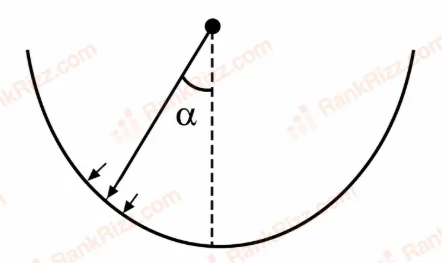
Figure for JEE Main 2012 Physics question on Static and kinetic friction
  1. A

    cot⁡α=3\cot\alpha = 3

  2. B

    sec⁡α=3\sec\alpha = 3

  3. C

    csc⁡α=3\csc\alpha = 3

  4. D

    cos⁡α=3\cos\alpha = 3

JEE MAIN 2010Motion on inclined planes and wedges

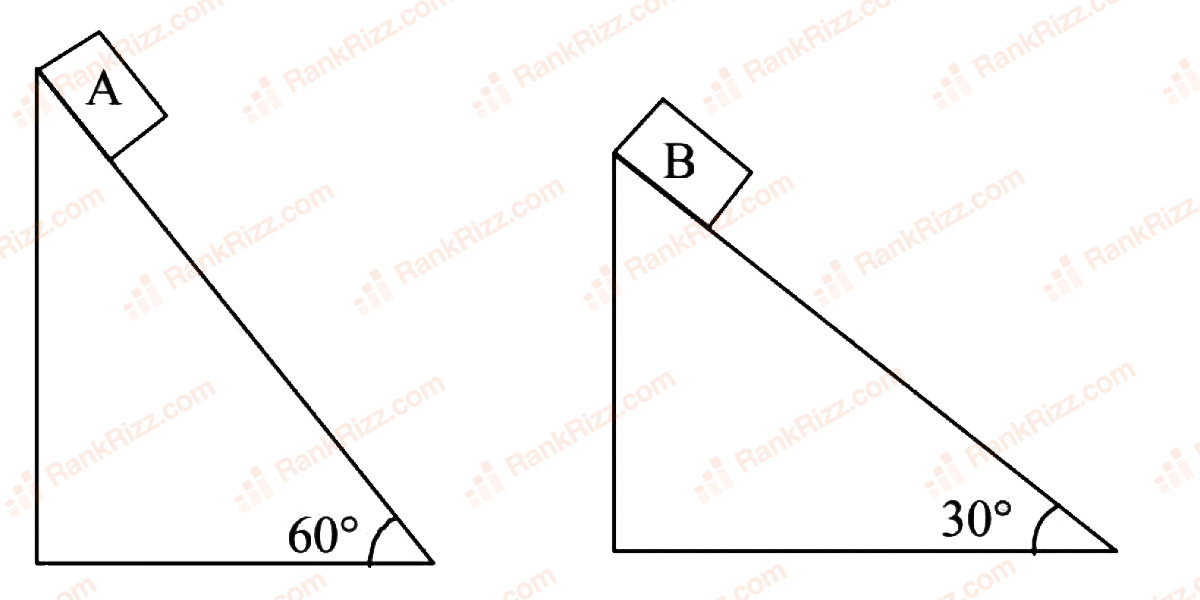
Two fixed frictionless inclined plane making an angle 30∘30^\circ and 60∘60^\circ with the vertical are shown in the figure. Two block AA and BB are placed on the two planes. What is the relative vertical acceleration of AA with respect to BB?

JMA_LOM_C03_075_Q01
  1. A

    4.94.9 ms−2^{-2} in horizontal direction

  2. B

    9.89.8 ms−2^{-2} in vertical direction

  3. C

    zero

  4. D

    4.94.9 ms−2^{-2} in vertical direction

JEE MAIN 2007Spring force and spring combinations in dynamics

A block of mass 'mm' is connected to another block of mass 'MM' by a spring (massless) of spring constant 'kk'. The blocks are kept on a smooth horizontal plane. Initially the blocks are at rest and the spring is unstretched. Then a constant force 'FF' starts acting on the block of mass 'MM' to pull it. Find the force on the block of mass 'mm'

  1. A

    mFM\frac{mF}{M}

  2. B

    (M+m)Fm\frac{(M+m)F}{m}

  3. C

    mF(m+M)\frac{mF}{(m+M)}

  4. D

    MF(m+M)\frac{MF}{(m+M)}

JEE MAIN 2007Newton's laws, free-body diagrams and equilibrium of a particle

A body weighing 13 kg is suspended by two strings 5 m and 12 m long, their other ends being fastened to the extremities of a rod 13 m long. If the rod be so held that the body hangs immediately below the middle point. The tensions in the strings are

  1. A

    12 kg and 13 kg

  2. B

    5 kg and 5 kg

  3. C

    5 kg and 12 kg

  4. D

    5 kg and 13 kg

JEE MAIN 2005Static and kinetic friction

A smooth block is released at rest on a 45∘45^\circ incline and then slides a distance dd. The time taken to slide is nn times as much to slide on rough incline than on a smooth incline. The coefficient of friction is

  1. A

    μk=1−1n2\mu_k = 1 - \frac{1}{n^2}

  2. B

    μk=1−1n2\mu_k = \sqrt{1 - \frac{1}{n^2}}

  3. C

    μs=1−1n2\mu_s = 1 - \frac{1}{n^2}

  4. D

    μs=1−1n2\mu_s = \sqrt{1 - \frac{1}{n^2}}

JEE MAIN 2005Static and kinetic friction

The upper half of an inclined plane with inclination ϕ\phi is perfectly smooth while the lower half is rough. A body starting from rest at the top will again come to rest at the bottom if the coefficient of friction for the lower half is given by

  1. A

    2sin⁡ϕ2 \sin \phi

  2. B

    2cos⁡ϕ2 \cos \phi

  3. C

    2tan⁡ϕ2 \tan \phi

  4. D

    tan⁡ϕ\tan \phi

JEE MAIN 2005Motion on inclined planes and wedges

A block is kept on a frictionless inclined surface with angle of inclination α\alpha. The incline is given an acceleration aa to keep the block stationary. Then aa is equal to?

  1. A

    g/tan⁡αg/\tan \alpha

  2. B

    g cosec αg \, \text{cosec} \, \alpha

  3. C

    gg

  4. D

    gtan⁡αg \tan \alpha

JEE MAIN 2005Spring force and spring combinations in dynamics

A particle of mass 0.30.3 kg is subjected to a force F=−kxF = -kx with k=15k = 15 N/m. What will be its initial acceleration if it is released from a point 2020 cm away from the origin?

  1. A

    33 m/s2^2

  2. B

    1515 m/s2^2

  3. C

    55 m/s2^2

  4. D

    1010 m/s2^2

JEE MAIN 2005Static and kinetic friction

Consider a car moving on a straight road with a speed of 100100 m/s. The distance at which car can be stopped is [μk=0.5][\mu_k = 0.5]

  1. A

    800800 m

  2. B

    10001000 m

  3. C

    100100 m

  4. D

    400400 m

JEE MAIN 2004Pseudo force: lifts and accelerating frames

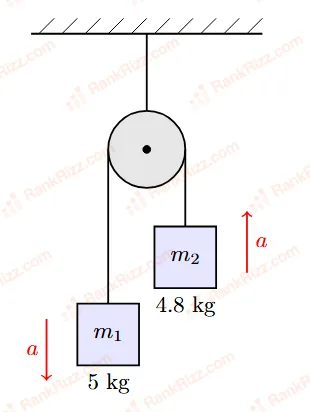
Two masses m1=5m_1 = 5 kg and m2=4.8m_2 = 4.8 kg tied to a string are hanging over a light frictionless pulley. What is the acceleration of the masses when lift free to move (g=9.8 m/s2)(g = 9.8 \text{ m/s}^2)?

Figure for JEE Main 2004 Physics question on Pseudo force: lifts and accelerating frames
  1. A

    0.2 m/s20.2 \text{ m/s}^2

  2. B

    9.8 m/s29.8 \text{ m/s}^2

  3. C

    5 m/s25 \text{ m/s}^2

  4. D

    4.8 m/s24.8 \text{ m/s}^2

JEE MAIN 2004Static and kinetic friction

A block rests on a rough inclined plane making an angle of 30∘30^\circ with the horizontal. The coefficient of static friction between the block and the plane is 0.80.8. If the frictional force on the block is 1010 N, the mass of the block (in kg) is (take g=10 m/s2g = 10 \text{ m/s}^2)

  1. A

    2.02.0

  2. B

    4.04.0

  3. C

    1.61.6

  4. D

    2.52.5