JEE MAIN 2024 · 30 JAN S1Connected bodies, pulleys and constraint relations
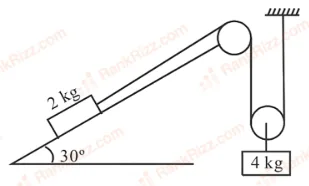
All surfaces shown in figure are assumed to be frictionless and the pulleys and the string are light. The acceleration of the block of mass is
- A
- B
- C
- D
Every Laws of Motion & Friction question JEE Main has set from 2004–2026, grouped by the idea it tests rather than the order of the syllabus. 151 questions across 7 distinct ideas. Free to read, answer key on every one.
DATA UPDATED
Questions
151
Distinct ideas
7
Share of marks
3%
Difficulty
MEDIUM
A chapter is not one subject — it is a handful of procedures the examiner reuses. These are the ones Laws of Motion & Friction questions actually test.
41–60 OF 151 · NEWEST FIRST
All surfaces shown in figure are assumed to be frictionless and the pulleys and the string are light. The acceleration of the block of mass is
Three blocks , and are pulled on a horizontal smooth surface by a force of 80 N as shown in figure. The tensions and in the string are respectively:

40N, 64N
60N, 80N
88N, 96N
80N, 100N
A block of mass is placed on a surface having vertical cross section given by . If coefficient of friction is 0.5, the maximum height above the ground at which block can be placed without slipping is:
m
m
m
m
Given below are two statements :
Statement (I) : The limiting force of static friction depends on the area of contact and independent of materials.
Statement (II) : The limiting force of kinetic friction is independent of the area of contact and depends on materials.
In the light of the above statements, choose the most appropriate answer from the options given below :
Statement I is correct but Statement II is incorrect
Statement I is incorrect but Statement II is correct
Both Statement I and Statement II are incorrect
Both Statement I and Statement II are correct
The position vector of a particle related to time is given by m. The direction of net force experienced by the particle is :
Positive -axis
In plane
Positive -axis
Positive -axis
Three forces N, N, N are acting on a particle of mass 5 kg. The forces and are applied perpendicularly so that particle remains at rest. If the force is removed, then the acceleration of the particle is
m s
m s
m s
m s
A body of mass 500 g moves along -axis such that it's velocity varies with displacement according to the relation m s. The force acting on the body is:
125 N
25 N
166 N
5 N
At any instant the velocity of a particle of mass 500 g is m s. If the force acting on the particle at s is N. Then the value of will be:
3
4
2
6
A block of mass 5 kg is placed at rest on a table of rough surface. Now, if a force of 30 N is applied in the direction parallel to surface of the table, the block slides through a distance of 50 m in an interval of time 10 s. Coefficient of kinetic friction is (given, m s):
0.60
0.75
0.50
0.25
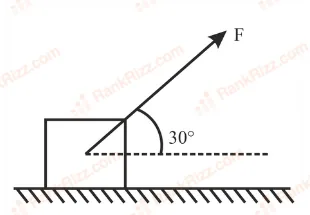
As shown in the figure a block of mass 10 kg lying on a horizontal surface is pulled by a force F acting at an angle , with horizontal. For , the block will just start to move for the value of : [Given ms]
N
N
N
N
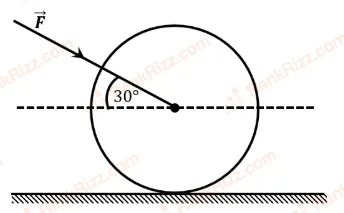
As shown in figure, a 70 kg garden roller is pushed with a force of N at an angle of 30° with horizontal. The normal reaction on the roller is (Given m s)
N
600 N
800 N
N
A body of mass 10 kg is moving with an initial speed of 20 m s. The body stops after 5 s due to friction between body and the floor. The value of the coefficient of friction is: (Take acceleration due to gravity m s)
0.2
0.3
0.5
0.4
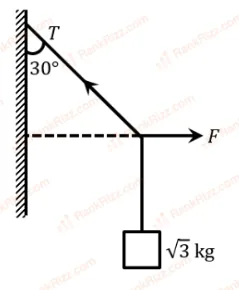
A block of kg is attached to a string whose other end is attached to the wall. An unknown force is applied so that the string makes an angle of with the wall. The tension is: (Given m s)
N
N
N
N
A block of mass slides down the plane inclined at angle with an acceleration . The value of coefficient of kinetic friction will be:
The time taken by an object to slide down rough inclined plane is times as it takes to slide down a perfectly smooth incline plane. The coefficient of kinetic friction between the object and the incline plane is:
Force acts for s on a body of mass kg, starting from rest, after which the force ceases and then body describes m in the next s. The value of force will be:
N
N
N
N
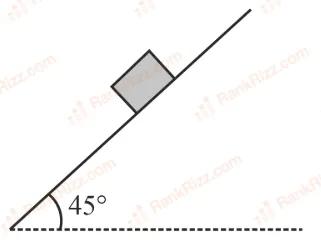
Consider a block kept on an inclined plane (inclined at 45°) as shown in the figure. If the force required to just push it up the incline is 2 times the force required to just prevent it from sliding down, the coefficient of friction between the block and inclined plane () is equal to:
0.33
0.60
0.25
0.50
As per given figure, a weightless pulley is attached on a double inclined frictionless surface. The tension in the string (massless) will be (if )
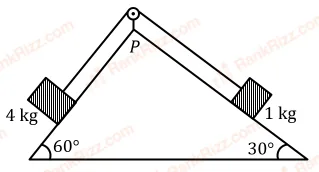
N
N
N
N
As per given figure, a weightless pulley is attached on a double inclined frictionless surface. The tension in the string (massless) will be (if m s)
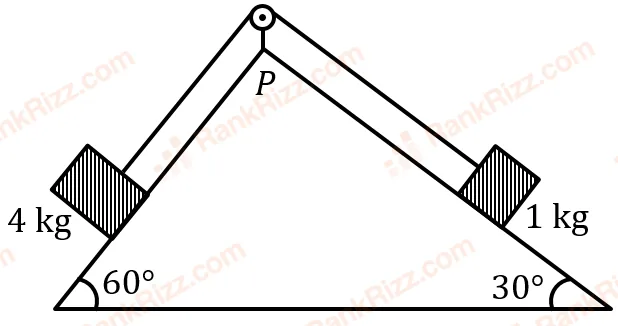
N
N
N
N
Given below are two statements:
Statement-I: An elevator can go up or down with uniform speed when its weight is balanced with the tension of its cable.
Statement-II: Force exerted by the floor of an elevator on the foot of a person standing on it is more than his/her weight when the elevator goes down with increasing speed.
In the light of the above statements, choose the correct answer from the options given below:
Both Statement I and Statement II are false
Statement I is true but Statement II is false
Both Statement I and Statement II are true
Statement I is false but Statement II is true
JEE Advanced has set 18 Laws of Motion & Friction questions too. Laws of Motion & Friction JEE Advanced PYQs →
OTHER PHYSICS CHAPTERS