JEE Main 2019 Physics question — Friction in multi-block systems
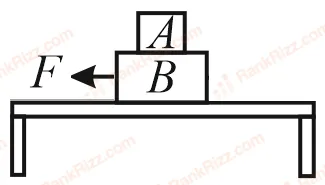
Two blocks A and B of masses m = 1 kg and m = 3 kg are kept on the table as shown in figure. The coefficients of friction between A and B is 0.2 and between B and the surface of the table is also 0.2. The maximum force F that can be applied on B horizontally, so that the block A does not slide over the block B is:
[Take g = 10 m/s]
SOLUTION
To solve for the maximum force such that block does not slide over block , we need to analyze the friction limits and the maximum common acceleration they can share.
Here is the structured, step-by-step breakdown of the solution.
1. Identify the Maximum Acceleration of Block A
Block moves forward solely due to the static friction acting between it and block .
- Mass of block A:
- Coefficient of friction between A and B:
- Coefficient of friction between B and table:
- Total normal force on the table:
- Correct Option: A (16 N)
The maximum static friction force () that can act on block is:
Using Newton's second law (), the maximum acceleration () block can achieve without slipping is:
If the system accelerates faster than , block will begin to slide backward relative to block .
2. Analyze the Whole System (A + B)
To find the maximum force required to achieve this common acceleration, we treat both blocks as a single combined system of mass:
Friction from the Table Surface
The table exerts a kinetic/limiting friction force () opposing the motion of the combined mass:
3. Calculate the Maximum Force ()
Using the equation of motion for the entire combined system:
Substitute the values we calculated:
Final Answer
The maximum horizontal force that can be applied to block without causing block to slide is 16 N.
Topic: Friction in multi-block systems