RankRizz

Newton's laws, free-body diagrams and equilibrium of a particle — JEE Main Previous Year Questions

Newton's laws, free-body diagrams and equilibrium of a particle has been asked 53 times in JEE Main, in 14 different years between 2007 and 2026, and in all of the last five exam years (2022–2026), 33 questions in all. That is 35% of Laws of Motion & Friction, its most-asked topic. Last asked in JEE Main 04 Apr 2026, Shift 2. 48 are multiple choice and 5 numerical-value; 28 easy, 19 medium and 2 hard by our difficulty labels. All of them are below, newest first, free to read.

Questions

53

Years asked

14

Since

2007

Of the chapter

35%

When JEE Main asked it

Questions on Newton's laws, free-body diagrams and equilibrium of a particle in every year it was asked, newest first.

JEE Main questions on Newton's laws, free-body diagrams and equilibrium of a particle by year, 2007–2026
YearRelative frequencyQuestions
20264
20255
20248
20237
20229
20215
20203
20193
20171
20161
20142
20131
20123
20071
Total53

Every Newton's laws, free-body diagrams and equilibrium of a particle question

1–20 OF 53 · NEWEST FIRST

JEE MAIN 2026 · 04 APR S2Newton's laws, free-body diagrams and equilibrium of a particle

At t=0t = 0, a body of mass 100100 g starts moving under the influence of a force (5i^+10j^)(5\hat{i} + 10\hat{j}) N. After 22 s, its  position is (2xi^+5yj^)(2x\hat{i} + 5y\hat{j}) m. The ratio x:yx : y is ______.

  1. A

    1:21:2

  2. B

    2:52:5

  3. C

    5:25:2

  4. D

    5:45:4

JEE MAIN 2026 · 28 JAN S1Newton's laws, free-body diagrams and equilibrium of a particle

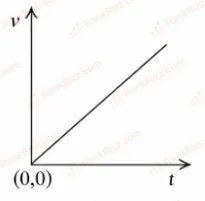
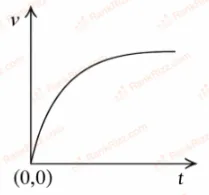
A particle of mass m falls from rest through a resistive medium having resistive force, F = -kv, where v is the velocity of the particle and k is a constant. Which of the following graphs represents velocity (v) versus time (t)?
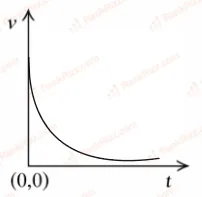
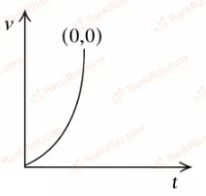
  1. A
    Figure for JEE Main 2026 Physics question on Newton's laws, free-body diagrams and equilibrium of a particle
  2. B
    Figure for JEE Main 2026 Physics question on Newton's laws, free-body diagrams and equilibrium of a particle
  3. C
    Figure for JEE Main 2026 Physics question on Newton's laws, free-body diagrams and equilibrium of a particle
  4. D
    Figure for JEE Main 2026 Physics question on Newton's laws, free-body diagrams and equilibrium of a particle
JEE MAIN 2026 · 24 JAN S2Newton's laws, free-body diagrams and equilibrium of a particle

A flexible chain of mass m hangs between two fixed points at the same level. The inclination of the chain with the horizontal at the two points of support is 30∘30^{\circ}. Considering the equilibrium of each half of the chain, the tension of the chain at the lowest point is __________.

  1. A

    3mg\sqrt{3}mg

  2. B

    mg

  3. C

    12mg\frac{1}{2}mg

  4. D

    32mg\frac{\sqrt{3}}{2}mg

JEE MAIN 2026 · 21 JAN S1Newton's laws, free-body diagrams and equilibrium of a particle

A 4 kg mass moves under the influence of a force F→=(4t3i^−3tj^)N\overrightarrow{F}=\left(4t^{3}\widehat{i}-3t\widehat{j}\right)N where t is the time in second. If mass starts from origin at t= 0, the velocity and position after t= 2 s will be:

  1. A

    v→=4i^−32j^ r→=85i^−j^\overrightarrow{v}=4\widehat{i}-\frac{3}{2}\widehat{j}\text{ } \overrightarrow{r}=\frac{8}{5}\widehat{i}-\widehat{j}

  2. B

    v→=4i^−52j^ r→=85i^−2j^\overrightarrow{v}=4\widehat{i}-\frac{5}{2}\widehat{j}\text{ } \overrightarrow{r}=\frac{8}{5}\widehat{i}-2\widehat{j}

  3. C

    v→=3i^+32j^ r→=65i^+j^\overrightarrow{v}=3\widehat{i}+\frac{3}{2}\widehat{j}\text{ } \overrightarrow{r}=\frac{6}{5}\widehat{i}+\widehat{j}

  4. D

    v→=4i^−32j^ r→=65i^−j^\overrightarrow{v}=4\widehat{i}-\frac{3}{2}\widehat{j}\text{ } \overrightarrow{r}=\frac{6}{5}\widehat{i}-\widehat{j}

JEE MAIN 2025 · 08 APR S2Newton's laws, free-body diagrams and equilibrium of a particle

A body of mass 2 kg moving with velocity of v⃗in=3i^+4j^\vec{v}_{in} = 3\hat{i} + 4\hat{j} ms−1^{-1} enters into a constant force field of 6N directed along positive z-axis. If the body remains in the field for a period of 53\frac{5}{3} seconds, then velocity of the body when it emerges from force field is

  1. A

    4i^+3j^+5k^4\hat{i} + 3\hat{j} + 5\hat{k}

  2. B

    3i^+4j^+5k^3\hat{i} + 4\hat{j} + 5\hat{k}

  3. C

    3i^+4j^−5k^3\hat{i} + 4\hat{j} - 5\hat{k}

  4. D

    3i^+4j^+5k^3\hat{i} + 4\hat{j} + \sqrt{5}\hat{k}

JEE MAIN 2025 · 07 APR S2Newton's laws, free-body diagrams and equilibrium of a particle

An object with mass 500 g moves along x-axis with speed v=4xv = 4\sqrt{x} m/s. The force acting on the object is :

  1. A

    8 N

  2. B

    5 N

  3. C

    6 N

  4. D

    4 N

JEE MAIN 2025 · 04 APR S1Newton's laws, free-body diagrams and equilibrium of a particle

A body of mass m is suspended by two strings making angles θ1\theta_1 and θ2\theta_2 with the horizontal ceiling with tensions T1T_1 and T2T_2 simultaneously. T1T_1 and T2T_2 are related by T1=3T2T_1 = \sqrt{3}T_2. The angles θ1\theta_1 and θ2\theta_2 are

  1. A

    θ1=30°\theta_1 = 30°, θ2=60°\theta_2 = 60° with T2=3mg4T_2 = \dfrac{3mg}{4}

  2. B

    θ1=60°\theta_1 = 60°, θ2=30°\theta_2 = 30° with T2=mg2T_2 = \dfrac{mg}{2}

  3. C

    θ1=45°\theta_1 = 45°, θ2=45°\theta_2 = 45° with T2=3mg4T_2 = \dfrac{3mg}{4}

  4. D

    θ1=30°\theta_1 = 30°, θ2=60°\theta_2 = 60° with T2=4mg5T_2 = \dfrac{4mg}{5}

JEE MAIN 2025 · 02 APR S2Newton's laws, free-body diagrams and equilibrium of a particle

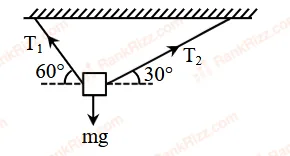
A body of mass 1 kg is suspended with the help of two strings making angles as shown in figure. Magnitude of tensions T1T_1 and T2T_2, respectively, are (in N) :

Figure for JEE Main 2025 Physics question on Newton's laws, free-body diagrams and equilibrium of a particle
  1. A

    5,535, 5\sqrt{3}

  2. B

    53,55\sqrt{3}, 5

  3. C

    53,535\sqrt{3}, 5\sqrt{3}

  4. D

    5,55, 5

JEE MAIN 2025 · 28 JAN S2Newton's laws, free-body diagrams and equilibrium of a particle

A balloon and its content having mass MM is moving up with an acceleration 'a'. The mass that must be released from the content so that the balloon starts moving up with an acceleration '3a' will be (Take ' g ' as acceleration due to gravity)

  1. A

    2Ma3a+g\frac{2Ma}{3a + g}

  2. B

    3Ma2a−g\frac{3Ma}{2a - g}

  3. C

    3Ma2a+g\frac{3Ma}{2a + g}

  4. D

    2Ma3a−g\frac{2Ma}{3a - g}

JEE MAIN 2024 · 09 APR S2Newton's laws, free-body diagrams and equilibrium of a particle


A 1 kg1 \text{ kg} mass is suspended from the ceiling by a rope of length 4 m4 \text{ m}. A horizontal force 'FF' is applied at the mid point of the rope so that the rope makes an angle of 45°45° with respect to the vertical axis as shown in figure.
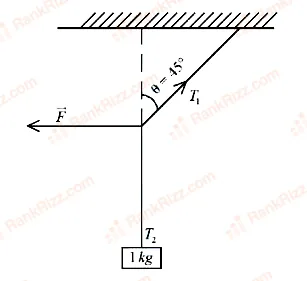
page1_img1

The magnitude of FF is : (Assume that the system is in equilibrium and g=10 m/s2g = 10 \text{ m/s}^2)

  1. A

    10 N10 \text{ N}

  2. B

    102 N\frac{10}{\sqrt{2}} \text{ N}

  3. C

    1 N1 \text{ N}

  4. D

    1102 N\frac{1}{10\sqrt{2}} \text{ N}

JEE MAIN 2024 · 08 APR S1Newton's laws, free-body diagrams and equilibrium of a particle

A player caught a cricket ball of mass 150 g150 \text{ g} moving at a speed of 20 m/s20 \text{ m/s}. If the catching process is completed in 0.1 s0.1 \text{ s}, the magnitude of force exerted by the ball on the hand of the player is:

  1. A

    3 N3 \text{ N}

  2. B

    300 N300 \text{ N}

  3. C

    150 N150 \text{ N}

  4. D

    30 N30 \text{ N}

JEE MAIN 2024 · 06 APR S2Newton's laws, free-body diagrams and equilibrium of a particle

A body of weight 200 N200 \text{ N} is suspended from a tree branch through a chain of mass 10 kg10 \text{ kg}. The branch pulls the chain by a force equal to (if g=10 m/s2g = 10 \text{ m/s}^2) :

  1. A

    100 N100 \text{ N}

  2. B

    200 N200 \text{ N}

  3. C

    300 N300 \text{ N}

  4. D

    150 N150 \text{ N}

JEE MAIN 2024 · 05 APR S1Newton's laws, free-body diagrams and equilibrium of a particle

A wooden block of mass 5 kg5 \text{ kg} rests on a soft horizontal floor. When an iron cylinder of mass 25 kg25 \text{ kg} is placed on the top of the block, the floor yields and the block and the cylinder together go down with an acceleration of 0.1 ms−20.1 \text{ ms}^{-2}. The action force of the system on the floor is equal to:

  1. A

    196 N196 \text{ N}

  2. B

    291 N291 \text{ N}

  3. C

    294 N294 \text{ N}

  4. D

    297 N297 \text{ N}

JEE MAIN 2024 · 05 APR S2Newton's laws, free-body diagrams and equilibrium of a particle

A particle moves in x−yx - y plane under the influence of a force F⃗\vec{F} such that its linear momentum is p⃗(t)=i^cos⁡(kt)−j^sin⁡(kt)\vec{p}(t) = \hat{i} \cos(kt) - \hat{j} \sin(kt). If kk is constant, the angle between F⃗\vec{F} and p⃗\vec{p} will be :

  1. A

    π4\frac{\pi}{4}

  2. B

    π6\frac{\pi}{6}

  3. C

    π2\frac{\pi}{2}

  4. D

    π3\frac{\pi}{3}

JEE MAIN 2024 · 04 APR S1Newton's laws, free-body diagrams and equilibrium of a particle

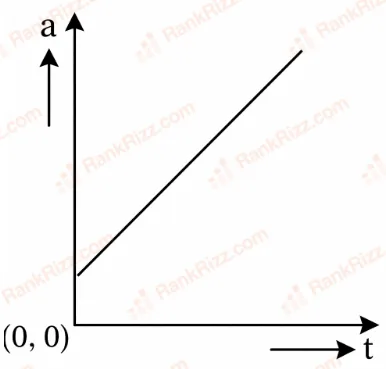
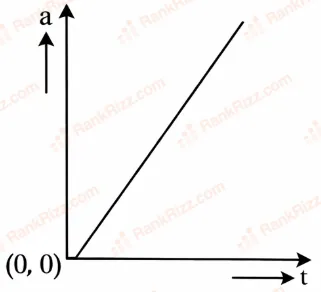
A wooden block, initially at rest on the ground, is pushed by a force which increases linearly with time t. Which of the following curve best describes acceleration of the block with time:
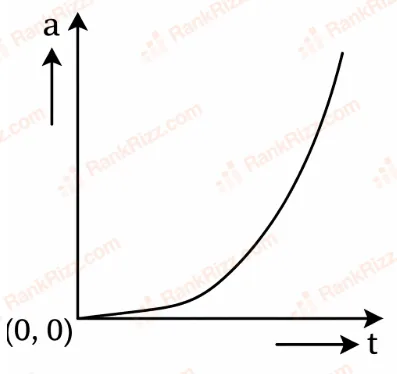
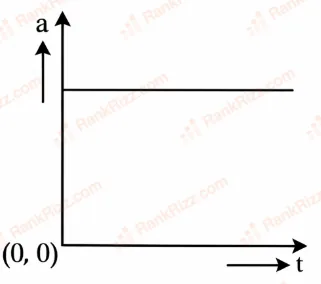
  1. A
    Figure for JEE Main 2024 Physics question on Newton's laws, free-body diagrams and equilibrium of a particle
  2. B
    Figure for JEE Main 2024 Physics question on Newton's laws, free-body diagrams and equilibrium of a particle
  3. C
    Figure for JEE Main 2024 Physics question on Newton's laws, free-body diagrams and equilibrium of a particle
  4. D
    Figure for JEE Main 2024 Physics question on Newton's laws, free-body diagrams and equilibrium of a particle
JEE MAIN 2024 · 01 FEB S2Newton's laws, free-body diagrams and equilibrium of a particle

A cricket player catches a ball of mass 120 g moving with 25 m s−125 \text{ m s}^{-1} speed. If the catching process is completed in 0.1 s then the magnitude of force exerted by the ball on the hand of player will be (in SI unit):

  1. A

    24

  2. B

    12

  3. C

    25

  4. D

    30

JEE MAIN 2024 · 01 FEB S2Newton's laws, free-body diagrams and equilibrium of a particle

A body of mass 4 kg experiences two forces F1⃗=5i^+8j^+7k^\vec{F_1} = 5\hat{i} + 8\hat{j} + 7\hat{k} and F2⃗=3i^−4j^−3k^\vec{F_2} = 3\hat{i} - 4\hat{j} - 3\hat{k}. The acceleration acting on the body is:

  1. A

    −2i^−j^−k^-2\hat{i} - \hat{j} - \hat{k}

  2. B

    4i^+2j^+2k^4\hat{i} + 2\hat{j} + 2\hat{k}

  3. C

    2i^+j^+k^2\hat{i} + \hat{j} + \hat{k}

  4. D

    2i^+3j^+3k^2\hat{i} + 3\hat{j} + 3\hat{k}

JEE MAIN 2023 · 15 APR S1Newton's laws, free-body diagrams and equilibrium of a particle

The position vector of a particle related to time tt is given by r⃗=(10ti^+15t2j^+7k^)\vec{r} = (10t\hat{i} + 15t^2\hat{j} + 7\hat{k}) m. The direction of net force experienced by the particle is :

  1. A

    Positive xx-axis

  2. B

    In x−yx - y plane

  3. C

    Positive yy-axis

  4. D

    Positive zz-axis

JEE MAIN 2023 · 12 APR S1Newton's laws, free-body diagrams and equilibrium of a particle

Three forces F1=10F_1 = 10 N, F2=8F_2 = 8 N, F3=6F_3 = 6 N are acting on a particle of mass 5 kg. The forces F2F_2 and F3F_3 are applied perpendicularly so that particle remains at rest. If the force F1F_1 is removed, then the acceleration of the particle is

  1. A

    77 m s−2^{-2}

  2. B

    0.50.5 m s−2^{-2}

  3. C

    4.84.8 m s−2^{-2}

  4. D

    22 m s−2^{-2}

JEE MAIN 2023 · 11 APR S2Newton's laws, free-body diagrams and equilibrium of a particle

A body of mass 500 g moves along xx-axis such that it's velocity varies with displacement xx according to the relation v=10xv = 10\sqrt{x} m s−1^{-1}. The force acting on the body is:

  1. A

    125 N

  2. B

    25 N

  3. C

    166 N

  4. D

    5 N

Newton's laws, free-body diagrams and equilibrium of a particle: common questions

How many Newton's laws, free-body diagrams and equilibrium of a particle questions have come in JEE Main?
Newton's laws, free-body diagrams and equilibrium of a particle has been asked 53 times in JEE Main, in 14 different years between 2007 and 2026. It came up in all of the last five exam years (2022–2026), 33 questions in all.
Is Newton's laws, free-body diagrams and equilibrium of a particle important for JEE Main?
It is the most-asked topic in Laws of Motion & Friction: 53 of the chapter's 151 JEE Main questions (35%). It came up in all of the last five exam years (2022–2026), 33 questions in all.
When was Newton's laws, free-body diagrams and equilibrium of a particle last asked in JEE Main?
Most recently in JEE Main 04 Apr 2026, Shift 2. Questions on this page are newest first, so the latest ones are at the top.
What kind of Newton's laws, free-body diagrams and equilibrium of a particle questions does JEE Main ask?
48 are multiple choice and 5 numerical-value; 28 easy, 19 medium and 2 hard by our difficulty labels. Each question shows its answer key and worked solution where we have them.