RankRizz

Laws of Motion & Friction — JEE Main Previous Year Questions

Every Laws of Motion & Friction question JEE Main has set from 2004–2026, grouped by the idea it tests rather than the order of the syllabus. 151 questions across 7 distinct ideas. Free to read, answer key on every one.

DATA UPDATED

Questions

151

Distinct ideas

7

Share of marks

3%

Difficulty

MEDIUM

The ideas inside Laws of Motion & Friction

A chapter is not one subject — it is a handful of procedures the examiner reuses. These are the ones Laws of Motion & Friction questions actually test.

Every Laws of Motion & Friction question

21–40 OF 151 · NEWEST FIRST

JEE MAIN 2025 · 28 JAN S2Newton's laws, free-body diagrams and equilibrium of a particle

A balloon and its content having mass MM is moving up with an acceleration 'a'. The mass that must be released from the content so that the balloon starts moving up with an acceleration '3a' will be (Take ' g ' as acceleration due to gravity)

  1. A

    2Ma3a+g\frac{2Ma}{3a + g}

  2. B

    3Ma2a−g\frac{3Ma}{2a - g}

  3. C

    3Ma2a+g\frac{3Ma}{2a + g}

  4. D

    2Ma3a−g\frac{2Ma}{3a - g}

JEE MAIN 2025 · 23 JAN S2Spring force and spring combinations in dynamics

A massless spring gets elongated by amount x1x_{1} under a tension of 5 N . Its elongation is x2x_{2} under the tension of 7 N . For the elongation of (5x1−2x2)(5x_{1}-2x_{2}),the tension in the spring will be,

  1. A

    39 N

  2. B

    15 N

  3. C

    11 N

  4. D

    20 N

JEE MAIN 2024 · 09 APR S1Connected bodies, pulleys and constraint relations

A light unstretchable string passing over a smooth light pulley connects two blocks of masses m1m_1 and m2m_2. If the acceleration of the system is g8\frac{g}{8}, then the ratio of the masses m2m1\frac{m_2}{m_1} is :

  1. A

    8:18 : 1

  2. B

    5:35 : 3

  3. C

    4:34 : 3

  4. D

    9:79 : 7

JEE MAIN 2024 · 09 APR S2Newton's laws, free-body diagrams and equilibrium of a particle


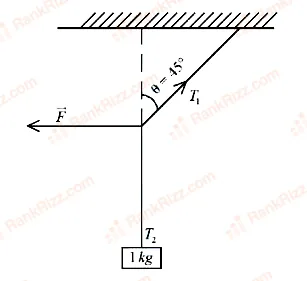
A 1 kg1 \text{ kg} mass is suspended from the ceiling by a rope of length 4 m4 \text{ m}. A horizontal force 'FF' is applied at the mid point of the rope so that the rope makes an angle of 45°45° with respect to the vertical axis as shown in figure.

page1_img1

The magnitude of FF is : (Assume that the system is in equilibrium and g=10 m/s2g = 10 \text{ m/s}^2)

  1. A

    10 N10 \text{ N}

  2. B

    102 N\frac{10}{\sqrt{2}} \text{ N}

  3. C

    1 N1 \text{ N}

  4. D

    1102 N\frac{1}{10\sqrt{2}} \text{ N}

JEE MAIN 2024 · 08 APR S1Newton's laws, free-body diagrams and equilibrium of a particle

A player caught a cricket ball of mass 150 g150 \text{ g} moving at a speed of 20 m/s20 \text{ m/s}. If the catching process is completed in 0.1 s0.1 \text{ s}, the magnitude of force exerted by the ball on the hand of the player is:

  1. A

    3 N3 \text{ N}

  2. B

    300 N300 \text{ N}

  3. C

    150 N150 \text{ N}

  4. D

    30 N30 \text{ N}

JEE MAIN 2024 · 08 APR S2Static and kinetic friction

A given object takes n times the time to slide down 45°45° rough inclined plane as it takes the time to slide down an identical perfectly smooth 45°45° inclined plane. The coefficient of kinetic friction between the object and the surface of inclined plane is :

  1. A

    1−1n2\sqrt{1 - \frac{1}{n^2}}

  2. B

    1−n21 - n^2

  3. C

    1−1n21 - \frac{1}{n^2}

  4. D

    1−n2\sqrt{1 - n^2}

JEE MAIN 2024 · 06 APR S1Connected bodies, pulleys and constraint relations

A light string passing over a smooth light pulley connects two blocks of masses m1m_1 and m2m_2 (where m2>m1m_2>m_1). If the acceleration of the system is g2\frac{g}{\sqrt{2}}, then the ratio of the masses m1m2\frac{m_1}{m_2} is:

  1. A

    1+55−1\frac{1+\sqrt{5}}{\sqrt{5}-1}

  2. B

    2−12+1\frac{\sqrt{2}-1}{\sqrt{2}+1}

  3. C

    1+52−1\frac{1+\sqrt{5}}{\sqrt{2}-1}

  4. D

    3+12−1\frac{\sqrt{3}+1}{\sqrt{2}-1}

JEE MAIN 2024 · 06 APR S2Newton's laws, free-body diagrams and equilibrium of a particle

A body of weight 200 N200 \text{ N} is suspended from a tree branch through a chain of mass 10 kg10 \text{ kg}. The branch pulls the chain by a force equal to (if g=10 m/s2g = 10 \text{ m/s}^2) :

  1. A

    100 N100 \text{ N}

  2. B

    200 N200 \text{ N}

  3. C

    300 N300 \text{ N}

  4. D

    150 N150 \text{ N}

JEE MAIN 2024 · 05 APR S1Newton's laws, free-body diagrams and equilibrium of a particle

A wooden block of mass 5 kg5 \text{ kg} rests on a soft horizontal floor. When an iron cylinder of mass 25 kg25 \text{ kg} is placed on the top of the block, the floor yields and the block and the cylinder together go down with an acceleration of 0.1 ms−20.1 \text{ ms}^{-2}. The action force of the system on the floor is equal to:

  1. A

    196 N196 \text{ N}

  2. B

    291 N291 \text{ N}

  3. C

    294 N294 \text{ N}

  4. D

    297 N297 \text{ N}

JEE MAIN 2024 · 05 APR S1Connected bodies, pulleys and constraint relations

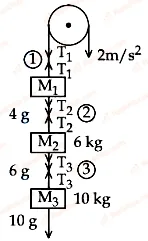
Three blocks M1,M2,M3M_1, M_2, M_3 having masses 4 kg,6 kg4 \text{ kg}, 6 \text{ kg} and 10 kg10 \text{ kg} respectively are hanging from a smooth pulley using rope 1, 2 and 3 as shown in figure. The tension in the rope 1, T1T_1 when they are moving upward with acceleration of 2 ms−22 \text{ ms}^{-2} is ______ N (if g=10 m/s2g = 10 \text{ m/s}^2).

Figure for JEE Main 2024 Physics question on Connected bodies, pulleys and constraint relations
JEE MAIN 2024 · 05 APR S2Newton's laws, free-body diagrams and equilibrium of a particle

A particle moves in x−yx - y plane under the influence of a force F⃗\vec{F} such that its linear momentum is p⃗(t)=i^cos⁡(kt)−j^sin⁡(kt)\vec{p}(t) = \hat{i} \cos(kt) - \hat{j} \sin(kt). If kk is constant, the angle between F⃗\vec{F} and p⃗\vec{p} will be :

  1. A

    π4\frac{\pi}{4}

  2. B

    π6\frac{\pi}{6}

  3. C

    π2\frac{\pi}{2}

  4. D

    π3\frac{\pi}{3}

JEE MAIN 2024 · 05 APR S2Static and kinetic friction

A heavy box of mass 5050 kg is moving on a horizontal surface. If co-efficient of kinetic friction between the box and horizontal surface is 0.3 then force of kinetic friction is :

  1. A

    1.471.47 N

  2. B

    147147 N

  3. C

    14.714.7 N

  4. D

    14701470 N

JEE MAIN 2024 · 04 APR S1Newton's laws, free-body diagrams and equilibrium of a particle

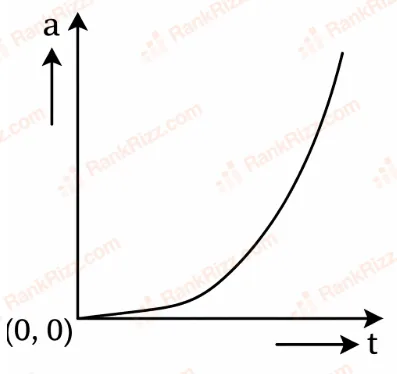
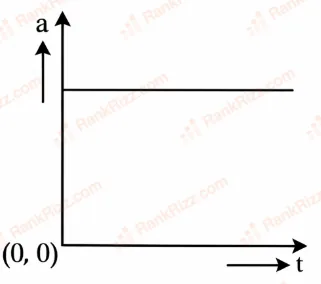
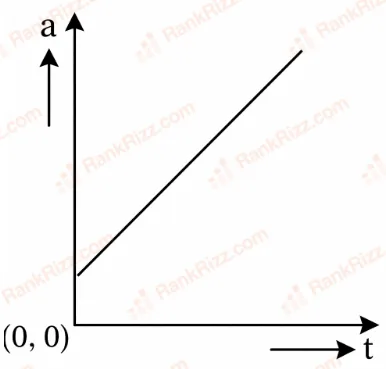
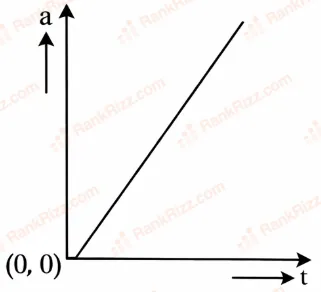
A wooden block, initially at rest on the ground, is pushed by a force which increases linearly with time t. Which of the following curve best describes acceleration of the block with time:

  1. A
    Figure for JEE Main 2024 Physics question on Newton's laws, free-body diagrams and equilibrium of a particle
  2. B
    Figure for JEE Main 2024 Physics question on Newton's laws, free-body diagrams and equilibrium of a particle
  3. C
    Figure for JEE Main 2024 Physics question on Newton's laws, free-body diagrams and equilibrium of a particle
  4. D
    Figure for JEE Main 2024 Physics question on Newton's laws, free-body diagrams and equilibrium of a particle
JEE MAIN 2024 · 04 APR S2Motion on inclined planes and wedges

A 22 kg brick begins to slide over a surface which is inclined at an angle of 45°45° with respect to horizontal axis. The co-efficient of static friction between their surfaces is:

  1. A

    1.71.7

  2. B

    13\frac{1}{\sqrt{3}}

  3. C

    0.50.5

  4. D

    11

JEE MAIN 2024 · 01 FEB S1Connected bodies, pulleys and constraint relations


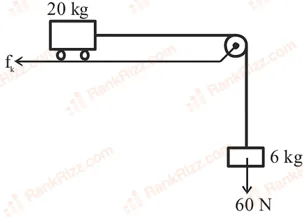
Consider a block and trolley system as shown in figure. If the coefficient of kinetic friction between the trolley and the surface is 0.040.04, the acceleration of the system in m s−2^{-2} is: (Consider that the string is massless and unstretchable and the pulley is also massless and frictionless):

Figure for JEE Main 2024 Physics question on Connected bodies, pulleys and constraint relations
  1. A

    33

  2. B

    44

  3. C

    22

  4. D

    1.21.2

JEE MAIN 2024 · 01 FEB S2Newton's laws, free-body diagrams and equilibrium of a particle

A cricket player catches a ball of mass 120 g moving with 25 m s−125 \text{ m s}^{-1} speed. If the catching process is completed in 0.1 s then the magnitude of force exerted by the ball on the hand of player will be (in SI unit):

  1. A

    24

  2. B

    12

  3. C

    25

  4. D

    30

JEE MAIN 2024 · 01 FEB S2Newton's laws, free-body diagrams and equilibrium of a particle

A body of mass 4 kg experiences two forces F1⃗=5i^+8j^+7k^\vec{F_1} = 5\hat{i} + 8\hat{j} + 7\hat{k} and F2⃗=3i^−4j^−3k^\vec{F_2} = 3\hat{i} - 4\hat{j} - 3\hat{k}. The acceleration acting on the body is:

  1. A

    −2i^−j^−k^-2\hat{i} - \hat{j} - \hat{k}

  2. B

    4i^+2j^+2k^4\hat{i} + 2\hat{j} + 2\hat{k}

  3. C

    2i^+j^+k^2\hat{i} + \hat{j} + \hat{k}

  4. D

    2i^+3j^+3k^2\hat{i} + 3\hat{j} + 3\hat{k}

JEE MAIN 2024 · 31 JAN S1Connected bodies, pulleys and constraint relations

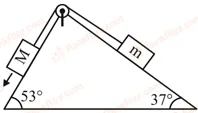
In the given arrangement of a doubly inclined plane two blocks of masses MM and mm are placed. The blocks are connected by a light string passing over an ideal pulley as shown. The coefficient of friction between the surface of the plane and the blocks is 0.250.25. The value of mm, for which M=10M = 10 kg will move down with an acceleration of 2 m s−22 \text{ m s}^{-2}, is: (take g=10 m s−2g = 10 \text{ m s}^{-2} and tan⁡37°=34\tan 37° = \frac{3}{4})

Figure for JEE Main 2024 Physics question on Connected bodies, pulleys and constraint relations
  1. A

    9 kg

  2. B

    4.5 kg

  3. C

    6.5 kg

  4. D

    2.25 kg

JEE MAIN 2024 · 31 JAN S2Connected bodies, pulleys and constraint relations

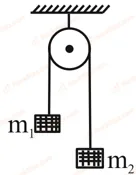
A light string passing over a smooth light fixed pulley connects two blocks of masses m1m_1 and m2m_2. If the acceleration of the system is g8\frac{g}{8}, then the ratio of masses is

Figure for JEE Main 2024 Physics question on Connected bodies, pulleys and constraint relations
  1. A

    97\frac{9}{7}

  2. B

    81\frac{8}{1}

  3. C

    43\frac{4}{3}

  4. D

    53\frac{5}{3}

JEE MAIN 2024 · 31 JAN S2Motion on inclined planes and wedges

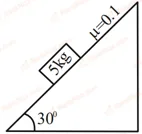
A block of mass 5 kg is placed on a rough inclined surface as shown in the figure. If F1⃗\vec{F_1} is the force required to just move the block up the inclined plane and F2⃗\vec{F_2} is the force required to just prevent the block from sliding down, then the value of ∣F1⃗∣−∣F2⃗∣|\vec{F_1}| - |\vec{F_2}| is: [Use g=10g = 10 m s−2^{-2}]

Figure for JEE Main 2024 Physics question on Motion on inclined planes and wedges
  1. A

    25325\sqrt{3} N

  2. B

    535\sqrt{3} N

  3. C

    532\frac{5\sqrt{3}}{2} N

  4. D

    10 N