RankRizz

Laws of Motion & Friction — JEE Main Previous Year Questions

Every Laws of Motion & Friction question JEE Main has set from 2004–2026, grouped by the idea it tests rather than the order of the syllabus. 151 questions across 7 distinct ideas. Free to read, answer key on every one.

DATA UPDATED

Questions

151

Distinct ideas

7

Share of marks

3%

Difficulty

MEDIUM

The ideas inside Laws of Motion & Friction

A chapter is not one subject — it is a handful of procedures the examiner reuses. These are the ones Laws of Motion & Friction questions actually test.

Every Laws of Motion & Friction question

121–140 OF 151 · NEWEST FIRST

JEE MAIN 2018 · 15 APR S2Static and kinetic friction

A body of mass 2 kg slides down with an acceleration of 3 m/s2^2 on a rough inclined plane having a slope of 30∘^\circ. The external force required to take the same body up the plane with the same acceleration will be: (g = 10 m/s2^2)

  1. A

    4 N

  2. B

    14 N

  3. C

    6 N

  4. D

    20 N

JEE MAIN 2018 · 08 APR OFFLINEConnected bodies, pulleys and constraint relations

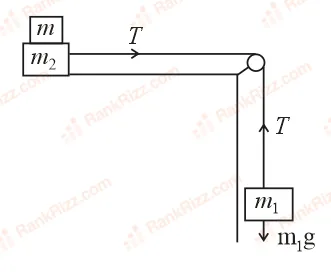
Two masses m1=5m_1 = 5 kg and m2=10m_2 = 10 kg, connected by an inextensible string over a frictionless pulley, are moving as shown in the figure. The coefficient of friction of horizontal surface is 0.15. The minimum weight m that should be put on top of m2m_2 to stop the motion is:
Figure for JEE Main 2018 Physics question on Connected bodies, pulleys and constraint relations

  1. A

    10.3 kg

  2. B

    18.3 kg

  3. C

    27.3 kg

  4. D

    43.3 kg

JEE MAIN 2017 · 02 APR OFFLINENewton's laws, free-body diagrams and equilibrium of a particle

A body of mass m=10−2m = 10^{-2} kg is moving in a medium and experiences a frictional force F=−kv2F = -kv^{2}. Its initial speed is v0=10v_{0} = 10 m s−1^{-1}. After 10 s its kinetic energy is 18mv02\frac{1}{8}mv_{0}^{2}, then the value of kk will be:

  1. A

    10−110^{-1} kg m−1^{-1} s−1^{-1}

  2. B

    10−310^{-3} kg m−1^{-1}

  3. C

    10−310^{-3} kg m−1^{-1} s−1^{-1}

  4. D

    10−410^{-4} kg m−1^{-1}

JEE MAIN 2016 · 10 APR ONLINENewton's laws, free-body diagrams and equilibrium of a particle

A particle of mass mm is acted upon by a force FF given by the empirical law F=Rt2v(t)F = \frac{R}{t^2}v(t). If this law is to be tested experimentally by observing the motion starting from rest, the best way is to plot

  1. A

    log⁡v(t)\log v(t) against 1t\frac{1}{t}

  2. B

    v(t)v(t) against t2t^2

  3. C

    log⁡v(t)\log v(t) against 1t2\frac{1}{t^2}

  4. D

    log⁡v(t)\log v(t) against tt

JEE MAIN 2016 · 09 APR ONLINEPseudo force: lifts and accelerating frames

A rocket is fired vertically from the earth with an acceleration of 2g, where g is the gravitational acceleration. On an inclined plane inside the rocket, making an angle θ\theta with the horizontal, a point object of mass m is kept. The minimum coefficient of friction μmin\mu_{min} between the mass and the inclined surface such that the mass does not move is:

  1. A

    tan⁡2θ\tan 2\theta

  2. B

    tan⁡θ\tan \theta

  3. C

    3tan⁡θ3\tan \theta

  4. D

    2tan⁡θ2\tan \theta

JEE MAIN 2015 · 04 APR OFFLINEFriction in multi-block systems
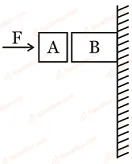
Figure for JEE Main 2015 Physics question on Friction in multi-block systems

Given in the figure are two blocks A and B of weight 20 N and 100 N, respectively. These are being pressed against a wall by a force F and kept in equilibrium as shown. If the coefficient of friction between the blocks is 0.1 and between block B and the wall is 0.15, the frictional force applied by the wall on block B is:

  1. A

    150 N

  2. B

    100 N

  3. C

    80 N

  4. D

    120 N

JEE MAIN 2014 · 19 APR ONLINEStatic and kinetic friction

A heavy box is to be dragged along a rough horizontal floor. To do so, the person A pushes it at an angle 30° from the horizontal and requires a minimum force FAF_A, while the person B pulls the box at an angle 60° from the horizontal and needs minimum force FBF_B. If the coefficient of friction between the box and the floor is 35\frac{\sqrt{3}}{5}, the ratio FAFB\frac{F_A}{F_B} is:

  1. A

    32\sqrt{\frac{3}{2}}

  2. B

    23\frac{2}{\sqrt{3}}

  3. C

    3\sqrt{3}

  4. D

    53\frac{5}{\sqrt{3}}

JEE MAIN 2014 · 11 APR ONLINENewton's laws, free-body diagrams and equilibrium of a particle

A body of mass 5 kg under the action of constant force F⃗=Fxi^+Fyj^\vec{F} = F_x\hat{i} + F_y\hat{j} has velocity at t = 0 s as v⃗=(6i^−2j^)\vec{v} = (6\hat{i} - 2\hat{j}) m/s and at t = 10 s as v⃗=+6j^\vec{v} = +6\hat{j} m/s. The force F⃗\vec{F} is:

  1. A

    (−3i^+4j^)(-3\hat{i} + 4\hat{j}) N

  2. B

    (−35i^+45j^)\left(-\frac{3}{5}\hat{i} + \frac{4}{5}\hat{j}\right) N

  3. C

    (3i^−4j^)(3\hat{i} - 4\hat{j}) N

  4. D

    (35i^−45j^)\left(\frac{3}{5}\hat{i} - \frac{4}{5}\hat{j}\right) N

JEE MAIN 2014 · 09 APR ONLINENewton's laws, free-body diagrams and equilibrium of a particle

Water is flowing at a speed of 1.5 m s−1^{-1} through a horizontal tube of cross-sectional area 10−210^{-2} m2^2 and you are trying to stop the flow by your palm. Assuming that the water stops immediately after hitting the palm, the minimum force that you must exert should be (density of water = 10310^3 kg m−3^{-3})

  1. A

    33.7 N

  2. B

    45 N

  3. C

    15 N

  4. D

    22.5 N

JEE MAIN 2014 · 09 APR ONLINEFriction in multi-block systems

A block A of mass 4 kg is placed on another block B of mass 5 kg, and the block B rests on a smooth horizontal table. If the minimum force that can be applied on A so that both the blocks move together is 12 N, the maximum force that can be applied on B for the blocks to move together will be:

  1. A

    0 N

  2. B

    25 N

  3. C

    48 N

  4. D

    27 N

JEE MAIN 2014 · 06 APR OFFLINEStatic and kinetic friction

A block of mass mm is placed on a surface with a vertical cross section given by y=x36y = \frac{x^3}{6}. If the coefficient of friction is 0.5, the maximum height above the ground at which the block can be placed without slipping is:

  1. A

    16\frac{1}{6} m

  2. B

    23\frac{2}{3} m

  3. C

    13\frac{1}{3} m

  4. D

    12\frac{1}{2} m

JEE MAIN 2013 · 25 APR ONLINEStatic and kinetic friction

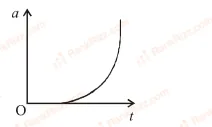
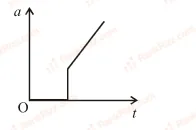
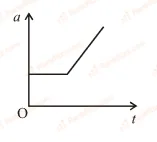
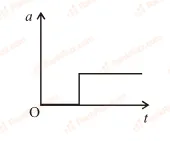
A block is placed on a rough horizontal plane. A time dependent horizontal force F=ktF = kt acts on the block, where k is a positive constant. The acceleration - time graph of the block is :

  1. A
    Figure for JEE Main 2013 Physics question on Static and kinetic friction
  2. B
    Figure for JEE Main 2013 Physics question on Static and kinetic friction
  3. C
    Figure for JEE Main 2013 Physics question on Static and kinetic friction
  4. D
    Figure for JEE Main 2013 Physics question on Static and kinetic friction
JEE MAIN 2013 · 25 APR ONLINEConnected bodies, pulleys and constraint relations

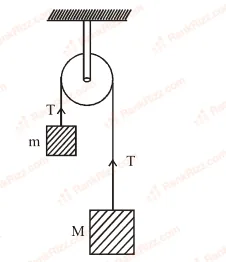
Two blocks of masses m and M are connected by means of a metal wire of cross-sectional area A passing over a frictionless fixed pulley as shown in the figure. The system is then released. If M = 2m, then the stress produced in the wire is:

Figure for JEE Main 2013 Physics question on Connected bodies, pulleys and constraint relations
  1. A

    2mg3A\frac{2mg}{3A}

  2. B

    4mg3A\frac{4mg}{3A}

  3. C

    mgA\frac{mg}{A}

  4. D

    3mg4A\frac{3mg}{4A}

JEE MAIN 2013 · 22 APR ONLINEConnected bodies, pulleys and constraint relations

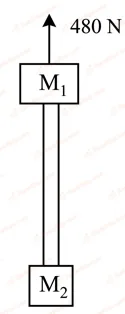
Two blocks of mass M1=20M_1 = 20 kg and M2=12M_2 = 12 kg are connected by a metal rod of mass 8 kg. The system is pulled vertically up by applying a force of 480 N as shown. The tension at the mid-point of the rod is:

Figure for JEE Main 2013 Physics question on Connected bodies, pulleys and constraint relations
  1. A

    144 N

  2. B

    96 N

  3. C

    240 N

  4. D

    192 N

JEE MAIN 2013 · 22 APR ONLINEStatic and kinetic friction

A body starts from rest on a long inclined plane of slope 45°. The coefficient of friction between the body and the plane varies as μ=0.3x\mu = 0.3x, where x is distance travelled down the plane. The body will have maximum speed (for g=10g = 10 m/s2^2) when xx =

  1. A

    9.8 m

  2. B

    27 m

  3. C

    12 m

  4. D

    3.33 m

JEE MAIN 2013 · 09 APR ONLINENewton's laws, free-body diagrams and equilibrium of a particle

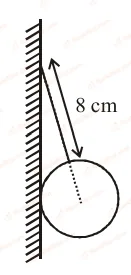
A uniform sphere of weight W and radius 5 cm is being held by a string as shown in the figure. The tension in the string will be :

Figure for JEE Main 2013 Physics question on Newton's laws, free-body diagrams and equilibrium of a particle
  1. A

    12W512\frac{W}{5}

  2. B

    5W125\frac{W}{12}

  3. C

    13W513\frac{W}{5}

  4. D

    13W1213\frac{W}{12}

JEE MAIN 2012Newton's laws, free-body diagrams and equilibrium of a particle

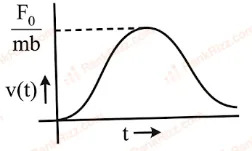
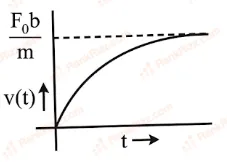
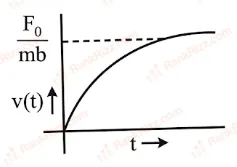
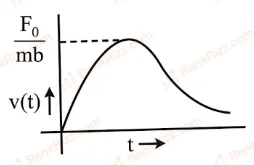
A particle of mass mm is at rest at the origin at time t=0t=0. It is subjected to a force F(t)=F0e−btF(t) = F_0 e^{-bt} in the xx direction. Its speed v(t)v(t) is depicted by which of the following curves?

  1. A
    Figure for JEE Main 2012 Physics question on Newton's laws, free-body diagrams and equilibrium of a particle
  2. B
    Figure for JEE Main 2012 Physics question on Newton's laws, free-body diagrams and equilibrium of a particle
  3. C
    Figure for JEE Main 2012 Physics question on Newton's laws, free-body diagrams and equilibrium of a particle
  4. D
    Figure for JEE Main 2012 Physics question on Newton's laws, free-body diagrams and equilibrium of a particle
JEE MAIN 2012Newton's laws, free-body diagrams and equilibrium of a particle

A car of mass 1000 kg is moving at a speed of 30 m/s30\ \text{m/s}. Brakes are applied to bring the car to rest. If the net retarding force is 5000 N5000\ \text{N}, the car comes to stop after travelling dd m in tt s. Then

  1. A

    d=150,t=5d = 150, t = 5

  2. B

    d=120,t=8d = 120, t = 8

  3. C

    d=180,t=6d = 180, t = 6

  4. D

    d=90,t=6d = 90, t = 6

JEE MAIN 2012Newton's laws, free-body diagrams and equilibrium of a particle

This question has Statement 1 and Statement 2. Of the four choices given after the Statements, choose the one that best describes the two Statements. 

Statement 1: If you push on a cart being pulled by a horse so that it does not move, the cart pushes you back with an equal and opposite force.

Statement 2: The cart does not move because the force described in statement 1 cancel each other.

  1. A

    Statement 1 is true, Statement 2 is true, Statement 2 is the correct explanation of Statement 1.

  2. B

    Statement 1 is false, Statement 2 is true.

  3. C

    Statement 1 is true, Statement 2 is false.

  4. D

    Statement 1 is true, Statement 2 is true, Statement 2 is not the correct explanation of Statement 1.

JEE MAIN 2012Static and kinetic friction

A block of weight WW rests on a horizontal floor with coefficient of static friction μ\mu. It is desired to make the block move by applying minimum amount of force. The angle θ\theta from the horizontal at which the force should be applied and magnitude of the force FF are respectively.

  1. A

    θ=tan⁡−1(μ), F=μW1+μ2\theta = \tan^{-1}(\mu),\ F = \frac{\mu W}{\sqrt{1+\mu^2}}

  2. B

    θ=tan⁡−1(1μ), F=μW1+μ2\theta = \tan^{-1}\left(\frac{1}{\mu}\right),\ F = \frac{\mu W}{\sqrt{1+\mu^2}}

  3. C

    θ=0, F=μW\theta = 0,\ F = \mu W

  4. D

    θ=tan⁡−1(μ1+μ), F=μW1+μ\theta = \tan^{-1}\left(\frac{\mu}{1+\mu}\right),\ F = \frac{\mu W}{1+\mu}