JEE Main 2021 Physics question — Friction in multi-block systems
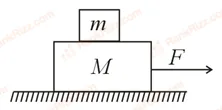
Two blocks ( kg and kg) are arranged on a horizontal frictionless table as shown in the figure. The coefficient of static friction between the two blocks is . Then the maximum horizontal force that can be applied on the larger block so that the blocks move together is . (Round off to the Nearest Integer) [Take as 9.8 m s]
SOLUTION
We need to determine the maximum horizontal force that can be applied to the larger block so that both blocks continue to move together without relative slipping.
1. Identify the System Parameters
From the layout shown on page, we have:
- Mass of the smaller top block () =
- Mass of the larger bottom block () =
- Coefficient of static friction between the blocks () =
- Acceleration due to gravity () =
2. Analyze the Maximum Acceleration of the Top Block
When the horizontal force is applied to the bottom block , the top block moves forward solely due to the static frictional force () acting between the two contact surfaces.
The maximum possible static frictional force that can act on block is:
According to Newton's second law, this maximum frictional force dictates the maximum acceleration () the top block can experience without slipping:
Substitute the given values into the acceleration equation:
3. Calculate the Maximum Applied Force ()
For both blocks to move together as a single combined system without relative motion, the entire system of mass () must accelerate at this maximum rate ():
Substitute the masses and the calculated acceleration into the formula:
Conclusion
The maximum horizontal force that can be applied so that the blocks move together is 21 N.
Topic: Friction in multi-block systems