RankRizz

Atoms & Nuclei — JEE Main Previous Year Questions

Every Atoms & Nuclei question JEE Main has set from 2004–2026, grouped by the idea it tests rather than the order of the syllabus. 304 questions across 7 distinct ideas. Free to read, answer key on every one.

DATA UPDATED

Questions

304

Distinct ideas

7

Share of marks

4.8%

Difficulty

EASY

The ideas inside Atoms & Nuclei

A chapter is not one subject — it is a handful of procedures the examiner reuses. These are the ones Atoms & Nuclei questions actually test.

Every Atoms & Nuclei question

181–200 OF 304 · NEWEST FIRST

JEE MAIN 2021 · 20 JUL S1Radioactivity: decay law, half-life and decay modes

A radioactive material decays by simultaneous emissions of two particles with half lives of 1400 years and 700 years, respectively. What will be the time after the which one third of the material remains? (Take ln 3 = 1.1)

  1. A

    1110 years

  2. B

    700 years

  3. C

    340 years

  4. D

    740 years

JEE MAIN 2021 · 20 JUL S1Nuclear size, mass defect and binding energy

A nucleus of mass MM emits γ\gamma-ray photon of frequency ν\nu. The loss of internal energy by the nucleus is: [Take cc as the speed of electromagnetic wave]

  1. A

    hνh\nu

  2. B

    0

  3. C

    hν[1−hν2Mc2]h\nu\left[1 - \frac{h\nu}{2Mc^2}\right]

  4. D

    hν[1+hν2Mc2]h\nu\left[1 + \frac{h\nu}{2Mc^2}\right]

JEE MAIN 2021 · 20 JUL S2Radioactivity: decay law, half-life and decay modes

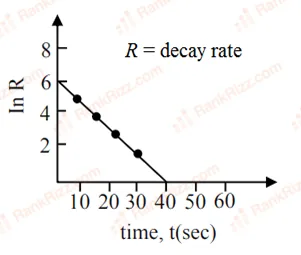
For a certain radioactive process, the graph between ln R and tt(sec) is obtained as shown in the figure. Then the value of half life for the unknown radioactive material is approximately:

Figure for JEE Main 2021 Physics question on Radioactivity: decay law, half-life and decay modes
  1. A

    9.15 sec

  2. B

    6.93 sec

  3. C

    2.62 sec

  4. D

    4.62 sec

JEE MAIN 2021 · 20 JUL S2Radioactivity: decay law, half-life and decay modes

A radioactive substance decays to (116)th\left(\frac{1}{16}\right)^{th} of its initial activity in 80 days. The half life of the radioactive substance expressed in days is ___.

JEE MAIN 2021 · 18 MAR S2Radioactivity: decay law, half-life and decay modes

The decay of a proton to neutron is :

  1. A

    not possible as proton mass is less than the neutron mass

  2. B

    possible only inside the nucleus

  3. C

    not possible but neutron to proton conversion is possible

  4. D

    always possible as it is associated only with β+\beta^+ decay

JEE MAIN 2021 · 17 MAR S1Hydrogen spectrum and spectral series

If an electron is moving in the nthn^{th} orbit of the hydrogen atom, then its velocity (vnv_n) for the nthn^{th} orbit is given as:

  1. A

    vn∝nv_n \propto n

  2. B

    vn∝1nv_n \propto \frac{1}{n}

  3. C

    vn∝n2v_n \propto n^2

  4. D

    vn∝1n2v_n \propto \frac{1}{n^2}

JEE MAIN 2021 · 17 MAR S1Hydrogen spectrum and spectral series

Which level of the single ionized carbon has the same energy as the ground state energy of hydrogen atom?

  1. A

    1

  2. B

    6

  3. C

    4

  4. D

    8

JEE MAIN 2021 · 17 MAR S2Hydrogen spectrum and spectral series

The atomic hydrogen emits a line spectrum consisting of various series. Which series of hydrogen atomic spectra is lying in the visible region?

  1. A

    Brackett series

  2. B

    Paschen series

  3. C

    Lyman series

  4. D

    Balmer series

JEE MAIN 2021 · 17 MAR S2Hydrogen spectrum and spectral series

A particle of mass mm moves in a circular orbit in a central potential field U(r)=U0r4U(r) = U_0 r^4. If Bohr's quantization conditions are applied, radii of possible orbitals rnr_n vary with n1/αn^{1/\alpha}, where α\alpha is ________.

JEE MAIN 2021 · 16 MAR S1Hydrogen spectrum and spectral series

The first three spectral lines of H-atom in the Balmer series are given λ1,λ2,λ3\lambda_1, \lambda_2, \lambda_3 considering the Bohr atomic model, the wave lengths of first and third spectral lines (λ1λ3)\left(\frac{\lambda_1}{\lambda_3}\right) are related by a factor of approximately x×10−1x \times 10^{-1}. The value of xx, to the nearest integer, is ________.

JEE MAIN 2021 · 16 MAR S2Radioactivity: decay law, half-life and decay modes

The half-life of Au198Au^{198} is 2.7 days. The activity of 1.50 mg of Au198Au^{198}, if its atomic weight is 198 g mol−1^{-1} is, (NA=6×10²³N_A = 6 \times 10^{23} mol−1^{-1})

  1. A

    240 Ci

  2. B

    357 Ci

  3. C

    535 Ci

  4. D

    252 Ci

JEE MAIN 2021 · 16 MAR S2Radioactivity: decay law, half-life and decay modes

Calculate the time interval between 33% decay and 67% decay if half-life of a substance is 20 min.

  1. A

    60 min

  2. B

    20 min

  3. C

    40 min

  4. D

    13 min

JEE MAIN 2021 · 26 FEB S2Radioactivity: decay law, half-life and decay modes

A radioactive sample is undergoing α\alpha decay. At any time t1t_1, its activity is AA and another time t2t_2, the activity is A5\frac{A}{5}. What is the average life time for the sample?

  1. A

    ln⁡5t2−t1\frac{\ln 5}{t_2 - t_1}

  2. B

    ln⁡(t2+t1)2\frac{\ln(t_2 + t_1)}{2}

  3. C

    t2−t1ln⁡5\frac{t_2 - t_1}{\ln 5}

  4. D

    t1−t2ln⁡5\frac{t_1 - t_2}{\ln 5}

JEE MAIN 2021 · 25 FEB S1Radioactivity: decay law, half-life and decay modes

Two radioactive substances XX and YY originally have N1N_1 and N2N_2 nuclei respectively. Half life of XX is half of the half life of YY. After three half lives of YY, number of nuclei of both are equal. The ratio N1N2\frac{N_1}{N_2} will be equal to:

  1. A

    13\frac{1}{3}

  2. B

    81\frac{8}{1}

  3. C

    31\frac{3}{1}

  4. D

    18\frac{1}{8}

JEE MAIN 2021 · 25 FEB S2Hydrogen spectrum and spectral series

The wavelength of the photon emitted by a hydrogen atom when an electron makes a transition from n=2n = 2 to n=1n = 1 state is:

  1. A

    121.8 nm

  2. B

    194.8 nm

  3. C

    490.7 nm

  4. D

    913.3 nm

JEE MAIN 2021 · 24 FEB S1Hydrogen spectrum and spectral series

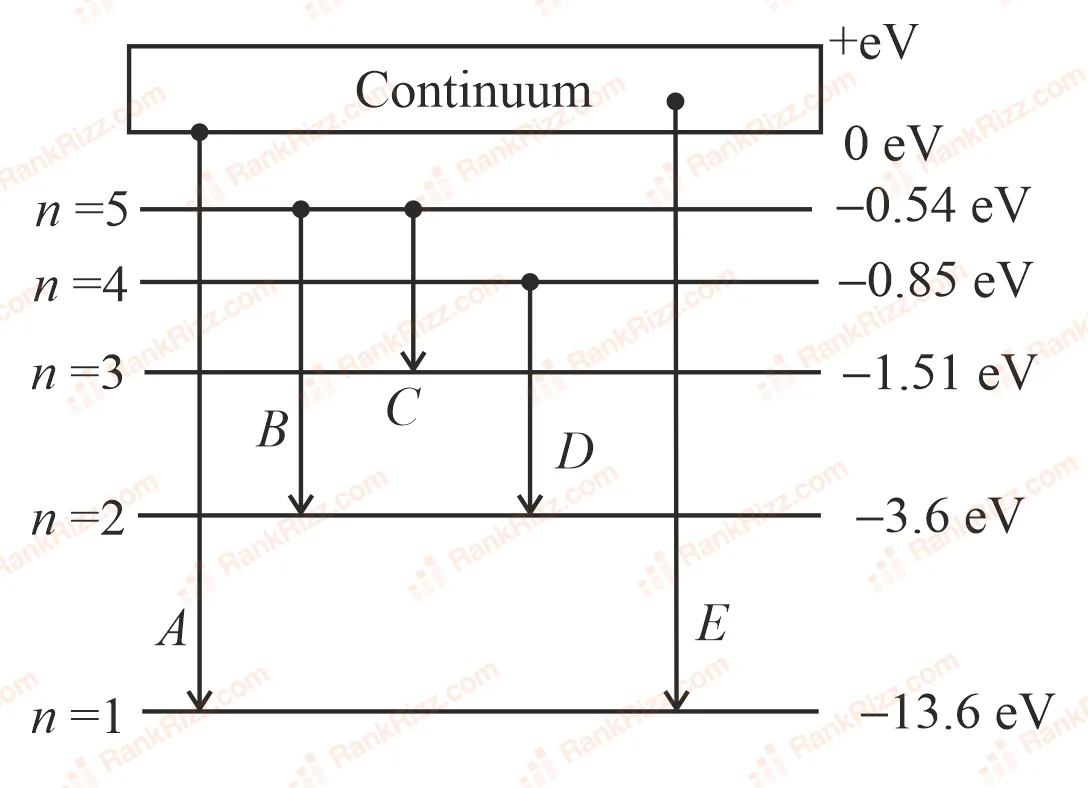
In the given figure, the energy levels of hydrogen atom have been shown along with some transitions marked A, B, C, D and E. The transitions A, B and C respectively represent

Figure for JEE Main 2021 Physics question on Hydrogen spectrum and spectral series
  1. A

    The ionization potential of hydrogen, second member of Balmer series and third member of Paschen series.

  2. B

    The series limit of Lyman series, second member of Balmer series and second member of Paschen series.

  3. C

    The series limit of Lyman series, third member of Balmer series and second member of Paschen series.

  4. D

    The first member of the Lyman series, third member of Balmer series and second member of Paschen series.

JEE MAIN 2021 · 24 FEB S2Hydrogen spectrum and spectral series

According to Bohr atom model, in which of the following transitions will the frequency be maximum?

  1. A

    n=3n = 3 to n=2n = 2

  2. B

    n=5n = 5 to n=4n = 4

  3. C

    n=4n = 4 to n=3n = 3

  4. D

    n=2n = 2 to n=1n = 1

JEE MAIN 2020 · 06 SEP S1Nuclear size, mass defect and binding energy

You are given that 37Li=7.0160 u^7_3\text{Li} = 7.0160\,\text{u}, Mass of 24He=4.0026 u^4_2\text{He} = 4.0026\,\text{u} and Mass of 11He=1.0079 H^1_1\text{He} = 1.0079\,\text{H}. When 20 g20\,\text{g} of 37Li^7_3\text{Li} is converted into 24He^4_2\text{He} by proton capture, the energy liberated, (in kWh), is: [Mass of nucleon =1 GeV/c2= 1\,\text{GeV}/c^2]

  1. A

    4.5×1054.5 \times 10^5

  2. B

    8×1068 \times 10^6

  3. C

    6.82×1056.82 \times 10^5

  4. D

    1.33×1061.33 \times 10^6

JEE MAIN 2020 · 06 SEP S2Radioactivity: decay law, half-life and decay modes

Given the masses of various atomic particles mP=1.0072 um_P = 1.0072\,\text{u}, mn=1.0087 um_n = 1.0087\,\text{u}, me=0.000548 um_e = 0.000548\,\text{u}, mvˉ=0m_{\bar{v}} = 0, md=2.0141 um_d = 2.0141\,\text{u}, where p = proton, n = neutron, e = electron, vˉ\bar{v} = antineutrino and d = deuteron. Which of the following process is allowed by momentum and energy conservation:

  1. A

    n+n→n + n \to deuterium atom (electron bound to the nucleus)

  2. B

    p→n+e++vˉp \to n + e^+ + \bar{v}

  3. C

    n+p→d+γn + p \to d + \gamma

  4. D

    e++e−→γe^+ + e^- \to \gamma

JEE MAIN 2020 · 05 SEP S1Radioactivity: decay law, half-life and decay modes

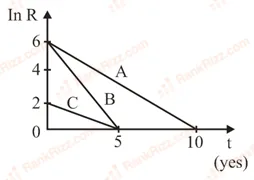
Activities of three radioactive substances AA, BB and CC are represented by the curves AA, BB and CC, in the figure. Then their half-lives T1/2(A):T1/2(B):T1/2(C)T_{1/2}(A) : T_{1/2}(B) : T_{1/2}(C) are in the ratio:

Figure for JEE Main 2020 Physics question on Radioactivity: decay law, half-life and decay modes
  1. A

    2:1:12 : 1 : 1

  2. B

    3:2:13 : 2 : 1

  3. C

    2:1:32 : 1 : 3

  4. D

    4:3:14 : 3 : 1