JEE MAIN 2026 · 22 JAN S2Hydrogen spectrum and spectral series
The smallest wavelength of Lyman series is 91 nm. The difference between the largest wavelengths of Paschen and Balmer series is nearly __ nm.
- A
1784
- B
1550
- C
1875
- D
1217
Every Atoms & Nuclei question JEE Main has set from 2004–2026, grouped by the idea it tests rather than the order of the syllabus. 304 questions across 7 distinct ideas. Free to read, answer key on every one.
DATA UPDATED
Questions
304
Distinct ideas
7
Share of marks
4.8%
Difficulty
EASY
A chapter is not one subject — it is a handful of procedures the examiner reuses. These are the ones Atoms & Nuclei questions actually test.
21–40 OF 304 · NEWEST FIRST
The smallest wavelength of Lyman series is 91 nm. The difference between the largest wavelengths of Paschen and Balmer series is nearly __ nm.
1784
1550
1875
1217
If an alpha particle with energy 7.7 MeV is bombarded on a thin gold foil, the closest distance from nucleus it can reach is ___ m. (Atomic number of gold = 79 and
The energy of an electron in an orbit of the Bohr's atom is where is the ground state energy. lf L is the angular momentum of the electron in this orbit and h is the Planck's constant, then is __________:
2
4
5
6
The activity of a radioactive sample decreases to one tenth of the original activity in a period of one year. After 9 more years its activity would be
For a nucleus of mass number A and radius R, the mass density of nucleus can be represented as
Independent of A
In a hydrogen like ion, the energy difference between the 2nd excitation energy state and ground state is 108.8 eV. The atomic number of the ion is
4
2
1
3
For a hydrogen atom, the ratio of the largest wavelength of Lyman series to that of the Balmer series is
5 : 36
5 : 27
3 : 4
27 : 5
Given below are two statements : one is labelled as Assertion (A) and the other is labelled as Reason (R).
Assertion (A) : The density of the copper nucleus is greater than that of the carbon nucleus.
Reason (R) : The nucleus of mass number A has a radius proportional to .
In the light of the above statements, choose the most appropriate answer from the options given below :
(A) is correct but (R) is not correct
(A) is not correct but (R) is correct
Both (A) and (R) are correct and (R) is the correct explanation of (A)
Both (A) and (R) are correct but (R) is not the correct explanation of (A)
Considering the Bohr model of hydrogen like atoms, the ratio of the radius orbit of the electron in and is
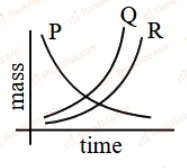
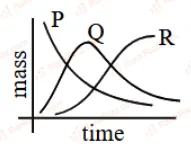
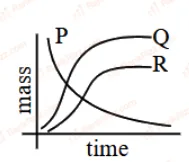
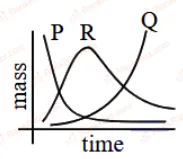
A radioactive material P first decays into Q and then Q decays to non-radioactive material R. Which of the following figure represents time dependent mass of P, Q and R?
Given below are two statements :
Statement (I) : The dimensions of Planck's constant and angular momentum are same.
Statement (II) : In Bohr's model electron revolve around the nucleus only in those orbits for which angular momentum is integral multiple of Planck's constant.
In the light of the above statements, choose the most appropriate answer from the options given below :
Both Statement I and Statement II are correct
Statement I is incorrect but Statement II is correct
Statement I is correct but Statement II is incorrect
Both Statement I and Statement II are incorrect
Match the LIST-I with LIST-II.
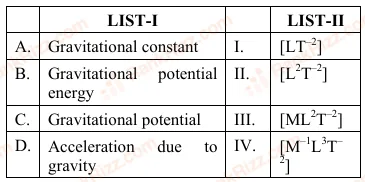
Choose the correct answer from the options given below :
A-IV, B-III, C-II, D-I
A-III, B-II, C-I, D-IV
A-II, B-IV, C-III, D-I
A-I, B-III, C-IV, D-II
Given below are two statements: one is labelled as Assertion A and the other is labelled as Reason R.
Assertion A: The Bohr model is applicable to hydrogen and hydrogen-like atoms only.
Reason R: The formulation of Bohr model does not include repulsive force between electrons.
In the light of the above statements, choose the correct answer from the options given below:
Both A and R are true but R is NOT the correct explanation of A.
A is false but R is true.
Both A and R are true and R is the correct explanation of A.
A is true but R is false.
An electron in the hydrogen atom initially in the fourth excited state makes a transition to energy state by emitting a photon of energy 2.86 eV. The integer value of n will be ________.
Considering Bohr's atomic model for hydrogen atom:
(A) the energy of H atom in ground state is same as energy of He ion in its first excited state.
(B) the energy of H atom in ground state is same as that for Li ion in its second excited state.
(C) the energy of H atom in ground state is same as that of He ion for its ground state.
(D) the energy of He ion in its first excited state is same as that for Li ion in its ground state.
Choose the correct answer from the options below:
(B), (D) only
(A), (B) only
(A), (D) only
(A), (C) only
Assuming the validity of Bohr's atomic model for hydrogen like ions the radius of ion in its ground state is given by , where ________. (Where is the first Bohr's radius.)
Energy released when two deuterons fuse to form a helium nucleus is :
(Given : Binding energy per nucleon of MeV and binding energy per nucleon of MeV)
MeV
MeV
MeV
MeV
The number of spectral lines emitted by atomic hydrogen that is in the energy level, is
3
1
6
0
Choose the correct nuclear process from the below options [p: proton, n : neutron, :electron, : positron, : neutrino, : antineutrino]
The frequency of revolution of the electron in Bohr's orbit varies with , the principal quantum number as
JEE Advanced has set 53 Atoms & Nuclei questions too. Atoms & Nuclei JEE Advanced PYQs →
OTHER PHYSICS CHAPTERS