RankRizz

Bohr model of hydrogen-like atoms — JEE Main Previous Year Questions

Bohr model of hydrogen-like atoms has been asked 13 times in JEE Main, in 9 different years between 2008 and 2025, and in 4 of the last five exam years (2022–2026), 5 questions in all. That is 4% of Atoms & Nuclei. Last asked in JEE Main 04 Apr 2025, Shift 2. 11 are multiple choice and 2 numerical-value; 4 easy and 2 medium by our difficulty labels. All of them are below, newest first, free to read.

Questions

13

Years asked

9

Since

2008

Of the chapter

4%

When JEE Main asked it

Questions on Bohr model of hydrogen-like atoms in every year it was asked, newest first.

JEE Main questions on Bohr model of hydrogen-like atoms by year, 2008–2025
YearRelative frequencyQuestions
20251
20242
20231
20221
20211
20182
20123
20111
20081
Total13

Every Bohr model of hydrogen-like atoms question

1–13 OF 13 · NEWEST FIRST

JEE MAIN 2025 · 04 APR S2Bohr model of hydrogen-like atoms

Given below are two statements :
Statement (I) : The dimensions of Planck's constant and angular momentum are same.
Statement (II) : In Bohr's model electron revolve around the nucleus only in those orbits for which angular momentum is integral multiple of Planck's constant.
In the light of the above statements, choose the most appropriate answer from the options given below :

  1. A

    Both Statement I and Statement II are correct

  2. B

    Statement I is incorrect but Statement II is correct

  3. C

    Statement I is correct but Statement II is incorrect

  4. D

    Both Statement I and Statement II are incorrect
JEE MAIN 2024 · 05 APR S1Bohr model of hydrogen-like atoms

An electron rotates in a circle around a nucleus having positive charge ZeZe. Correct relation between total energy (E)(E) of electron to its potential energy (U)(U) is :

  1. A

    E=UE = U

  2. B

    2E=U2E = U

  3. C

    2E=3U2E = 3U

  4. D

    E=2UE = 2U

JEE MAIN 2024 · 27 JAN S1Bohr model of hydrogen-like atoms

The radius of third stationary orbit of electron for Bohr's atom is RR. The radius of fourth stationary orbit will be:

  1. A

    43R\frac{4}{3}R

  2. B

    169R\frac{16}{9}R

  3. C

    34R\frac{3}{4}R

  4. D

    916R\frac{9}{16}R

JEE MAIN 2023 · 06 APR S2Bohr model of hydrogen-like atoms

Experimentally it is found that 12.8 eV energy is required to separate a hydrogen atom into a proton and an electron. So the orbital radius of the electron in a hydrogen atom is 9x×10−10\dfrac{9}{x} \times 10^{-10} m. The value of the xx is ______.
(1 eV = 1.6×10−191.6 \times 10^{-19} J, 14πε0=9×10⁹\dfrac{1}{4\pi\varepsilon_0} = 9 \times 10^9 Nm2C2\dfrac{Nm^2}{C^2} and electronic charge = 1.6×10−191.6 \times 10^{-19} C)

JEE MAIN 2022 · 25 JUL S1Bohr model of hydrogen-like atoms

The magnetic moment of an electron (ee) revolving in an orbit around nucleus with an orbital angular momentum is given by

  1. A

    μ⃗L=eL⃗2m\vec{\mu}_L = \dfrac{e\vec{L}}{2m}

  2. B

    μ⃗L=−eL⃗2m\vec{\mu}_L = -\dfrac{e\vec{L}}{2m}

  3. C

    μ⃗L=−eL⃗m\vec{\mu}_L = -\dfrac{e\vec{L}}{m}

  4. D

    μ⃗L=2eL⃗m\vec{\mu}_L = \dfrac{2e\vec{L}}{m}

JEE MAIN 2021 · 27 JUL S1Bohr model of hydrogen-like atoms

In Bohr's atomic model, the electron is assumed to revolve in a circular orbit of radius 0.5 A˚\mathring{A}. If the speed of electron is 2.2×1062.2 \times 10^6 m s−1^{-1}. Then the current associated with the electron will be _________ ×10−2\times 10^{-2} mA. [Take π\pi as 227\frac{22}{7}]

JEE MAIN 2018 · 08 APR OFFLINEBohr model of hydrogen-like atoms

An electron from various excited states of hydrogen atom emit radiation to come to the ground state. Let λn\lambda_n, λg\lambda_g be the de Broglie wavelength of the electron in the nthn^{th} state and the ground state respectively. Let Λn\Lambda_n be the wavelength of the emitted photon in the transition from the nthn^{th} state to the ground state. For large n, (A, B are constants)

  1. A

    Λn2≈λ\Lambda_n^2 \approx \lambda

  2. B

    Λn≈A+Bλn2\Lambda_n \approx A + \frac{B}{\lambda_n^2}

  3. C

    Λn≈A+Bλn\Lambda_n \approx A + B\lambda_n

  4. D

    Λn2≈A+Bλn2\Lambda_n^2 \approx A + B\lambda_n^2

JEE MAIN 2018 · 08 APR OFFLINEBohr model of hydrogen-like atoms

If the series limit frequency of the Lyman series is VLV_L, then the series limit frequency of the Pfund series is:

  1. A

    VL25\frac{V_L}{25}

  2. B

    25VL25 V_L

  3. C

    16VL16 V_L

  4. D

    VL16\frac{V_L}{16}

JEE MAIN 2012Bohr model of hydrogen-like atoms

A diatomic molecule is made of two masses m1m_1 and m2m_2 which are separated by a distance rr. If we calculate its rotational energy by applying Bohr's rule of angular momentum quantization, its energy will be given by (nn is an integer)

  1. A

    (m1+m2)2n2h22m12m22r2\frac{(m_1+m_2)^2 n^2 h^2}{2 m_1^2 m_2^2 r^2}

  2. B

    n2h22(m1+m2)r2\frac{n^2 h^2}{2(m_1+m_2)r^2}

  3. C

    2n2h2(m1+m2)r2\frac{2 n^2 h^2}{(m_1+m_2)r^2}

  4. D

    (m1+m2)n2h22m1m2r2\frac{(m_1+m_2) n^2 h^2}{2 m_1 m_2 r^2}

JEE MAIN 2012Bohr model of hydrogen-like atoms

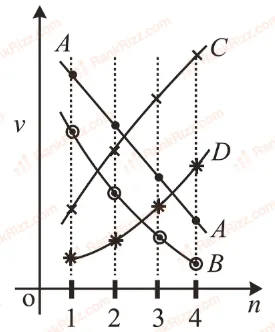
Which of the plots shown in the figure represents speed (vv) of the electron in a hydrogen atom as a function of the principal quantum number (nn)?

Figure for JEE Main 2012 Physics question on Bohr model of hydrogen-like atoms
  1. A

    BB

  2. B

    DD

  3. C

    CC

  4. D

    AA

JEE MAIN 2012Bohr model of hydrogen-like atoms

Ionisation energy of Li (Lithium) atom in ground state is 5.45.4eV. Binding energy of an electron in Li+^+ion in ground state is 75.675.6eV. Energy required to remove all three electrons of Lithium (Li) atom is

  1. A

    81.081.0eV

  2. B

    135.4135.4eV

  3. C

    203.4203.4eV

  4. D

    156.6156.6eV

JEE MAIN 2011Bohr model of hydrogen-like atoms

Energy required for the electron excitation in Li++\text{Li}^{++} from the first to the third Bohr orbit is:

  1. A

    36.3 eV36.3 \, \text{eV}

  2. B

    108.8 eV108.8 \, \text{eV}

  3. C

    122.4 eV122.4 \, \text{eV}

  4. D

    12.1 eV12.1 \, \text{eV}

JEE MAIN 2008Bohr model of hydrogen-like atoms

Suppose an electron is attracted towards the origin by a force k/rk/r where 'kk' is a constant and 'rr' is the distance of the electron from the origin. By applying Bohr model to this system, the radius of the nthn^{th} orbital of the electron is found to be 'rnr_n' and the kinetic energy of the electron to be TnT_n. Then which of the following is true?

  1. A

    Tn∝1/n2, rn∝n2T_n \propto 1/n^2,\ r_n \propto n^2

  2. B

    TnT_n independent of nn, rn∝nr_n \propto n

  3. C

    Tn∝1/n, rn∝nT_n \propto 1/n,\ r_n \propto n

  4. D

    Tn∝1/n, rn∝n2T_n \propto 1/n,\ r_n \propto n^2

Bohr model of hydrogen-like atoms: common questions

How many Bohr model of hydrogen-like atoms questions have come in JEE Main?
Bohr model of hydrogen-like atoms has been asked 13 times in JEE Main, in 9 different years between 2008 and 2025. It came up in 4 of the last five exam years (2022–2026), 5 questions in all.
Is Bohr model of hydrogen-like atoms important for JEE Main?
It is part of Atoms & Nuclei: 13 of the chapter's 304 JEE Main questions (4%). It came up in 4 of the last five exam years (2022–2026), 5 questions in all.
When was Bohr model of hydrogen-like atoms last asked in JEE Main?
Most recently in JEE Main 04 Apr 2025, Shift 2. Questions on this page are newest first, so the latest ones are at the top.
What kind of Bohr model of hydrogen-like atoms questions does JEE Main ask?
11 are multiple choice and 2 numerical-value; 4 easy and 2 medium by our difficulty labels. Each question shows its answer key and worked solution where we have them.