In a hydrogen spectrum be the wavelength of first transition line of Lyman series. The wavelength difference will be "" between the wavelength of transition line of Paschen series and that of transition line of Balmer Series where ______.
Every Atoms & Nuclei question JEE Main has set from 2004–2026, grouped by the idea it tests rather than the order of the syllabus. 304 questions across 7 distinct ideas. Free to read, answer key on every one.
DATA UPDATED
Questions
304
Distinct ideas
7
Share of marks
4.8%
Difficulty
EASY
A chapter is not one subject — it is a handful of procedures the examiner reuses. These are the ones Atoms & Nuclei questions actually test.
141–160 OF 304 · NEWEST FIRST
In a hydrogen spectrum be the wavelength of first transition line of Lyman series. The wavelength difference will be "" between the wavelength of transition line of Paschen series and that of transition line of Balmer Series where ______.
Mass numbers of two nuclei are in the ratio of . Their nuclear densities will be in the ratio of
Two lighter nuclei combine to form a comparatively heavier nucleus by the relation given below:
The binding energies per nucleon of and are and respectively. The energy released in this process is ______ MeV.
The magnetic moment of an electron () revolving in an orbit around nucleus with an orbital angular momentum is given by
The momentum of an electron revolving in orbit is given by: (Symbols have their usual meanings)
Hydrogen atom from excited state comes to the ground by emitting a photon of wavelength . The value of principal quantum number of the excited state will be: ( : Rydberg constant)
is the ratio of energies of photons produced due to transition of an electron of hydrogen atom from its (i) third permitted energy level to the second level and (ii) the highest permitted energy level to the second permitted level. The value of will be ______.
The activity of a radioactive material is Ci. If the half life of the material is 5 days, after how many days the activity will become Ci?
30 days
35 days
40 days
25 days
and are the impact parameters corresponding to scattering angles 60° and 90° respectively, when an particle is approaching a gold nucleus. For , the value of will be ______.
In the following nuclear reaction,
Mass number of is 182 and atomic number is 74. Mass number and atomic number of respectively will be
174 and 71
174 and 69
172 and 69
172 and 71
The half life of a radioactive substance is 5 years. After years a given sample of the radioactive substance gets reduced to 6.25% of its initial value. The value of is ______.
The -value of a nuclear reaction and kinetic energy of the projectile particle, are related as
Following statements related to radioactivity are given below:
(A) Radioactivity is a random and spontaneous process and is dependent on physical and chemical conditions.
(B) The number of undecayed nuclei in the radioactive sample decays exponentially with time.
(C) Slope of the graph of (no. of undecayed nuclei) vs. time represents the reciprocal of mean life time ().
(D) Product of decay constant () and half-life time is not constant.
Choose the most appropriate answer from the options given below:
(A) and (B) only
(B) and (D) only
(B) and (C) only
(C) and (D) only
A hydrogen atom in its ground state absorbs eV of energy. The angular momentum of electron of the hydrogen atom will increase by the value of (Given, Planck's constant Js).
Js
Js
Js
Js
A beam of monochromatic light is used to excite the electron in from the first orbit to the third orbit. The wavelength of monochromatic light is found to be m. The value of is ______.
[Given eV nm]
Given below are two statements
Statement I: In hydrogen atom, the frequency of radiation emitted when an electron jumps from lower energy orbit () to higher energy orbit (), is given as
Statement II: The jumping of electron from higher energy orbit () to lower energy orbit () is associated with frequency of radiation given as . This condition is Bohr's frequency condition.
In the light of the above statements, choose the correct answer from the options given below:
Both statement I and statement II are true.
Both statement I and statement II are false.
Statement I is correct but statement II is false.
Statement I is incorrect but statement II is true.
How many alpha and beta particles are emitted when Uranium decays to lead ?
3 alpha particles and 5 beta particles
6 alpha particles and 4 beta particles
4 alpha particles and 5 beta particles
8 alpha particles and 6 beta particles
A radioactive nucleus can decay by two different processes. Half-life for the first process is hours while it is hours for the second process. The effective halflife of the nucleus will be
hours
hours
hours
hours
The ratio for the speed of the electron in the orbit of to the speed of the electron in the orbit of hydrogen atom will be :
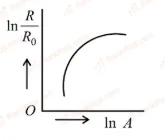
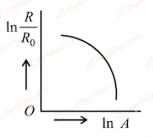
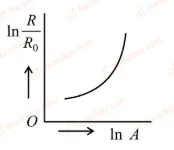
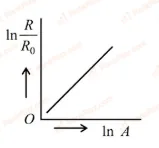
Which of the following figure represents the variation of with (if = radius of a nucleus and = its mass number)?


JEE Advanced has set 53 Atoms & Nuclei questions too. Atoms & Nuclei JEE Advanced PYQs →
OTHER PHYSICS CHAPTERS