RankRizz

Atoms & Nuclei — JEE Main Previous Year Questions

Every Atoms & Nuclei question JEE Main has set from 2004–2026, grouped by the idea it tests rather than the order of the syllabus. 304 questions across 7 distinct ideas. Free to read, answer key on every one.

DATA UPDATED

Questions

304

Distinct ideas

7

Share of marks

4.8%

Difficulty

EASY

The ideas inside Atoms & Nuclei

A chapter is not one subject — it is a handful of procedures the examiner reuses. These are the ones Atoms & Nuclei questions actually test.

Every Atoms & Nuclei question

161–180 OF 304 · NEWEST FIRST

JEE MAIN 2022 · 24 JUN S1Alpha-particle scattering and Rutherford model

Choose the correct option from the following options given below :

  1. A

    In the ground state of Rutherford's model electrons are in stable equilibrium. While in Thomson's model electrons always experience a net-force.

  2. B

    An atom has a nearly continuous mass distribution in a Rutherford's model but has a highly non-uniform mass distribution in Thomson's model

  3. C

    A classical atom based on Rutherford's model is doomed to collapse.

  4. D

    The positively charged part of the atom possesses most of the mass in Rutherford's model but not in Thomson's model.
JEE MAIN 2022 · 24 JUN S1Nuclear size, mass defect and binding energy

Nucleus AA is having mass number 220220 and its binding energy per nucleon is 5.65.6 MeV. It splits in two fragments BB and CC of mass numbers 105105 and 115115. The binding energy of nucleons in BB and CC is 6.46.4 MeV per nucleon. The energy QQ released per fission will be:

  1. A

    0.8 MeV

  2. B

    275 MeV

  3. C

    220 MeV

  4. D

    176 MeV

JEE MAIN 2022 · 24 JUN S2Hydrogen spectrum and spectral series

In Bohr's atomic model of hydrogen, let KK, PP and EE are the kinetic energy, potential energy and total energy of the electron respectively. Choose the correct option when the electron undergoes transitions to a higher level :

  1. A

    All KK, PP and EE increase.

  2. B

    KK decreases, PP and EE increase.

  3. C

    PP decreases, KK and EE increase.

  4. D

    KK increases, PP and EE decrease

JEE MAIN 2022 · 24 JUN S2Radioactivity: decay law, half-life and decay modes

A sample contains 10−210^{-2} kg each of two substances AA and BB with half lives 44 s and 88 s respectively. The ratio of their atomic weights is 1:21 : 2. The ratio of the amounts of AA and BB after 1616 s is x100\frac{x}{100}. The value of xx is ______.

JEE MAIN 2021 · 01 SEP S2Radioactivity: decay law, half-life and decay modes

The half life period of a radioactive element xx is same as the mean life time of another radioactive element yy. Initially they have the same number of atoms. Then:

  1. A

    xx and yy decay at the same rate always.

  2. B

    xx-will decay faster than yy.

  3. C

    yy-will decay faster than xx.

  4. D

    xx and yy have same decay rate initially and later on different decay rate.

JEE MAIN 2021 · 31 AUG S1Radioactivity: decay law, half-life and decay modes

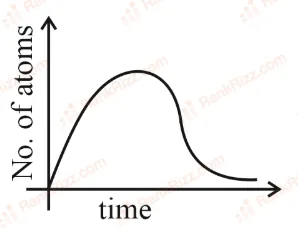
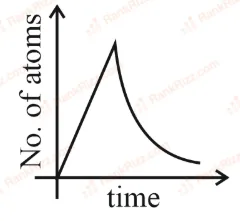
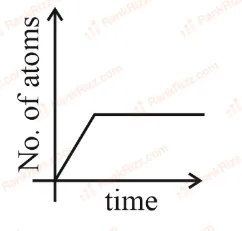
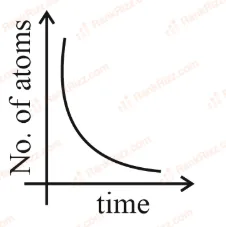
A sample of a radioactive nucleus AA disintegrates to another radioactive nucleus BB, which in turn disintegrates to some other stable nucleus CC. Plot of a graph showing the variation of number of atoms of nucleus BB versus time is: (Assume that at t=0t = 0, there are no BB atoms in the sample)

  1. A
    Figure for JEE Main 2021 Physics question on Radioactivity: decay law, half-life and decay modes
  2. B
    Figure for JEE Main 2021 Physics question on Radioactivity: decay law, half-life and decay modes
  3. C
    Figure for JEE Main 2021 Physics question on Radioactivity: decay law, half-life and decay modes
  4. D
    Figure for JEE Main 2021 Physics question on Radioactivity: decay law, half-life and decay modes
JEE MAIN 2021 · 27 AUG S1Radioactivity: decay law, half-life and decay modes

There are 101010^{10} radioactive nuclei in a given radioactive element. Its half-life time is 1 min. How many nuclei will remain after 30 s? (2=1.414)(\sqrt{2} = 1.414)

  1. A

    7×1097 \times 10^9

  2. B

    10510^5

  3. C

    2×10102 \times 10^{10}

  4. D

    4×10104 \times 10^{10}

JEE MAIN 2021 · 27 AUG S2Hydrogen spectrum and spectral series

XX different wavelength may be observed in the spectrum from a hydrogen sample if the atoms are excited to states with principal quantum number n=6n = 6? The value of XX is _________.

JEE MAIN 2021 · 26 AUG S1Hydrogen spectrum and spectral series

A particular hydrogen like ion emits radiation of frequency 2.92×10152.92 \times 10^{15} Hz when it makes transition from n = 3 to n = 1. The frequency in Hz of radiation emitted in transition from n = 2 to n = 1 will be:

  1. A

    6.57×10156.57 \times 10^{15}

  2. B

    2.46×10152.46 \times 10^{15}

  3. C

    0.44×10150.44 \times 10^{15}

  4. D

    4.38×10154.38 \times 10^{15}

JEE MAIN 2021 · 26 AUG S2Radioactivity: decay law, half-life and decay modes

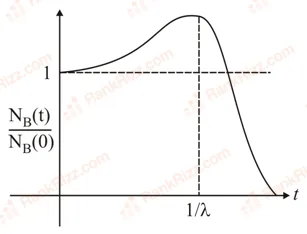
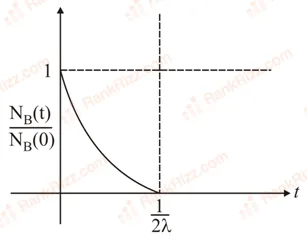
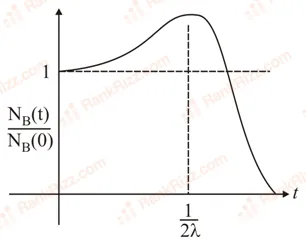
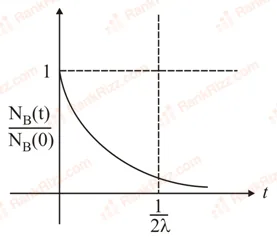
At time t=0t = 0, a material is composed of two radioactive atoms AA and BB, where NA(0)=2NB(0)N_A(0) = 2N_B(0). The decay constant of both kind of radioactive atoms is λ\lambda. However, AA disintegrates to BB and BB disintegrates to CC. Which of the following figures represents the evolution of NB(t)NB(0)\frac{N_B(t)}{N_B(0)} with respect to time tt?

  1. A
    Figure for JEE Main 2021 Physics question on Radioactivity: decay law, half-life and decay modes
  2. B
    Figure for JEE Main 2021 Physics question on Radioactivity: decay law, half-life and decay modes
  3. C
    Figure for JEE Main 2021 Physics question on Radioactivity: decay law, half-life and decay modes
  4. D
    Figure for JEE Main 2021 Physics question on Radioactivity: decay law, half-life and decay modes
JEE MAIN 2021 · 27 JUL S1Radioactivity: decay law, half-life and decay modes

If ff denotes the ratio of the number of nuclei decayed (Nd)(N_d) to the number of nuclei at t=0t = 0, (N0)(N_0) then for a collection of radioactive nuclei, the rate of change of ff with respect to time is given as: [λ\lambda is the radioactive decay constant]

  1. A

    −λ(1−e−λt)-\lambda(1 - e^{-\lambda t})

  2. B

    λ(1−e−λt)\lambda(1 - e^{-\lambda t})

  3. C

    λe−λt\lambda e^{-\lambda t}

  4. D

    −λe−λt-\lambda e^{-\lambda t}

JEE MAIN 2021 · 27 JUL S1Bohr model of hydrogen-like atoms

In Bohr's atomic model, the electron is assumed to revolve in a circular orbit of radius 0.5 A˚\mathring{A}. If the speed of electron is 2.2×1062.2 \times 10^6 m s−1^{-1}. Then the current associated with the electron will be _________ ×10−2\times 10^{-2} mA. [Take π\pi as 227\frac{22}{7}]

JEE MAIN 2021 · 27 JUL S1Radioactivity: decay law, half-life and decay modes

A radioactive sample has an average life of 30 ms and is decaying. A capacitor of capacitance 200 μ\muF is first charged and later connected with resistor RR. If the ratio of the charge on the capacitor to the activity of the radioactive sample is fixed with respect to time then the value of RR should be _________ Ω\Omega.

JEE MAIN 2021 · 27 JUL S2Radioactivity: decay law, half-life and decay modes

Consider the following statements:
A. Atoms of each element emit characteristics spectrum.
B. According to Bohr's Postulate, an electron in a hydrogen atom revolves in a certain stationary orbit.
C. The density of nuclear matter depends on the size of the nucleus.
D. A free neutron is stable but a free proton decay is possible.
E. Radioactivity is an indication of the instability of nuclei. Choose the correct answer from the options given below.

  1. A

    A,B,C,DA, B, C, D and EE

  2. B

    A,BA, B and EE only.

  3. C

    BB and DD only

  4. D

    A,CA, C and EE only

JEE MAIN 2021 · 27 JUL S2X-rays: continuous and characteristic spectra, Moseley's law

The KαK_\alpha X-ray of molybdenum has wavelength 0.071 nm. If the energy of a molybdenum atom with a KK electron knocked out is 27.5 keV, the energy of this atom when an LL electron is knocked out will be _________ keV. (Round off to the nearest integer) [h=4.14×10⁻¹⁵h = 4.14 \times 10^{-15} eV s, c=3×10⁸c = 3 \times 10^8 m s−1^{-1}]

JEE MAIN 2021 · 25 JUL S1Radioactivity: decay law, half-life and decay modes

Some nuclei of a radioactive material are undergoing radioactive decay. The time gap between the instances when a quarter of the nuclei have decayed and when half of the nuclei have decayed is given as: (where λ\lambda is the decay constant)

  1. A

    12 ln⁡2λ\frac{1}{2} \frac{\ln 2}{\lambda}

  2. B

    ln⁡2λ\frac{\ln 2}{\lambda}

  3. C

    2ln⁡2λ\frac{2\ln 2}{\lambda}

  4. D

    ln⁡32λ\frac{\ln\frac{3}{2}}{\lambda}

JEE MAIN 2021 · 25 JUL S1Radioactivity: decay law, half-life and decay modes

The half-life of 198^{198}Au is 3 days. If atomic weight of 198^{198}Au is 198 g mol−1^{-1}, then the activity of 2 mg of 198^{198}Au is [in disintegration second−1^{-1}]:

  1. A

    2.67×10122.67 \times 10^{12}

  2. B

    6.06×10186.06 \times 10^{18}

  3. C

    32.36×101232.36 \times 10^{12}

  4. D

    16.18×101216.18 \times 10^{12}

JEE MAIN 2021 · 25 JUL S2Nuclear size, mass defect and binding energy

From the given data, the amount of energy required to break the nucleus of aluminium 1327_{13}^{27}Al is _________ x×10−3x \times 10^{-3} J
Mass of neutron = 1.00866 u
Mass of proton = 1.00726 u
Mass of Aluminium nucleus = 27.18846 u
(Assume 1 u corresponds to xx J of energy)
(Round off to the nearest integer)

JEE MAIN 2021 · 25 JUL S2Radioactivity: decay law, half-life and decay modes

The nuclear activity of a radioactive element becomes (18)th\left(\frac{1}{8}\right)^{th} of its initial value in 30 years. The half-life of radioactive element is _________ years.

JEE MAIN 2021 · 22 JUL S1Nuclear size, mass defect and binding energy

A nucleus with mass number 184 initially at rest emits an α\alpha-particle. If the Q value of the reaction is 5.5 MeV, calculate the kinetic energy of the α\alpha-particle.

  1. A

    5.0 MeV

  2. B

    5.5 MeV

  3. C

    0.12 MeV

  4. D

    5.38 MeV