RankRizz

Atoms & Nuclei — JEE Main Previous Year Questions

Every Atoms & Nuclei question JEE Main has set from 2004–2026, grouped by the idea it tests rather than the order of the syllabus. 304 questions across 7 distinct ideas. Free to read, answer key on every one.

DATA UPDATED

Questions

304

Distinct ideas

7

Share of marks

4.8%

Difficulty

EASY

The ideas inside Atoms & Nuclei

A chapter is not one subject — it is a handful of procedures the examiner reuses. These are the ones Atoms & Nuclei questions actually test.

Every Atoms & Nuclei question

101–120 OF 304 · NEWEST FIRST

JEE MAIN 2023 · 08 APR S1Nuclear size, mass defect and binding energy

A nucleus with mass number 242 and binding energy per nucleon as 7.6 MeV breaks into two fragment each with mass number 121. If each fragment nucleus has binding energy per nucleon as 8.1 MeV, the total gain in binding energy is ______ MeV.
JEE MAIN 2023 · 08 APR S2Radioactivity: decay law, half-life and decay modes

A radio active material is reduced to 18\frac{1}{8} of its original amount in 3 days. If 8×10−38 \times 10^{-3} kg of the material is left after 5 days the initial amount of the material is

  1. A

    40 g

  2. B

    32 g

  3. C

    64 g

  4. D

    256 g

JEE MAIN 2023 · 08 APR S2Hydrogen spectrum and spectral series

The ratio of wavelength of spectral lines HαH_\alpha and HβH_\beta in the Balmer series is x20\frac{x}{20}. The value of xx is _____.

JEE MAIN 2023 · 06 APR S1Hydrogen spectrum and spectral series

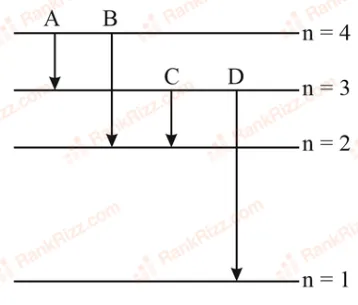
The energy levels of a hydrogen atom are shown below. The transition corresponding to emission of shortest wavelength is

Figure for JEE Main 2023 Physics question on Hydrogen spectrum and spectral series
  1. A

    D

  2. B

    A

  3. C

    B

  4. D

    C

JEE MAIN 2023 · 06 APR S1Hydrogen spectrum and spectral series

The radius of fifth orbit of Li++^{++} is ______ ×10−12\times 10^{-12} m. Take: radius of hydrogen atom = 0.51 A˚\mathring{A}

JEE MAIN 2023 · 06 APR S2Hydrogen spectrum and spectral series

A small particle of mass mm moves in such a way that its potential energy U=12mω2r2U = \dfrac{1}{2}m\omega^2 r^2 where ω\omega is constant and rr is the distance of the particle from origin. Assuming Bohr's quantization of momentum and circular orbit, the radius of nth^{th} orbit will be proportional to

  1. A

    n\sqrt{n}

  2. B

    1n\dfrac{1}{n}

  3. C

    n2n^2

  4. D

    nn

JEE MAIN 2023 · 06 APR S2Bohr model of hydrogen-like atoms

Experimentally it is found that 12.8 eV energy is required to separate a hydrogen atom into a proton and an electron. So the orbital radius of the electron in a hydrogen atom is 9x×10−10\dfrac{9}{x} \times 10^{-10} m. The value of the xx is ______.
(1 eV = 1.6×10−191.6 \times 10^{-19} J, 14πε0=9×10⁹\dfrac{1}{4\pi\varepsilon_0} = 9 \times 10^9 Nm2C2\dfrac{Nm^2}{C^2} and electronic charge = 1.6×10−191.6 \times 10^{-19} C)

JEE MAIN 2023 · 01 FEB S1Nuclear size, mass defect and binding energy

The mass of proton, neutron and helium nucleus are respectively 1.0073 u, 1.0087 u and 4.0015u. The binding energy of helium nucleus is:

  1. A

    14.2 MeV

  2. B

    28.4 MeV

  3. C

    56.8 MeV

  4. D

    7.1 MeV

JEE MAIN 2023 · 01 FEB S1Hydrogen spectrum and spectral series

A light of energy 12.75 eV is incident on a hydrogen atom in its ground state. The atom absorbs the radiation and reaches to one of its excited states. The angular momentum of the atom in the excited state is xπ×10−17\frac{x}{\pi} \times 10^{-17} eVs. The value of xx is _____ (use h=4.14×10⁻¹⁵h = 4.14 \times 10^{-15} eVs, c=3×10⁸c = 3 \times 10^8 m s−1^{-1})

JEE MAIN 2023 · 01 FEB S2Hydrogen spectrum and spectral series

An electron of a hydrogen like atom, having Z=4Z = 4, jumps from 4th4^{th} energy state to 2nd2^{nd} energy state. The energy released in this process, will be: (Given Rch=13.6Rch = 13.6 eV, where RR = Rydberg constant, cc = Speed of light in vacuum, hh = Planck's constant)

  1. A

    13.613.6 eV

  2. B

    10.510.5 eV

  3. C

    3.43.4 eV

  4. D

    40.840.8 eV

JEE MAIN 2023 · 01 FEB S2Nuclear size, mass defect and binding energy

Nucleus A having Z=17Z = 17 and equal number of protons and neutrons has 1.21.2 MeV binding energy per nucleon. Another nucleus BB of Z=12Z = 12 has total 26 nucleons and 1.81.8 MeV binding energy per nucleons. The difference of binding energy of BB and AA will be ______ MeV.

JEE MAIN 2023 · 31 JAN S1Radioactivity: decay law, half-life and decay modes

A free neutron decays into a proton but a free proton does not decay into neutron. This is because

  1. A

    neutron is an uncharged particle

  2. B

    proton is a charged particle

  3. C

    neutron is a composite particle made of a proton and an electron

  4. D

    neutron has larger rest mass than proton

JEE MAIN 2023 · 31 JAN S1Hydrogen spectrum and spectral series

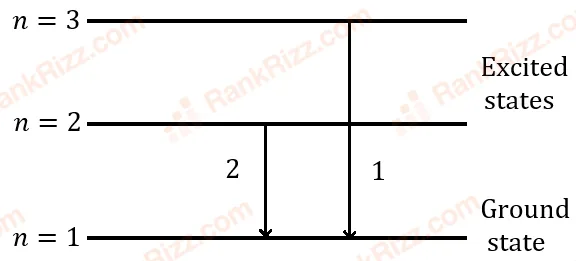
For hydrogen atom, λ1\lambda_1 and λ2\lambda_2 are the wavelengths corresponding to the transitions 1 and 2 respectively as shown in figure. The ratio of λ1\lambda_1 and λ2\lambda_2 is x32\dfrac{x}{32}. The value of xx is ______.

Figure for JEE Main 2023 Physics question on Hydrogen spectrum and spectral series
JEE MAIN 2023 · 31 JAN S2Hydrogen spectrum and spectral series

The radius of electron's second stationary orbit in Bohr's atom is RR. The radius of 3rd^{rd} orbit will be

  1. A

    R3\dfrac{R}{3}

  2. B

    2.25 RR

  3. C

    3R3R

  4. D

    9R9R

JEE MAIN 2023 · 31 JAN S2Hydrogen spectrum and spectral series

If the binding energy of ground state electron in a hydrogen atom is 13.6 eV, then, the energy required to remove the electron from the second excited state of Li2+^{2+} will be: x×10−1x \times 10^{-1} eV. The value of xx is ______.

JEE MAIN 2023 · 30 JAN S1Hydrogen spectrum and spectral series

Speed of an electron in Bohr's 7th7^{th} orbit for Hydrogen atom is 3.6×1063.6 \times 10^6 m s−1^{-1}. The corresponding speed of the electron in 3rd3^{rd} orbit, in m s−1^{-1} is:

  1. A

    1.8×1061.8 \times 10^6

  2. B

    7.5×1067.5 \times 10^6

  3. C

    3.6×1063.6 \times 10^6

  4. D

    8.4×1068.4 \times 10^6

JEE MAIN 2023 · 30 JAN S2Radioactivity: decay law, half-life and decay modes

Given below are two statements: one is labelled as Assertion A and the other is labelled as Reason R.
Assertion A: The nuclear density of nuclides 510^{10}_5B, 36^{6}_3Li, 2656^{56}_{26}Fe, 1020^{20}_{10}Ne and 83209^{209}_{83}Bi can be arranged as
ρBiN>ρFeN>ρNeN>ρBN>ρLiN\rho^N_{Bi} > \rho^N_{Fe} > \rho^N_{Ne} > \rho^N_{B} > \rho^N_{Li}
Reason R: The radius RR of nucleus is related to its mass number AA as R=R0A13R = R_0 A^{\frac{1}{3}}, where R0R_0 is a constant.
In the light of the above statement, choose the correct answer from the options given below:

  1. A

    Both A and R are true and R is the correct explanation of A

  2. B

    A is false but R is true

  3. C

    A is true but R is false

  4. D

    Both A and R are true but R is NOT the correct explanation of A

JEE MAIN 2023 · 30 JAN S2Radioactivity: decay law, half-life and decay modes

A radioactive nucleus decays by two different process. The half life of the first process is 55 minutes and that of the second process is 3030 s. The effective half-life of the nucleus is calculated to be α11\frac{\alpha}{11} s. The value of α\alpha is ______.

JEE MAIN 2023 · 29 JAN S1Radioactivity: decay law, half-life and decay modes

If a radioactive element having half-life of 3030 min is undergoing beta decay, the fraction of radioactive element remains undecayed after 9090 min will be:

  1. A

    18\frac{1}{8}

  2. B

    116\frac{1}{16}

  3. C

    14\frac{1}{4}

  4. D

    12\frac{1}{2}

JEE MAIN 2023 · 29 JAN S1Radioactivity: decay law, half-life and decay modes

A radioactive element 92242^{242}_{92}X emits two α\alpha-particles, one electron and two positrons. The product nucleus is represented by P234^{234}_{P}Y. The value of PP is ______.