RankRizz

Atoms & Nuclei — JEE Main Previous Year Questions

Every Atoms & Nuclei question JEE Main has set from 2004–2026, grouped by the idea it tests rather than the order of the syllabus. 304 questions across 7 distinct ideas. Free to read, answer key on every one.

DATA UPDATED

Questions

304

Distinct ideas

7

Share of marks

4.8%

Difficulty

EASY

The ideas inside Atoms & Nuclei

A chapter is not one subject — it is a handful of procedures the examiner reuses. These are the ones Atoms & Nuclei questions actually test.

Every Atoms & Nuclei question

121–140 OF 304 · NEWEST FIRST

JEE MAIN 2023 · 29 JAN S2Radioactivity: decay law, half-life and decay modes

Substance AA has atomic mass number 1616 and half life of 11 day. Another substance BB has atomic mass number 3232 and half life of 12\frac{1}{2} day. If both AA and BB simultaneously start undergo radio activity at the same time with initial mass 320320 g each, how many total atoms of AA and BB combined would be left after 22 days

  1. A

    3.38×10243.38 \times 10^{24}

  2. B

    6.76×10246.76 \times 10^{24}

  3. C

    6.76×10236.76 \times 10^{23}

  4. D

    1.69×10241.69 \times 10^{24}

JEE MAIN 2023 · 25 JAN S1Radioactivity: decay law, half-life and decay modes

The ratio of the density of oxygen nucleus (816{}^{16}_8O) and helium nucleus (24{}^{4}_2He) is

  1. A

    4 : 1

  2. B

    8 : 1

  3. C

    1 : 1

  4. D

    2 : 1

JEE MAIN 2023 · 25 JAN S1Hydrogen spectrum and spectral series

The wavelength of the radiation emitted is λ0\lambda_0 when an electron jumps from the second excited state to the first excited state of hydrogen atom. If the electron jumps from the third excited state to the second orbit of the hydrogen atom, the wavelength of the radiation emitted will be 20xλ0\frac{20}{x}\lambda_0. The value of xx is _____.

JEE MAIN 2023 · 25 JAN S2Hydrogen spectrum and spectral series

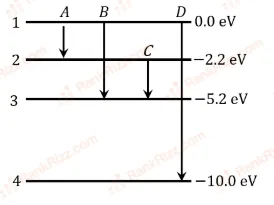
The energy levels of an atom is shown in figure.

Figure for JEE Main 2023 Physics question on Hydrogen spectrum and spectral series

Which one of these transitions will result in the emission of a photon of wavelength 124.1 nm?
Given (h=6.62×10⁻³⁴h = 6.62 \times 10^{-34} J s)

  1. A

    B

  2. B

    A

  3. C

    C

  4. D

    D

JEE MAIN 2023 · 25 JAN S2Radioactivity: decay law, half-life and decay modes

A nucleus disintegrates into two smaller parts, which have their velocities in the ratio 3 : 2. The ratio of their nuclear sizes will be (x3)13(\frac{x}{3})^{\frac{1}{3}}. The value of 'xx' is:

JEE MAIN 2023 · 24 JAN S1Radioactivity: decay law, half-life and decay modes

Consider the following radioactive decay process:
84218A→αA1→β−A2→γA3→αA4→β+A5→γA6^{218}_{84}A \xrightarrow{\alpha} A_1 \xrightarrow{\beta^-} A_2 \xrightarrow{\gamma} A_3 \xrightarrow{\alpha} A_4 \xrightarrow{\beta^+} A_5 \xrightarrow{\gamma} A_6
The mass number and the atomic number of A6A_6 are given by:

  1. A

    210 and 82

  2. B

    210 and 84

  3. C

    210 and 80

  4. D

    211 and 80

JEE MAIN 2023 · 24 JAN S1Radioactivity: decay law, half-life and decay modes

Consider the following radioactive decay process:
84218A→αA1→β−A2→γA3→αA4→β+A5→γA6{}^{218}_{84}A \xrightarrow{\alpha} A_1 \xrightarrow{\beta^-} A_2 \xrightarrow{\gamma} A_3 \xrightarrow{\alpha} A_4 \xrightarrow{\beta^+} A_5 \xrightarrow{\gamma} A_6
The mass number and the atomic number of A6A_6 are given by:

  1. A

    210 and 82

  2. B

    210 and 84

  3. C

    210 and 80

  4. D

    211 and 80

JEE MAIN 2023 · 24 JAN S1Radioactivity: decay law, half-life and decay modes

Assume that protons and neutrons have equal masses. Mass of a nucleon is 1.6×10−271.6 \times 10^{-27} kg and radius of nucleus is 1.5×10⁻¹⁵A1/31.5 \times 10^{-15} A^{1/3} m. The approximate ratio of the nuclear density and water density is n×1013n \times 10^{13}. The value of n is _____.

JEE MAIN 2023 · 24 JAN S1Radioactivity: decay law, half-life and decay modes

Assume that protons and neutrons have equal masses. Mass of a nucleon is 1.6×10−271.6 \times 10^{-27} kg and radius of nucleus is 1.5×10⁻¹⁵A1/31.5 \times 10^{-15} A^{1/3} m. The approximate ratio of the nuclear density and water density is n×1013n \times 10^{13}. The value of nn is _____.

JEE MAIN 2023 · 24 JAN S2Hydrogen spectrum and spectral series

A photon is emitted in transition from n=4n = 4 to n=1n = 1 level in hydrogen atom. The corresponding wavelength for this transition is (given, h=4×10⁻¹⁵h = 4 \times 10^{-15} eV s)

  1. A

    941 nm

  2. B

    974 nm

  3. C

    99.3 nm

  4. D

    94.1 nm

JEE MAIN 2023 · 24 JAN S2Nuclear size, mass defect and binding energy

The energy released per fission of nucleus of 240^{240}X is 200 MeV. The energy released if all the atoms in 120 g of pure 240^{240}X undergo fission is _____ ×1025\times 10^{25} MeV.
(Given NA=6×10²³N_A = 6 \times 10^{23})

JEE MAIN 2022 · 29 JUL S1Hydrogen spectrum and spectral series

Find the ratio of energies of photons produced due to transition of an electron of hydrogen atom from its (i) second permitted energy level to the first level, and (ii) the highest permitted energy level to the first permitted level.

  1. A

    3 : 4

  2. B

    4 : 3

  3. C

    1 : 4

  4. D

    4 : 1

JEE MAIN 2022 · 29 JUL S2Radioactivity: decay law, half-life and decay modes

Read the following statements:
(A) Volume of the nucleus is directly proportional to the mass number.
(B) Volume of the nucleus is independent of mass number.
(C) Density of the nucleus is directly proportional to the mass number.
(D) Density of the nucleus is directly proportional to the cube root of the mass number.
(E) Density of the nucleus is independent of the mass number.
Choose the correct option from the following options.

  1. A

    (A) and (D) only

  2. B

    (A) and (E) only

  3. C

    (B) and (E) only

  4. D

    (A) and (C) only

JEE MAIN 2022 · 29 JUL S2Radioactivity: decay law, half-life and decay modes

Two radioactive materials A and B have decay constants 25λ25\lambda and 16λ16\lambda respectively. If initially they have the same number of nuclei, then the ratio of the number of nuclei of B to that of A will be 'e' after a time 1aλ\frac{1}{a\lambda}. The value of a is _____

JEE MAIN 2022 · 28 JUL S1Radioactivity: decay law, half-life and decay modes

The half life period of a radioactive substance is 60 days. The time taken for 78\frac{7}{8}th of its original mass to disintegrate will be:

  1. A

    120 days

  2. B

    130 days

  3. C

    180 days

  4. D

    20 days

JEE MAIN 2022 · 28 JUL S1Radioactivity: decay law, half-life and decay modes

A freshly prepared radioactive source of half life 2 hours 30 minutes emits radiation which is 64 times the permissible safe level. The minimum time, after which it would be possible to work safely with source, will be _____ hours.

JEE MAIN 2022 · 28 JUL S2Radioactivity: decay law, half-life and decay modes

A radioactive sample decays 78\frac{7}{8} times its original quantity in 15 minutes. The half-life of the sample is

  1. A

    5 min

  2. B

    7.5 min

  3. C

    15 min

  4. D

    30 min

JEE MAIN 2022 · 27 JUL S1Radioactivity: decay law, half-life and decay modes

What is the half-life period of a radioactive material if its activity drops to 116th\dfrac{1}{16^{th}} of its initial value of 3030 years?

  1. A

    9.59.5 years

  2. B

    8.58.5 years

  3. C

    7.57.5 years

  4. D

    10.510.5 years

JEE MAIN 2022 · 27 JUL S2Radioactivity: decay law, half-life and decay modes

The activity of a radioactive material is 6.4×10−46.4 \times 10^{-4} curie. Its half life is 5 days. The activity will become 5×10−65 \times 10^{-6} curie after

  1. A

    7 days

  2. B

    15 days

  3. C

    25 days

  4. D

    35 days

JEE MAIN 2022 · 26 JUL S1Radioactivity: decay law, half-life and decay modes

The disintegration rate of a certain radioactive sample at any instant is 42504250 disintegrations per minute. 1010 minutes later, the rate becomes 22502250 disintegrations per minute. The approximate decay constant is (Take log⁡e1.88=0.63\log_e 1.88 = 0.63)

  1. A

    0.02 min−10.02 \text{ min}^{-1}

  2. B

    2.7 min−12.7 \text{ min}^{-1}

  3. C

    0.063 min−10.063 \text{ min}^{-1}

  4. D

    6.3 min−16.3 \text{ min}^{-1}