Atoms & Nuclei JEE Main PYQs with answer key
PHYSICS · 304 PAST QUESTIONS · 7 TOPICS · 2004–2026
HOW TO USE THIS SHEET
Every JEE Main Atoms & Nuclei question we hold, grouped by topic, most-asked topic first and newest first inside each. The answer key is at the end (303 of 304 questions have a checked key); the worked solution is on each question’s page, printed beside it.
Hydrogen spectrum and spectral series 116
The ratio of momentum of the photons of the 1 and 2 line of Balmer series of Hydrogen atoms is . The possible values of and are:
- (A)
27 and 20
- (B)
3 and 16
- (C)
5 and 36
- (D)
20 and 27
rr2.rankrizz.com/jee-main/physics/atoms-and-nuclei/q/6-apr-2026-s1-q44
- (A)
In the hydrogen atom, the electron makes a transition from the higher orbit () to a lower orbit (). The ratio of the radius of the orbits is given by . The wavelength of photon emitted due to this transition is _______ nm. (Given Rydberg constant = /m)
- (A)
- (B)
- (C)
- (D)
rr2.rankrizz.com/jee-main/physics/atoms-and-nuclei/q/5-apr-2026-s1-q36
- (A)
Angular momentum of an electron in a hydrogen atom is , then the energy of the electron is __________ eV.
- (A)
- (B)
- (C)
- (D)
rr2.rankrizz.com/jee-main/physics/atoms-and-nuclei/q/2-apr-2026-s1-q44
- (A)
Two electrons are moving in orbits of two hydrogen like atoms with speeds respectively. If the radii of these orbits are nearly same then the possible order of energy states are ____ respectively.
- (A)
9 and 8
- (B)
10 and 12
- (C)
6 and 5
- (D)
8 and 10
rr2.rankrizz.com/jee-main/physics/atoms-and-nuclei/q/24-jan-2026-s1-q39
- (A)
In hydrogen atom spectrum, (R Rydberg's constant)
A. the maximum wavelength of the radiation of Lyman series is
B. the Balmer series lies in the visible region of the spectrum
C. the minimum wavelength of the radiation of Paschen series is
D. the minimum wavelength of Lyman series is
Choose the correct answer from the options given below :- (A)
A, B Only
- (B)
A, B and D Only
- (C)
A, B and C Only
- (D)
B, D Only
rr2.rankrizz.com/jee-main/physics/atoms-and-nuclei/q/23-jan-2026-s1-q30
- (A)
The smallest wavelength of Lyman series is 91 nm. The difference between the largest wavelengths of Paschen and Balmer series is nearly __ nm.
- (A)
1784
- (B)
1550
- (C)
1875
- (D)
1217
rr2.rankrizz.com/jee-main/physics/atoms-and-nuclei/q/22-jan-2026-s2-q42
- (A)
The energy of an electron in an orbit of the Bohr's atom is where is the ground state energy. lf L is the angular momentum of the electron in this orbit and h is the Planck's constant, then is __________:
- (A)
2
- (B)
4
- (C)
5
- (D)
6
rr2.rankrizz.com/jee-main/physics/atoms-and-nuclei/q/21-jan-2026-s2-q31
- (A)
In a hydrogen like ion, the energy difference between the 2nd excitation energy state and ground state is 108.8 eV. The atomic number of the ion is
- (A)
4
- (B)
2
- (C)
1
- (D)
3
rr2.rankrizz.com/jee-main/physics/atoms-and-nuclei/q/2025-apr-7-s1-q40
- (A)
For a hydrogen atom, the ratio of the largest wavelength of Lyman series to that of the Balmer series is
- (A)
5 : 36
- (B)
5 : 27
- (C)
3 : 4
- (D)
27 : 5
rr2.rankrizz.com/jee-main/physics/atoms-and-nuclei/q/2025-apr-7-s1-q41
- (A)
Considering the Bohr model of hydrogen like atoms, the ratio of the radius orbit of the electron in and is
- (A)
- (B)
- (C)
- (D)
rr2.rankrizz.com/jee-main/physics/atoms-and-nuclei/q/2025-apr-4-s1-q45
- (A)
Given below are two statements: one is labelled as Assertion A and the other is labelled as Reason R.
Assertion A: The Bohr model is applicable to hydrogen and hydrogen-like atoms only.
Reason R: The formulation of Bohr model does not include repulsive force between electrons.
In the light of the above statements, choose the correct answer from the options given below:- (A)
Both A and R are true but R is NOT the correct explanation of A.
- (B)
A is false but R is true.
- (C)
Both A and R are true and R is the correct explanation of A.
- (D)
A is true but R is false.
rr2.rankrizz.com/jee-main/physics/atoms-and-nuclei/q/2025-apr-3-s2-q32
- (A)
An electron in the hydrogen atom initially in the fourth excited state makes a transition to energy state by emitting a photon of energy 2.86 eV. The integer value of n will be ________.
Answer: ____________
rr2.rankrizz.com/jee-main/physics/atoms-and-nuclei/q/2025-apr-3-s2-q49
Considering Bohr's atomic model for hydrogen atom:
(A) the energy of H atom in ground state is same as energy of He ion in its first excited state.
(B) the energy of H atom in ground state is same as that for Li ion in its second excited state.
(C) the energy of H atom in ground state is same as that of He ion for its ground state.
(D) the energy of He ion in its first excited state is same as that for Li ion in its ground state.
Choose the correct answer from the options below:- (A)
(B), (D) only
- (B)
(A), (B) only
- (C)
(A), (D) only
- (D)
(A), (C) only
rr2.rankrizz.com/jee-main/physics/atoms-and-nuclei/q/2025-apr-02-s1-q40
- (A)
Assuming the validity of Bohr's atomic model for hydrogen like ions the radius of ion in its ground state is given by , where ________. (Where is the first Bohr's radius.)
- (A)
- (B)
- (C)
- (D)
rr2.rankrizz.com/jee-main/physics/atoms-and-nuclei/q/2025-apr-02-s2-q36
- (A)
The number of spectral lines emitted by atomic hydrogen that is in the energy level, is
- (A)
3
- (B)
1
- (C)
6
- (D)
0
rr2.rankrizz.com/jee-main/physics/atoms-and-nuclei/q/29-jan-2025-s2-q35
- (A)
The frequency of revolution of the electron in Bohr's orbit varies with , the principal quantum number as
- (A)
- (B)
- (C)
- (D)
rr2.rankrizz.com/jee-main/physics/atoms-and-nuclei/q/28-jan-2025-s2-q44
- (A)
During the transition of electron from state A to state C of a Bohr atom, the wavelength of emitted radiation is 2000 A˚ and it becomes 6000 A˚ when the electron jumps from state B to state C. Then the wavelength of the radiation emitted during the transition of electrons from state A to state B is:
- (A)
4000A˚
- (B)
2000A˚
- (C)
3000A˚
- (D)
6000A˚
rr2.rankrizz.com/jee-main/physics/atoms-and-nuclei/q/24-jan-2025-s1-q26
- (A)
A hydrogen atom in ground state is given an energy of . How many spectral lines will be emitted due to transition of electrons?
- (A)
6
- (B)
3
- (C)
10
- (D)
1
rr2.rankrizz.com/jee-main/physics/atoms-and-nuclei/q/9-apr-2024-s2-q16
- (A)
The ratio of the shortest wavelength of Balmer series to the shortest wavelength of Lyman series for hydrogen atom is :
- (A)
4 : 1
- (B)
1 : 4
- (C)
2 : 1
- (D)
1 : 2
rr2.rankrizz.com/jee-main/physics/atoms-and-nuclei/q/6-apr-2024-s1-q18
- (A)
Radius of a certain orbit of hydrogen atom is . If energy of electron in this orbit is , then _______ (Given , energy of electron in ground state).
Answer: ____________
rr2.rankrizz.com/jee-main/physics/atoms-and-nuclei/q/6-apr-2024-s1-q30
The longest wavelength associated with Paschen series is : (Given )
- (A)
- (B)
- (C)
- (D)
rr2.rankrizz.com/jee-main/physics/atoms-and-nuclei/q/6-apr-2024-s2-q18
- (A)
In Franck-Hertz experiment, the first dip in the current-voltage graph for hydrogen is observed at 10.2 V. The wavelength of light emitted by hydrogen atom when excited to the first excitation level is ___________ nm. (Given , ).
Answer: ____________
rr2.rankrizz.com/jee-main/physics/atoms-and-nuclei/q/6-apr-2024-s2-q30
The angular momentum of an electron in a hydrogen atom is proportional to : (Where is the radius of orbit of electron)
- (A)
- (B)
- (C)
- (D)
rr2.rankrizz.com/jee-main/physics/atoms-and-nuclei/q/05-apr-2024-s2-q18
- (A)
The shortest wavelength of the spectral lines in the Lyman series of hydrogen spectrum is Å. The longest wavelength of spectral lines in the Balmer series will be ______ Å.
Answer: ____________
rr2.rankrizz.com/jee-main/physics/atoms-and-nuclei/q/05-apr-2024-s2-q30
A hydrogen atom changes its state from n = 3 to n = 2. Due to recoil, the percentage change in the wavelength of emitted light is approximately . The value of n is _____. [Given Rhc = 13.6 eV, hc = 1242 eVnm, h = 6.6×10⁻³⁴ Js, mass of hydrogen atom = 1.6×10⁻²⁷ kg]
Answer: ____________
rr2.rankrizz.com/jee-main/physics/atoms-and-nuclei/q/04-apr-2024-s1-q30
According to Bohr's theory, the moment of momentum of an electron revolving in orbit of hydrogen atom is:
- (A)
- (B)
- (C)
- (D)
rr2.rankrizz.com/jee-main/physics/atoms-and-nuclei/q/04-apr-2024-s2-q18
- (A)
The minimum energy required by a hydrogen atom in ground state to emit radiation in Balmer series is nearly :
- (A)
eV
- (B)
eV
- (C)
eV
- (D)
eV
rr2.rankrizz.com/jee-main/physics/atoms-and-nuclei/q/01-feb-2024-s1-q18
- (A)
From the statements given below:
(A) The angular momentum of an electron in orbit is an integral multiple of .
(B) Nuclear forces do not obey inverse square law.
(C) Nuclear forces are spin dependent.
(D) Nuclear forces are central and charge independent.
(E) Stability of nucleus is inversely proportional to the value of packing fraction.
Choose the correct answer from the options given below:- (A)
(A), (B), (C), (D) only
- (B)
(A), (C), (D), (E) only
- (C)
(A), (B), (C), (E) only
- (D)
(B), (C), (D), (E) only
rr2.rankrizz.com/jee-main/physics/atoms-and-nuclei/q/01-feb-2024-s2-q19
- (A)
A particular hydrogen-like ion emits the radiation of frequency Hz when it makes transition from to . The frequency of radiation emitted in transition from to is Hz, when = ______.
Answer: ____________
rr2.rankrizz.com/jee-main/physics/atoms-and-nuclei/q/01-feb-2024-s2-q30
If the wavelength of the first member of Lyman series of hydrogen is . The wavelength of the second member will be
- (A)
- (B)
- (C)
- (D)
rr2.rankrizz.com/jee-main/physics/atoms-and-nuclei/q/31-jan-2024-s1-q19
- (A)
The ratio of the magnitude of the kinetic energy to the potential energy of an electron in the excited state of a hydrogen atom is :
- (A)
- (B)
- (C)
- (D)
rr2.rankrizz.com/jee-main/physics/atoms-and-nuclei/q/30-jan-2024-s1-q19
- (A)
An electron of hydrogen atom on an excited state is having energy . The maximum number of allowed transitions to lower energy level is _______.
Answer: ____________
rr2.rankrizz.com/jee-main/physics/atoms-and-nuclei/q/30-jan-2024-s1-q30
An electron revolving in Bohr orbit has magnetic moment . If , the value of is:
- (A)
2
- (B)
1
- (C)
3
- (D)
0
rr2.rankrizz.com/jee-main/physics/atoms-and-nuclei/q/30-jan-2024-s2-q17
- (A)
When a hydrogen atom going from to emits a photon, its recoil speed is m s. Where _______. (Use: mass of hydrogen atom kg, charge of electron C)
Answer: ____________
rr2.rankrizz.com/jee-main/physics/atoms-and-nuclei/q/29-jan-2024-s1-q30
Hydrogen atom is bombarded with electrons accelerated through a potential different of , which causes excitation of hydrogen atoms. If the experiment is being formed at K. The minimum potential difference needed to observe any Balmer series lines in the emission spectra will be V, where ______.
Answer: ____________
rr2.rankrizz.com/jee-main/physics/atoms-and-nuclei/q/29-jan-2024-s2-q30
If Rydberg's constant is R, the longest wavelength of radiation in Paschen series will be , where = _____.
Answer: ____________
rr2.rankrizz.com/jee-main/physics/atoms-and-nuclei/q/27-jan-2024-s2-q30
As per the given figure , and are the first, second and third excited energy levels of hydrogen atom respectively. If the ratio of the two wavelengths (i.e. ) is , then the value of will be _____.
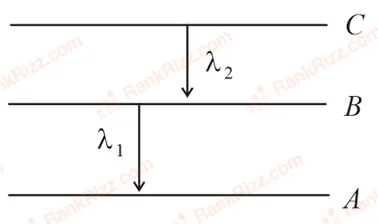
Answer: ____________
rr2.rankrizz.com/jee-main/physics/atoms-and-nuclei/q/15-apr-2023-s1-q30
The radius of 2 orbit of He of Bohr's model is and that of fourth orbit of Be is represented as . Now the ratio is . The value of is _____.
Answer: ____________
rr2.rankrizz.com/jee-main/physics/atoms-and-nuclei/q/13-apr-2023-s1-q29
A eV electron beam is used to bombard gaseous hydrogen at room temperature. The number of spectral lines emitted will be:
- (A)
- (B)
- (C)
- (D)
rr2.rankrizz.com/jee-main/physics/atoms-and-nuclei/q/12-apr-2023-s1-q18
- (A)
A monochromatic light is incident on a hydrogen sample in ground state. Hydrogen atoms absorb a fraction of light and subsequently emit radiation of six different wavelengths. The frequency of incident light is Hz. The value of x is _______.
(Given eVs)Answer: ____________
rr2.rankrizz.com/jee-main/physics/atoms-and-nuclei/q/11-apr-2023-s1-q30
The energy of He ion in its first state is, (The ground state energy for the Hydrogen atom eV):
- (A)
eV
- (B)
eV
- (C)
eV
- (D)
eV
rr2.rankrizz.com/jee-main/physics/atoms-and-nuclei/q/11-apr-2023-s2-q18
- (A)
The angular momentum for the electron in Bohr's orbit is . If the electron is assumed to revolve in second orbit of hydrogen atom, then the change in angular momentum will be
- (A)
Zero
- (B)
- (C)
- (D)
rr2.rankrizz.com/jee-main/physics/atoms-and-nuclei/q/10-apr-2023-s1-q18
- (A)
If 917 be the lowest wavelength of Lyman series then the lowest wavelength of Balmer series will be _______ .
Answer: ____________
rr2.rankrizz.com/jee-main/physics/atoms-and-nuclei/q/10-apr-2023-s2-q30
The ratio of wavelength of spectral lines and in the Balmer series is . The value of is _____.
Answer: ____________
rr2.rankrizz.com/jee-main/physics/atoms-and-nuclei/q/08-apr-2023-s2-q30
The energy levels of a hydrogen atom are shown below. The transition corresponding to emission of shortest wavelength is
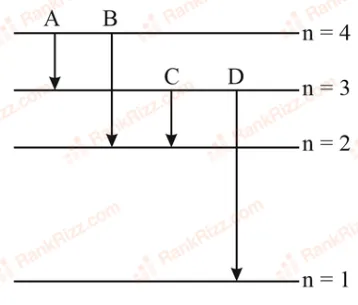
- (A)
D
- (B)
A
- (C)
B
- (D)
C
rr2.rankrizz.com/jee-main/physics/atoms-and-nuclei/q/6-apr-2023-s1-q17
- (A)
The radius of fifth orbit of Li is ______ m. Take: radius of hydrogen atom = 0.51
Answer: ____________
rr2.rankrizz.com/jee-main/physics/atoms-and-nuclei/q/6-apr-2023-s1-q30
A small particle of mass moves in such a way that its potential energy where is constant and is the distance of the particle from origin. Assuming Bohr's quantization of momentum and circular orbit, the radius of n orbit will be proportional to
- (A)
- (B)
- (C)
- (D)
rr2.rankrizz.com/jee-main/physics/atoms-and-nuclei/q/6-apr-2023-s2-q4
- (A)
A light of energy 12.75 eV is incident on a hydrogen atom in its ground state. The atom absorbs the radiation and reaches to one of its excited states. The angular momentum of the atom in the excited state is eVs. The value of is _____ (use eVs, m s)
Answer: ____________
rr2.rankrizz.com/jee-main/physics/atoms-and-nuclei/q/01-feb-2023-s1-q30
An electron of a hydrogen like atom, having , jumps from energy state to energy state. The energy released in this process, will be: (Given eV, where = Rydberg constant, = Speed of light in vacuum, = Planck's constant)
- (A)
eV
- (B)
eV
- (C)
eV
- (D)
eV
rr2.rankrizz.com/jee-main/physics/atoms-and-nuclei/q/01-feb-2023-s2-q18
- (A)
For hydrogen atom, and are the wavelengths corresponding to the transitions 1 and 2 respectively as shown in figure. The ratio of and is . The value of is ______.
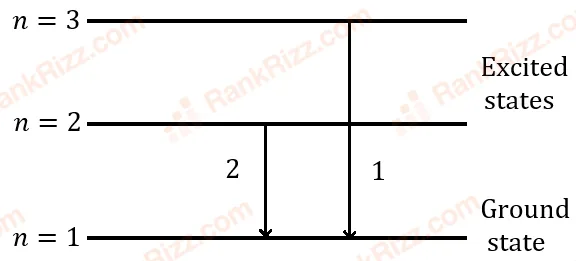
Answer: ____________
rr2.rankrizz.com/jee-main/physics/atoms-and-nuclei/q/31-jan-2023-s1-q30
The radius of electron's second stationary orbit in Bohr's atom is . The radius of 3 orbit will be
- (A)
- (B)
2.25
- (C)
- (D)
rr2.rankrizz.com/jee-main/physics/atoms-and-nuclei/q/31-jan-2023-s2-q18
- (A)
If the binding energy of ground state electron in a hydrogen atom is 13.6 eV, then, the energy required to remove the electron from the second excited state of Li will be: eV. The value of is ______.
Answer: ____________
rr2.rankrizz.com/jee-main/physics/atoms-and-nuclei/q/31-jan-2023-s2-q30
Speed of an electron in Bohr's orbit for Hydrogen atom is m s. The corresponding speed of the electron in orbit, in m s is:
- (A)
- (B)
- (C)
- (D)
rr2.rankrizz.com/jee-main/physics/atoms-and-nuclei/q/30-jan-2023-s1-q18
- (A)
The wavelength of the radiation emitted is when an electron jumps from the second excited state to the first excited state of hydrogen atom. If the electron jumps from the third excited state to the second orbit of the hydrogen atom, the wavelength of the radiation emitted will be . The value of is _____.
Answer: ____________
rr2.rankrizz.com/jee-main/physics/atoms-and-nuclei/q/25-jan-2023-s1-q30
The energy levels of an atom is shown in figure.
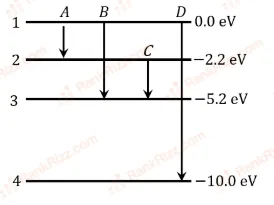
Which one of these transitions will result in the emission of a photon of wavelength 124.1 nm?
Given ( J s)- (A)
B
- (B)
A
- (C)
C
- (D)
D
rr2.rankrizz.com/jee-main/physics/atoms-and-nuclei/q/25-jan-2023-s2-q19
- (A)
A photon is emitted in transition from to level in hydrogen atom. The corresponding wavelength for this transition is (given, eV s)
- (A)
941 nm
- (B)
974 nm
- (C)
99.3 nm
- (D)
94.1 nm
rr2.rankrizz.com/jee-main/physics/atoms-and-nuclei/q/24-jan-2023-s2-q18
- (A)
Find the ratio of energies of photons produced due to transition of an electron of hydrogen atom from its (i) second permitted energy level to the first level, and (ii) the highest permitted energy level to the first permitted level.
- (A)
3 : 4
- (B)
4 : 3
- (C)
1 : 4
- (D)
4 : 1
rr2.rankrizz.com/jee-main/physics/atoms-and-nuclei/q/29-jul-2022-s1-q17
- (A)
In a hydrogen spectrum be the wavelength of first transition line of Lyman series. The wavelength difference will be "" between the wavelength of transition line of Paschen series and that of transition line of Balmer Series where ______.
Answer: ____________
rr2.rankrizz.com/jee-main/physics/atoms-and-nuclei/q/26-jul-2022-s1-q29
The momentum of an electron revolving in orbit is given by: (Symbols have their usual meanings)
- (A)
- (B)
- (C)
- (D)
rr2.rankrizz.com/jee-main/physics/atoms-and-nuclei/q/25-jul-2022-s1-q19
- (A)
Hydrogen atom from excited state comes to the ground by emitting a photon of wavelength . The value of principal quantum number of the excited state will be: ( : Rydberg constant)
- (A)
- (B)
- (C)
- (D)
rr2.rankrizz.com/jee-main/physics/atoms-and-nuclei/q/25-jul-2022-s2-q19
- (A)
is the ratio of energies of photons produced due to transition of an electron of hydrogen atom from its (i) third permitted energy level to the second level and (ii) the highest permitted energy level to the second permitted level. The value of will be ______.
Answer: ____________
rr2.rankrizz.com/jee-main/physics/atoms-and-nuclei/q/25-jul-2022-s2-q29
A hydrogen atom in its ground state absorbs eV of energy. The angular momentum of electron of the hydrogen atom will increase by the value of (Given, Planck's constant Js).
- (A)
Js
- (B)
Js
- (C)
Js
- (D)
Js
rr2.rankrizz.com/jee-main/physics/atoms-and-nuclei/q/27-jun-2022-s1-q19
- (A)
A beam of monochromatic light is used to excite the electron in from the first orbit to the third orbit. The wavelength of monochromatic light is found to be m. The value of is ______.
[Given eV nm]Answer: ____________
rr2.rankrizz.com/jee-main/physics/atoms-and-nuclei/q/27-jun-2022-s1-q29
Given below are two statements
Statement I: In hydrogen atom, the frequency of radiation emitted when an electron jumps from lower energy orbit () to higher energy orbit (), is given as
Statement II: The jumping of electron from higher energy orbit () to lower energy orbit () is associated with frequency of radiation given as . This condition is Bohr's frequency condition.
In the light of the above statements, choose the correct answer from the options given below:- (A)
Both statement I and statement II are true.
- (B)
Both statement I and statement II are false.
- (C)
Statement I is correct but statement II is false.
- (D)
Statement I is incorrect but statement II is true.
rr2.rankrizz.com/jee-main/physics/atoms-and-nuclei/q/27-jun-2022-s2-q18
- (A)
The ratio for the speed of the electron in the orbit of to the speed of the electron in the orbit of hydrogen atom will be :
- (A)
- (B)
- (C)
- (D)
rr2.rankrizz.com/jee-main/physics/atoms-and-nuclei/q/25-jun-2022-s1-q18
- (A)
In Bohr's atomic model of hydrogen, let , and are the kinetic energy, potential energy and total energy of the electron respectively. Choose the correct option when the electron undergoes transitions to a higher level :
- (A)
All , and increase.
- (B)
decreases, and increase.
- (C)
decreases, and increase.
- (D)
increases, and decrease
rr2.rankrizz.com/jee-main/physics/atoms-and-nuclei/q/24-jun-2022-s2-q20
- (A)
different wavelength may be observed in the spectrum from a hydrogen sample if the atoms are excited to states with principal quantum number ? The value of is _________.
Answer: ____________
rr2.rankrizz.com/jee-main/physics/atoms-and-nuclei/q/27-aug-2021-s2-q29
A particular hydrogen like ion emits radiation of frequency Hz when it makes transition from n = 3 to n = 1. The frequency in Hz of radiation emitted in transition from n = 2 to n = 1 will be:
- (A)
- (B)
- (C)
- (D)
rr2.rankrizz.com/jee-main/physics/atoms-and-nuclei/q/26-aug-2021-s1-q17
- (A)
If an electron is moving in the orbit of the hydrogen atom, then its velocity () for the orbit is given as:
- (A)
- (B)
- (C)
- (D)
rr2.rankrizz.com/jee-main/physics/atoms-and-nuclei/q/17-mar-2021-s1-q17
- (A)
Which level of the single ionized carbon has the same energy as the ground state energy of hydrogen atom?
- (A)
1
- (B)
6
- (C)
4
- (D)
8
rr2.rankrizz.com/jee-main/physics/atoms-and-nuclei/q/17-mar-2021-s1-q18
- (A)
The atomic hydrogen emits a line spectrum consisting of various series. Which series of hydrogen atomic spectra is lying in the visible region?
- (A)
Brackett series
- (B)
Paschen series
- (C)
Lyman series
- (D)
Balmer series
rr2.rankrizz.com/jee-main/physics/atoms-and-nuclei/q/17-mar-2021-s2-q18
- (A)
A particle of mass moves in a circular orbit in a central potential field . If Bohr's quantization conditions are applied, radii of possible orbitals vary with , where is ________.
Answer: ____________
rr2.rankrizz.com/jee-main/physics/atoms-and-nuclei/q/17-mar-2021-s2-q30
The first three spectral lines of H-atom in the Balmer series are given considering the Bohr atomic model, the wave lengths of first and third spectral lines are related by a factor of approximately . The value of , to the nearest integer, is ________.
Answer: ____________
rr2.rankrizz.com/jee-main/physics/atoms-and-nuclei/q/16-mar-2021-s1-q28
The wavelength of the photon emitted by a hydrogen atom when an electron makes a transition from to state is:
- (A)
121.8 nm
- (B)
194.8 nm
- (C)
490.7 nm
- (D)
913.3 nm
rr2.rankrizz.com/jee-main/physics/atoms-and-nuclei/q/25-feb-2021-s2-q17
- (A)
In the given figure, the energy levels of hydrogen atom have been shown along with some transitions marked A, B, C, D and E. The transitions A, B and C respectively represent
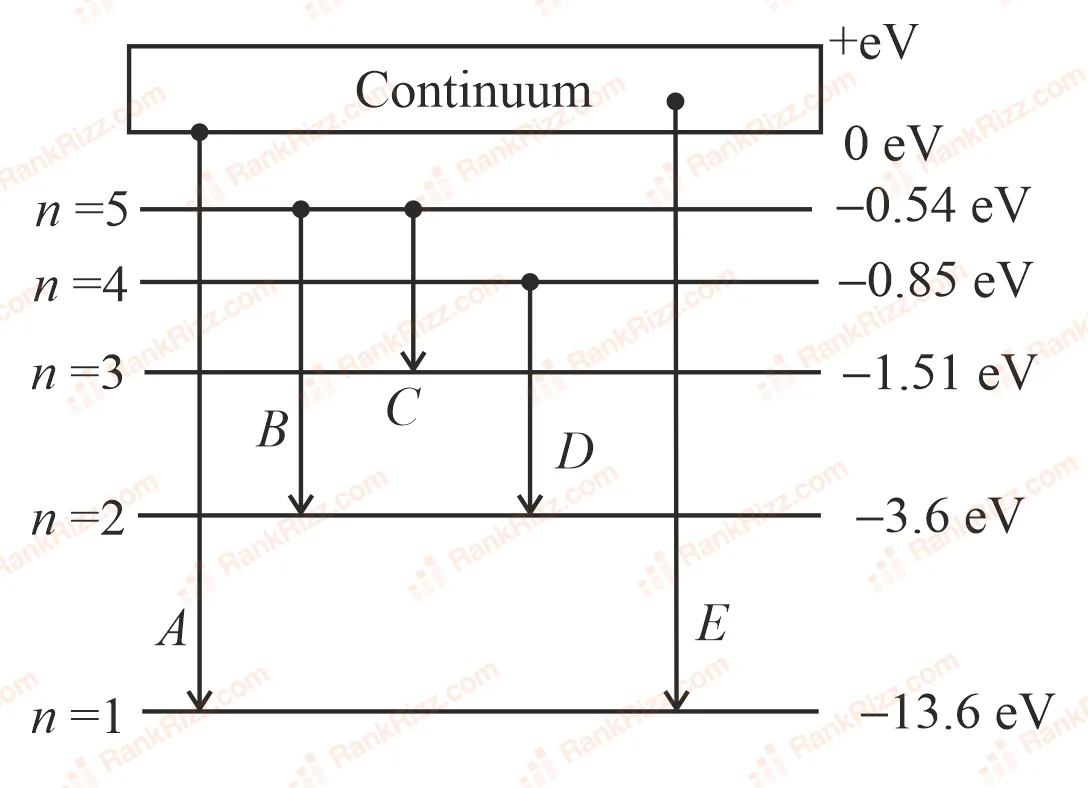
- (A)
The ionization potential of hydrogen, second member of Balmer series and third member of Paschen series.
- (B)
The series limit of Lyman series, second member of Balmer series and second member of Paschen series.
- (C)
The series limit of Lyman series, third member of Balmer series and second member of Paschen series.
- (D)
The first member of the Lyman series, third member of Balmer series and second member of Paschen series.
rr2.rankrizz.com/jee-main/physics/atoms-and-nuclei/q/24-feb-2021-s1-q19
- (A)
According to Bohr atom model, in which of the following transitions will the frequency be maximum?
- (A)
to
- (B)
to
- (C)
to
- (D)
to
rr2.rankrizz.com/jee-main/physics/atoms-and-nuclei/q/24-feb-2021-s2-q17
- (A)
A particle of mass collides with a hydrogen atom at rest. Soon after the collision, the particle comes to rest, and the atom recoils and goes to its first excited state. The initial kinetic energy of the particle (in eV) is . The value of is: (Given the mass of the hydrogen atom to be )........
Answer: ____________
rr2.rankrizz.com/jee-main/physics/atoms-and-nuclei/q/5-sep-2020-s1-q21
In the line spectra of hydrogen atom, difference between the largest and the shortest wavelengths of the Lyman series is 305 . The corresponding difference for the Paschan series in is __________ (nearest integer)
Answer: ____________
rr2.rankrizz.com/jee-main/physics/atoms-and-nuclei/q/4-sep-2020-s1-q25
In a hydrogen atom the electron makes a transition from level to the level. If , the frequency of radiation emitted is proportional to:
- (A)
- (B)
- (C)
- (D)
rr2.rankrizz.com/jee-main/physics/atoms-and-nuclei/q/2-sep-2020-s2-q19
- (A)
The energy required to ionise a hydrogen like ion in its ground state is 9 Rydbergs. What is the wavelength of the radiation emitted when the electron in this ion jumps from the second excited state to the ground state?
- (A)
24.2 nm
- (B)
11.4 nm
- (C)
35.8 nm
- (D)
8.6 nm
rr2.rankrizz.com/jee-main/physics/atoms-and-nuclei/q/9-jan-2020-s2-q19
- (A)
The first member of the Balmer series of hydrogen atom has a wavelength of 6561 . The wavelength of the second member of the Balmer series (in nm) is
Answer: ____________
rr2.rankrizz.com/jee-main/physics/atoms-and-nuclei/q/8-jan-2020-s2-q25
The time period of revolution of electron in its ground state orbit in a hydrogen atom is s. The frequency of revolution of the electron in its first excited state (in s) is:
- (A)
- (B)
- (C)
- (D)
rr2.rankrizz.com/jee-main/physics/atoms-and-nuclei/q/7-jan-2020-s1-q19
- (A)
An excited He ion emits two photons in succession, with wavelengths 108.5 nm and 30.4 nm in making a transition to the ground state. The quantum number n, corresponding to its initial excited state is
(for a photon of wavelength , energy E = )- (A)
n = 6
- (B)
n = 5
- (C)
n = 7
- (D)
n = 4
rr2.rankrizz.com/jee-main/physics/atoms-and-nuclei/q/12-apr-2019-s1-q28
- (A)
Consider an electron in a hydrogen atom, revolving in its second excited state (having radius 4.65 Å). The de-Broglie wavelength of this electron is:
- (A)
12.9 Å
- (B)
6.6 Å
- (C)
9.7 Å
- (D)
3.5 Å
rr2.rankrizz.com/jee-main/physics/atoms-and-nuclei/q/12-apr-2019-s2-q25
- (A)
The electron in a hydrogen atom first jumps from the third excited state to the second excited state and subsequently to the first excited state. The ratio of the respective wavelengths, , of the photons emitted in this process is:
- (A)
- (B)
- (C)
- (D)
rr2.rankrizz.com/jee-main/physics/atoms-and-nuclei/q/12-apr-2019-s2-q26
- (A)
In Li, electron in first Bohr orbit is excited to a level by a radiation of wavelength . When the ion gets de-excited to the ground state in all possible ways (including intermediate emissions), a total of six spectral lines are observed. What is the value of ?
(Given: h = J s; c = m s)- (A)
10.8 nm
- (B)
9.4 nm
- (C)
11.4 nm
- (D)
12.3 nm
rr2.rankrizz.com/jee-main/physics/atoms-and-nuclei/q/10-apr-2019-s2-q28
- (A)
Taking the wavelength of first Balmer line in hydrogen spectrum (n = 3 to n = 2) as 660 nm, the wavelength of the 2nd Balmer line (n = 4 to n = 2) will be:
- (A)
889.2 nm
- (B)
488.9 nm
- (C)
388.9 nm
- (D)
642.7 nm
rr2.rankrizz.com/jee-main/physics/atoms-and-nuclei/q/9-apr-2019-s1-q28
- (A)
A He ion is in its first excited state. Its ionization energy is:
- (A)
13.60 eV
- (B)
48.36 eV
- (C)
54.40 eV
- (D)
6.04 eV
rr2.rankrizz.com/jee-main/physics/atoms-and-nuclei/q/9-apr-2019-s2-q28
- (A)
Radiation coming from transitions to of hydrogen atoms fall on He ions in and states. The possible transition of helium ions as they absorb energy from the radiation is:
- (A)
- (B)
- (C)
- (D)
rr2.rankrizz.com/jee-main/physics/atoms-and-nuclei/q/8-apr-2019-s1-q28
- (A)
A particle of mass m moves in a circular orbit in a central potential field . If Bohr's quantization conditions are applied, radii of possible orbitals and energy levels vary with quantum number n as:
- (A)
,
- (B)
,
- (C)
,
- (D)
,
rr2.rankrizz.com/jee-main/physics/atoms-and-nuclei/q/12-jan-2019-s1-q26
- (A)
A hydrogen atom, initially in the ground state is excited by absorbing a photon of wavelength 980 . The radius of the atom in the excited state, in terms of Bohr radius , will be:
- (A)
- (B)
- (C)
- (D)
None of the above
rr2.rankrizz.com/jee-main/physics/atoms-and-nuclei/q/11-jan-2019-s1-q27
- (A)
In a hydrogen like atom, when an electron jumps from the M-shell to the L-shell, the wavelength of emitted radiation is . If an electron jumps from N-shell to the L-shell, the wavelength of emitted radiation will be:
- (A)
- (B)
- (C)
- (D)
rr2.rankrizz.com/jee-main/physics/atoms-and-nuclei/q/11-jan-2019-s2-q27
- (A)
The energy required to remove the electron from a singly ionized Helium atom is 2.2 times the energy required to remove an electron from Helium atom. The total energy required to ionize the Helium atom completely is:
- (A)
20 eV
- (B)
79 eV
- (C)
109 eV
- (D)
34 eV
rr2.rankrizz.com/jee-main/physics/atoms-and-nuclei/q/15-apr-2018-s1-q26
- (A)
Muon () is negatively charged (|q| = |e|) with a mass m = 200 m, where m is the mass of the electron and e is the electronic charge. If is bound to a proton to form a hydrogen like atom, identify the correct statements:
(A) Radius of the muonic orbit is 200 times smaller than that of the electron
(B) The speed of the in the nth orbit is times that of the electron in the nth orbit
(C) The ionization energy of muonic atom is 200 times more than that of an hydrogen atom
(D) The momentum of the muon in the nth orbit is 200 times more than that of the electron- (A)
(A), (B), (D)
- (B)
(B), (D)
- (C)
(C), (D)
- (D)
(A), (C), (D)
rr2.rankrizz.com/jee-main/physics/atoms-and-nuclei/q/15-apr-2018-s2-q27
- (A)
The acceleration of an electron in the first orbit of the hydrogen atom () is:
- (A)
- (B)
- (C)
- (D)
rr2.rankrizz.com/jee-main/physics/atoms-and-nuclei/q/9-apr-2017-online-q27
- (A)
According to Bohr's theory, the time averaged magnetic field at the centre (i.e., nucleus) of a hydrogen atom due to the motion of electrons in the orbit is proportional to: ( = principal quantum number)
- (A)
- (B)
- (C)
- (D)
rr2.rankrizz.com/jee-main/physics/atoms-and-nuclei/q/8-apr-2017-online-q26
- (A)
Some energy levels of a molecule are shown in the figure. The ratio of the wavelengths , is given by:
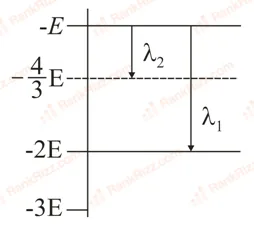
- (A)
- (B)
- (C)
- (D)
rr2.rankrizz.com/jee-main/physics/atoms-and-nuclei/q/2-apr-2017-offline-q27
- (A)
A neutron moving with a speed 'v' makes a head on collision with a stationary hydrogen atom in ground state. The minimum kinetic energy of the neutron for which perfectly inelastic collision will take place is:
- (A)
20.4 eV
- (B)
10.2 eV
- (C)
12.1 eV
- (D)
16.8 eV
rr2.rankrizz.com/jee-main/physics/atoms-and-nuclei/q/10-apr-2016-online-q26
- (A)
An electron in a hydrogen atom makes a transition from to and emits a photon. This photon strikes a doubly ionized lithium atom which was already in an excited state and completely removes the orbiting electron. The least quantum number for the excited state of the lithium-ion for the process is
- (A)
2
- (B)
4
- (C)
5
- (D)
3
rr2.rankrizz.com/jee-main/physics/atoms-and-nuclei/q/9-apr-2016-online-q26
- (A)
The de-Broglie wavelength associated with the electron in the level is:
- (A)
Half of the de-Broglie wavelength of the electron in the ground state
- (B)
Four times the de-Broglie wavelength of the electron in the ground state
- (C)
th of the de-Broglie wavelength of the electron in the ground state
- (D)
Two times the de-Broglie wavelength of the electron in the ground state
rr2.rankrizz.com/jee-main/physics/atoms-and-nuclei/q/11-apr-2015-online-q28
- (A)
If one were to apply the Bohr model to a particle of mass and charge moving in a plane under the influence of a magnetic field 'B', the energy of the charged particle in the level will be:
- (A)
- (B)
- (C)
- (D)
rr2.rankrizz.com/jee-main/physics/atoms-and-nuclei/q/10-apr-2015-online-q28
- (A)
As an electron makes a transition from an excited state to the ground state of a hydrogen-like atom/ion
- (A)
kinetic energy and total energy decrease but potential energy increases
- (B)
its kinetic energy increases but potential energy and total energy decrease
- (C)
kinetic energy, potential energy and total energy decrease
- (D)
kinetic energy decreases, potential energy increases but total energy remains same
rr2.rankrizz.com/jee-main/physics/atoms-and-nuclei/q/4-apr-2015-offline-q29
- (A)
If the binding energy of the electron in a hydrogen atom is 13.6 eV, the energy required to remove the electron from the first excited state of Li is:
- (A)
13.6 eV
- (B)
3.4 eV
- (C)
122.4 eV
- (D)
30.6 eV
rr2.rankrizz.com/jee-main/physics/atoms-and-nuclei/q/9-apr-2014-online-q27
- (A)
The radiation corresponding to transition of hydrogen atom falls on a metal surface to produce photoelectrons. These electrons are made to enter a magnetic field of T. If the radius of the largest circular path followed by these electrons is 10.0 mm, the work function of the metal is close to:
- (A)
1.8 eV
- (B)
1.1 eV
- (C)
0.8 eV
- (D)
1.6 eV
rr2.rankrizz.com/jee-main/physics/atoms-and-nuclei/q/6-apr-2014-offline-q27
- (A)
Hydrogen (), Deuterium (), singly ionised Helium () and doubly ionised lithium () all have one electron around the nucleus. Consider an electron transition from to . If the wave lengths of emitted radiation are , , and respectively then approximately which one of the following is correct?
- (A)
- (B)
- (C)
- (D)
rr2.rankrizz.com/jee-main/physics/atoms-and-nuclei/q/6-apr-2014-offline-q28
- (A)
A 12.5 eV electron beam is used to bombard gaseous hydrogen at room temperature. It will emit:
- (A)
2 lines in the Lyman series and 1 line in the Balmer series
- (B)
3 lines in the Lyman series
- (C)
1 line in the Lyman series and 2 lines in the Balmer series
- (D)
3 lines in the Balmer series
rr2.rankrizz.com/jee-main/physics/atoms-and-nuclei/q/25-apr-2013-online-q28
- (A)
In the Bohr's model of hydrogen-like atom the force between the nucleus and the electron is modified as , where is a constant. For this atom, the radius of the orbit in terms of the Bohr radius is :
- (A)
- (B)
- (C)
- (D)
rr2.rankrizz.com/jee-main/physics/atoms-and-nuclei/q/23-apr-2013-online-q27
- (A)
In the Bohr model an electron moves in a circular orbit around the proton. Considering the orbiting electron to be a circular current loop, the magnetic moment of the hydrogen atom, when the electron is in excited state, is :
- (A)
- (B)
- (C)
- (D)
rr2.rankrizz.com/jee-main/physics/atoms-and-nuclei/q/9-apr-2013-online-q27
- (A)
In a hydrogen like atom electron makes transition from an energy level with quantum number n to another with quantum number (n - 1). If n >> 1, the frequency of radiation emitted is proportional to :
- (A)
- (B)
- (C)
- (D)
rr2.rankrizz.com/jee-main/physics/atoms-and-nuclei/q/7-apr-2013-offline-q28
- (A)
Hydrogen atom is excited from ground state to another state with principal quantum number equal to . Then the number of spectral lines in the emission spectra will be
- (A)
- (B)
- (C)
- (D)
rr2.rankrizz.com/jee-main/physics/atoms-and-nuclei/q/2012-physics-499043
- (A)
The electron of a hydrogen atom makes a transition from the orbit to the orbit. For large the wavelength of the emitted radiation is proportional to
- (A)
- (B)
- (C)
- (D)
rr2.rankrizz.com/jee-main/physics/atoms-and-nuclei/q/2012-physics-499134
- (A)
A hypothetical atom has only three energy levels. The ground level has energy, eV. The two excited states have energies, eV and eV. Then which of the following wavelengths will not be present in the emission spectrum of this atom?
- (A)
nm
- (B)
nm
- (C)
nm
- (D)
nm
rr2.rankrizz.com/jee-main/physics/atoms-and-nuclei/q/2012-physics-499404
- (A)
A doubly ionised Li atom is excited from its ground state () to state. The wavelengths of the spectral lines are given by , and . The ratio and are, respectively
- (A)
- (B)
- (C)
- (D)
rr2.rankrizz.com/jee-main/physics/atoms-and-nuclei/q/2012-physics-499405
- (A)
The transition from the state to in a hydrogen like atom results in ultraviolet radiation. Infrared radiation will be obtained in the transition from
- (A)
- (B)
- (C)
- (D)
rr2.rankrizz.com/jee-main/physics/atoms-and-nuclei/q/2009-physics-499584
- (A)
Which of the following transitions in hydrogen atoms emit photons of highest frequency?
- (A)
to
- (B)
to
- (C)
to
- (D)
to
rr2.rankrizz.com/jee-main/physics/atoms-and-nuclei/q/2007-physics-499776
- (A)
The diagram shows the energy levels for an electron in a certain atom. Which transition shown represents the emission of a photon with the most energy?
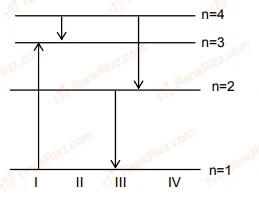
- (A)
III
- (B)
IV
- (C)
I
- (D)
II
rr2.rankrizz.com/jee-main/physics/atoms-and-nuclei/q/2005-physics-500237
- (A)
Radioactivity: decay law, half-life and decay modes 104
Two radioactive substances A and B of mass numbers 200 and 212 respectively, shows spontaneous -decay with same Q value of 1 MeV. The ratio of energies of -rays produced by A and B is __________.
- (A)
- (B)
- (C)
- (D)
rr2.rankrizz.com/jee-main/physics/atoms-and-nuclei/q/8-apr-2026-s2-q44
- (A)
An atom is bombarded by shower of fundamental particles and in 10s this atom absorbed 10 electrons, 10 protons and 9 neutrons. The surface area of the nucleons is now _____ of initial value.
- (A)
225%
- (B)
250%
- (C)
150%
- (D)
900%
rr2.rankrizz.com/jee-main/physics/atoms-and-nuclei/q/28-jan-2026-s1-q28
- (A)
A nucleus has mass number and radius Another nucleus has mass number and radius . If then is:
- (A)
1
- (B)
2
- (C)
0.5
- (D)
8
rr2.rankrizz.com/jee-main/physics/atoms-and-nuclei/q/28-jan-2026-s2-q41
- (A)
Which of the following pair of nuclei are isobars of the element?
- (A)
- (B)
- (C)
- (D)
rr2.rankrizz.com/jee-main/physics/atoms-and-nuclei/q/23-jan-2026-s2-q36
- (A)
The activity of a radioactive sample decreases to one tenth of the original activity in a period of one year. After 9 more years its activity would be
- (A)
- (B)
- (C)
- (D)
rr2.rankrizz.com/jee-main/physics/atoms-and-nuclei/q/2026-physics-515271
- (A)
For a nucleus of mass number A and radius R, the mass density of nucleus can be represented as
- (A)
- (B)
- (C)
- (D)
Independent of A
rr2.rankrizz.com/jee-main/physics/atoms-and-nuclei/q/2025-apr-8-s2-q44
- (A)
Given below are two statements : one is labelled as Assertion (A) and the other is labelled as Reason (R).
Assertion (A) : The density of the copper nucleus is greater than that of the carbon nucleus.
Reason (R) : The nucleus of mass number A has a radius proportional to .
In the light of the above statements, choose the most appropriate answer from the options given below :- (A)
(A) is correct but (R) is not correct
- (B)
(A) is not correct but (R) is correct
- (C)
Both (A) and (R) are correct and (R) is the correct explanation of (A)
- (D)
Both (A) and (R) are correct but (R) is not the correct explanation of (A)
rr2.rankrizz.com/jee-main/physics/atoms-and-nuclei/q/2025-apr-7-s2-q27
- (A)
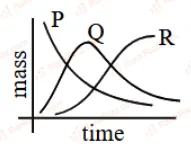
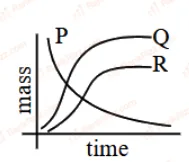
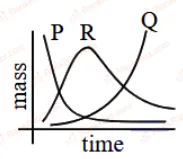
A radioactive material P first decays into Q and then Q decays to non-radioactive material R. Which of the following figure represents time dependent mass of P, Q and R?
- (A)
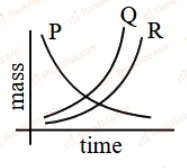
- (B)
- (C)
- (D)
rr2.rankrizz.com/jee-main/physics/atoms-and-nuclei/q/2025-apr-4-s2-q26
- (A)
Choose the correct nuclear process from the below options [p: proton, n : neutron, :electron, : positron, : neutrino, : antineutrino]
- (A)
- (B)
- (C)
- (D)
rr2.rankrizz.com/jee-main/physics/atoms-and-nuclei/q/28-jan-2025-s1-q32
- (A)
A radioactive nucleus has 3 times the decay constant as compared to the decay constant of another radioactive nucleus . If initial number of both nuclei are the same, what is the ratio of number of nuclei of to the number of nuclei of , after one half-life of ?
- (A)
1/8
- (B)
8
- (C)
4
- (D)
1/4
rr2.rankrizz.com/jee-main/physics/atoms-and-nuclei/q/23-jan-2025-s1-q40
- (A)
The radius of a nucleus of mass number is fermi. Then the mass number of another nucleus having radius of fermi is , where is _________.
Answer: ____________
rr2.rankrizz.com/jee-main/physics/atoms-and-nuclei/q/01-feb-2024-s1-q30
The mass number of nucleus having radius equal to half of the radius of nucleus with mass number 192 is:
- (A)
24
- (B)
32
- (C)
40
- (D)
20
rr2.rankrizz.com/jee-main/physics/atoms-and-nuclei/q/31-jan-2024-s2-q18
- (A)
A nucleus has mass number and volume . Another nucleus has mass number and volume . If relation between mass number is , then
Answer: ____________
rr2.rankrizz.com/jee-main/physics/atoms-and-nuclei/q/31-jan-2024-s2-q30
The half-life of a radioactive nucleus is 5 years. The fraction of the original sample that would decay in 15 years is :
- (A)
- (B)
- (C)
- (D)
rr2.rankrizz.com/jee-main/physics/atoms-and-nuclei/q/15-apr-2023-s1-q19
- (A)
Two radioactive elements A and B initially have same number of atoms. The half life of A is same as the average life of B. If and are decay constants of A and B respectively, then choose the correct relation from the given options.
- (A)
- (B)
- (C)
- (D)
rr2.rankrizz.com/jee-main/physics/atoms-and-nuclei/q/11-apr-2023-s1-q18
- (A)
The decay constant for a radioactive nuclide is s. Atomic weight of the substance is 60 g mole, . The activity of 1.0 g of the substance is _______ Bq.
Answer: ____________
rr2.rankrizz.com/jee-main/physics/atoms-and-nuclei/q/10-apr-2023-s1-q30
The half life of a radioactive substance is . The time taken, for disintegrating part of its original mass will be:
- (A)
2T
- (B)
3T
- (C)
T
- (D)
8T
rr2.rankrizz.com/jee-main/physics/atoms-and-nuclei/q/10-apr-2023-s2-q17
- (A)
A radio active material is reduced to of its original amount in 3 days. If kg of the material is left after 5 days the initial amount of the material is
- (A)
40 g
- (B)
32 g
- (C)
64 g
- (D)
256 g
rr2.rankrizz.com/jee-main/physics/atoms-and-nuclei/q/08-apr-2023-s2-q18
- (A)
A free neutron decays into a proton but a free proton does not decay into neutron. This is because
- (A)
neutron is an uncharged particle
- (B)
proton is a charged particle
- (C)
neutron is a composite particle made of a proton and an electron
- (D)
neutron has larger rest mass than proton
rr2.rankrizz.com/jee-main/physics/atoms-and-nuclei/q/31-jan-2023-s1-q18
- (A)
Given below are two statements: one is labelled as Assertion A and the other is labelled as Reason R.
Assertion A: The nuclear density of nuclides B, Li, Fe, Ne and Bi can be arranged as
Reason R: The radius of nucleus is related to its mass number as , where is a constant.
In the light of the above statement, choose the correct answer from the options given below:- (A)
Both A and R are true and R is the correct explanation of A
- (B)
A is false but R is true
- (C)
A is true but R is false
- (D)
Both A and R are true but R is NOT the correct explanation of A
rr2.rankrizz.com/jee-main/physics/atoms-and-nuclei/q/30-jan-2023-s2-q17
- (A)
A radioactive nucleus decays by two different process. The half life of the first process is minutes and that of the second process is s. The effective half-life of the nucleus is calculated to be s. The value of is ______.
Answer: ____________
rr2.rankrizz.com/jee-main/physics/atoms-and-nuclei/q/30-jan-2023-s2-q30
If a radioactive element having half-life of min is undergoing beta decay, the fraction of radioactive element remains undecayed after min will be:
- (A)
- (B)
- (C)
- (D)
rr2.rankrizz.com/jee-main/physics/atoms-and-nuclei/q/29-jan-2023-s1-q17
- (A)
A radioactive element X emits two -particles, one electron and two positrons. The product nucleus is represented by Y. The value of is ______.
Answer: ____________
rr2.rankrizz.com/jee-main/physics/atoms-and-nuclei/q/29-jan-2023-s1-q29
Substance has atomic mass number and half life of day. Another substance has atomic mass number and half life of day. If both and simultaneously start undergo radio activity at the same time with initial mass g each, how many total atoms of and combined would be left after days
- (A)
- (B)
- (C)
- (D)
rr2.rankrizz.com/jee-main/physics/atoms-and-nuclei/q/29-jan-2023-s2-q17
- (A)
The ratio of the density of oxygen nucleus (O) and helium nucleus (He) is
- (A)
4 : 1
- (B)
8 : 1
- (C)
1 : 1
- (D)
2 : 1
rr2.rankrizz.com/jee-main/physics/atoms-and-nuclei/q/25-jan-2023-s1-q18
- (A)
A nucleus disintegrates into two smaller parts, which have their velocities in the ratio 3 : 2. The ratio of their nuclear sizes will be . The value of '' is:
Answer: ____________
rr2.rankrizz.com/jee-main/physics/atoms-and-nuclei/q/25-jan-2023-s2-q21
Consider the following radioactive decay process:
The mass number and the atomic number of are given by:- (A)
210 and 82
- (B)
210 and 84
- (C)
210 and 80
- (D)
211 and 80
rr2.rankrizz.com/jee-main/physics/atoms-and-nuclei/q/24-jan-2023-s1-q18
- (A)
Consider the following radioactive decay process:
The mass number and the atomic number of are given by:- (A)
210 and 82
- (B)
210 and 84
- (C)
210 and 80
- (D)
211 and 80
rr2.rankrizz.com/jee-main/physics/atoms-and-nuclei/q/24-jan-2023-s1-q18-494033
- (A)
Assume that protons and neutrons have equal masses. Mass of a nucleon is kg and radius of nucleus is m. The approximate ratio of the nuclear density and water density is . The value of n is _____.
Answer: ____________
rr2.rankrizz.com/jee-main/physics/atoms-and-nuclei/q/24-jan-2023-s1-q30
Assume that protons and neutrons have equal masses. Mass of a nucleon is kg and radius of nucleus is m. The approximate ratio of the nuclear density and water density is . The value of is _____.
Answer: ____________
rr2.rankrizz.com/jee-main/physics/atoms-and-nuclei/q/24-jan-2023-s1-q30-494045
Read the following statements:
(A) Volume of the nucleus is directly proportional to the mass number.
(B) Volume of the nucleus is independent of mass number.
(C) Density of the nucleus is directly proportional to the mass number.
(D) Density of the nucleus is directly proportional to the cube root of the mass number.
(E) Density of the nucleus is independent of the mass number.
Choose the correct option from the following options.- (A)
(A) and (D) only
- (B)
(A) and (E) only
- (C)
(B) and (E) only
- (D)
(A) and (C) only
rr2.rankrizz.com/jee-main/physics/atoms-and-nuclei/q/29-jul-2022-s2-q20
- (A)
Two radioactive materials A and B have decay constants and respectively. If initially they have the same number of nuclei, then the ratio of the number of nuclei of B to that of A will be 'e' after a time . The value of a is _____
Answer: ____________
rr2.rankrizz.com/jee-main/physics/atoms-and-nuclei/q/29-jul-2022-s2-q28
The half life period of a radioactive substance is 60 days. The time taken for th of its original mass to disintegrate will be:
- (A)
120 days
- (B)
130 days
- (C)
180 days
- (D)
20 days
rr2.rankrizz.com/jee-main/physics/atoms-and-nuclei/q/28-jul-2022-s1-q18
- (A)
A freshly prepared radioactive source of half life 2 hours 30 minutes emits radiation which is 64 times the permissible safe level. The minimum time, after which it would be possible to work safely with source, will be _____ hours.
Answer: ____________
rr2.rankrizz.com/jee-main/physics/atoms-and-nuclei/q/28-jul-2022-s1-q30
A radioactive sample decays times its original quantity in 15 minutes. The half-life of the sample is
- (A)
5 min
- (B)
7.5 min
- (C)
15 min
- (D)
30 min
rr2.rankrizz.com/jee-main/physics/atoms-and-nuclei/q/28-jul-2022-s2-q18
- (A)
What is the half-life period of a radioactive material if its activity drops to of its initial value of years?
- (A)
years
- (B)
years
- (C)
years
- (D)
years
rr2.rankrizz.com/jee-main/physics/atoms-and-nuclei/q/27-jul-2022-s1-q18
- (A)
The activity of a radioactive material is curie. Its half life is 5 days. The activity will become curie after
- (A)
7 days
- (B)
15 days
- (C)
25 days
- (D)
35 days
rr2.rankrizz.com/jee-main/physics/atoms-and-nuclei/q/27-jul-2022-s2-q18
- (A)
The disintegration rate of a certain radioactive sample at any instant is disintegrations per minute. minutes later, the rate becomes disintegrations per minute. The approximate decay constant is (Take )
- (A)
- (B)
- (C)
- (D)
rr2.rankrizz.com/jee-main/physics/atoms-and-nuclei/q/26-jul-2022-s1-q18
- (A)
Mass numbers of two nuclei are in the ratio of . Their nuclear densities will be in the ratio of
- (A)
- (B)
- (C)
- (D)
rr2.rankrizz.com/jee-main/physics/atoms-and-nuclei/q/26-jul-2022-s2-q18
- (A)
The activity of a radioactive material is Ci. If the half life of the material is 5 days, after how many days the activity will become Ci?
- (A)
30 days
- (B)
35 days
- (C)
40 days
- (D)
25 days
rr2.rankrizz.com/jee-main/physics/atoms-and-nuclei/q/29-jun-2022-s1-q19
- (A)
In the following nuclear reaction,
Mass number of is 182 and atomic number is 74. Mass number and atomic number of respectively will be- (A)
174 and 71
- (B)
174 and 69
- (C)
172 and 69
- (D)
172 and 71
rr2.rankrizz.com/jee-main/physics/atoms-and-nuclei/q/29-jun-2022-s2-q19
- (A)
The half life of a radioactive substance is 5 years. After years a given sample of the radioactive substance gets reduced to 6.25% of its initial value. The value of is ______.
Answer: ____________
rr2.rankrizz.com/jee-main/physics/atoms-and-nuclei/q/29-jun-2022-s2-q28
Following statements related to radioactivity are given below:
(A) Radioactivity is a random and spontaneous process and is dependent on physical and chemical conditions.
(B) The number of undecayed nuclei in the radioactive sample decays exponentially with time.
(C) Slope of the graph of (no. of undecayed nuclei) vs. time represents the reciprocal of mean life time ().
(D) Product of decay constant () and half-life time is not constant.
Choose the most appropriate answer from the options given below:- (A)
(A) and (B) only
- (B)
(B) and (D) only
- (C)
(B) and (C) only
- (D)
(C) and (D) only
rr2.rankrizz.com/jee-main/physics/atoms-and-nuclei/q/28-jun-2022-s2-q18
- (A)
How many alpha and beta particles are emitted when Uranium decays to lead ?
- (A)
3 alpha particles and 5 beta particles
- (B)
6 alpha particles and 4 beta particles
- (C)
4 alpha particles and 5 beta particles
- (D)
8 alpha particles and 6 beta particles
rr2.rankrizz.com/jee-main/physics/atoms-and-nuclei/q/26-jun-2022-s1-q18
- (A)
A radioactive nucleus can decay by two different processes. Half-life for the first process is hours while it is hours for the second process. The effective halflife of the nucleus will be
- (A)
hours
- (B)
hours
- (C)
hours
- (D)
hours
rr2.rankrizz.com/jee-main/physics/atoms-and-nuclei/q/26-jun-2022-s2-q18
- (A)
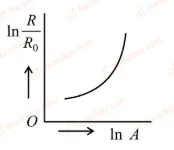
Which of the following figure represents the variation of with (if = radius of a nucleus and = its mass number)?
- (A)
- (B)
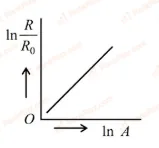
- (C)
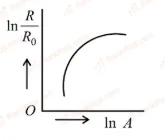
- (D)
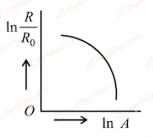
rr2.rankrizz.com/jee-main/physics/atoms-and-nuclei/q/25-jun-2022-s2-q18
- (A)
A sample contains kg each of two substances and with half lives s and s respectively. The ratio of their atomic weights is . The ratio of the amounts of and after s is . The value of is ______.
Answer: ____________
rr2.rankrizz.com/jee-main/physics/atoms-and-nuclei/q/24-jun-2022-s2-q28
The half life period of a radioactive element is same as the mean life time of another radioactive element . Initially they have the same number of atoms. Then:
- (A)
and decay at the same rate always.
- (B)
-will decay faster than .
- (C)
-will decay faster than .
- (D)
and have same decay rate initially and later on different decay rate.
rr2.rankrizz.com/jee-main/physics/atoms-and-nuclei/q/1-sep-2021-s2-q19
- (A)
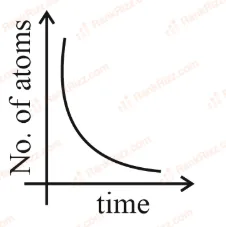
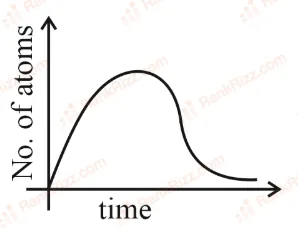
A sample of a radioactive nucleus disintegrates to another radioactive nucleus , which in turn disintegrates to some other stable nucleus . Plot of a graph showing the variation of number of atoms of nucleus versus time is: (Assume that at , there are no atoms in the sample)
- (A)
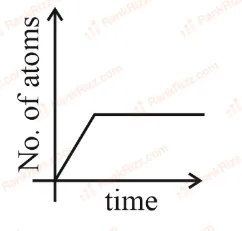
- (B)
- (C)
- (D)
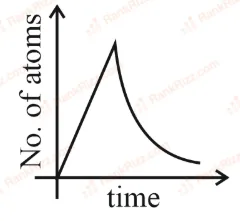
rr2.rankrizz.com/jee-main/physics/atoms-and-nuclei/q/31-aug-2021-s1-q18
- (A)
There are radioactive nuclei in a given radioactive element. Its half-life time is 1 min. How many nuclei will remain after 30 s?
- (A)
- (B)
- (C)
- (D)
rr2.rankrizz.com/jee-main/physics/atoms-and-nuclei/q/27-aug-2021-s1-q19
- (A)
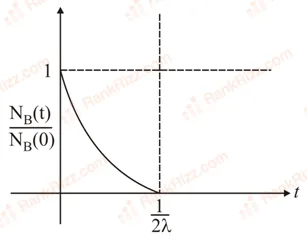
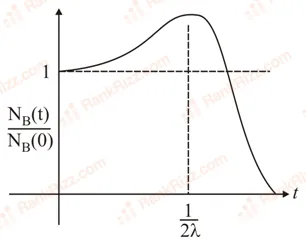
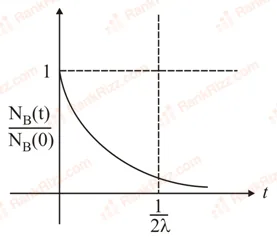
At time , a material is composed of two radioactive atoms and , where . The decay constant of both kind of radioactive atoms is . However, disintegrates to and disintegrates to . Which of the following figures represents the evolution of with respect to time ?
- (A)
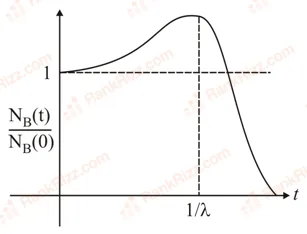
- (B)
- (C)
- (D)
rr2.rankrizz.com/jee-main/physics/atoms-and-nuclei/q/26-aug-2021-s2-q18
- (A)
If denotes the ratio of the number of nuclei decayed to the number of nuclei at , then for a collection of radioactive nuclei, the rate of change of with respect to time is given as: [ is the radioactive decay constant]
- (A)
- (B)
- (C)
- (D)
rr2.rankrizz.com/jee-main/physics/atoms-and-nuclei/q/27-jul-2021-s1-q19
- (A)
A radioactive sample has an average life of 30 ms and is decaying. A capacitor of capacitance 200 F is first charged and later connected with resistor . If the ratio of the charge on the capacitor to the activity of the radioactive sample is fixed with respect to time then the value of should be _________ .
Answer: ____________
rr2.rankrizz.com/jee-main/physics/atoms-and-nuclei/q/27-jul-2021-s1-q28
Consider the following statements:
A. Atoms of each element emit characteristics spectrum.
B. According to Bohr's Postulate, an electron in a hydrogen atom revolves in a certain stationary orbit.
C. The density of nuclear matter depends on the size of the nucleus.
D. A free neutron is stable but a free proton decay is possible.
E. Radioactivity is an indication of the instability of nuclei. Choose the correct answer from the options given below.- (A)
and
- (B)
and only.
- (C)
and only
- (D)
and only
rr2.rankrizz.com/jee-main/physics/atoms-and-nuclei/q/27-jul-2021-s2-q19
- (A)
Some nuclei of a radioactive material are undergoing radioactive decay. The time gap between the instances when a quarter of the nuclei have decayed and when half of the nuclei have decayed is given as: (where is the decay constant)
- (A)
- (B)
- (C)
- (D)
rr2.rankrizz.com/jee-main/physics/atoms-and-nuclei/q/25-jul-2021-s1-q17
- (A)
The half-life of Au is 3 days. If atomic weight of Au is 198 g mol, then the activity of 2 mg of Au is [in disintegration second]:
- (A)
- (B)
- (C)
- (D)
rr2.rankrizz.com/jee-main/physics/atoms-and-nuclei/q/25-jul-2021-s1-q18
- (A)
The nuclear activity of a radioactive element becomes of its initial value in 30 years. The half-life of radioactive element is _________ years.
Answer: ____________
rr2.rankrizz.com/jee-main/physics/atoms-and-nuclei/q/25-jul-2021-s2-q28
A radioactive material decays by simultaneous emissions of two particles with half lives of 1400 years and 700 years, respectively. What will be the time after the which one third of the material remains? (Take ln 3 = 1.1)
- (A)
1110 years
- (B)
700 years
- (C)
340 years
- (D)
740 years
rr2.rankrizz.com/jee-main/physics/atoms-and-nuclei/q/20-jul-2021-s1-q18
- (A)
For a certain radioactive process, the graph between ln R and (sec) is obtained as shown in the figure. Then the value of half life for the unknown radioactive material is approximately:
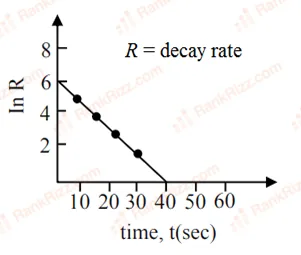
- (A)
9.15 sec
- (B)
6.93 sec
- (C)
2.62 sec
- (D)
4.62 sec
rr2.rankrizz.com/jee-main/physics/atoms-and-nuclei/q/20-jul-2021-s2-q20
- (A)
A radioactive substance decays to of its initial activity in 80 days. The half life of the radioactive substance expressed in days is ___.
Answer: ____________
rr2.rankrizz.com/jee-main/physics/atoms-and-nuclei/q/20-jul-2021-s2-q28
The decay of a proton to neutron is :
- (A)
not possible as proton mass is less than the neutron mass
- (B)
possible only inside the nucleus
- (C)
not possible but neutron to proton conversion is possible
- (D)
always possible as it is associated only with decay
rr2.rankrizz.com/jee-main/physics/atoms-and-nuclei/q/18-mar-2021-s2-q19
- (A)
The half-life of is 2.7 days. The activity of 1.50 mg of , if its atomic weight is 198 g mol is, ( mol)
- (A)
240 Ci
- (B)
357 Ci
- (C)
535 Ci
- (D)
252 Ci
rr2.rankrizz.com/jee-main/physics/atoms-and-nuclei/q/16-mar-2021-s2-q17
- (A)
Calculate the time interval between 33% decay and 67% decay if half-life of a substance is 20 min.
- (A)
60 min
- (B)
20 min
- (C)
40 min
- (D)
13 min
rr2.rankrizz.com/jee-main/physics/atoms-and-nuclei/q/16-mar-2021-s2-q18
- (A)
A radioactive sample is undergoing decay. At any time , its activity is and another time , the activity is . What is the average life time for the sample?
- (A)
- (B)
- (C)
- (D)
rr2.rankrizz.com/jee-main/physics/atoms-and-nuclei/q/26-feb-2021-s2-q19
- (A)
Two radioactive substances and originally have and nuclei respectively. Half life of is half of the half life of . After three half lives of , number of nuclei of both are equal. The ratio will be equal to:
- (A)
- (B)
- (C)
- (D)
rr2.rankrizz.com/jee-main/physics/atoms-and-nuclei/q/25-feb-2021-s1-q17
- (A)
Given the masses of various atomic particles , , , , , where p = proton, n = neutron, e = electron, = antineutrino and d = deuteron. Which of the following process is allowed by momentum and energy conservation:
- (A)
deuterium atom (electron bound to the nucleus)
- (B)
- (C)
- (D)
rr2.rankrizz.com/jee-main/physics/atoms-and-nuclei/q/6-sep-2020-s2-q19
- (A)
Activities of three radioactive substances , and are represented by the curves , and , in the figure. Then their half-lives are in the ratio:
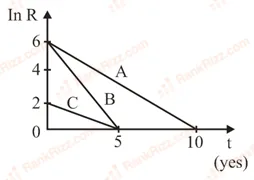
- (A)
- (B)
- (C)
- (D)
rr2.rankrizz.com/jee-main/physics/atoms-and-nuclei/q/5-sep-2020-s1-q19
- (A)
A radioactive nucleus decays by two different processes. The half-life for the first process is and that for the second is . The effective half-life of the nucleus is close to:
- (A)
9 s
- (B)
6 s
- (C)
55 s
- (D)
12 s
rr2.rankrizz.com/jee-main/physics/atoms-and-nuclei/q/5-sep-2020-s2-q19
- (A)
In a radioactive material, a fraction of active material remaining after the time is . The fraction that was remaining after the time is:
- (A)
- (B)
- (C)
- (D)
rr2.rankrizz.com/jee-main/physics/atoms-and-nuclei/q/3-sep-2020-s1-q18
- (A)
The radius R of a nucleus of mass number A can be estimated by the formula m. It follows that the mass density of n nucleus is of the order of: kg)
- (A)
kg m
- (B)
kg m
- (C)
kg m
- (D)
kg m
rr2.rankrizz.com/jee-main/physics/atoms-and-nuclei/q/3-sep-2020-s2-q19
- (A)
The activity of a radioactive sample falls from 700 s to 500 s in 30 minutes. Its half life is close to:
- (A)
72 min
- (B)
62 min
- (C)
66 min
- (D)
52 min
rr2.rankrizz.com/jee-main/physics/atoms-and-nuclei/q/7-jan-2020-s2-q20
- (A)
Half lives of two radioactive nuclei A and B are 10 minutes and 20 minutes, respectively. If, initially a sample has equal number of nuclei, then after 60 minutes, the ratio of decayed numbers of nuclei A and B will be:
- (A)
3 : 8
- (B)
8 : 1
- (C)
1 : 8
- (D)
9 : 8
rr2.rankrizz.com/jee-main/physics/atoms-and-nuclei/q/12-apr-2019-s2-q27
- (A)
Two radioactive materials A and B have decay constants and , respectively. If initially they have the same number of nuclei, then the ratio of the number of nuclei of A to that of B will be 1/e after a time:
- (A)
- (B)
- (C)
- (D)
rr2.rankrizz.com/jee-main/physics/atoms-and-nuclei/q/10-apr-2019-s1-q27
- (A)
Two radioactive substances A and B have decay constants and respectively. At t = 0, a sample has the same number of the two nuclei. The time taken for the ratio of the number of nuclei to become will be
- (A)
- (B)
- (C)
- (D)
rr2.rankrizz.com/jee-main/physics/atoms-and-nuclei/q/10-apr-2019-s2-q29
- (A)
The ratio of mass densities of nuclei of Ca and O is close to:
- (A)
1
- (B)
0.1
- (C)
2
- (D)
5
rr2.rankrizz.com/jee-main/physics/atoms-and-nuclei/q/8-apr-2019-s2-q28
- (A)
In a radioactive decay chain, the initial nucleus is . At the end, there are 6 -particles and 4-particles which are emitted. If the end nucleus is , A and Z are given by:
- (A)
A = 208; Z = 82
- (B)
A = 208; Z = 80
- (C)
A = 200; Z = 81
- (D)
A = 202; Z = 80
rr2.rankrizz.com/jee-main/physics/atoms-and-nuclei/q/12-jan-2019-s2-q27
- (A)
Using a nuclear counter the count rate of emitted particles from a radioactive source is measured. At it was 1600 counts per second and seconds it was 100 counts per second. The count rate observed, as counts per second, at seconds is close to:
- (A)
400
- (B)
200
- (C)
150
- (D)
360
rr2.rankrizz.com/jee-main/physics/atoms-and-nuclei/q/10-jan-2019-s1-q27
- (A)
A Sample of radioactive material A, that has an activity of 10 mCi (1 Ci decays s), has twice the number of nuclei as another sample of a different radioactive material B which has an activity of 20 mCi. The correct choices for half-lives of A and B would then be, respectively:
- (A)
5 days and 10 days
- (B)
10 days and 40 days
- (C)
20 days and 10 days
- (D)
20 days and 5 days
rr2.rankrizz.com/jee-main/physics/atoms-and-nuclei/q/9-jan-2019-s1-q30
- (A)
At a given instant, say , two radioactive substance A and B have equal activities. The ratio of their activities after time itself decays with time as . If the half-life of A is , the half-life of B is:
- (A)
- (B)
- (C)
- (D)
rr2.rankrizz.com/jee-main/physics/atoms-and-nuclei/q/9-jan-2019-s2-q27
- (A)
Both the nucleus and the atom of some element are in their respective first excited states. They get de-excited by emitting photons of wavelengths , respectively. The ratio is closest to:
- (A)
- (B)
- (C)
10
- (D)
rr2.rankrizz.com/jee-main/physics/atoms-and-nuclei/q/16-apr-2018-online-q27
- (A)
At some instant, a radioactive sample S having an activity 5Ci has twice the number of nuclei as another sample S which has an activity of 10Ci. The half lives of S and S are:
- (A)
4 : 1
- (B)
1 : 4
- (C)
1 : 2
- (D)
2 : 1
rr2.rankrizz.com/jee-main/physics/atoms-and-nuclei/q/16-apr-2018-online-q28
- (A)
A solution containing active cobalt Co having activity of 0.8 Ci and decay constant is injected in an animal's body. If 1 cm of blood is drawn from the animal's body after 10 hrs of injection, the activity found was 300 decays per minute. What is the volume of blood that is flowing in the body? (1 Ci = decay per second and at t = 10 hrs the value of = 0.84)
- (A)
6 litres
- (B)
7 litres
- (C)
4 litres
- (D)
5 litres
rr2.rankrizz.com/jee-main/physics/atoms-and-nuclei/q/15-apr-2018-s1-q27
- (A)
An unstable heavy nucleus at rest breaks into two nuclei which move away with velocities in the ratio of 8 : 27. The ratio of the radii of the nuclei (assumed to be spherical) is:
- (A)
8 : 27
- (B)
2 : 3
- (C)
3 : 2
- (D)
4 : 9
rr2.rankrizz.com/jee-main/physics/atoms-and-nuclei/q/15-apr-2018-s2-q28
- (A)
A radioactive nucleus with a half-life , decays into a nucleus . At , there is no nucleus . At some time , the ratio of the number of to that of is 0.3. Then, is given by: (Consider )
- (A)
- (B)
- (C)
- (D)
rr2.rankrizz.com/jee-main/physics/atoms-and-nuclei/q/2-apr-2017-offline-q28
- (A)
Half-lives of two radioactive elements A and B are 20 minutes and 40 minutes, respectively. Initially, the samples have an equal number of nuclei. After 80 minutes, the ratio of decayed numbers of A and B nuclei will be:
- (A)
1 : 4
- (B)
5 : 4
- (C)
1 : 16
- (D)
4 : 1
rr2.rankrizz.com/jee-main/physics/atoms-and-nuclei/q/3-apr-2016-offline-q24
- (A)
Let be the number of particle emitted by 1 gram of Na radioactive nuclei having a half life of 15 h. In 7.5 h, the number is close to mole
- (A)
- (B)
- (C)
- (D)
rr2.rankrizz.com/jee-main/physics/atoms-and-nuclei/q/11-apr-2015-online-q29
- (A)
A piece of wood from a recently cut tree shows 20 decays per minute. A wooden piece of the same size placed in a museum (obtained from a tree cut many years back) shows 2 decays per minute. If the half-life of C is 5730 years, then the age of the wooden piece placed in the museum is approximately: [This question was awarded a bonus and proper correction was made to avoid that]
- (A)
10439 years
- (B)
39049 years
- (C)
19042 years
- (D)
13094 years
rr2.rankrizz.com/jee-main/physics/atoms-and-nuclei/q/19-apr-2014-online-q27
- (A)
A piece of bone of an animal from a ruin is found to have C activity of 12 disintegrations per minute per gm of its carbon content. The C activity of a living animal is 16 disintegrations per minute per gm. How long ago nearly did the animal die? (Given half life of C is = 5760 years)
- (A)
1672 years
- (B)
2391 years
- (C)
3291 years
- (D)
4453 years
rr2.rankrizz.com/jee-main/physics/atoms-and-nuclei/q/12-apr-2014-online-q29
- (A)
A radioactive nuclei with decay constant 0.5/s is being produced at a constant rate of 100 nuclei/s. If at t = 0 there were no nuclei, the time when there are 50 nuclei is:
- (A)
1 s
- (B)
s
- (C)
s
- (D)
s
rr2.rankrizz.com/jee-main/physics/atoms-and-nuclei/q/11-apr-2014-online-q29
- (A)
The half-life of a radioactive element A is the same as the mean-life of another radioactive element B. Initially both substances have the same number of atoms, then :
- (A)
A and B decay at the same rate always.
- (B)
A and B decay at the same rate initially.
- (C)
A will decay at a faster rate than B.
- (D)
B will decay at a faster rate than A.
rr2.rankrizz.com/jee-main/physics/atoms-and-nuclei/q/22-apr-2013-online-q29
- (A)
A sample originally contained radioactive atoms, which emit -particles. The ratio of particles emitted in the third year to that emitted during the second year is 0.3. How many particles were emitted in the first year?
- (A)
- (B)
- (C)
- (D)
rr2.rankrizz.com/jee-main/physics/atoms-and-nuclei/q/2012-physics-499136
- (A)
The counting rate observed from a radioactive source at was 1600 counts s, and s, it was 100 counts s. The counting rate observed as counts s at s will be
- (A)
250
- (B)
400
- (C)
300
- (D)
200
rr2.rankrizz.com/jee-main/physics/atoms-and-nuclei/q/2012-physics-499207
- (A)
The decay constants of a radioactive substance for and emission are and respectively. If the substance emits and simultaneously, then the average half life of the material will be
- (A)
- (B)
- (C)
- (D)
rr2.rankrizz.com/jee-main/physics/atoms-and-nuclei/q/2012-physics-499307
- (A)
Which of the following Statements is correct?
- (A)
The rate of radioactive decay cannot be controlled but that of nuclear fission can be controlled.
- (B)
Nuclear forces are short range, attractive and charge dependent.
- (C)
Nuclei of atoms having same number of neutrons are known as isobars.
- (D)
Wavelength of matter waves is given by de Broglie formula but that of photons is not given by the same formula.
rr2.rankrizz.com/jee-main/physics/atoms-and-nuclei/q/2012-physics-499406
- (A)
The half life of a radioactive substance is 20 minutes. The approximate time interval between the time when of it has decayed and time and of it had decayed is:
- (A)
- (B)
- (C)
- (D)
rr2.rankrizz.com/jee-main/physics/atoms-and-nuclei/q/2011-physics-499496
- (A)
A radioactive nucleus (initial mass number and atomic number ) emits 3 -particles and 2 positrons. The ratio of number of neutrons to that of protons in the final nucleus will be
- (A)
- (B)
- (C)
- (D)
rr2.rankrizz.com/jee-main/physics/atoms-and-nuclei/q/2010-physics-499660
- (A)
In gamma ray emission from a nucleus
- (A)
both the neutron number and the proton number change
- (B)
there is no change in the proton number and the neutron number.
- (C)
only the neutron number changes
- (D)
only the proton number changes
rr2.rankrizz.com/jee-main/physics/atoms-and-nuclei/q/2007-physics-499778
- (A)
The half-life period of a radio-active element is same as the mean life time of another radioactive element . Initially they have the same number of atoms. Then
- (A)
will decay faster than
- (B)
will decay faster than
- (C)
and have same decay rate initially
- (D)
and decay at same rate always.
rr2.rankrizz.com/jee-main/physics/atoms-and-nuclei/q/2007-physics-499779
- (A)
The energy spectrum of -particles [number as a function of -energy ] emitted from a radioactive source is
- (A)
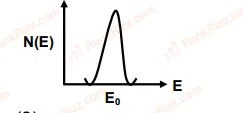
- (B)
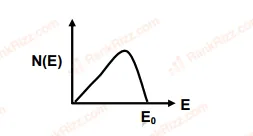
- (C)
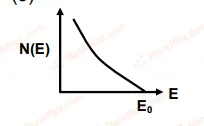
- (D)
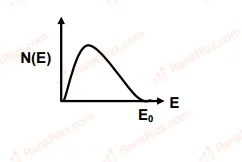
rr2.rankrizz.com/jee-main/physics/atoms-and-nuclei/q/2006-physics-500014
- (A)
When nuclei are bombarded by protons, and the resultant nuclei are , the emitted particles will be
- (A)
neutrons
- (B)
alpha particles
- (C)
beta particles
- (D)
gamma photons
rr2.rankrizz.com/jee-main/physics/atoms-and-nuclei/q/2006-physics-500015
- (A)
The 'rad' is the correct unit used to report the measurement of
- (A)
the rate of decay of radioactive source
- (B)
the ability of a beam of gamma ray photons to produce ions in a target
- (C)
the energy delivered by radiation to a target.
- (D)
the biological effect of radiation
rr2.rankrizz.com/jee-main/physics/atoms-and-nuclei/q/2006-physics-500017
- (A)
The intensity of gamma radiation from a given source is . On passing through mm of lead, it is reduced to . The thickness of lead which will reduce the intensity to will be
- (A)
mm
- (B)
mm
- (C)
mm
- (D)
mm
rr2.rankrizz.com/jee-main/physics/atoms-and-nuclei/q/2005-physics-500239
- (A)
Starting with a sample of pure Cu, of it decays into Zn in minutes. The corresponding half-life is
- (A)
minutes
- (B)
minutes
- (C)
minutes
- (D)
minutes
rr2.rankrizz.com/jee-main/physics/atoms-and-nuclei/q/2005-physics-500241
- (A)
A nuclear transformation is denoted by . Which of the following is the nucleus of element ?
- (A)
- (B)
- (C)
- (D)
rr2.rankrizz.com/jee-main/physics/atoms-and-nuclei/q/2005-physics-500245
- (A)
Nuclear size, mass defect and binding energy 54
The energy released when kg of Li is converted into He by proton bombardment is eV. The value of is _______. (Nearest integer)
(Mass of Li = 7.0183 u, mass of He = 4.004 u, mass of proton = 1.008 u and 1 u = 931 MeV/c and Avogadro number = )Answer: ____________
rr2.rankrizz.com/jee-main/physics/atoms-and-nuclei/q/6-apr-2026-s1-q48
The energy released if hydrogen atoms are combined to form He is __________ MeV. (Take binding energies per nucleon of H and He as 1.1 MeV and 7.2 MeV, respectively)
- (A)
6.1
- (B)
24.4
- (C)
26.6
- (D)
5
rr2.rankrizz.com/jee-main/physics/atoms-and-nuclei/q/6-apr-2026-s2-q41
- (A)
Assuming the experimental mass of as 12 u, The mass defect of atom is (in MeV/) :
(Mass of proton = 1.00727 u, mass of neutron = 1.00866 u, 1 u = 931.5MeV/ and c is the speed of the light in vacuum).- (A)
- (B)
- (C)
- (D)
rr2.rankrizz.com/jee-main/physics/atoms-and-nuclei/q/5-apr-2026-s2-q44
- (A)
Two nuclei of mass number 3 combine with another nucleus of mass number 4 to yield a nucleus of mass number 10. If the binding energy per nucleon for the mass numbers 3, 4 and 10 are 5.6 MeV, 7.4 MeV and 6.1 MeV, respectively, then in the process, = _____ MeV.
- (A)
- (B)
- (C)
- (D)
rr2.rankrizz.com/jee-main/physics/atoms-and-nuclei/q/4-apr-2026-s1-q29
- (A)
The binding energy per nucleon of is _________ MeV. [Take u, u, u, u MeV/c]
- (A)
- (B)
- (C)
- (D)
rr2.rankrizz.com/jee-main/physics/atoms-and-nuclei/q/2-apr-2026-s2-q44
- (A)
Given below are two statements:
Statement I: For all elements, greater the mass of the nucleus, greater is the binding energy per nucleon.
Statement II: For all elements, nuclei with less binding energy per nucleon transforms to nuclei with greater binding energy per nucleon.
In the light of the above statements, choose the correct answer from the options given below- (A)
Statement I is true but Statement II is false
- (B)
Both Statement I and Statement II are true
- (C)
Both Statement I and Statement II are false
- (D)
Statement I is false but Statement II is true
rr2.rankrizz.com/jee-main/physics/atoms-and-nuclei/q/24-jan-2026-s1-q43
- (A)
The binding energy for the following nuclear reactions are expressed in MeV.
MeV
MeV
If , , denote the stability of and respectively, then the correct order is :- (A)
- (B)
- (C)
- (D)
rr2.rankrizz.com/jee-main/physics/atoms-and-nuclei/q/24-jan-2026-s2-q29
- (A)
The average energy released per fission for the nucleus of is 190 MeV.
When all the atoms of 47g pure undergo fission process, the energy released is MeV. The value of is ______.
(Avogadro Number = 6 per mole)Answer: ____________
rr2.rankrizz.com/jee-main/physics/atoms-and-nuclei/q/23-jan-2026-s2-q49
The minimum frequency of photon required to break a particle of mass 15.348 amu into particles is ____ kHz.
[mass of He nucleus and ]- (A)
- (B)
- (C)
- (D)
rr2.rankrizz.com/jee-main/physics/atoms-and-nuclei/q/22-jan-2026-s1-q38
- (A)
Match the LIST-I with LIST-II.
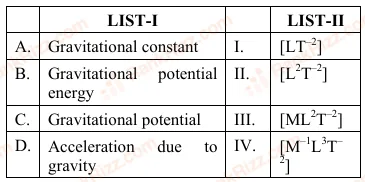
Choose the correct answer from the options given below :- (A)
A-IV, B-III, C-II, D-I
- (B)
A-III, B-II, C-I, D-IV
- (C)
A-II, B-IV, C-III, D-I
- (D)
A-I, B-III, C-IV, D-II
rr2.rankrizz.com/jee-main/physics/atoms-and-nuclei/q/2025-apr-03-s1-q34
- (A)
Energy released when two deuterons fuse to form a helium nucleus is :
(Given : Binding energy per nucleon of MeV and binding energy per nucleon of MeV)- (A)
MeV
- (B)
MeV
- (C)
MeV
- (D)
MeV
rr2.rankrizz.com/jee-main/physics/atoms-and-nuclei/q/2025-apr-02-s2-q37
- (A)
Given below are two statements. One is labelled as Assertion (A) and the other is labelled as Reason (R). Assertion (A) : The binding energy per nucleon is found to be practically independent of the atomic number A, for nuclei with mass numbers between 30 and 170. Reason (R): Nuclear force is long range. In the light of the above statements, choose the correct answer from the options given below :
- (A)
(A) is true but (R) is false
- (B)
(A) is false but (R) is true
- (C)
Both (A) and (R) are true and (R) is the correct explanation of (A)
- (D)
Both (A) and (R) are true but (R) is NOT the correct explanation of (A)
rr2.rankrizz.com/jee-main/physics/atoms-and-nuclei/q/23-jan-2025-s2-q40
- (A)
The energy equivalent of g of substance is :
- (A)
MeV
- (B)
MeV
- (C)
MeV
- (D)
eV
rr2.rankrizz.com/jee-main/physics/atoms-and-nuclei/q/9-apr-2024-s1-q18
- (A)
A star has helium composition. It starts to convert three He into one C via triple alpha process as He He He C . The mass of the star is kg and it generates energy at the rate of W. The rate of converting these He to C is s, where n is ________ [Take, mass of He u, mass of C u]
Answer: ____________
rr2.rankrizz.com/jee-main/physics/atoms-and-nuclei/q/9-apr-2024-s1-q30
A nucleus at rest disintegrates into two smaller nuclei with their masses in the ratio of . After disintegration they will move :
- (A)
in the same direction with same speed.
- (B)
in opposite directions with the same speed.
- (C)
in opposite directions with speed in the ratio of respectively.
- (D)
in opposite directions with speed in the ratio of respectively.
rr2.rankrizz.com/jee-main/physics/atoms-and-nuclei/q/9-apr-2024-s2-q17
- (A)
The energy released in the fusion of of hydrogen deep in the sun is and the energy released in the fission of of is . The ratio is approximately: (Consider the fusion reaction as , energy released in the fission reaction of is per fission nucleus and )
- (A)
7.62
- (B)
25.6
- (C)
15.04
- (D)
9.13
rr2.rankrizz.com/jee-main/physics/atoms-and-nuclei/q/9-apr-2024-s2-q18
- (A)
Binding energy of a certain nucleus is . How much is the difference between total mass of all the nucleons and nuclear mass of the given nucleus:
- (A)
- (B)
- (C)
- (D)
rr2.rankrizz.com/jee-main/physics/atoms-and-nuclei/q/8-apr-2024-s1-q18
- (A)
If is the mass of isotope , and are the masses of proton and neutron, then nuclear binding energy of isotope is :
- (A)
- (B)
- (C)
- (D)
rr2.rankrizz.com/jee-main/physics/atoms-and-nuclei/q/8-apr-2024-s2-q17
- (A)
In a hypothetical fission reaction . The identity of emitted particles (R) is :
- (A)
Electron
- (B)
Neutron
- (C)
-radiations
- (D)
Proton
rr2.rankrizz.com/jee-main/physics/atoms-and-nuclei/q/8-apr-2024-s2-q18
- (A)
If three helium nuclei combine to form a carbon nucleus then the energy released in this reaction is ______ . (Given , atomic mass of helium )
Answer: ____________
rr2.rankrizz.com/jee-main/physics/atoms-and-nuclei/q/5-apr-2024-s1-q30
Which of the following nuclear fragments corresponding to nuclear fission between neutron and uranium isotope is correct:
- (A)
- (B)
- (C)
- (D)
rr2.rankrizz.com/jee-main/physics/atoms-and-nuclei/q/04-apr-2024-s1-q19
- (A)
The disintegration energy for the nuclear fission of is _____ MeV. Given atomic masses of u; u; u; u, Value of MeV/u
Answer: ____________
rr2.rankrizz.com/jee-main/physics/atoms-and-nuclei/q/04-apr-2024-s2-q30
The mass defect in a particular reaction is g. The amount of energy liberated is kW h, where = _____. (speed of light )
Answer: ____________
rr2.rankrizz.com/jee-main/physics/atoms-and-nuclei/q/31-jan-2024-s1-q30
In a nuclear fission reaction of an isotope of mass , three similar daughter nuclei of same mass are formed. The speed of a daughter nuclei in terms of mass defect will be:
- (A)
- (B)
- (C)
- (D)
rr2.rankrizz.com/jee-main/physics/atoms-and-nuclei/q/30-jan-2024-s2-q18
- (A)
The explosive in a Hydrogen bomb is a mixture of , and in some condensed form. The chain reaction is given by ;
During the explosion the energy released is approximately [Given: amu, amu, amu and amu MeV]- (A)
MeV
- (B)
MeV
- (C)
MeV
- (D)
MeV
rr2.rankrizz.com/jee-main/physics/atoms-and-nuclei/q/29-jan-2024-s1-q19
- (A)
In a nuclear fission process, a high mass nuclide with binding energy MeV/Nucleon dissociated into two middle mass nuclides , having binding energy of MeV/Nucleon. The energy released in the process would be _______ MeV.
Answer: ____________
rr2.rankrizz.com/jee-main/physics/atoms-and-nuclei/q/27-jan-2024-s1-q30
The atomic mass of is 12.000000 u and that of is 13.003354 u. The required energy to remove a neutron from , if mass of neutron is 1.008665 u, will be :
- (A)
62.5 MeV
- (B)
6.25 MeV
- (C)
4.95 MeV
- (D)
49.5 MeV
rr2.rankrizz.com/jee-main/physics/atoms-and-nuclei/q/27-jan-2024-s2-q18
- (A)
A B D
In the given nuclear reaction, the approximate amount of energy released will be:
[Given, mass of A MeV c, mass of B MeV c, mass of D MeV c]- (A)
MeV
- (B)
MeV
- (C)
MeV
- (D)
MeV
rr2.rankrizz.com/jee-main/physics/atoms-and-nuclei/q/13-apr-2023-s1-q18
- (A)
Given below are two statements: one is labelled as Assertion A and the other is labelled as Reason R
Assertion A : The binding energy per nucleon is practically independent of the atomic number for nuclei of mass number in the range 30 to 170.
Reason R : Nuclear force is short ranged.
In the light of the above statements, choose the correct answer from the options given below- (A)
A is false but R is true
- (B)
Both A and R are true and R is the correct explanation of A
- (C)
Both A and R are true but R is NOT the correct explanation of A
- (D)
A is true but R is false.
rr2.rankrizz.com/jee-main/physics/atoms-and-nuclei/q/13-apr-2023-s2-q18
- (A)
A common example of alpha decay is U Th He
Given:
U u
Th u
He u and u
The energy released during the alpha decay of U is _____ MeV.Answer: ____________
rr2.rankrizz.com/jee-main/physics/atoms-and-nuclei/q/12-apr-2023-s1-q30
A nucleus disintegrates into two nuclear parts, in such a way that ratio of their nuclear sizes is . Their respective speed have a ratio of . The value of is _______
Answer: ____________
rr2.rankrizz.com/jee-main/physics/atoms-and-nuclei/q/11-apr-2023-s2-q22
For a nucleus having mass number A and atomic number Z
A. The surface energy per nucleon .
B. The Coulomb contribution to the binding energy .
C. The volume energy
D. Decrease in the binding energy is proportional to surface area.
E. While estimating the surface energy, it is assumed that each nucleon interacts with 12 nucleons.( and are constants)
Choose the most appropriate answer from the options given below:- (A)
B, C, E only
- (B)
B, C, D only
- (C)
A, B, C, D only
- (D)
B, C only
rr2.rankrizz.com/jee-main/physics/atoms-and-nuclei/q/8-apr-2023-s1-q18
- (A)
A nucleus with mass number 242 and binding energy per nucleon as 7.6 MeV breaks into two fragment each with mass number 121. If each fragment nucleus has binding energy per nucleon as 8.1 MeV, the total gain in binding energy is ______ MeV.
Answer: ____________
rr2.rankrizz.com/jee-main/physics/atoms-and-nuclei/q/8-apr-2023-s1-q30
The mass of proton, neutron and helium nucleus are respectively 1.0073 u, 1.0087 u and 4.0015u. The binding energy of helium nucleus is:
- (A)
14.2 MeV
- (B)
28.4 MeV
- (C)
56.8 MeV
- (D)
7.1 MeV
rr2.rankrizz.com/jee-main/physics/atoms-and-nuclei/q/01-feb-2023-s1-q18
- (A)
Nucleus A having and equal number of protons and neutrons has MeV binding energy per nucleon. Another nucleus of has total 26 nucleons and MeV binding energy per nucleons. The difference of binding energy of and will be ______ MeV.
Answer: ____________
rr2.rankrizz.com/jee-main/physics/atoms-and-nuclei/q/01-feb-2023-s2-q30
The energy released per fission of nucleus of X is 200 MeV. The energy released if all the atoms in 120 g of pure X undergo fission is _____ MeV.
(Given )Answer: ____________
rr2.rankrizz.com/jee-main/physics/atoms-and-nuclei/q/24-jan-2023-s2-q30
Two lighter nuclei combine to form a comparatively heavier nucleus by the relation given below:
The binding energies per nucleon of and are and respectively. The energy released in this process is ______ MeV.Answer: ____________
rr2.rankrizz.com/jee-main/physics/atoms-and-nuclei/q/26-jul-2022-s2-q29
The -value of a nuclear reaction and kinetic energy of the projectile particle, are related as
- (A)
- (B)
- (C)
- (D)
rr2.rankrizz.com/jee-main/physics/atoms-and-nuclei/q/28-jun-2022-s1-q16
- (A)
Nucleus is having mass number and its binding energy per nucleon is MeV. It splits in two fragments and of mass numbers and . The binding energy of nucleons in and is MeV per nucleon. The energy released per fission will be:
- (A)
0.8 MeV
- (B)
275 MeV
- (C)
220 MeV
- (D)
176 MeV
rr2.rankrizz.com/jee-main/physics/atoms-and-nuclei/q/24-jun-2022-s1-q19
- (A)
From the given data, the amount of energy required to break the nucleus of aluminium Al is _________ J
Mass of neutron = 1.00866 u
Mass of proton = 1.00726 u
Mass of Aluminium nucleus = 27.18846 u
(Assume 1 u corresponds to J of energy)
(Round off to the nearest integer)Answer: ____________
rr2.rankrizz.com/jee-main/physics/atoms-and-nuclei/q/25-jul-2021-s2-q27
A nucleus with mass number 184 initially at rest emits an -particle. If the Q value of the reaction is 5.5 MeV, calculate the kinetic energy of the -particle.
- (A)
5.0 MeV
- (B)
5.5 MeV
- (C)
0.12 MeV
- (D)
5.38 MeV
rr2.rankrizz.com/jee-main/physics/atoms-and-nuclei/q/22-jul-2021-s1-q18
- (A)
A nucleus of mass emits -ray photon of frequency . The loss of internal energy by the nucleus is: [Take as the speed of electromagnetic wave]
- (A)
- (B)
0
- (C)
- (D)
rr2.rankrizz.com/jee-main/physics/atoms-and-nuclei/q/20-jul-2021-s1-q19
- (A)
You are given that , Mass of and Mass of . When of is converted into by proton capture, the energy liberated, (in kWh), is: [Mass of nucleon ]
- (A)
- (B)
- (C)
- (D)
rr2.rankrizz.com/jee-main/physics/atoms-and-nuclei/q/6-sep-2020-s1-q18
- (A)
Find the Binding energy per nucleon for . Mass of proton U, mass of neutron U and mass of tin nucleus U. (take 1U = 931 MeV)
- (A)
7.5 MeV
- (B)
9.0 MeV
- (C)
8.0 MeV
- (D)
8.5 MeV
rr2.rankrizz.com/jee-main/physics/atoms-and-nuclei/q/4-sep-2020-s2-q19
- (A)
In a reactor, 2 kg of fuel is fully used up in 30 days. The energy released fission is 200 MeV. Given that the Avogadro number, per kilo mole and J. The power output of the reactor is close to:
- (A)
35 MW
- (B)
60 MW
- (C)
125 MW
- (D)
54 MW
rr2.rankrizz.com/jee-main/physics/atoms-and-nuclei/q/2-sep-2020-s1-q5
- (A)
Consider the nuclear fission, . Given that the binding energy/nucleon of , and are 8.03 MeV, 7.86 MeV, respectively. Identify the correct statement:
- (A)
Energy of 12.4 MeV will be supplied
- (B)
Energy of 9.72 MeV has to be supplied
- (C)
Energy of 3.6 MeV will be released
- (D)
8.3 MeV energy will be released
rr2.rankrizz.com/jee-main/physics/atoms-and-nuclei/q/10-jan-2019-s2-q28
- (A)
Imagine that a reactor converts all the given mass into energy and that it operates at a power level of Watt. The mass of the fuel consumed per hour, in the reactor, will be: (velocity of light, is m s)
- (A)
g
- (B)
0.96 g
- (C)
g
- (D)
0.8 g
rr2.rankrizz.com/jee-main/physics/atoms-and-nuclei/q/9-apr-2017-online-q28
- (A)
Two deuterons undergo nuclear fusion to form a Helium nucleus. The energy released in this process is (given binding energy per nucleon for deuteron = 1.1 MeV and for helium = 7.0 MeV):
- (A)
23.6 MeV
- (B)
30.2 MeV
- (C)
25.8 MeV
- (D)
32.4 MeV
rr2.rankrizz.com/jee-main/physics/atoms-and-nuclei/q/8-apr-2017-online-q27
- (A)
When Uranium is bombarded with neutrons, it undergoes fission. The fission reaction can be written as :
(energy) where three particles named x are produced and energy Q is released. What is the name of the particle x?- (A)
electron
- (B)
-particle
- (C)
neutron
- (D)
neutrino
rr2.rankrizz.com/jee-main/physics/atoms-and-nuclei/q/9-apr-2013-online-q28
- (A)
Assume that a neutron breaks into a proton and an electron. The energy released during this process is (Mass of neutron kg; mass of proton kg; mass of electron kg)
- (A)
MeV
- (B)
MeV
- (C)
MeV
- (D)
MeV
rr2.rankrizz.com/jee-main/physics/atoms-and-nuclei/q/2012-physics-499045
- (A)
A nucleus of mass is at rest and decays into two daughter nuclei of equal mass each. Speed of light is . The binding energy per nucleon for the parent nucleus is and that for the daughter nuclei is . Then
- (A)
- (B)
- (C)
- (D)
rr2.rankrizz.com/jee-main/physics/atoms-and-nuclei/q/2010-physics-499656
- (A)
If is the mass of an oxygen isotope , and are the masses of a proton and a neutron respectively, the nuclear binding energy of the isotope is
- (A)
- (B)
- (C)
- (D)
rr2.rankrizz.com/jee-main/physics/atoms-and-nuclei/q/2007-physics-499777
- (A)
If radius of Al nucleus is estimated to be Fermi then the radius of Te nucleus be nearly
- (A)
fermi
- (B)
fermi
- (C)
fermi
- (D)
fermi
rr2.rankrizz.com/jee-main/physics/atoms-and-nuclei/q/2005-physics-500243
- (A)
A nucleus disintegrates into two nuclear parts which have their velocities in the ratio . The ratio of their nuclear sizes will be
- (A)
- (B)
- (C)
- (D)
rr2.rankrizz.com/jee-main/physics/atoms-and-nuclei/q/2004-physics-500281
- (A)
Bohr model of hydrogen-like atoms 13
Given below are two statements :
Statement (I) : The dimensions of Planck's constant and angular momentum are same.
Statement (II) : In Bohr's model electron revolve around the nucleus only in those orbits for which angular momentum is integral multiple of Planck's constant.
In the light of the above statements, choose the most appropriate answer from the options given below :- (A)
Both Statement I and Statement II are correct
- (B)
Statement I is incorrect but Statement II is correct
- (C)
Statement I is correct but Statement II is incorrect
- (D)
Both Statement I and Statement II are incorrect
rr2.rankrizz.com/jee-main/physics/atoms-and-nuclei/q/2025-apr-4-s2-q29
- (A)
An electron rotates in a circle around a nucleus having positive charge . Correct relation between total energy of electron to its potential energy is :
- (A)
- (B)
- (C)
- (D)
rr2.rankrizz.com/jee-main/physics/atoms-and-nuclei/q/5-apr-2024-s1-q19
- (A)
The radius of third stationary orbit of electron for Bohr's atom is . The radius of fourth stationary orbit will be:
- (A)
- (B)
- (C)
- (D)
rr2.rankrizz.com/jee-main/physics/atoms-and-nuclei/q/27-jan-2024-s1-q18
- (A)
Experimentally it is found that 12.8 eV energy is required to separate a hydrogen atom into a proton and an electron. So the orbital radius of the electron in a hydrogen atom is m. The value of the is ______.
(1 eV = J, and electronic charge = C)Answer: ____________
rr2.rankrizz.com/jee-main/physics/atoms-and-nuclei/q/6-apr-2023-s2-q25
The magnetic moment of an electron () revolving in an orbit around nucleus with an orbital angular momentum is given by
- (A)
- (B)
- (C)
- (D)
rr2.rankrizz.com/jee-main/physics/atoms-and-nuclei/q/25-jul-2022-s1-q12
- (A)
In Bohr's atomic model, the electron is assumed to revolve in a circular orbit of radius 0.5 . If the speed of electron is m s. Then the current associated with the electron will be _________ mA. [Take as ]
Answer: ____________
rr2.rankrizz.com/jee-main/physics/atoms-and-nuclei/q/27-jul-2021-s1-q27
An electron from various excited states of hydrogen atom emit radiation to come to the ground state. Let , be the de Broglie wavelength of the electron in the state and the ground state respectively. Let be the wavelength of the emitted photon in the transition from the state to the ground state. For large n, (A, B are constants)
- (A)
- (B)
- (C)
- (D)
rr2.rankrizz.com/jee-main/physics/atoms-and-nuclei/q/8-apr-2018-offline-q27
- (A)
If the series limit frequency of the Lyman series is , then the series limit frequency of the Pfund series is:
- (A)
- (B)
- (C)
- (D)
rr2.rankrizz.com/jee-main/physics/atoms-and-nuclei/q/8-apr-2018-offline-q28
- (A)
A diatomic molecule is made of two masses and which are separated by a distance . If we calculate its rotational energy by applying Bohr's rule of angular momentum quantization, its energy will be given by ( is an integer)
- (A)
- (B)
- (C)
- (D)
rr2.rankrizz.com/jee-main/physics/atoms-and-nuclei/q/2012-physics-499044
- (A)
Which of the plots shown in the figure represents speed () of the electron in a hydrogen atom as a function of the principal quantum number ()?
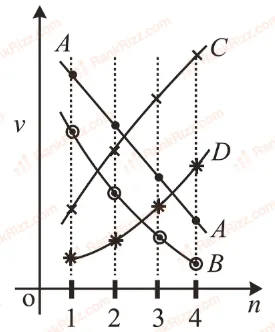
- (A)
- (B)
- (C)
- (D)
rr2.rankrizz.com/jee-main/physics/atoms-and-nuclei/q/2012-physics-499205
- (A)
Ionisation energy of Li (Lithium) atom in ground state is eV. Binding energy of an electron in Liion in ground state is eV. Energy required to remove all three electrons of Lithium (Li) atom is
- (A)
eV
- (B)
eV
- (C)
eV
- (D)
eV
rr2.rankrizz.com/jee-main/physics/atoms-and-nuclei/q/2012-physics-499305
- (A)
Energy required for the electron excitation in from the first to the third Bohr orbit is:
- (A)
- (B)
- (C)
- (D)
rr2.rankrizz.com/jee-main/physics/atoms-and-nuclei/q/2011-physics-499495
- (A)
Suppose an electron is attracted towards the origin by a force where '' is a constant and '' is the distance of the electron from the origin. By applying Bohr model to this system, the radius of the orbital of the electron is found to be '' and the kinetic energy of the electron to be . Then which of the following is true?
- (A)
- (B)
independent of ,
- (C)
- (D)
rr2.rankrizz.com/jee-main/physics/atoms-and-nuclei/q/2008-physics-499892
- (A)
Alpha-particle scattering and Rutherford model 11
In Rutherford's alpha-particle scattering experiment, only a few alpha particles rebound back because
A. The size of gold nucleus is very small as compared to the size of gold atom.
B. Alpha particle and gold nucleus have equal charge.
C. The impact parameter is minimum for a few alpha particles.
D. A few alpha particles have very high kinetic energy.
E. Only a few alpha particles undergo head-on collision with the nuclei.
Choose the correct answer from the options given below:- (A)
A, B Only
- (B)
B, E Only
- (C)
C, D Only
- (D)
A, C, E Only
rr2.rankrizz.com/jee-main/physics/atoms-and-nuclei/q/4-apr-2026-s2-q43
- (A)
scatters from a target material of atomic muuber 79. From the given data the estimated diameter of nuclei of the target material is (approximately) ___m.
- (A)
- (B)
- (C)
- (D)
rr2.rankrizz.com/jee-main/physics/atoms-and-nuclei/q/22-jan-2026-s1-q30
- (A)
If an alpha particle with energy 7.7 MeV is bombarded on a thin gold foil, the closest distance from nucleus it can reach is ___ m. (Atomic number of gold = 79 and
- (A)
- (B)
- (C)
- (D)
rr2.rankrizz.com/jee-main/physics/atoms-and-nuclei/q/21-jan-2026-s1-physics-q19
- (A)
In an alpha particle scattering experiment distance of closest approach for the particle is . If target nucleus has atomic number 80, then maximum velocity of -particle is ______ approximately.
Answer: ____________
rr2.rankrizz.com/jee-main/physics/atoms-and-nuclei/q/8-apr-2024-s1-q30
Given below are two statements:
Statement I: Most of the mass of the atom and all its positive charge are concentrated in a tiny nucleus and the electrons revolve around it, is Rutherford's model.
Statement II: An atom is a spherical cloud of positive charges with electrons embedded in it, is a special case of Rutherford's model.
In the light of the above statements, choose the most appropriate from the options given below.- (A)
Both statement I and statement II are false
- (B)
Statement I is false but statement II is true
- (C)
Statement I is true but statement II is false
- (D)
Both statement I and statement II are true
rr2.rankrizz.com/jee-main/physics/atoms-and-nuclei/q/29-jan-2024-s2-q19
- (A)
and are the impact parameters corresponding to scattering angles 60° and 90° respectively, when an particle is approaching a gold nucleus. For , the value of will be ______.
Answer: ____________
rr2.rankrizz.com/jee-main/physics/atoms-and-nuclei/q/29-jun-2022-s1-q29
Choose the correct option from the following options given below :
- (A)
In the ground state of Rutherford's model electrons are in stable equilibrium. While in Thomson's model electrons always experience a net-force.
- (B)
An atom has a nearly continuous mass distribution in a Rutherford's model but has a highly non-uniform mass distribution in Thomson's model
- (C)
A classical atom based on Rutherford's model is doomed to collapse.
- (D)
The positively charged part of the atom possesses most of the mass in Rutherford's model but not in Thomson's model.
rr2.rankrizz.com/jee-main/physics/atoms-and-nuclei/q/24-jun-2022-s1-q18
- (A)
The graph which depicts the results of Rutherford gold foil experiment with -particles is:
: Scattering angle
Y: Number of scattered -particles detected
(Plots are schematic and not to scale)- (A)
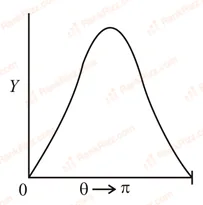
- (B)
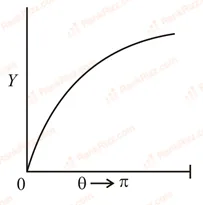
- (C)
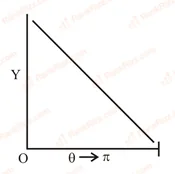
- (D)
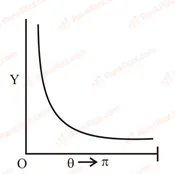
rr2.rankrizz.com/jee-main/physics/atoms-and-nuclei/q/8-jan-2020-s1-q19
- (A)
In the Rutherford experiment, -particles are scattered from a nucleus as shown. Out of the four paths, which path is not possible?
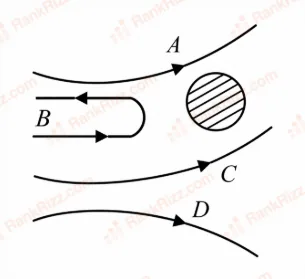
- (A)
- (B)
- (C)
- (D)
rr2.rankrizz.com/jee-main/physics/atoms-and-nuclei/q/2012-physics-499135
- (A)
An alpha nucleus of energy bombards a heavy nuclear target of charge . Then the distance of closest approach for the alpha nucleus will be proportional to
- (A)
- (B)
- (C)
- (D)
rr2.rankrizz.com/jee-main/physics/atoms-and-nuclei/q/2006-physics-500013
- (A)
An -particle of energy MeV is scattered through by a fixed uranium nucleus. The distance of the closest approach is of the order of
- (A)
Å
- (B)
cm
- (C)
cm
- (D)
cm
rr2.rankrizz.com/jee-main/physics/atoms-and-nuclei/q/2004-physics-500226
- (A)
Nuclear fission, fusion and Q-value 5
A nucleus of mass is at rest and decays into two daughter nuclei of equal mass each. Speed of light is . The speed of daughter nuclei is
- (A)
- (B)
- (C)
- (D)
rr2.rankrizz.com/jee-main/physics/atoms-and-nuclei/q/2010-physics-499658
- (A)
The above is a plot of binding energy per nucleon , against the nuclear mass ; correspond to different nuclei. Consider four reactions: (i) (ii) (iii) and (iv) where is the energy released? In which reactions is positive?
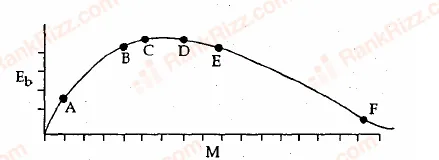
- (A)
(i) and (iv)
- (B)
(i) and (iii)
- (C)
(ii) and (iv)
- (D)
(ii) and (iii)
rr2.rankrizz.com/jee-main/physics/atoms-and-nuclei/q/2009-physics-499585
- (A)
This question contains Statement-1 and Statement-2. Of the four choices given after the statements, choose the one that best describes the two statements. Statement - I: Energy is released when heavy nuclei undergo fission or light nuclei undergo fusion. Statement - II: For heavy nuclei, binding energy per nucleon increases with increasing while for light nuclei it decrease with increasing .
- (A)
Statement-1 is false, Statement-2 is true.
- (B)
Statement-1 is true, Statement-2 is true; Statement-2 is correct explanation for Statement-1.
- (C)
Statement-1 is true, Statement-2 is true; Statement-2 is not a correct explanation for Statement-1.
- (D)
Statement-1 is true, Statement-2 is False.
rr2.rankrizz.com/jee-main/physics/atoms-and-nuclei/q/2008-physics-499893
- (A)
If the binding energy per nucleon in and nuclei are and respectively, then in the reaction energy of proton must be
- (A)
- (B)
- (C)
- (D)
rr2.rankrizz.com/jee-main/physics/atoms-and-nuclei/q/2006-physics-500018
- (A)
The binding energy per nucleon of deuteron and helium nucleus is MeV and MeV respectively. If two deuteron nuclei react to form a single helium nucleus, then the energy released is
- (A)
MeV
- (B)
MeV
- (C)
MeV
- (D)
MeV
rr2.rankrizz.com/jee-main/physics/atoms-and-nuclei/q/2004-physics-500283
- (A)
X-rays: continuous and characteristic spectra, Moseley's law 1
The X-ray of molybdenum has wavelength 0.071 nm. If the energy of a molybdenum atom with a electron knocked out is 27.5 keV, the energy of this atom when an electron is knocked out will be _________ keV. (Round off to the nearest integer) [ eV s, m s]
Answer: ____________
rr2.rankrizz.com/jee-main/physics/atoms-and-nuclei/q/27-jul-2021-s2-q29
Answer key
- 01 D
- 02 C
- 03 C
- 04 C
- 05 C
- 06 D
- 07 C
- 08 D
- 09 B
- 10 D
- 11 C
- 12 2
- 13 B
- 14 C
- 15 C
- 16 D
- 17 C
- 18 D
- 19 A
- 20 16
- 21 B
- 22 122
- 23 B
- 24 6588
- 25 7
- 26 D
- 27 D
- 28 C
- 29 32
- 30 A
- 31 C
- 32 6
- 33 B
- 34 17
- 35 121
- 36 144
- 37 5
- 38 2
- 39 D
- 40 3
- 41 C
- 42 C
- 43 3668
- 44 27
- 45 A
- 46 425
- 47 A
- 48 828
- 49 D
- 50 27
- 51 B
- 52 136
- 53 D
- 54 27
- 55 D
- 56 D
- 57 A
- 58 5
- 59 A
- 60 B
- 61 5
- 62 B
- 63 114
- 64 D
- 65 D
- 66 B
- 67 15
- 68 B
- 69 B
- 70 B
- 71 D
- 72 3
- 73 15
- 74 A
- 75 C
- 76 D
- 77 51
- 78 10553
- 79 C
- 80 B
- 81 486
- 82 B
- 83 B
- 84 C
- 85 B
- 86 A
- 87 B
- 88 A
- 89 B
- 90 B
- 91 C
- 92 D
- 93 B
- 94 D
- 95 D
- 96 D
- 97 A
- 98 A
- 99 B
- 100 B
- 101 B
- 102 B
- 103 D
- 104 B
- 105 C
- 106 A
- 107 C
- 108 C
- 109 B
- 110 D
- 111 B
- 112 B
- 113 C
- 114 D
- 115 C
- 116 A
- 117 C
- 118 A
- 119 C
- 120 B
- 121 C
- 122 D
- 123 B
- 124 B
- 125 D
- 126 D
- 127 27
- 128 A
- 129 4
- 130 C
- 131 C
- 132 15
- 133 B
- 134 D
- 135 D
- 136 B
- 137 300
- 138 A
- 139 87
- 140 B
- 141 C
- 142 2
- 143 C
- 144 C
- 145 11
- 146 11
- 147 B
- 148 9
- 149 C
- 150 15
- 151 A
- 152 C
- 153 D
- 154 C
- 155 C
- 156 B
- 157 A
- 158 20
- 159 C
- 160 D
- 161 D
- 162 B
- 163 25
- 164 C
- 165 C
- 166 A
- 167 C
- 168 C
- 169 150
- 170 B
- 171 D
- 172 D
- 173 10
- 174 D
- 175 D
- 176 20
- 177 B
- 178 B
- 179 B
- 180 C
- 181 B
- 182 C
- 183 C
- 184 A
- 185 C
- 186 D
- 187 B
- 188 D
- 189 B
- 190 B
- 191 A
- 192 A
- 193 B
- 194 D
- 195 C
- 196 B
- 197 A
- 198 D
- 199 C
- 200 C
- 201 B
- 202 C
- 203 C
- 204 B
- 205 B
- 206 D
- 207 B
- 208 D
- 209 C
- 210 A
- 211 B
- 212 B
- 213 B
- 214 B
- 215 D
- 216 D
- 217 D
- 218 D
- 219 C
- 220 B
- 221 6
- 222 B
- 223 B
- 224 C
- 225 B
- 226 D
- 227 A
- 228 228
- 229 B
- 230 A
- 231 C
- 232 A
- 233 B
- 234 —
- 235 D
- 236 A
- 237 B
- 238 B
- 239 B
- 240 727
- 241 B
- 242 208
- 243 1
- 244 C
- 245 D
- 246 236
- 247 C
- 248 B
- 249 B
- 250 4
- 251 2
- 252 B
- 253 121
- 254 B
- 255 6
- 256 6
- 257 26
- 258 D
- 259 D
- 260 27
- 261 D
- 262 D
- 263 D
- 264 D
- 265 B
- 266 B
- 267 C
- 268 A
- 269 C
- 270 A
- 271 C
- 272 B
- 273 A
- 274 B
- 275 C
- 276 B
- 277 B
- 278 16
- 279 B
- 280 112
- 281 B
- 282 A
- 283 D
- 284 A
- 285 D
- 286 B
- 287 B
- 288 D
- 289 C
- 290 C
- 291 156
- 292 C
- 293 3
- 294 C
- 295 D
- 296 C
- 297 C
- 298 C
- 299 B
- 300 A
- 301 D
- 302 C
- 303 C
- 304 10
“—” marks a question whose key we have not checked yet; its page shows the latest on it.
Past questions are reproduced with their sitting. Not affiliated with NTA or the IITs. Every question, online and free: rr2.rankrizz.com/jee-main/physics/atoms-and-nuclei