JEE Main 2021 Physics question — Radioactivity: decay law, half-life and decay modes
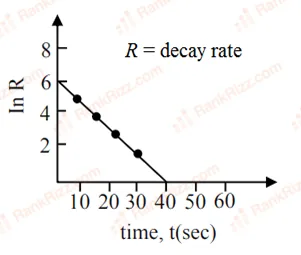
For a certain radioactive process, the graph between ln R and (sec) is obtained as shown in the figure. Then the value of half life for the unknown radioactive material is approximately:
SOLUTION
We need to determine the approximate half-life () of an unknown radioactive material using the given linear graph between the natural logarithm of the decay rate () and time ().
1. Establish the Governing Radioactivity Equation
The decay rate (or activity) of a radioactive substance at any given time follows the exponential decay law:
Where is the initial decay rate at , and is the radioactive decay constant.
Taking the natural logarithm () on both sides of the equation:
Comparing this with the standard equation of a straight line (), where and :
- Slope ():
- y-intercept ():
2. Calculate the Decay Constant () from the Graph
From the provided graph, we can easily identify two key points where the straight line intercepts the axes:
- When ,
- When ,
Now, we compute the slope () of this straight line:
Since the slope of our line is equal to :
3. Calculate the Half-Life ()
The standard formula linking the half-life period to the decay constant is:
Substituting the value of into this relation:
Final Answer: 4.62 sec (Option D)