The volume of gas A is twice than that of gas B. The compressibility factor of gas A is thrice than that of gas B at same temperature. What are the pressures of the gases for equal number of moles?
- A
- B
- C
- D
Every States of Matter: Gases and Liquids question JEE Main has set from 2004–2025, grouped by the idea it tests rather than the order of the syllabus. 70 questions across 6 distinct ideas. Free to read, answer key on every one.
DATA UPDATED
Questions
70
Distinct ideas
6
Share of marks
0%
Difficulty
EASY
A chapter is not one subject — it is a handful of procedures the examiner reuses. These are the ones States of Matter: Gases and Liquids questions actually test.
41–60 OF 70 · NEWEST FIRST
The volume of gas A is twice than that of gas B. The compressibility factor of gas A is thrice than that of gas B at same temperature. What are the pressures of the gases for equal number of moles?
An open vessel at is heated until two fifth of the air (assumed as an ideal gas) in it has escaped from the vessel. Assuming that the volume of the vessel remains constant, the temperature to which the vessel has heated is:
750 K
500 K
0.5 moles of gas A and x moles of gas B exert a pressure of 200 Pa in a container of volume 10 m at 1000 K. Given, R is the gas constant in JKmol, x is:
Assuming ideal gas behavior, the ratio of density of ammonia to that of hydrogen chloride at same temperature and pressure is: (Atomic weight of Cl is 35.5 u)
1.46
1.64
0.46
0.64
At 300 K, the density of a certain gaseous molecule at 2 bar is double to that of dinitrogen (N) at 4 bar. The molar mass of the gaseous molecule is
224 g mol
112 g mol
56 g mol
28 g mol
Among the following, the incorrect statement is:
at low pressure, real gases show ideal behaviour.
at very low temperature, real gases show ideal behaviour.
at Boyle's temperature, real gases show ideal behaviour.
at very large volume, real gases show ideal behaviour.
Initially, the root-mean-square (RMS) velocity of molecules at certain temperature is u. If this temperature is doubled and all the nitrogen molecules dissociate into nitrogen atoms, then the new RMS velocity will be:
2u
14u
4u
u/2
At very high pressures, the compressibility factor of one mole of a gas is given by:
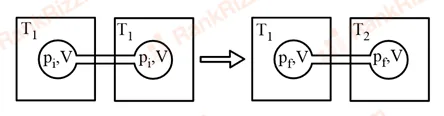
Two closed bulbs of equal volume (V) containing an ideal gas initially at pressure and temperature are connected through a narrow tube of negligible volume, as shown in the figure below. The temperature of one of the bulbs is then raised to . The final pressure is:

When does a gas deviate the most from its ideal behavior?
At low pressure and high temperature
At high pressure and high temperature
At low pressure and low temperature
At high pressure and low temperature
Which of the following is not an assumption of the kinetic theory of gases?
Collisions of gas particles are perfectly elastic.
A gas consists of many identical particles which are in continual motion.
At high pressure, gas particles are difficult to compress.
Gas particles have negligible volume.
Sulphur dioxide and oxygen were allowed to diffuse through a porous partition. 20 dm of SO diffuses through the porous partition in 60 seconds. The volume of O in dm which diffuses under the similar condition in 30 seconds will be (atomic mass of sulphur = 32 u):
28.2
10.0
14.1
7.09
The initial volume of a gas cylinder is 750.0 mL. If the pressure of gas inside the cylinder changes from 840.0 mmHg to 360.0 mmHg, the final volume the gas will be:
1.750 L
3.60 L
4.032 L
7.50 L
The temperature at which oxygen molecules have the same root mean square speed as helium atoms have at 300 K is: (Atomic masses: He = 4 u, O = 16 u)
600 K
2400 K
1200 K
300 K
Van der Waal's equation for a gas is stated as, . This equation reduces to the perfect gas equation, When,
temperature is sufficiently high and pressure is low
both temperature and pressure are very low
both temperature and pressure are very high
temperature is sufficiently low and pressure is high
If Z is the compressibility factor, then Van der Waal's equation at low pressure can be written as:
Which one of the following is the wrong assumption of kinetic theory of gases?
Momentum and energy always remain conserved.
Pressure is the result of elastic collision of molecules with the container's wall.
Molecules are separated by great distances compared to their sizes.
All the molecules move in straight line between collision and with same velocity.
By how many folds the temperature of a gas would increase when the root mean square velocity of the gas molecules in a container of fixed volume is increased from cm/s to cm/s?
Two
Three
Six
Four
For gaseous state, if most probable speed is denoted by , average speed by and root mean square speed by C, then for many molecules, what is the ratios of these speeds?
The compressibility factor for a real gas at high pressure is :
JEE Advanced has set 19 States of Matter: Gases and Liquids questions too. States of Matter: Gases and Liquids JEE Advanced PYQs →
OTHER CHEMISTRY CHAPTERS