JEE MAIN 2022 · 26 JUN S1Gas laws and ideal gas equation
g of gas is adsorbed on g of platinum powder at K and bar pressure. The volume of the gas adsorbed per gram of the adsorbent is ______ mL
(Given : L bar K mol)
Every States of Matter: Gases and Liquids question JEE Main has set from 2004–2025, grouped by the idea it tests rather than the order of the syllabus. 70 questions across 6 distinct ideas. Free to read, answer key on every one.
DATA UPDATED
Questions
70
Distinct ideas
6
Share of marks
0%
Difficulty
EASY
A chapter is not one subject — it is a handful of procedures the examiner reuses. These are the ones States of Matter: Gases and Liquids questions actually test.
21–40 OF 70 · NEWEST FIRST
g of gas is adsorbed on g of platinum powder at K and bar pressure. The volume of the gas adsorbed per gram of the adsorbent is ______ mL
(Given : L bar K mol)
A rigid nitrogen tank stored inside a laboratory has a pressure of atm at am when the temperature is C. At pm, when the temperature is C, the pressure in the tank will be ______ atm. [nearest integer]
At K, a sample of g of gas A occupies the same volume as g of hydrogen at K at the same pressure. The molar mass of gas A is ______ g mol. (nearest integer) Assume that the behaviour of gases as ideal.
(Given: The molar mass of hydrogen () gas is g mol.)
An empty LPG cylinder weighs 14.8 kg. When full, it weighs 29.0 kg and shows a pressure of 3.47 atm. In the course of use at ambient temperature, the mass of the cylinder is reduced to 23.0 kg. The final pressure inside the cylinder is _________ atm. (Nearest integer)
(Assume LPG to be an ideal gas)
Which one of the following is the correct PV vs P plot at constant temperature for an ideal gas? (P and V stand for pressure and volume of the gas respectively)
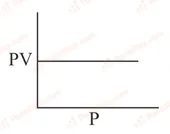
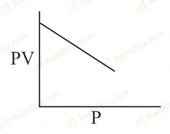
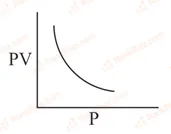
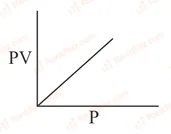
The unit of the van der Waals gas equation parameter 'a' in is:
dm mol
kg ms
atm dm mol
kg ms
A home owner uses m of methane CH gas, (assume CH is an ideal gas) in a year to heat his home. Under the pressure of 1.0 atm and 300 K, mass of gas used is g. The value of x is ___.
(Nearest integer)
(Given R = 0.083 L atm K mol)
An LPG cylinder contains gas at a pressure of 300 kPa at 27°C. The cylinder can withstand the pressure of Pa. The room in which the cylinder is kept catches fire. The minimum temperature at which the bursting of cylinder will take place is _________ °C. (Nearest integer)
The pressure exerted by a non-reactive gaseous mixture of 6.4 g of methane and 8.8 g of carbon dioxide in a 10 L vessel at 27°C is ________ kPa. (Round off to the Nearest Integer).
[Assume gases are ideal, R = 8.314 J mol K, Atomic masses: C: 12.0 u, H: 1.0 u, O: 16.0 u]
The number of chlorine atoms in 20 mL of chlorine gas at STP is ________ . (Round off to the Nearest Integer).
[Assume chlorine is an ideal gas at STP. R = 0.083 L bar mol K, ]
A car tyre is filled with nitrogen gas at 35 psi at 27°C. It will burst if pressure exceeds 40 psi. The temperature in °C at which the car tyre will burst is ______ (Rounded-off to the nearest integer)
The volume occupied by 4.75 g of acetylene gas at 50°C and 740 mm Hg pressure is ______ L.
(Rounded off to the nearest integer)
[Given R = 0.0826 L atm K mol]
A spherical balloon of radius containing helium gas has a pressure of . At the same temperature, the pressure, of a spherical balloon of radius containing the same amount of gas will be............ .
A mixture of one mole each of , He and each are enclosed in a cylinder of volume V at temperature T. If the partial pressure of is 2 atm, the total pressure of the gases in the cylinder is:
6 atm
38 atm
14 atm
22 atm
Which one of the following graphs is not correct for ideal gas?
d = Density, P = Pressure, T = Temperature
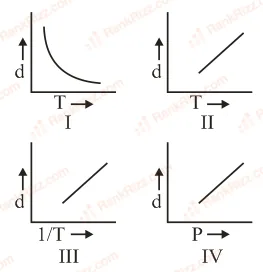
I
II
IV
III
Identify the correct labels of A, B and C in the following graph from the options given below:
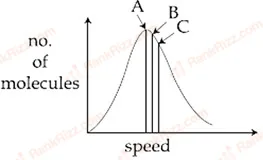
Root mean square speed (V); most probable speed (V); Average speed (V)
A = V; B = V; C = V
A = V; B = V; C = V
A = V; B = V; C = V
A = V; B = V; C = V
Consider the following table:
Gas a/(kPa dm mol) b/(dm mol)
A 642.32 0.05196
B 155.21 0.04136
C 431.91 0.05196
D 155.21 0.4382
a and b are van der Waals constants. The correct statement about the gases is:
Gas C will occupy more volume than gas A; gas B will be lesser compressible than gas D
Gas C will occupy lesser volume than gas A; gas B will be lesser compressible than gas D
Gas C will occupy more volume than gas A; gas B will be more compressible than gas D
Gas C will occupy lesser volume than gas A; gas B will be more compressible than gas D
Points I, II and III in the following plot respectively correspond to (V: most probable velocity)
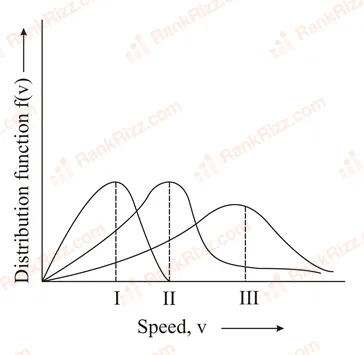
V of N 300 K; V of H 300 K; V of O 400 K;
V of H 300 K; V of N 300 K; V of O 400 K;
V of N 300 K; V of O 400 K; V of H 300 K;
V of O 400 K; V of N 300 K; V of H 300 K;
Consider the van der Waal's constants, a and b, for the following gases.

Which gas is expected to have the highest critical temperature?
Kr
Ar
Xe
Ne
At a given temperature T, gases Ne, Ar, Xe and Kr are found to deviate from ideal gas behaviour. Their equation of state is given as at T. Here, b is the van der Waals constant. Which gas will exhibit steepest increase in the plot of Z (compression factor) vs p?
Ne
Kr
Ar
Xe
JEE Advanced has set 19 States of Matter: Gases and Liquids questions too. States of Matter: Gases and Liquids JEE Advanced PYQs →
OTHER CHEMISTRY CHAPTERS