RankRizz

States of Matter: Gases and Liquids — JEE Advanced Previous Year Questions

States of Matter: Gases and Liquids has been asked in 15 of the 20 JEE Advanced years from 2007 to 2026: 19 questions in all. In 2026 it averaged 0.5 questions per paper (1 across 2 papers), 2.9% of Chemistry questions, down from 3.1% in 2025. Across the last 20 papers it carried 2.3% of Chemistry questions. By type: 8 numerical, 7 single-correct, 3 multiple-correct and 1 match-the-list. Of the 19 with a difficulty tag, 32% are easy, 68% medium and 0% hard. Most asked: Real gases, compressibility factor and van der Waals equation (7, 37%), Gas laws and ideal gas equation (5, 26%) and Kinetic theory of gases and molecular speeds (5, 26%).

DATA UPDATED

Questions

19

Distinct ideas

4

Share of marks

2.3%

Difficulty

EASY

States of Matter: Gases and Liquids weightage, year by year

The share of each year’s Chemistry questions that came from States of Matter: Gases and Liquids, counted from the 19 papers we hold for the last 10 years, and paper by paper inside a year.

Rising: 3.0% of Chemistry questions in 2024–2026, up from 2.1% in 2017–2023. Its heaviest year was 2018, at 5.6%. Not asked at all in 2017, 2021, 2022.

States of Matter: Gases and Liquids questions per year, per paper, and as a share of Chemistry questions
YEARQSPER PAPERSHARE OF CHEMISTRYCHANGE
20261 / 340.52.9%−0.2 pts
20251 / 320.53.1%+0.2 pts
20241 / 340.52.9%level
20231 / 340.52.9%+2.9 pts
20220 / 360.00.0%level
20210 / 380.00.0%−5.6 pts
20202 / 361.05.6%+2.8 pts
20191 / 360.52.8%−2.8 pts
20181 / 181.05.6%+5.6 pts
20170 / 360.00.0%—

“QS” is States of Matter: Gases and Liquids questions out of all Chemistry questions that year; “per paper” is that count over the year’s papers, and “change” is the share against the year before. A year with more sittings asks more questions, which is why the share, not the count, is the number to compare.

The ideas inside States of Matter: Gases and Liquids

A chapter is not one subject — it is a handful of procedures the examiner reuses. These are the ones States of Matter: Gases and Liquids questions actually test.

01Gas laws and ideal gas equationset 5×
02Dalton's law of partial pressuresNot set in Advanced
03Graham's law of diffusion and effusionset 2×
04Kinetic theory of gases and molecular speedsset 5×
05Real gases, compressibility factor and van der Waals equationset 7×
06Critical constants, liquefaction and properties of liquidsNot set in Advanced

All 19 States of Matter: Gases and Liquids questions, by topic

Every JEE Advanced States of Matter: Gases and Liquids question we hold, newest first inside each topic. Open one for its options, answer key and solution.

FREE PDF

States of Matter: Gases and Liquids JEE Advanced PYQs with answer key

All 19 questions on A4, by topic, with the answer key at the end. No sign-up, no email: your browser saves it as a PDF.

Download free PDF

UNIQUE CONCEPTS

States of Matter: Gases and Liquids: one question per idea

6 ideas, each with the latest past question that tested it, drawn from 89 JEE Main and Advanced questions.

States of Matter: Gases and Liquids Unique Concepts sheet →

JEE MAIN

States of Matter: Gases and Liquids in JEE Main

JEE Main has set 70 States of Matter: Gases and Liquids questions, 2004–2025.

States of Matter: Gases and Liquids JEE Main PYQs →

States of Matter: Gases and Liquids: quick answers

Is States of Matter: Gases and Liquids asked every year in JEE Advanced?

Not every year. It has been asked in 15 of the 20 JEE Advanced years from 2007 to 2026; the years without a States of Matter: Gases and Liquids question were 2010, 2013, 2017, 2021 and 2022.

Which States of Matter: Gases and Liquids topic is asked most in JEE Advanced?

Real gases, compressibility factor and van der Waals equation: 7 of the 19 questions (37%). Next come Gas laws and ideal gas equation (5) and Kinetic theory of gases and molecular speeds (5).

What share of Chemistry questions does States of Matter: Gases and Liquids carry in JEE Advanced?

About 2.3% of Chemistry questions across the last 20 papers. In 2026 it was 2.9% (1 of 34 Chemistry questions).

When was States of Matter: Gases and Liquids last asked in JEE Advanced?

In JEE Advanced 2026 Paper 1, the latest sitting with a States of Matter: Gases and Liquids question.

How many States of Matter: Gases and Liquids questions has JEE Advanced asked?

19 from 2007 to 2026, across 4 topics. Every one is listed on this page by topic and links to its own page, with the answer key and solution wherever we have them. Free, no sign-up.

Every States of Matter: Gases and Liquids question

1–19 OF 19 · NEWEST FIRST

JEE ADVANCED 2026 · PAPER 1Gas laws and ideal gas equation

Two cylinders, both fitted with frictionless pistons, are filled with mixtures of He\mathrm{He} and Ar\mathrm{Ar} gases. In the first cylinder, the masses of He\mathrm{He} and Ar\mathrm{Ar} are m1m_1 and m2m_2, respectively. In the second cylinder, the masses of He\mathrm{He} and Ar\mathrm{Ar} are m2m_2 and m1m_1, respectively. The molar mass of Ar\mathrm{Ar} is 1010 times the molar mass of He\mathrm{He}. The external pressure applied by the piston on the first cylinder needs to be 55 times that on the second cylinder so that the volume of the gas mixtures in both the cylinders are equal at the same temperature. Assuming He\mathrm{He} and Ar\mathrm{Ar} behave like ideal gases, the value of (m1/m2)(m_1/m_2) is ___.

JEE ADVANCED 2025 · PAPER 1Real gases, compressibility factor and van der Waals equation

Molar volume (VmV_m) of a van der Waals gas can be calculated by expressing the van der Waals equation as a cubic equation with VmV_m as the variable. The ratio (in mol dm−3^{-3}) of the coefficient of Vm2V_m^2 to the coefficient of VmV_m for a gas having van der Waals constants a=6.0a = 6.0 dm6^6 atm mol−2^{-2} and b=0.060b = 0.060 dm3^3 mol−1^{-1} at 300 K and 300 atm is ________.

Use: Universal gas constant (R) = 0.082 dm3^3 atm mol−1^{-1} K−1^{-1}

JEE ADVANCED 2024 · PAPER 1Gas laws and ideal gas equation

A closed vessel contains 10 g of an ideal gas X at 300 K, which exerts 2 atm pressure. At the same temperature, 80 g of another ideal gas Y is added to it and the pressure becomes 6 atm. The ratio of root mean square velocities of X and Y at 300 K is

  1. A

    22:32\sqrt{2} : \sqrt{3}

  2. B

    22:12\sqrt{2} : 1

  3. C

    1:21 : 2

  4. D

    2:12 : 1

JEE ADVANCED 2023 · PAPER 1Real gases, compressibility factor and van der Waals equation

A gas has a compressibility factor of 0.5 and a molar volume of 0.4 dm3^3 mol−1^{-1} at a temperature of 800 K and pressure x atm. If it shows ideal gas behaviour at the same temperature and pressure, the molar volume will be y dm3^3 mol−1^{-1}. The value of x/y is ____.

[Use: Gas constant, R = 8×10⁻²⁸ \times 10^{-2} L atm K−1^{-1} mol−1^{-1}]

JEE ADVANCED 2020 · PAPER 1Kinetic theory of gases and molecular speeds

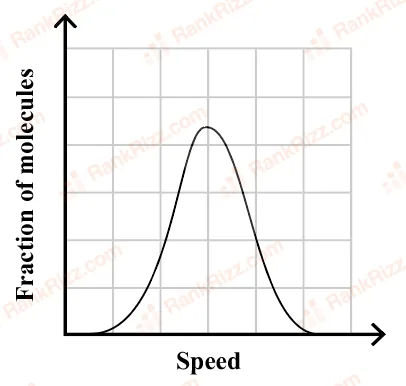
If the distribution of molecular speeds of a gas is as per the figure shown below, then the ratio of the most probable, the average, and the root mean square speeds, respectively, is

Figure for JEE Advanced 2020 Chemistry question on Kinetic theory of gases and molecular speeds
  1. A

    1 : 1 : 1

  2. B

    1 : 1 : 1.224

  3. C

    1 : 1.128 : 1.224

  4. D

    1 : 1.128 : 1

JEE ADVANCED 2020 · PAPER 1Gas laws and ideal gas equation

Aluminium reacts with sulfuric acid to form aluminium sulfate and hydrogen. What is the volume of hydrogen gas in liters (L) produced at 300 K and 1.0 atm pressure, when 5.4 g of aluminium and 50.0 mL of 5.0 M sulfuric acid are combined for the reaction?
(Use molar mass of aluminium as 27.0gmol−1,𝑅=0.082atmLmol−1K−127.0 g mol^{−1}, 𝑅 = 0.082 atm L mol^{−1} K^{−1})

JEE ADVANCED 2019 · PAPER 1Kinetic theory of gases and molecular speeds

Which of the following statement(s) is (are) correct regarding the root mean square speed (μrms)(\mu_{rms}) and average translational kinetic energy (ϵav)(\epsilon_{av}) of a molecule in a gas at equilibrium ?

  1. A

    (μrms)(\mu_{rms}) is doubled when its temperature is increased four times

  2. B

    (ϵav)(\epsilon_{av}) is doubled when its temperature is increased four times

  3. C

    (ϵav)(\epsilon_{av}) at a given temperature does not depend on its molecular mass

  4. D

    (μrms)(\mu_{rms}) is inversely proportional to the square rootof its molecular mass

JEE ADVANCED 2018 · PAPER 1Gas laws and ideal gas equation

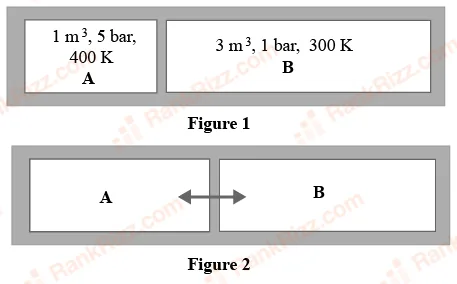
A closed tank has two compartments A and B, both filled with oxygen (assumed to be ideal gas). The partition separating the two compartments is fixed and is a perfect heat insulator (Figure 1). If the old partition is replaced by a new partition which can slide and conduct heat but does NOT allow the gas to leak across (Figure 2), the volume (in m3m^{3}) of the compartment A after the system attains equilibrium is ____.

Figure for JEE Advanced 2018 Chemistry question on Gas laws and ideal gas equation
JEE ADVANCED 2016 · PAPER 1Graham's law of diffusion and effusion

The diffusion coefficient of an ideal gas is proportional to its mean free path and meanspeed. The absolute temperature of an ideal gas is increased 4 times and its pressure is increased 2 times. As a result, the diffusion coefficient of this gas increases x times. The value of x is

JEE ADVANCED 2015 · PAPER 2Real gases, compressibility factor and van der Waals equation

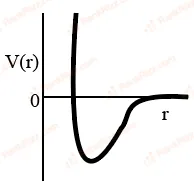
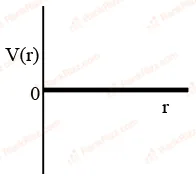
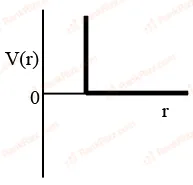
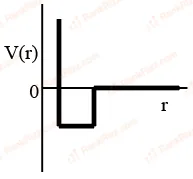
One mole of a monoatomic real gas satisfies the equation p(V−b)=RTp(V - b) = RT where b is a constant. The relationship of interatomic potential V(r) and interatomic distance r for the gas is given by

  1. A
    Figure for JEE Advanced 2015 Chemistry question on Real gases, compressibility factor and van der Waals equation
  2. B
    Figure for JEE Advanced 2015 Chemistry question on Real gases, compressibility factor and van der Waals equation
  3. C
    Figure for JEE Advanced 2015 Chemistry question on Real gases, compressibility factor and van der Waals equation
  4. D
    Figure for JEE Advanced 2015 Chemistry question on Real gases, compressibility factor and van der Waals equation
JEE ADVANCED 2014 · PAPER 2Graham's law of diffusion and effusion

The value of d in cm (shown in the figure), as estimated from Graham’s law, is

  1. A

    8

  2. B

    12

  3. C

    16

  4. D

    20

JEE ADVANCED 2014 · PAPER 2Kinetic theory of gases and molecular speeds

The experimental value of d is found to be smaller than the estimate obtained using Graham’s law. This is due to

  1. A

    larger mean free path for X as compared to that of Y.

  2. B

    larger mean free path for Y as compared to that of X.

  3. C

    increased collision frequency of Y with the inert gas as compared to that of X with the inert gas.

  4. D

    increased collision frequency of X with the inert gas as compared to that of Y with the inert gas.

JEE ADVANCED 2012 · PAPER 1Real gases, compressibility factor and van der Waals equation

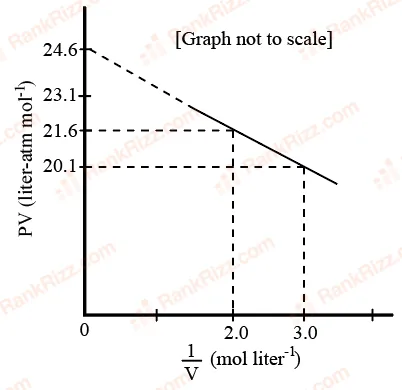
For one mole of a van der Waals gas when b= 0 and T= 300 K, the PV vs. 1/V plot is shown below. The value of the van der Waals constant a (atm.liter2mol−2)(atm.liter^2 mol^{-2}) is

Figure for JEE Advanced 2012 Chemistry question on Real gases, compressibility factor and van der Waals equation
  1. A

    1.0

  2. B

    4.5

  3. C

    1.5

  4. D

    3.0

JEE ADVANCED 2011 · PAPER 1Kinetic theory of gases and molecular speeds

According to kinetic theory of gases -

  1. A

    collisions are always elastic

  2. B

    heavier molecules transfer more momentum to the wall of the container

  3. C

    only a small number of molecules have very high velocity

  4. D

    between collisions, the molecules move in straight lines with constant velocities

JEE ADVANCED 2011 · PAPER 1Gas laws and ideal gas equation

To an evacuated vessel with movable piston under external pressure of 1 atm., 0.1 mol of He and 1.0 mol of an unknown compound (vapour pressure 0.68 atm, at 0∘C0^\circ C) are introduced. Considering the ideal gas behaviour, the total volume (in litre) of the gases at 0ºC is close to.

JEE ADVANCED 2009 · PAPER 1Real gases, compressibility factor and van der Waals equation

The term that correct for the attractive forces present in a real gas in the van der Waals equation is

  1. A

    nbnb

  2. B

    an2V2\frac{an^{2}}{V^{2}}

  3. C

    −an2V2-\frac{an^{2}}{V^{2}}

  4. D

    −nb-nb

JEE ADVANCED 2009 · PAPER 2Kinetic theory of gases and molecular speeds

At 400 K, the root mean square (rms) speed of a gas X (molecular weight = 40) is equal to the most probable speed of gas Y at 60K. The molecular weight of the gas Y is

JEE ADVANCED 2008 · PAPER 1Real gases, compressibility factor and van der Waals equation

A gas described by van der Waals equation

  1. A

    behaves similar to an ideal gasin the limit of large molar volumes

  2. B

    behaves similar to an ideal gas in the limit of large pressures

  3. C

    is characterised by van der Waals coefficients that are dependent on the identity of the gas but are independent of the temperature

  4. D

    has the pressure that is lower than the pressure exerted by the same gas behaving ideally

JEE ADVANCED 2007 · PAPER 1Real gases, compressibility factor and van der Waals equation

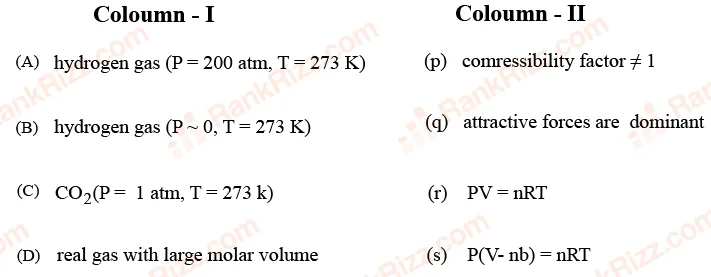
Match gases under specified conditions listed in Column I with their properties/laws in Column II. Indicate your answer by darkening the appropriate bubbles of the 4×44 \times 4 matrix given in the ORS.

Figure for JEE Advanced 2007 Chemistry question on Real gases, compressibility factor and van der Waals equation