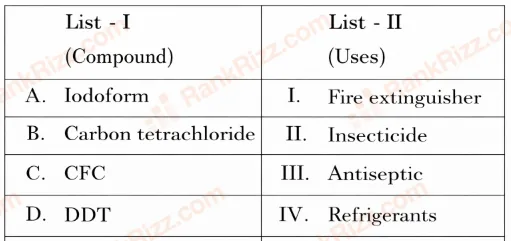
Match List I with List II
Choose the correct answer from the options given below:
- A
A-I, B-II, C-III, D-IV
- B
A-III, B-I, C-IV, D-II
- C
A-II, B-IV, C-I, D-III
- D
A-III, B-II, C-IV, D-I
Every Qualitative Salt Analysis question JEE Main has set from 2013–2026, grouped by the idea it tests rather than the order of the syllabus. 69 questions across 4 distinct ideas. Free to read, answer key on every one.
DATA UPDATED
Questions
69
Distinct ideas
4
Share of marks
1.8%
Difficulty
EASY
A chapter is not one subject — it is a handful of procedures the examiner reuses. These are the ones Qualitative Salt Analysis questions actually test.
21–40 OF 69 · NEWEST FIRST
Match List I with List II
Choose the correct answer from the options given below:
A-I, B-II, C-III, D-IV
A-III, B-I, C-IV, D-II
A-II, B-IV, C-I, D-III
A-III, B-II, C-IV, D-I
During the detection of acidic radical present in a salt, a student gets a pale yellow precipitate soluble with difficulty in solution when sodium carbonate extract was first acidified with dil. and then solution was added. This indicates presence of :
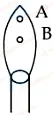
In a borax bead test under hot condition, a metal salt (one from the given) is heated at point B of the flame, resulted in green colour salt bead. The spin-only magnetic moment value of the salt is ______ BM (Nearest integer) [Given atomic number of ]
In the precipitation of the iron group (III) in qualitative analysis, ammonium chloride is added before adding ammonium hydroxide to:
increase concentration of Cl⁻ ions
increase concentration of NH₄⁺ ions
prevent interference by phosphate ions
decrease concentration of ⁻OH ions
When and is added to a salt (A), the greenish yellow gas liberated as salt (A) is:
The number of white coloured salts among the following is: (A) (B) (C) (D) (E) (F) (G) (H) (I) (J)
The compound that is white in color is
ammonium sulphide
lead sulphate
lead iodide
ammonium arsinomolybdate
Molar mass of the salt from and which does not evolve coloured vapours on heating with concentrated is ____ g mol. (Molar mass in g mol: Na: 23, N: 14, K: 39, O: 16, Br: 80, I: 127, F: 19, Ca: 40)
Given below are two statements:
Statement-I: The gas liberated on warming a salt with dil , turns a piece of paper dipped in lead acetate into black, it is a confirmatory test for sulphide ion.
Statement-II: In statement-I the colour of paper turns black because of formation of lead sulphite.
In the light of the above statements, choose the most appropriate answer from the options given below:
Both Statement-I and Statement-II are false
Statement-I is false but Statement-II is true
Statement-I is true but Statement-II is false
Both Statement-I and Statement-II are true
Number of metal ions characterized by flame test among the following is _________.
, , , , , ,
In chromyl chloride test for confirmation of ion, a yellow solution is obtained. Acidification of the solution and addition of amyl alcohol and turns organic layer blue indicating formation of chromium pentoxide. The oxidation state of chromium in that is
On passing a gas, '', through Nessler's reagent, a brown precipitate is obtained. The gas '' is
HS
CO
NH
Cl
A reagent which gives brilliant red precipitate with Nickel ions in basic medium is
sodium nitroprusside
neutral FeCl
meta-dinitrobenzene
dimethyl glyoxime
NaCl reacts with conc. and to give reddish fumes (B), which react with NaOH to give yellow solution (C). (B) and (C) respectively are :
In the wet tests for detection of various cations by precipitation, Ba cations are detected by obtaining precipitate of
Ba(ox) : Barium oxalate
BaCO
Ba(OAc)
BaSO
When a solution of mixture of two inorganic salts was treated with freshly prepared ferrous sulphate in acidic medium, a dark brown ring was formed whereas on treatment with neutral FeCl, it gave deep red colour which disappeared on boiling and a brown red ppt was formed. The mixture contains
SO & CHCOO
CHCOO & NO
SO & CO
CO & NO
Element not present in Nessler's reagent is
N
Hg
I
K
Formation of which complex, among the following, is not a confirmatory test of Pb ions
Lead sulphate
Lead nitrate
Lead chromate
Lead iodide
Given below are two statements:
Statement I: Upon heating a borax bead dipped in cupric sulphate in a luminous flame, the colour of the bead becomes green.
Statement II: The green colour observed is due to the formation of copper(I) metaborate.
In the light of the above statements, choose the most appropriate answer from the options given below:
Both Statement I and Statement II are false
Both Statement I and Statement II are true
Statement I is false but Statement II is true
Statement I is true but Statement II is false
During the qualitative analysis of SO using dilute HSO, SO gas is evolved which turns KCrO solution (acidified with dilute HSO):
Black
Red
Green
Blue
JEE Advanced has set 27 Qualitative Salt Analysis questions too. Qualitative Salt Analysis JEE Advanced PYQs →
OTHER CHEMISTRY CHAPTERS