JEE ADVANCED 2025 · PAPER 2Analysis of anions
During sodium nitroprusside test of sulphide ion in an aqueous solution, one of the ligands coordinated to the metal ion is converted to
- A
NOS
- B
SCN
- C
SNO
- D
NCS
Qualitative Salt Analysis has been asked in 13 of the 20 JEE Advanced years from 2007 to 2026: 27 questions in all. It was not set in any of the 2 2026 papers, after 6.3% of Chemistry questions in 2025. Across the last 20 papers it carried 3.1% of Chemistry questions. By type: 21 single-correct, 3 numerical and 3 multiple-correct. Of the 27 with a difficulty tag, 48% are easy, 41% medium and 11% hard. Most asked: Group analysis and confirmatory tests of cations (20, 74%), Analysis of anions (4, 15%) and Chemical principles of qualitative analysis (2, 7%).
DATA UPDATED
Questions
27
Distinct ideas
4
Share of marks
3.1%
Difficulty
EASY
The share of each year’s Chemistry questions that came from Qualitative Salt Analysis, counted from the 19 papers we hold for the last 10 years, and paper by paper inside a year.
Rising: 4.0% of Chemistry questions in 2024–2026, up from 2.6% in 2017–2023. Its heaviest year was 2021, at 7.9%. Not asked at all in 2017, 2018, 2023, 2026.
| YEAR | QS | PER PAPER | SHARE OF CHEMISTRY | CHANGE | |
|---|---|---|---|---|---|
| 2026 | 0 / 34 | 0.0 | 0.0% | −6.3 pts | PAPER 1 0.0%PAPER 2 0.0% |
| 2025 | 2 / 32 | 1.0 | 6.3% | +0.4 pts | PAPER 1 6.3%PAPER 2 6.3% |
| 2024 | 2 / 34 | 1.0 | 5.9% | +5.9 pts | PAPER 1 0.0%PAPER 2 11.8% |
| 2023 | 0 / 34 | 0.0 | 0.0% | −2.8 pts | PAPER 1 0.0%PAPER 2 0.0% |
| 2022 | 1 / 36 | 0.5 | 2.8% | −5.1 pts | PAPER 1 0.0%PAPER 2 5.6% |
| 2021 | 3 / 38 | 1.5 | 7.9% | +5.1 pts | PAPER 1 5.3%PAPER 2 10.5% |
| 2020 | 1 / 36 | 0.5 | 2.8% | level | PAPER 1 5.6%PAPER 2 0.0% |
| 2019 | 1 / 36 | 0.5 | 2.8% | +2.8 pts | PAPER 1 5.6%PAPER 2 0.0% |
| 2018 | 0 / 18 | 0.0 | 0.0% | level | 1 PAPER |
| 2017 | 0 / 36 | 0.0 | 0.0% | — | PAPER 1 0.0%PAPER 2 0.0% |
“QS” is Qualitative Salt Analysis questions out of all Chemistry questions that year; “per paper” is that count over the year’s papers, and “change” is the share against the year before. A year with more sittings asks more questions, which is why the share, not the count, is the number to compare.
A chapter is not one subject — it is a handful of procedures the examiner reuses. These are the ones Qualitative Salt Analysis questions actually test.
Every JEE Advanced Qualitative Salt Analysis question we hold, newest first inside each topic. Open one for its options, answer key and solution.
FREE PDF
All 27 questions on A4, by topic, with the answer key at the end. No sign-up, no email: your browser saves it as a PDF.
Download free PDFUNIQUE CONCEPTS
4 ideas, each with the latest past question that tested it, drawn from 95 JEE Main and Advanced questions.
Qualitative Salt Analysis Unique Concepts sheet →JEE MAIN
JEE Main has set 69 Qualitative Salt Analysis questions, 2013–2026.
Qualitative Salt Analysis JEE Main PYQs →Not every year. It has been asked in 13 of the 20 JEE Advanced years from 2007 to 2026; the years without a Qualitative Salt Analysis question were 2008, 2010, 2012, 2017, 2018, 2023 and 2026.
Group analysis and confirmatory tests of cations: 20 of the 27 questions (74%). Next come Analysis of anions (4) and Chemical principles of qualitative analysis (2).
About 3.1% of Chemistry questions across the last 20 papers. In 2026 it was 0.0% (0 of 34 Chemistry questions).
In JEE Advanced 2025 Paper 2, the latest sitting with a Qualitative Salt Analysis question. It has not been set since 2025, though the bank holds JEE Advanced papers up to 2026.
27 from 2007 to 2025, across 4 topics. Every one is listed on this page by topic and links to its own page, with the answer key and solution wherever we have them. Free, no sign-up.
1–20 OF 27 · NEWEST FIRST
During sodium nitroprusside test of sulphide ion in an aqueous solution, one of the ligands coordinated to the metal ion is converted to
NOS
SCN
SNO
NCS
The correct match of the group reagents in List-I for precipitating the metal ion given in List-II from solutions, is
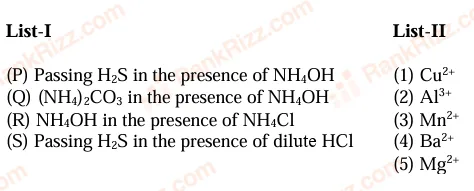
P3; Q4; R2; S1
P4; Q2; R3; S1
P3; Q4; R1; S5
P5; Q3; R2; S4
The number of moles of potassium iodide required to produce two moles of P is ______.
The number of zinc ions present in the molecular formula of Q is ______.
The reaction Pb(NO) and NaCl in water produces a precipitate that dissolves upon the addition of HCl of appropriate concentration. The dissolution of the precipitate is due to the formation of
PbCl
PbCl
[PbCl]
[PbCl]
Precipitate X is
A mixture of two salts is used to prepare a solution S, which gives the following results:

The correct option(s) for the salt mixture is(are)
and
and
and
and
Among the following, the brown ring is due to the formation of
A colorless aqueous solution contains nitrates of two metals, X and Y. When it was added to an aqueous solution of NaCl, a white precipitate was formed. This precipitate was found to be partly soluble in hot water to give a residue P and a solution Q. The residue P was soluble in aq. and also in excess sodium thiosulfate. The hot solution Q gave a yellow precipitate with KI. The metals X and Y, respectively, are
Ag and Pb
Ag and Cd
Cd and Pb
Cd and Zn
The green colour produced in the borax beadtest of a chromium(III) salt is due to
CrB
In the following reaction sequence in aqueous solution, the species X, Y and Z, respectively, are
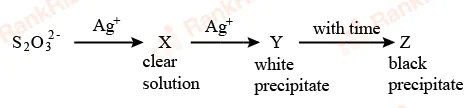
The reagent(s) that can selectively precipitate from a mixture of and in aqueous solution is(are)
The pair(s) of ions where BOTHtheions are precipitated upon passing gas in presence of dilute HCl, is(are)
Among PbS, CuS, HgS, MnS, , NiS, CoS, and , the total number of BLACK coloured sulfides is
M1, Q and R, respectively are
, KCN and HCl
, HCl and KCN
, KCN and HCl
, HCl, and KCN
Reagent S is
Upon treatment with ammoniacal , the metal ion that precipitates as a sulfide is
Fe(III)
Al(III)
Mg(II)
Zn(II)
The precipitate P contains
The coloured solution S contains
Passing gasinto a mixture of and ions in an acidified aqueous solution precipitates
CuS and HgS
MnS and CuS
MnS and NiS
NiS and HgS
OTHER CHEMISTRY CHAPTERS