Qualitative Salt Analysis JEE Main PYQs with answer key
CHEMISTRY · 69 PAST QUESTIONS · 4 TOPICS · 2013–2026
HOW TO USE THIS SHEET
Every JEE Main Qualitative Salt Analysis question we hold, grouped by topic, most-asked topic first and newest first inside each. The answer key is at the end (66 of 69 questions have a checked key); the worked solution is on each question’s page, printed beside it.
Group analysis and confirmatory tests of cations 34
Among Fe, Pb, Cu and Mn, identify the one that gets precipitated out while passing HS in presence of NHOH as group reagent. The highest possible oxidation state of the corresponding metal is
- (A)
- (B)
- (C)
- (D)
rr2.rankrizz.com/jee-main/chemistry/qualitative-salt-analysis/q/4-apr-2026-s2-q69
- (A)
A salt with few drops of conc. HCl gives apple green colour in flame test. The group precipitate of the salt is dissolved in acetic acid and treated with KCrO to give yellow precipitate. When the sodium carbonate extract of the salt solution is heated with conc. HNO and ammonium molybdate, it resulted a canary yellow precipitate. The cation and anion present in the salt are respectively,
- (A)
Ca and SO
- (B)
Ba and PO
- (C)
Mn and PO
- (D)
Ba and SO
rr2.rankrizz.com/jee-main/chemistry/qualitative-salt-analysis/q/2-apr-2026-s1-q70
- (A)
In the Group analysis of cations, & are precipitated respectively as
- (A)
chromate & sulphide
- (B)
hydroxide & carbonate
- (C)
sulphide & sulphide
- (D)
carbonate & carbonate
rr2.rankrizz.com/jee-main/chemistry/qualitative-salt-analysis/q/24-jan-2026-s2-q65
- (A)
Consider the following reactions.
(Hot solution)
In the above reactions, A, Band X are respectively.- (A)
- (B)
and
- (C)
and
- (D)
rr2.rankrizz.com/jee-main/chemistry/qualitative-salt-analysis/q/21-jan-2026-s1-chemistry-q6
- (A)
When a salt is treated with sodium hydroxide solution it gives gas X. On passing gas X through reagent Y a brown coloured precipitate is formed. X and Y respectively, are
- (A)
and
- (B)
and
- (C)
and
- (D)
and
rr2.rankrizz.com/jee-main/chemistry/qualitative-salt-analysis/q/2025-apr-7-s1-q62
- (A)
Choose the correct tests with respective observations.
(A) (acidified with acetic acid) + Chocolate brown precipitate.
(B) Prussian blue precipitate.
(C) , neutralised with White or bluish white precipitate.
(D) Blue precipitate.
(E) , neutralised with NaOH White precipitate.
Choose the correct answer from the options given below:
- (A)
A, D and E only
- (B)
B, D and E only
- (C)
A, B and C only
- (D)
C, D and E only
rr2.rankrizz.com/jee-main/chemistry/qualitative-salt-analysis/q/2025-apr-02-s1-q66
- (A)
Among the following cations, the number of cations which will give characteristic precipitate in their identification tests with is .
Answer: ____________
rr2.rankrizz.com/jee-main/chemistry/qualitative-salt-analysis/q/24-jan-2025-s1-q74
Find the compound ' A ' from the following reaction sequences.
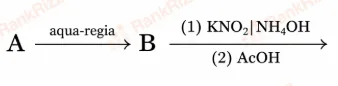
yellow ppt
- (A)
CoS
- (B)
ZnS
- (C)
NiS
- (D)
MnS
rr2.rankrizz.com/jee-main/chemistry/qualitative-salt-analysis/q/24-jan-2025-s2-q59
- (A)
Identify A,B and C in the given below reaction sequence
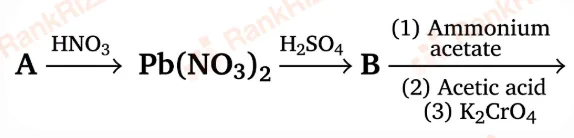
- (A)
- (B)
- (C)
- (D)
rr2.rankrizz.com/jee-main/chemistry/qualitative-salt-analysis/q/23-jan-2025-s2-q62
- (A)
Consider the following test for a group-IV cation. The spin-only magnetic moment value of the metal complex C is ______ BM (Nearest integer)Answer: ____________
rr2.rankrizz.com/jee-main/chemistry/qualitative-salt-analysis/q/9-apr-2024-s2-q60
Match List I with List II
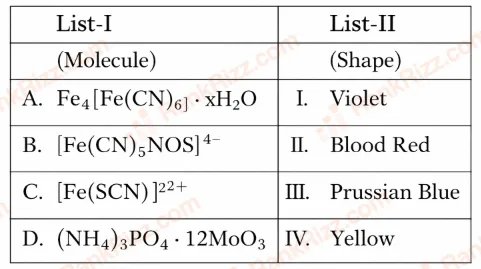
Choose the correct answer from the options given below:
- (A)
A-III, B-I, C-II, D-IV
- (B)
A-I, B-II, C-III, D-IV
- (C)
A-IV, B-I, C-II, D-III
- (D)
A-II, B-III, C-IV, D-I
rr2.rankrizz.com/jee-main/chemistry/qualitative-salt-analysis/q/8-apr-2024-s1-q34
- (A)
Match List I with List II
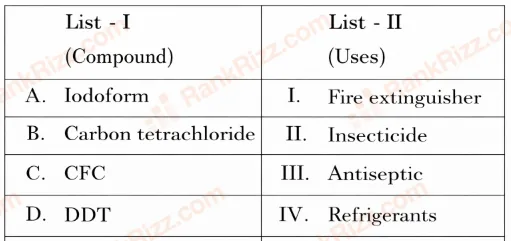
Choose the correct answer from the options given below:
- (A)
A-I, B-II, C-III, D-IV
- (B)
A-III, B-I, C-IV, D-II
- (C)
A-II, B-IV, C-I, D-III
- (D)
A-III, B-II, C-IV, D-I
rr2.rankrizz.com/jee-main/chemistry/qualitative-salt-analysis/q/6-apr-2024-s1-q44
- (A)
In the precipitation of the iron group (III) in qualitative analysis, ammonium chloride is added before adding ammonium hydroxide to:
- (A)
increase concentration of Cl⁻ ions
- (B)
increase concentration of NH₄⁺ ions
- (C)
prevent interference by phosphate ions
- (D)
decrease concentration of ⁻OH ions
rr2.rankrizz.com/jee-main/chemistry/qualitative-salt-analysis/q/04-apr-2024-s1-q49
- (A)
A reagent which gives brilliant red precipitate with Nickel ions in basic medium is
- (A)
sodium nitroprusside
- (B)
neutral FeCl
- (C)
meta-dinitrobenzene
- (D)
dimethyl glyoxime
rr2.rankrizz.com/jee-main/chemistry/qualitative-salt-analysis/q/29-jan-2024-s2-q49
- (A)
In the wet tests for detection of various cations by precipitation, Ba cations are detected by obtaining precipitate of
- (A)
Ba(ox) : Barium oxalate
- (B)
BaCO
- (C)
Ba(OAc)
- (D)
BaSO
rr2.rankrizz.com/jee-main/chemistry/qualitative-salt-analysis/q/13-apr-2023-s2-q49
- (A)
Element not present in Nessler's reagent is
- (A)
N
- (B)
Hg
- (C)
I
- (D)
K
rr2.rankrizz.com/jee-main/chemistry/qualitative-salt-analysis/q/6-apr-2023-s2-q45
- (A)
Formation of which complex, among the following, is not a confirmatory test of Pb ions
- (A)
Lead sulphate
- (B)
Lead nitrate
- (C)
Lead chromate
- (D)
Lead iodide
rr2.rankrizz.com/jee-main/chemistry/qualitative-salt-analysis/q/6-apr-2023-s2-q49
- (A)
In the wet tests for identification of various cations by precipitation, which transition element cation doesn't belong to group IV in qualitative inorganic analysis?
- (A)
Fe
- (B)
Zn
- (C)
Co
- (D)
Ni
rr2.rankrizz.com/jee-main/chemistry/qualitative-salt-analysis/q/30-jan-2023-s1-q49
- (A)
Formulae for Nessler's reagent is:
- (A)
KHg I
- (B)
KHgI
- (C)
K HgI
- (D)
HgI
rr2.rankrizz.com/jee-main/chemistry/qualitative-salt-analysis/q/30-jan-2023-s2-q43
- (A)
Match the List-I with List-II:
Cations Group reaction
P Pb, Cu (i) HS gas in presence of dilute HCl
Q Al, Fe (ii) (NH)CO in presence of NHOH
R Co, Ni (iii) NHOH in presence of NHCl
S Ba, Ca (iv) HS in presence of NHOH- (A)
P i, Q iii, R ii, S iv
- (B)
P iv, Q ii, R iii, S i
- (C)
P iii, Q i, R iv, S ii
- (D)
P i, Q iii, R iv, S ii
rr2.rankrizz.com/jee-main/chemistry/qualitative-salt-analysis/q/25-jan-2023-s1-q43
- (A)
An ammoniacal metal salt solution gives a brilliant red precipitate on addition of dimethylglyoxime. The metal ion is :
- (A)
- (B)
- (C)
- (D)
rr2.rankrizz.com/jee-main/chemistry/qualitative-salt-analysis/q/24-jan-2023-s1-q41
- (A)
An ammoniacal metal salt solution gives a brilliant red precipitate on addition of dimethylglyoxime. The metal ion is:
- (A)
- (B)
- (C)
- (D)
rr2.rankrizz.com/jee-main/chemistry/qualitative-salt-analysis/q/24-jan-2023-s1-q41-494056
- (A)
During the qualitative analysis of salt with cation , addition of a reagent (X) to alkaline solution of the salt gives a bright red precipitate. The reagent (X) and the cation () present respectively are :
- (A)
Dimethylglyoxime and Ni
- (B)
Dimethylglyoxime and Co
- (C)
Nessler's reagent and Hg
- (D)
Nessler's reagent and Ni
rr2.rankrizz.com/jee-main/chemistry/qualitative-salt-analysis/q/24-jun-2022-s1-q49
- (A)
Match List - I with List - II:
List - I (Metal ion) List - II (Group in Qualitative analysis)
(a) Mn (i) Group - III
(b) As (ii) Group - IIA
(c) Cu (iii) Group - IV
(d) Al (iv) Group - IIB
Choose the most appropriate answer from the options given below:- (A)
(a)-(iii), (b)-(iv), (c)-(ii), (d)-(i)
- (B)
(a)-(iv), (b)-(ii), (c)-(iii), (d)-(i)
- (C)
(a)-(i), (b)-(iv), (c)-(ii), (d)-(iii)
- (D)
(a)-(i), (b)-(ii), (c)-(iii), (d)-(iv)
rr2.rankrizz.com/jee-main/chemistry/qualitative-salt-analysis/q/31-aug-2021-s2-q35
- (A)
Acidic ferric chloride solution on treatment with excess of potassium ferrocyanide gives a Prussian blue coloured colloidal species. It is:
- (A)
HFe[Fe(CN)]
- (B)
KFe[Fe(CN)]
- (C)
Fe[Fe(CN)]
- (D)
KFe[Fe(CN)]
rr2.rankrizz.com/jee-main/chemistry/qualitative-salt-analysis/q/27-aug-2021-s1-q42
- (A)
To an aqueous solution containing ions such as Al, Zn, Ca, Fe, Ni, Ba and Cu was added conc. HCl, followed by HS. The total number of cations precipitated during this reaction is/are:
- (A)
1
- (B)
3
- (C)
4
- (D)
2
rr2.rankrizz.com/jee-main/chemistry/qualitative-salt-analysis/q/27-jul-2021-s2-q49
- (A)
Cu salt reacts with potassium iodide to give:
- (A)
CuI
- (B)
CuI
- (C)
CuI
- (D)
Cu(I)
rr2.rankrizz.com/jee-main/chemistry/qualitative-salt-analysis/q/20-jul-2021-s2-q35
- (A)
Given below are two statements:
Statement I: The identification of is carried out by dimethyl glyoxime in the presence of .
Statement II: The dimethyl glyoxime is a bidentate neutral ligand.
In the light of the above statements, choose the correct answer from the options given below:- (A)
Statement I is false but Statement II is true.
- (B)
Statement I is true but Statement II is false.
- (C)
Both Statement I and Statement II are true.
- (D)
Both Statement I and Statement II are false.
rr2.rankrizz.com/jee-main/chemistry/qualitative-salt-analysis/q/25-feb-2021-s2-q46
- (A)
The incorrect statement is:
- (A)
Cu ion gives chocolate coloured precipitate with potassium ferrocyanide solution
- (B)
Cu and Ni ions give black precipitate with HS in presence of HCl solution
- (C)
Ferric ion gives blood red colour with potassium thiocyanate
- (D)
Cu salts give red coloured borax bead test in reducing flame
rr2.rankrizz.com/jee-main/chemistry/qualitative-salt-analysis/q/16-apr-2018-online-q50
- (A)
A solution containing a period-IV cation gives a precipitate on passing HS. A solution of this precipitate in dil. HCl produces a white precipitate with NaOH solution and bluish-white precipitate with basic potassium ferrocyanide. The cation is:
- (A)
- (B)
- (C)
- (D)
rr2.rankrizz.com/jee-main/chemistry/qualitative-salt-analysis/q/8-apr-2017-online-q53
- (A)
The cation that will not be precipitated by in the presence of dil HCl is:
- (A)
- (B)
- (C)
- (D)
rr2.rankrizz.com/jee-main/chemistry/qualitative-salt-analysis/q/10-apr-2015-online-q51
- (A)
An aqueous solution of a salt X turns blood red on treatment with and blue on treatment with , X also gives a positive chromyl chloride test. The salt X is:
- (A)
- (B)
- (C)
- (D)
rr2.rankrizz.com/jee-main/chemistry/qualitative-salt-analysis/q/10-apr-2015-online-q52
- (A)
Which of the following statements is incorrect?
- (A)
ion also gives blood red colour with SCN ion.
- (B)
ion also gives blood red colour with SCN ion.
- (C)
On passing HS into NaZnO solution a white ppt of ZnS is formed.
- (D)
Cupric ion reacts with excess of ammonia solution to give deep blue colour of ion.
rr2.rankrizz.com/jee-main/chemistry/qualitative-salt-analysis/q/22-apr-2013-online-q53
- (A)
Sodium Carbonate cannot be used in place of for the identification of , and ions (in group V) during mixture analysis because :
- (A)
ions will also be precipitated.
- (B)
Concentration of ions is very low.
- (C)
Sodium ions will react with acid radicals.
- (D)
ions will interfere with the detection of , , ions.
rr2.rankrizz.com/jee-main/chemistry/qualitative-salt-analysis/q/9-apr-2013-online-q40
- (A)
Analysis of anions 17
Given below are two statements:
Statement I: Griss-Ilosvay test is used for the detection of nitrite ion, which involves the use of sulphanilic acid and reagent.
Statement II: In the above test, sulphanilic acid is diazotized by the acidified nitrite ion, which on further coupling with forms an azo-dye.
In the light of the above statements, choose the correct answer from the options given below- (A)
Statement I is true but Statement II is false
- (B)
Statement I is false but Statement II is true
- (C)
Both Statement I and Statement II are false
- (D)
Both Statement I and Statement II are true
rr2.rankrizz.com/jee-main/chemistry/qualitative-salt-analysis/q/28-jan-2026-s1-q54
- (A)
Consider the following reactions:
In the product 'C, 'X' is the number of units, 'Y' is the total number oxygen atoms present and 'Z' is the oxidation state of Cr·. The value of X + Y + Z is ______Answer: ____________
rr2.rankrizz.com/jee-main/chemistry/qualitative-salt-analysis/q/21-jan-2026-s1-q74
On heating a mixture of common salt and in equal amount along with concentrated in a test tube, a gas is evolved. Formula of the gas evolved and oxidation State of the central metal atom in the gas respectively are:
- (A)
and +5
- (B)
and +6
- (C)
and +3
- (D)
and +6
rr2.rankrizz.com/jee-main/chemistry/qualitative-salt-analysis/q/21-jan-2026-s2-q67
- (A)
Formation of , a purple coloured complex formed by addition of sodium nitroprusside in sodium carbonate extract of salt indicates the presence of :
- (A)
Sodium ion
- (B)
Sulphate ion
- (C)
Sulphide ion
- (D)
Sulphite ion
rr2.rankrizz.com/jee-main/chemistry/qualitative-salt-analysis/q/2025-apr-02-s2-q55
- (A)
During the detection of acidic radical present in a salt, a student gets a pale yellow precipitate soluble with difficulty in solution when sodium carbonate extract was first acidified with dil. and then solution was added. This indicates presence of :
- (A)
- (B)
- (C)
- (D)
rr2.rankrizz.com/jee-main/chemistry/qualitative-salt-analysis/q/6-apr-2024-s2-q48
- (A)
When and is added to a salt (A), the greenish yellow gas liberated as salt (A) is:
- (A)
- (B)
- (C)
- (D)
rr2.rankrizz.com/jee-main/chemistry/qualitative-salt-analysis/q/04-apr-2024-s2-q44
- (A)
Given below are two statements:
Statement-I: The gas liberated on warming a salt with dil , turns a piece of paper dipped in lead acetate into black, it is a confirmatory test for sulphide ion.
Statement-II: In statement-I the colour of paper turns black because of formation of lead sulphite.
In the light of the above statements, choose the most appropriate answer from the options given below:- (A)
Both Statement-I and Statement-II are false
- (B)
Statement-I is false but Statement-II is true
- (C)
Statement-I is true but Statement-II is false
- (D)
Both Statement-I and Statement-II are true
rr2.rankrizz.com/jee-main/chemistry/qualitative-salt-analysis/q/30-jan-2024-s1-q48
- (A)
In chromyl chloride test for confirmation of ion, a yellow solution is obtained. Acidification of the solution and addition of amyl alcohol and turns organic layer blue indicating formation of chromium pentoxide. The oxidation state of chromium in that is
- (A)
- (B)
- (C)
- (D)
rr2.rankrizz.com/jee-main/chemistry/qualitative-salt-analysis/q/29-jan-2024-s1-q45
- (A)
NaCl reacts with conc. and to give reddish fumes (B), which react with NaOH to give yellow solution (C). (B) and (C) respectively are :
- (A)
- (B)
- (C)
- (D)
rr2.rankrizz.com/jee-main/chemistry/qualitative-salt-analysis/q/27-jan-2024-s1-q44
- (A)
When a solution of mixture of two inorganic salts was treated with freshly prepared ferrous sulphate in acidic medium, a dark brown ring was formed whereas on treatment with neutral FeCl, it gave deep red colour which disappeared on boiling and a brown red ppt was formed. The mixture contains
- (A)
SO & CHCOO
- (B)
CHCOO & NO
- (C)
SO & CO
- (D)
CO & NO
rr2.rankrizz.com/jee-main/chemistry/qualitative-salt-analysis/q/11-apr-2023-s1-q43
- (A)
During the qualitative analysis of SO using dilute HSO, SO gas is evolved which turns KCrO solution (acidified with dilute HSO):
- (A)
Black
- (B)
Red
- (C)
Green
- (D)
Blue
rr2.rankrizz.com/jee-main/chemistry/qualitative-salt-analysis/q/30-jan-2023-s1-q41
- (A)
A chloride salt solution acidified with dil. HNO gives a curdy white precipitate, [A], on addition of AgNO. [A] on treatment with NHOH gives a clear solution, B.
- (A)
H[AgCl] & [Ag(NH)]Cl
- (B)
H[AgCl] & (NH)[Ag(OH)]
- (C)
AgCl & [Ag(NH)]Cl
- (D)
AgCl & (NH)[Ag(OH)]
rr2.rankrizz.com/jee-main/chemistry/qualitative-salt-analysis/q/25-jan-2023-s2-q42
- (A)
A white precipitate was formed when BaCl was added to water extract of an inorganic salt. Further, a gas 'X' with characteristic odour was released when the formed white precipitate was dissolved in dilute HCI. The anion present in the inorganic salt is:
- (A)
I
- (B)
SO
- (C)
S
- (D)
NO
rr2.rankrizz.com/jee-main/chemistry/qualitative-salt-analysis/q/29-jun-2022-s2-q49
- (A)
Match List - I with List - II.
List-I (Anion) List-II (gas evolved on reaction with dil. ) (A) (I) Colourless gas which turns lead acetate paper black. (B) (II) Colourless gas which turns acidified potassium dichromate solution green. (C) (III) Brown fumes which turns acidified KI solution containing starch blue. (D) (IV) Colourless gas evolved with brisk effervescence, which turns lime water milky. Choose the correct answer from the options given below
- (A)
A - III, B - I, C - II, D - IV
- (B)
A - II, B - I, C - IV, D - III
- (C)
A - IV, B - I, C - III, D - II
- (D)
A - IV, B - I, C - II, D - III
rr2.rankrizz.com/jee-main/chemistry/qualitative-salt-analysis/q/27-jun-2022-s2-q49
- (A)
Which statement is not true with respect to nitrate ion test?
- (A)
A dark brown ring is formed at the junction of two solutions.
- (B)
Ring is formed due to nitroferrous sulphate complex.
- (C)
The brown complex is
- (D)
Heating the nitrate salt with conc. , light brown fumes are evolved.
rr2.rankrizz.com/jee-main/chemistry/qualitative-salt-analysis/q/26-jun-2022-s1-q50
- (A)
A white sodium salt dissolves readily in water to give a solution which is neutral to litmus. When silver nitrate solution is added to the aforementioned solution, a white precipitate is obtained which does not dissolve in dil. nitric acid. The anion is:
- (A)
CO
- (B)
SO
- (C)
S
- (D)
Cl
rr2.rankrizz.com/jee-main/chemistry/qualitative-salt-analysis/q/15-apr-2018-s1-q44
- (A)
Potassium dichromate when heated with concentrated sulphuric acid and a soluble chloride, gives brown-red vapours of :
- (A)
- (B)
- (C)
- (D)
rr2.rankrizz.com/jee-main/chemistry/qualitative-salt-analysis/q/9-apr-2013-online-q52
- (A)
Preliminary and dry tests 14
Consider the following reactions
The oxidation states of Cu in Z and Q, respectively are:- (A)
+ 2 and + 2
- (B)
+ 2 and + 1
- (C)
+ 1 and + 1
- (D)
+ 1 and + 2
rr2.rankrizz.com/jee-main/chemistry/qualitative-salt-analysis/q/28-jan-2026-s2-q65
- (A)
The metal ion whose electronic configuration is not affected by the nature of the ligand and which gives a violet colour in non-luminous flame under hot condition in borax bead test is
- (A)
- (B)
- (C)
- (D)
rr2.rankrizz.com/jee-main/chemistry/qualitative-salt-analysis/q/28-jan-2025-s1-q64
- (A)
Match List I with List II
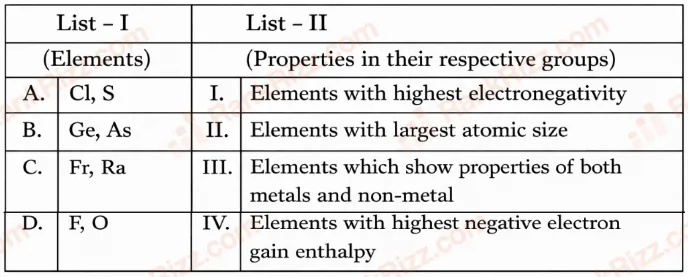
Choose the correct answer from the options given below:- (A)
A-II, B-I, C-IV, D-III
- (B)
A-III, B-II, C-I, D-IV
- (C)
A-IV, B-III, C-II, D-I
- (D)
A-II, B-III, C-IV, D-I
rr2.rankrizz.com/jee-main/chemistry/qualitative-salt-analysis/q/8-apr-2024-s1-q32
- (A)
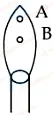
In a borax bead test under hot condition, a metal salt (one from the given) is heated at point B of the flame, resulted in green colour salt bead. The spin-only magnetic moment value of the salt is ______ BM (Nearest integer) [Given atomic number of ]
Answer: ____________
rr2.rankrizz.com/jee-main/chemistry/qualitative-salt-analysis/q/5-apr-2024-s1-q60
The number of white coloured salts among the following is: (A) (B) (C) (D) (E) (F) (G) (H) (I) (J)
Answer: ____________
rr2.rankrizz.com/jee-main/chemistry/qualitative-salt-analysis/q/01-feb-2024-s1-q60
The compound that is white in color is
- (A)
ammonium sulphide
- (B)
lead sulphate
- (C)
lead iodide
- (D)
ammonium arsinomolybdate
rr2.rankrizz.com/jee-main/chemistry/qualitative-salt-analysis/q/31-jan-2024-s1-q49
- (A)
Molar mass of the salt from and which does not evolve coloured vapours on heating with concentrated is ____ g mol. (Molar mass in g mol: Na: 23, N: 14, K: 39, O: 16, Br: 80, I: 127, F: 19, Ca: 40)
Answer: ____________
rr2.rankrizz.com/jee-main/chemistry/qualitative-salt-analysis/q/31-jan-2024-s1-q60
Number of metal ions characterized by flame test among the following is _________.
, , , , , ,Answer: ____________
rr2.rankrizz.com/jee-main/chemistry/qualitative-salt-analysis/q/30-jan-2024-s2-q59
On passing a gas, '', through Nessler's reagent, a brown precipitate is obtained. The gas '' is
- (A)
HS
- (B)
CO
- (C)
NH
- (D)
Cl
rr2.rankrizz.com/jee-main/chemistry/qualitative-salt-analysis/q/29-jan-2024-s2-q48
- (A)
Given below are two statements:
Statement I: Upon heating a borax bead dipped in cupric sulphate in a luminous flame, the colour of the bead becomes green.
Statement II: The green colour observed is due to the formation of copper(I) metaborate.
In the light of the above statements, choose the most appropriate answer from the options given below:- (A)
Both Statement I and Statement II are false
- (B)
Both Statement I and Statement II are true
- (C)
Statement I is false but Statement II is true
- (D)
Statement I is true but Statement II is false
rr2.rankrizz.com/jee-main/chemistry/qualitative-salt-analysis/q/31-jan-2023-s2-q49
- (A)
During the borax bead test with CuSO, a blue green colour of the bead was observed in oxidising flame due to the formation of
- (A)
CuB
- (B)
Cu
- (C)
Cu(BO)
- (D)
CuO
rr2.rankrizz.com/jee-main/chemistry/qualitative-salt-analysis/q/29-jan-2023-s1-q37
- (A)
Match List I with List II
List I (Elements) List II (Colour imparted to the flame)
A. K I. Brick Red
B. Ca II. Violet
C. Sr III. Apple Green
D. Ba IV. Crimson Red
Choose the correct answer from the options given below:- (A)
A-II, B-I, C-III, D-IV
- (B)
A-II, B-IV, C-I, D-III
- (C)
A-II, B-I, C-IV, D-III
- (D)
A-IV, B-III, C-II, D-I
rr2.rankrizz.com/jee-main/chemistry/qualitative-salt-analysis/q/25-jan-2023-s1-q33
- (A)
In the flame test of a mixture of salts, a green flame with blue centre was observed. Which one of the following cations may be present?
- (A)
Calcium
- (B)
Copper
- (C)
Barium
- (D)
Strontium
rr2.rankrizz.com/jee-main/chemistry/qualitative-salt-analysis/q/24-jun-2022-s2-q50
- (A)
Given below are two statements:
Statement I: Colourless cupric metaborate is reduced to cuprous metaborate in a luminous flame.
Statement II: Cuprous metaborate is obtained by heating boric anhydride and copper sulphate in a non-luminous flame.
In the light of the above statements, choose the most appropriate answer from the options given below.- (A)
Statement I is false but Statement II is true
- (B)
Both Statement I and Statement II are false
- (C)
Both Statement I and Statement II are true
- (D)
Statement I is true but Statement II is false
rr2.rankrizz.com/jee-main/chemistry/qualitative-salt-analysis/q/24-feb-2021-s1-q49
- (A)
Chemical principles of qualitative analysis 4
Consider three metal chlorides x, y and z, where x is water soluble at room temperature, y is sparingly soluble in water at room temperature and z is soluble in hot water. x, y and z are respectively
- (A)
and
- (B)
and
- (C)
and
- (D)
and
rr2.rankrizz.com/jee-main/chemistry/qualitative-salt-analysis/q/24-jan-2026-s1-q53
- (A)
Identify the inorganic sulphides that are yellow in colour : (A) (B) (C) (D) (E) Choose the correct answer from the options given below :
- (A)
(A), (D) and (E) only
- (B)
(D) and (E) only
- (C)
(A) and (B) only
- (D)
(A) and (C) only
rr2.rankrizz.com/jee-main/chemistry/qualitative-salt-analysis/q/28-jan-2025-s2-q68
- (A)
An inorganic Compound 'X' on treatment with concentrated HSO produces brown fumes and gives dark brown ring with FeSO in presence of concentrated HSO. Also Compound 'X' gives precipitate 'Y', when its solution in dilute HCl is treated with HS gas. The precipitate 'Y' on treatment with concentrated HNO followed by excess of NHOH further gives deep blue coloured solution, Compound 'X' is:
- (A)
Co(NO)
- (B)
Pb(NO)
- (C)
Cu(NO)
- (D)
Pb(NO)
rr2.rankrizz.com/jee-main/chemistry/qualitative-salt-analysis/q/20-jul-2021-s1-q31
- (A)
The sodium salt of an organic acid X produces effervescence with concentrated HSO. X reacts with the acidified aqueous CaCl solution to give a white precipitate which decolourises acidic solution of KMnO. X is
- (A)
HCOONa
- (B)
CHCOONa
- (C)
NaCO
- (D)
CHCOONa
rr2.rankrizz.com/jee-main/chemistry/qualitative-salt-analysis/q/2-apr-2017-offline-q51
- (A)
Answer key
- 01 D
- 02 B
- 03 D
- 04 C
- 05 B
- 06 C
- 07 —
- 08 A
- 09 D
- 10 0
- 11 A
- 12 B
- 13 D
- 14 D
- 15 B
- 16 A
- 17 B
- 18 A
- 19 D
- 20 D
- 21 B
- 22 B
- 23 A
- 24 A
- 25 D
- 26 A
- 27 A
- 28 —
- 29 B
- 30 B
- 31 A
- 32 A
- 33 A
- 34 A
- 35 D
- 36 13
- 37 D
- 38 C
- 39 A
- 40 D
- 41 C
- 42 A
- 43 A
- 44 B
- 45 C
- 46 C
- 47 B
- 48 D
- 49 B
- 50 D
- 51 C
- 52 B
- 53 C
- 54 C
- 55 6
- 56 5
- 57 B
- 58 78
- 59 4
- 60 C
- 61 A
- 62 C
- 63 C
- 64 B
- 65 B
- 66 B
- 67 —
- 68 C
- 69 C
“—” marks a question whose key we have not checked yet; its page shows the latest on it.
Past questions are reproduced with their sitting. Not affiliated with NTA or the IITs. Every question, online and free: rr2.rankrizz.com/jee-main/chemistry/qualitative-salt-analysis