JEE MAIN 2020 · 08 JAN S2Quantitative estimation of elements
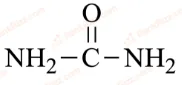
Kjeldahl's method cannot be used to estimate nitrogen for which of the following compounds?
- A
CHNH
- B
CHCH-CN
- C
CHNO
- D
Every Purification and Characterisation of Organic Compounds question JEE Main has set from 2004–2026, grouped by the idea it tests rather than the order of the syllabus. 151 questions across 4 distinct ideas. Free to read, answer key on every one.
DATA UPDATED
Questions
151
Distinct ideas
4
Share of marks
3.8%
Difficulty
EASY
A chapter is not one subject — it is a handful of procedures the examiner reuses. These are the ones Purification and Characterisation of Organic Compounds questions actually test.
121–140 OF 151 · NEWEST FIRST
Kjeldahl's method cannot be used to estimate nitrogen for which of the following compounds?
CHNH
CHCH-CN
CHNO
A solution of m-chloroaniline, m-chlorophenol and m-chlorobenzoic acid in ethyl acetate was extracted initially with a saturated solution of NaHCO to give fraction A. The left over organic phase was extracted with dilute NaOH solution to give fraction B. The final organic layer was labelled as fraction C. Fractions A, B and C, contain respectively:
m-chlorobenzoic acid, m-chloroaniline and m-chlorophenol
m-chlorobenzoic acid, m-chlorophenol and m-chloroaniline
m-chlorophenol, m-chlorobenzoic acid and m-chloroaniline
m-chloroaniline, m-chlorobenzoic acid and m-chlorophenol
A chromatography column, packed with silica gel as stationary phase, was used to separate a mixture of compounds consisting of (A) benzanilide (B) aniline and (C) acetophenone. When the column is eluted with a mixture of solvents, hexane:ethyl acetate (20 : 80), the sequence of obtained compounds is:
(B), (C) and (A)
(B), (A) and (C)
(C), (A) and (B)
(A), (B) and (C)
An organic compound 'A' is oxidized with NaO followed by boiling with HNO. The resultant solution is then treated with ammonium molybdate to yield a yellow precipitate. Based on above observation, the element present in the given compound is:
Fluorine
Phosphorus
Nitrogen
Sulphur
The principle of column chromatography is:
Differential adsorption of the substances on the solid phase.
Differential absorption of the substances on the solid phase.
Gravitational force.
Capillary action
In chromatography, which of the following statements is incorrect for R?
Higher R value means higher adsorption.
The value of R cannot be more than one.
R value depends on the type of chromatography.
R value of dependent on the mobile phase.
The organic compound that gives following qualitative analysis is:
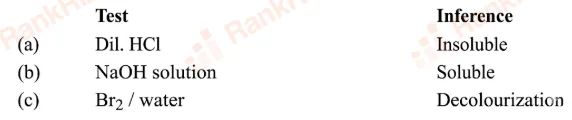
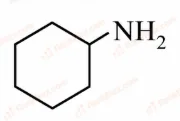
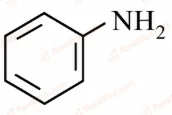
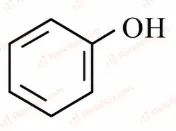
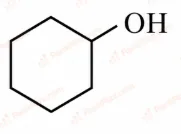
An organic compound 'X' showing the following solubility profile is:
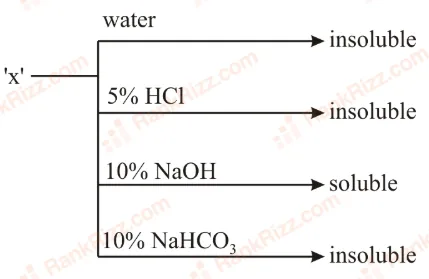
m-Cresol
o-Toluidine
Oleic acid
Benzamide
The correct match between items I and II is:
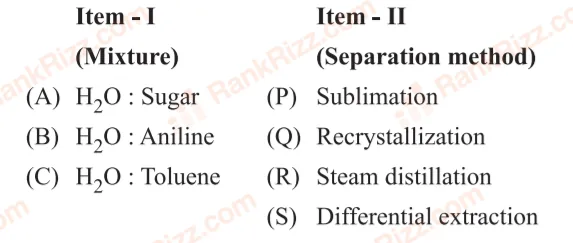
(A) (S); (B) (R); (C) (P)
(A) (Q); (B) (R); (C) (S)
(A) (R); (B) (P); (C) (S)
(A) (Q); (B) (R); (C) (P)
If Dichloromethane (DCM) and water are used for differential extraction, which one of the following statements is correct?
DCM and would stay as upper and lower layer respectively in the separating funnel (S.F.)
DCM and will be miscible clearly
DCM and would stay as lower and upper layer respectively in the S.F.
DCM and will make turbid/colloidal mixture
The correct match between item I and item II is:
Item I (Compound) Item II (Reagent)
a. Lysine p. 1-naphthol
b. Furfural q. Ninhydrin
c. Benzyl alcohol r. KMnO
d. Styrene s. Ceric ammonium nitrate
a q, b r, c s, d p
a q, b p, c s, d r
a r, b p, c q, d s
a q, b p, c r, d s
The correct match between column-I and column-II is:
Column-I (drug) Column-II (test)
(A) Chloroxylenol (P) Carbylamine test
(B) Norethindrone (Q) Sodium hydrogen carbonate test
(C) Sulphapyridine (R) Ferric chloride test
(D) Penicillin (S) Baeyer's test
A R, B P, C S, D Q
A Q, B S, C P, D R
A Q, B P, C S, D R
A R, B S, C P, D Q
The correct match between Item I and Item II is:
Item I Item II
(A) Benzaldehyde (P) Mobile phase
(B) Alumina (Q) Adsorbent
(C) Acetonitrile (R) Adsorbate
(A) (P); (B) (R); (C) (Q)
(A) (R); (B) (Q); (C) (P)
(A) (Q); (B) (P); (C) (R)
(A) (Q); (B) (R); (C) (P)
The test performed on compound x and their inferences are:
Test Inference
(a) 2,4-DNP test Coloured precipitate yellow
(b) Iodoform test Yellow precipitate
(c) Azo-dye test No dye formation
Compound 'x' is:
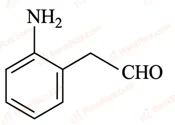
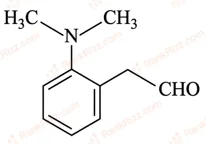
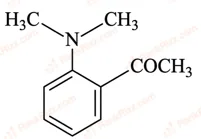
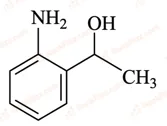
The correct match between items of List-I and List-II is:
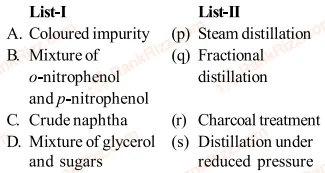
(A)-(r), (B)-(s), (C)-(p), (D)-(q)
(A)-(p), (B)-(s), (C)-(r), (D)-(q)
(A)-(r), (B)-(p), (C)-(q), (D)-(s)
(A)-(r), (B)-(p), (C)-(s), (D)-(q)
Two compounds I and II are eluted by column chromatography (adsorption of I > II). Which one of the following is a correct statement?
II moves slower and has higher R value than I
II moves faster and has higher R value than I
I moves faster and has higher R value than II
I moves slower and has higher R value than I
Which of the following statements is not true about partition chromatography?
Stationary phase is a finely divided solid adsorbent.
Separation depends upon equilibration of solute between a mobile and a stationary phase.
Mobile phase can be a gas.
Paper chromatography is an example of partition chromatography.
Sodium extract is heated with concentrated before testing for halogens because:
and AgCN are soluble in acidic medium.
Silver halides are totally insoluble in nitric acid.
and , if present, are decomposed by conc. and hence do not interfere in the test.
Ag reacts faster with halides in acidic medium
The distillation technique most suited for separating glycerol from spent - lye in the soap industry is:
Steam distillation
Distillation under reduced pressure
Simple distillation
Fractional distillation
Match the organic compounds in column - I with the Lassaigne's test result in column - II appropriately:
Column - I Column - II
A. Aniline i. Red colour with FeCl
B. Benzene sulfonic acid ii. Violet color with sodium nitroprusside
C. Thiourea iii. Blue color with acidic solution of FeSO
A - ii; B - iii; C - i
A - iii; B - ii; C - i
A - ii; B - i; C - iii
A - iii; B - i; C - ii
OTHER CHEMISTRY CHAPTERS