JEE MAIN 2026 · 05 APR S1Quantitative estimation of elements
In an estimation of sulphur by Carius method 0.2 g of the substance gave 0.6 g of BaSO. The percentage of sulphur in the substance is _______%. (Given molar mass in g mol S: 32, BaSO: 231)
Quantitative estimation of elements has been asked 75 times in JEE Main, in 15 different years between 2004 and 2026, and in all of the last five exam years (2022–2026), 46 questions in all. That is 50% of Purification and Characterisation of Organic Compounds, its most-asked topic. Last asked in JEE Main 05 Apr 2026, Shift 1. 48 are multiple choice and 27 numerical-value; 42 easy, 29 medium and 1 hard by our difficulty labels. All of them are below, newest first, free to read.
Questions
75
Years asked
15
Since
2004
Of the chapter
50%
Questions on Quantitative estimation of elements in every year it was asked, newest first.
| Year | Relative frequency | Questions |
|---|---|---|
| 2026 | 11 | |
| 2025 | 12 | |
| 2024 | 8 | |
| 2023 | 7 | |
| 2022 | 8 | |
| 2021 | 10 | |
| 2020 | 5 | |
| 2019 | 5 | |
| 2016 | 1 | |
| 2015 | 2 | |
| 2014 | 1 | |
| 2013 | 2 | |
| 2010 | 1 | |
| 2008 | 1 | |
| 2004 | 1 | |
| Total | 75 |
1–20 OF 75 · NEWEST FIRST
In an estimation of sulphur by Carius method 0.2 g of the substance gave 0.6 g of BaSO. The percentage of sulphur in the substance is _______%. (Given molar mass in g mol S: 32, BaSO: 231)
2.0 g of a bromo hydrocarbon was subjected to Carius analysis, gave 3.36 g of AgBr. The percentage of carbon in the compound is 26.7%. Total number of carbon atoms in the empirical formula for compound is _____.
( Given molar mass in g )
In sulphur estimation, mol of an organic compound (X) (molar mass 76 g mol) gave 0.4813 g of barium sulphate (molar mass 233 g mol). The percentage of sulphur in the compound (X) is _________ % (Nearest integer)
Complete combustion of g of an organic compound gave 0.25 g of CO and 0.12 g of HO. If the % of carbon is 25% and of hydrogen is 4.89%, then _____ g. (Nearest integer) (Molar mass of C, H and O are 12, 1 and 16 g mol respectively.)
Consider the following reactions sequence.
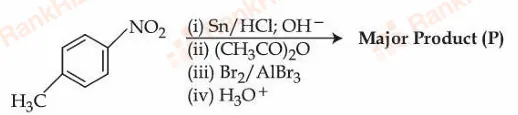
When the product (P) is subjected to Carius analysis using AgNO, 1.0 g of the product (P) will produce _____ g of the precipitate of AgBr. (Nearest Integer)
(Given: molar mass in g mol C: 12, H: 1, O: 16, N: 14, Br: 80, Ag: 108)
In Dumas method for estimation of nitrogen, 0.50 g of an organic compound gave 70 mL of nitrogen collected at 300 K and 715 mm pressure. The percentage of nitrogen in the organic compound is __ %.
(Aqueous tension at 300 K is 15 mm).
In Carius method 0.2425 g of an organic compound gave 0.5253 g silver chloride.
The percentage of chlorine in the organic compound is
37.57%
53.58%
87.65%
34.79%
Sodium fusion extract of an organic compound (Y) with and chlorine water gives violet color to the layer. 0.15g of gave 0.12g of the silver halide precipitate in Carius method. Percentage of halogen in the compound is _______ . (Nearest integer)
(Given : molar mass g C : 12 , H : 1, Cl : 35.5, Br : 80 , I : 127)
When 1 g of cmnpow1d (X) is subjected to Kjeldahl's method for estimation of nitrogen, 15 mL 1 M was neutrilized by ammonia evolved. The percentage of nitrogen in compound
(X) is :
42
0.42
0.21
21
In Carius method, 0.75 g of an organic compound gave 1.2 g of barium sulphate, find percentage of sulphur (molar mass 32 g ) Molar mass of barium sulphate is 233 g
10.30%
16.48%
4.55%
21.97%
By usual analysis, 1.00 g of compound (X) gave 1.79 g of magnesium pyrophosphate. The percentage of phosphorus in compound (X) is: (nearest integer)
(Given, molar mass in : 0 = 16, Mg = 24, P = 31 )
40
20
30
50
In Dumas' method 292 mg of an organic compound released 50 mL of nitrogen gas () at 300 K temperature and 715 mm Hg pressure. The percentage composition of 'N' in the organic compound is _____ %.(Nearest integer)
(Aqueous tension at 300 K = 15 mm Hg)
In Dumas' method for estimation of nitrogen 1g of an organic compound gave 150 mL of nitrogen collected at 300K temperature and 900 mm Hg pressure. The percentage composition of nitrogen in the compound is ________ % (nearest integer). (Aqueous tension at 300 K = 15 mm Hg)
During estimation of nitrogen by Dumas' method of compound X (0.42 g) :
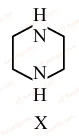
_________ mL of gas will be liberated at STP. (nearest integer)
(Given molar mass in g mol : C : 12, H : 1, N : 14)
In Dumas' method for estimation of nitrogen 0.4 g of an organic compound gave 60 mL of nitrogen collected at 300 K temperature and 715 mm Hg pressure. The percentage composition of nitrogen in the compound is (Given: Aqueous tension at 300 K = 15 mm Hg)
15.71%
20.95%
17.46%
7.85%
In Dumas' method for estimation of nitrogen, 0.5 gram of an organic compound gave 60 mL of nitrogen collected at 300 K temperature and 715 mm Hg pressure. The percentage composition of nitrogen in the compound (Aqueous tension at 300 K = 15 mm Hg) is
In the sulphur estimation, 0.20 g of a pure organic compound gave 0.40 g of barium sulphate. The percentage of sulphur in the compound is ______ . (Molar mass : O = 16, S=32, Ba = 137 in )
Given below are two statements I and II. Statement I: Dumas method is used for estimation of "Nitrogen" in an organic compound. Statement II: Dumas method involves the formation of ammonium sulphate by heating the organic compound with conc . In the light of the above statements, choose the correct answer from the options given below
Statement I is true but Statement II is false
Both Statement I and Statement II are false
Statement I is false but Statement II is true
Both Statement I and Statement II are true
In Carius method of estimation of halogen, of an organic compound gave of silver bromide The percentage of Bromine in the organic compound is (Nearest integer). }[ Given: Molar mass of Ag is 108 and Br is 80 g ]
Given below are two statements:
Statement I: In Lassaigne's test, the covalent organic molecules are transformed into ionic compounds.
Statement II: The sodium fusion extract of an organic compound having N and S gives prussian blue colour with and In the light of the above statements, choose
the correct answer from the options given below.
Statement I is true but Statement II is false
Both Statement I and Statement II are false
Both Statement I and Statement II are true
Statement I is false but Statement II is true
RELATED PURIFICATION AND CHARACTERISATION OF ORGANIC COMPOUNDS TOPICS