RankRizz

Atomic Structure — JEE Main Previous Year Questions

Every Atomic Structure question JEE Main has set from 2004–2026, grouped by the idea it tests rather than the order of the syllabus. 226 questions across 9 distinct ideas. Free to read, answer key on every one.

DATA UPDATED

Questions

226

Distinct ideas

9

Share of marks

6.1%

Difficulty

EASY

The ideas inside Atomic Structure

A chapter is not one subject — it is a handful of procedures the examiner reuses. These are the ones Atomic Structure questions actually test.

Every Atomic Structure question

141–160 OF 226 · NEWEST FIRST

JEE MAIN 2021 · 16 MAR S1Electromagnetic radiation, Planck's quantum theory and photoelectric effect

When light of wavelength 248 nm falls on a metal of threshold energy 3.0 eV, the de-Broglie wavelength of emitted electrons is ________ A˚\mathring{A} (angstrom). (Round off to the Nearest Integer).
[Use: 3=1.73\sqrt{3} = 1.73, h=6.63×10⁻³⁴h = 6.63 \times 10^{-34} Js; me=9.1×10⁻³¹m_e = 9.1 \times 10^{-31} kg; c=3.0×10⁸c = 3.0 \times 10^{8} ms−1^{-1}; 11 eV =1.6×10−19= 1.6 \times 10^{-19} J]

JEE MAIN 2021 · 16 MAR S2Quantum numbers and shapes of orbitals

The number of orbitals with n=5n = 5, ml=+2m_l = +2 is ________. (Round off to the Nearest Integer).

JEE MAIN 2021 · 26 FEB S2de Broglie wavelength and Heisenberg uncertainty principle

A ball weighing 10 g is moving with a velocity of 90 m s−1^{-1}. If the uncertainty in its velocity is 5%, then the uncertainty in its position is ______ ×10−33\times 10^{-33} m. (Rounded off to the nearest integer)
[Given: h = 6.63×10−346.63 \times 10^{-34} Js]

JEE MAIN 2021 · 25 FEB S1Quantum mechanical model, wave function and probability

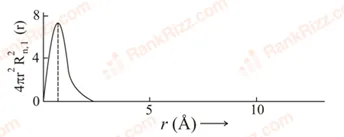
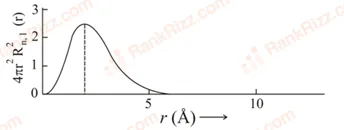
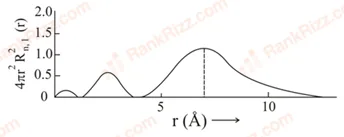
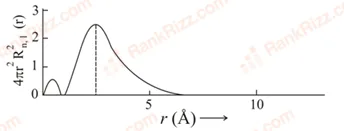
The plots of radial distribution functions for various orbitals of hydrogen atom against 'r' are given below. The correct plot for 3s orbital is:

  1. A
    Figure for JEE Main 2021 Chemistry question on Quantum mechanical model, wave function and probability
  2. B
    Figure for JEE Main 2021 Chemistry question on Quantum mechanical model, wave function and probability
  3. C
    Figure for JEE Main 2021 Chemistry question on Quantum mechanical model, wave function and probability
  4. D
    Figure for JEE Main 2021 Chemistry question on Quantum mechanical model, wave function and probability
JEE MAIN 2021 · 25 FEB S2Electromagnetic radiation, Planck's quantum theory and photoelectric effect

Electromagnetic radiation of wavelength 663 nm is just sufficient to ionise the atom of metal A. The ionization energy of metal A in kJ mol−1^{-1} is ______. (Rounded-off to the nearest integer)
[h=6.63×10⁻³⁴h = 6.63 \times 10^{-34} Js, c=3.00×10⁸c = 3.00 \times 10^8 ms−1^{-1}, NA=6.02×10²³N_A = 6.02 \times 10^{23} mol−1^{-1}]

JEE MAIN 2021 · 25 FEB S2Electromagnetic radiation, Planck's quantum theory and photoelectric effect

Among the following, number of metal/s which can be used as electrodes in the photoelectric cell is ______. (Integer answer)
(A) Li (B) Na (C) Rb (D) Cs

JEE MAIN 2021 · 24 FEB S1de Broglie wavelength and Heisenberg uncertainty principle

A proton and a Li3+Li^{3+} nucleus are accelerated by the same potential. If λLi\lambda_{Li} and λp\lambda_p denote the de Broglie wavelengths of Li3+Li^{3+} and proton respectively, then the value of λLiλp\frac{\lambda_{Li}}{\lambda_p} is x×10−1x \times 10^{-1}. The value of xx is ______ (Rounded off to the nearest integer) [Mass of Li3+Li^{3+} = 8.3 mass of proton]

JEE MAIN 2021 · 24 FEB S2Bohr model of hydrogen-like species

According to Bohr's atomic theory:
(A) Kinetic energy of electron is ∝Z2n2\propto \frac{Z^2}{n^2}.
(B) The product of velocity (v) of electron and principal quantum number (n), ′vn′∝Z2'vn' \propto Z^2.
(C) Frequency of revolution of electron in an orbit is ∝Z3n3\propto \frac{Z^3}{n^3}.
(D) Coulombic force of attraction on the electron is ∝Z3n4\propto \frac{Z^3}{n^4}.
Choose the most appropriate answer from the options given below:

  1. A

    (A), (C) and (D) only

  2. B

    (A) and (D) only

  3. C

    (C) only

  4. D

    (A) only

JEE MAIN 2020 · 05 SEP S1Bohr model of hydrogen-like species

The difference between the radii of 3rd and 4th orbits of Li2+\text{Li}^{2+} is ΔR1\Delta R_1. The difference between the radii of 3rd and 4th orbits of He+\text{He}^+ is ΔR2\Delta R_2. Ratio ΔR1:ΔR2\Delta R_1 : \Delta R_2 is:

  1. A

    8 : 3

  2. B

    3 : 8

  3. C

    2 : 3

  4. D

    3 : 2

JEE MAIN 2020 · 05 SEP S2Quantum mechanical model, wave function and probability

The correct statement about probability density (except at infinite distance from nucleus) is:

  1. A

    It can be zero for 1s orbital

  2. B

    It can be negative for 2p orbital

  3. C

    It can be zero for 3p orbital

  4. D

    It can never be zero for 2s orbital

JEE MAIN 2020 · 04 SEP S1Hydrogen spectrum and spectral series

The region in the electromagnetic spectrum where the Balmer series lines appear is:

  1. A

    Visible

  2. B

    Microwave

  3. C

    Infrared

  4. D

    Ultraviolet

JEE MAIN 2020 · 04 SEP S2Hydrogen spectrum and spectral series

The shortest wavelength of H atom in the Lyman series is λ1\lambda_1. The longest wavelength in the Balmer series of He+^+ is:

  1. A

    36λ15\frac{36\lambda_1}{5}

  2. B

    5λ19\frac{5\lambda_1}{9}

  3. C

    9λ15\frac{9\lambda_1}{5}

  4. D

    27λ15\frac{27\lambda_1}{5}

JEE MAIN 2020 · 03 SEP S2Quantum numbers and shapes of orbitals

Consider the hypothetical situation where the azimuthal quantum number, ℓ\ell, takes values 0, 1, 2, ......... n + 1. Where n is the principal quantum number. Then, the element with atomic number:

  1. A

    9 is the first alkali metal

  2. B

    13 has a half-filled valence subshell

  3. C

    8 is the first noble gas

  4. D

    6 has a 2p-valence subshell

JEE MAIN 2020 · 02 SEP S1Electromagnetic radiation, Planck's quantum theory and photoelectric effect

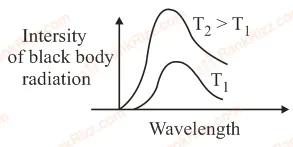
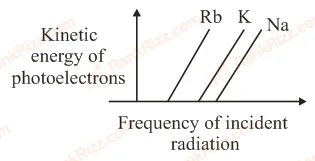
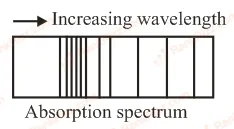
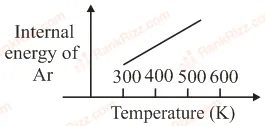
The figure that is not a direct manifestation of the quantum nature of atom is:

  1. A
    Figure for JEE Main 2020 Chemistry question on Electromagnetic radiation, Planck's quantum theory and photoelectric effect
  2. B
    Figure for JEE Main 2020 Chemistry question on Electromagnetic radiation, Planck's quantum theory and photoelectric effect
  3. C
    Figure for JEE Main 2020 Chemistry question on Electromagnetic radiation, Planck's quantum theory and photoelectric effect
  4. D
    Figure for JEE Main 2020 Chemistry question on Electromagnetic radiation, Planck's quantum theory and photoelectric effect
JEE MAIN 2020 · 02 SEP S2Quantum numbers and shapes of orbitals

The number of subshells associated with n=4n = 4 and m=−2m = -2 quantum numbers is:

  1. A

    8

  2. B

    2

  3. C

    16

  4. D

    4

JEE MAIN 2020 · 02 SEP S2Electromagnetic radiation, Planck's quantum theory and photoelectric effect

The work function of sodium metal is 4.41×10−194.41 \times 10^{-19} J. If photons of wavelength 300 nm are incident on the metal, the kinetics energy of the ejected electrons will be (h=6.63×10⁻³⁴(h = 6.63 \times 10^{-34} J s; c=3×10⁸c = 3 \times 10^8 m s−1)^{-1}) ___________ ×10−21\times 10^{-21} J.

JEE MAIN 2020 · 09 JAN S1de Broglie wavelength and Heisenberg uncertainty principle

The de Broglie wavelength of an electron in the 4th4^{th} Bohr orbit is:

  1. A

    2πa02\pi a_0

  2. B

    4πa04\pi a_0

  3. C

    6πa06\pi a_0

  4. D

    8πa08\pi a_0

JEE MAIN 2020 · 08 JAN S1Hydrogen spectrum and spectral series

For the Balmer series, in the spectrum of H atom, vˉ=RH{1n12−1n22}\bar{v} = R_H\left\{\frac{1}{n_1^2} - \frac{1}{n_2^2}\right\}, the correct statements among (I) to (IV) are,
(I) As wavelength decreases, the lines in the series converge.
(II) The integer n1n_1 is equal to 2.
(III) The lines of the longest wavelength correspond to n2=3n_2 = 3.
(IV) The ionization energy of hydrogen can be calculated from the wave number of these lines.

  1. A

    (I), (III), (IV)

  2. B

    (I), (II), (III)

  3. C

    (I), (II), (IV)

  4. D

    (II), (III), (IV)

JEE MAIN 2020 · 08 JAN S2Bohr model of hydrogen-like species

The radius of the second Bohr orbit, in terms of the Bohr radius, a0a_0, in Li2+^{2+} is:

  1. A

    2a03\frac{2a_0}{3}

  2. B

    4a09\frac{4a_0}{9}

  3. C

    4a03\frac{4a_0}{3}

  4. D

    2a09\frac{2a_0}{9}

JEE MAIN 2020 · 08 JAN S2Radial and angular nodes and orbital energies

Hydrogen has three isotopes (A), (B) and (C). If the number of neutron(s) in (A), (B) and (C) respectively, are (x), (y) and (z), the sum of (x), (y) and (z) is

  1. A

    3

  2. B

    2

  3. C

    4

  4. D

    1