JEE MAIN 2026 · 05 APR S1Quantum numbers and shapes of orbitals
Arrange the following atomic orbitals of multi electron atoms in order of increasing energy.
A.
B.
C.
D.
E.
Choose the correct answer from the options given below:
- A
- B
- C
- D
Quantum numbers and shapes of orbitals has been asked 45 times in JEE Main, in 12 different years between 2004 and 2026, and in all of the last five exam years (2022–2026), 30 questions in all. That is 20% of Atomic Structure, its most-asked topic. Last asked in JEE Main 05 Apr 2026, Shift 2. 33 are multiple choice and 12 numerical-value; 30 easy, 12 medium and 2 hard by our difficulty labels. All of them are below, newest first, free to read.
Questions
45
Years asked
12
Since
2004
Of the chapter
20%
Questions on Quantum numbers and shapes of orbitals in every year it was asked, newest first.
| Year | Relative frequency | Questions |
|---|---|---|
| 2026 | 4 | |
| 2025 | 6 | |
| 2024 | 7 | |
| 2023 | 5 | |
| 2022 | 8 | |
| 2021 | 5 | |
| 2020 | 3 | |
| 2019 | 2 | |
| 2016 | 1 | |
| 2014 | 1 | |
| 2013 | 2 | |
| 2004 | 1 | |
| Total | 45 |
1–20 OF 45 · NEWEST FIRST
Arrange the following atomic orbitals of multi electron atoms in order of increasing energy.
A.
B.
C.
D.
E.
Choose the correct answer from the options given below:
Which of the following statement(s) is/are true?
If two orbitals have the same value of , the orbital with lower value of will have lower energy.
Energies of the orbitals in the same subshell increase with increase in atomic number.
The size of orbital is less than the size of orbital.
Among , , , and orbitals, none of the orbitals have 2 radial nodes.
Choose the correct answer from the options given below:
A, B, C
A, C
C, D
A only
Which of the following is correct set of 4 quantum numbers of 19th electron in Chromium (Atomic number = 24) in accordance with Aufbau principle?
Given,
(A)
(B)
The maximum number of electron(s) in an atom that can have the quantum numbers as given in (A) and (B) respectively are:
26 and 1
8 and 1
2 and 4
4 and 1
For electron in '2s' and '2p' orbitals, the orbital angular momentum values, respectively are:
and 0
and
0 and
0 and
Which of the following statements are true ?
(A) The subsidiary quantum number describes the shape of the orbital occupied by the electron.
(B)
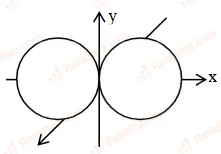
is the boundary diagram of the orbital.
(C) The + and - signs in the wave function of the orbital refer to charge.
(D) The wave function of orbital is zero everywhere in the xy plane.
(B) and (D) only
(A), (B) and (C) only
(C) and (D) only
(A) and (B) only
In a multielectron atom, which of the following orbitals described by three quantum numbers will have same energy in absence of electric and magnetic fields? Choose the correct answer from the options given below:
B and C Only
A and B Only
C and D Only
D and E Only
Which of the following is/are not correct with respect to energy of atomic orbitals of hydrogen atom? (A)1s < 2p < 3d < 4s (B) 1s < 2s = 2p < 3s = 3p (C)1s < 2s < 2p < 3s < 3p (D) 1s < 2s < 4s < 3d
Choose the correct answer from the options given below :
(A) and (C) only
(B) and (D) only
(C) and (D) only
(A) and (B) only
Given below are two statements : Statement (I) : For a given shell, the total number of allowed orbitals is given by . Statement (II) : For any subshell, the spatial orientation of the orbitals is given by -l to +l values including zero. In the light of the above statements, choose the correct answer from the options given below :
Both Statement I and Statement II are false
Statement I is true but Statement II is false
Both Statement I and Statement II are true
Statement I is false but Statement II is true
Given below are two statements : Statement (I) : A spectral line will be observed for a transition.Statement (II) : and are degenerate orbitals. In the light of the above statements, choose the correct answer from the options given below :
Both Statement I and Statement II are true
Statement I is false but Statement II is true
Both Statement I and Statement II are false
Statement I is true but Statement II is false
Compare the energies of following sets of quantum numbers for multielectron system. (A) (B) (C) (D) (E) . Choose the correct answer from the options given below :
(B) > (A) > (C) > (E) > (D)
(E) < (C) < (D) < (A) < (B)
(E) > (C) > (A) > (D) > (B)
(C) < (E) < (D) < (A) < (B)
In an atom, total number of electrons having quantum numbers , and is ______
The maximum number of orbitals which can be identified with and is ______
The four quantum numbers for the electron in the outer most orbital of potassium (atomic no. 19) are
Given below are two statements:
Statement-I: The orbitals having same energy are called as degenerate orbitals.
Statement-II: In hydrogen atom, and orbitals are not degenerate orbitals.
In the light of the above statements, choose the most appropriate answer from the options given
Statement-I is true but Statement-II is false
Both Statement-I and Statement-II are true
Both Statement-I and Statement-II are false
Statement-I is false but Statement-II is true
The correct set of four quantum numbers for the valence electron of rubidium atom is:
The number of electrons present in all the completely filled subshells having and is ______ (Where = principal quantum number and = spin quantum number)
The orbital angular momentum of an electron in s orbital is . The value of x is _____ (nearest integer)
The number of correct statements from the following is _______
A. For 1s orbital, the probability density is maximum at the nucleus
B. For 2s orbital, the probability density first increases to maximum and then decreases sharply to zero.
C. Boundary surface diagrams of the orbitals encloses a region of 100% probability of finding the electron.
D. p and d-orbitals have 1 and 2 angular nodes respectively
E. probability density of p-orbital is zero at the nucleus
Arrange the following orbitals in decreasing order of energy.
A. n = 3, l = 0, m = 0
B. n = 4, l = 0, m = 0
C. n = 3, l = 1, m = 0
D. n = 3, l = 2, m = 1
The correct option for the order is:
D > B > C > A
B > D > C > A
A > C > B > D
D > B > A > C
RELATED ATOMIC STRUCTURE TOPICS