RankRizz

Radial and angular nodes and orbital energies — JEE Main Previous Year Questions

Radial and angular nodes and orbital energies has been asked 23 times in JEE Main, in 12 different years between 2005 and 2026, and in all of the last five exam years (2022–2026), 14 questions in all. That is 10% of Atomic Structure. Last asked in JEE Main 06 Apr 2026, Shift 1. 21 are multiple choice and 2 numerical-value; 14 easy and 3 medium by our difficulty labels. All of them are below, newest first, free to read.

Questions

23

Years asked

12

Since

2005

Of the chapter

10%

When JEE Main asked it

Questions on Radial and angular nodes and orbital energies in every year it was asked, newest first.

JEE Main questions on Radial and angular nodes and orbital energies by year, 2005–2026
YearRelative frequencyQuestions
20263
20253
20241
20234
20223
20201
20191
20161
20151
20122
20071
20052
Total23

Every Radial and angular nodes and orbital energies question

1–20 OF 23 · NEWEST FIRST

JEE MAIN 2026 · 06 APR S1Radial and angular nodes and orbital energies

Match the LIST-I with LIST-II

List-I
Orbital
List-II
Radial nodes and nodal plane
A.2sI.1 Radial node + two nodal planes
B.3sII.1 Radial node + one nodal plane
C.3pIII.2 Radial nodes + No nodal plane
D.4dIV.1 Radial node + No nodal plane


Choose the correct answer from the options given below:

  1. A

    A-IV, B-I, C-III, D-II

  2. B

    A-IV, B-II, C-III, D-I

  3. C

    A-III, B-I, C-IV, D-II

  4. D

    A-IV, B-III, C-II, D-I

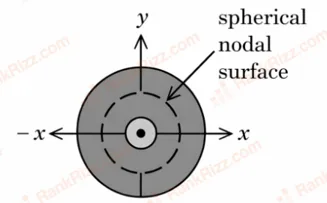
JEE MAIN 2026 · 28 JAN S1Radial and angular nodes and orbital energies
69-A

Figure 1. electron probability density for 2s orbital

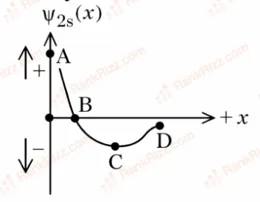
69-b


Figure 2. wave function for 2s orbital

 Which of the following point in Figure 2 most accurately represents the nodal surface as shown in Figure 1?

  1. A

    B

  2. B

    D

  3. C

    C

  4. D

    A

JEE MAIN 2026Radial and angular nodes and orbital energies

The orbital having one radial node as well one angular node is:

  1. A

    3p

  2. B

    4f

  3. C

    4d

  4. D

    5d

JEE MAIN 2025 · 08 APR S2Radial and angular nodes and orbital energies

Correct statements for an element with atomic number 9 are :
A. There can be 5 electrons for which ms=+12m_s = +\frac{1}{2} and 4 electrons for which ms=−12m_s = -\frac{1}{2}
B. There is only one electron in pzp_z orbital
C. The last electron goes to orbital with n=2n = 2 and l=1l = 1
D. The sum of angular nodes of all the atomic orbitals is 1.
Choose the correct answer from the options given below:

  1. A

    C and D Only

  2. B

    A and C Only

  3. C

    A, C and D Only

  4. D

    A and B Only

JEE MAIN 2025 · 07 APR S2Radial and angular nodes and orbital energies

The extra stability of half-filled subshell is due to :
(A) Symmetrical distribution of electrons
(B) Smaller coulombic repulsion energy
(C) The presence of electrons with the same spin in non-degenerate orbitals
(D) Larger exchange energy
(E) Relatively smaller shielding of electrons by one another
Identify the correct statements

  1. A

    (B), (D) and (E) only

  2. B

    (A), (B), (D) and (E) only

  3. C

    (B), (C) and (D) only

  4. D

    (A), (B) and (D) only

JEE MAIN 2025 · 04 APR S2Radial and angular nodes and orbital energies

Consider the ground state of chromium atom (Z = 24). How many electrons are with Azimuthal quantum number l=1l = 1 and l=2l = 2 respectively?

  1. A

    12 and 4

  2. B

    16 and 4

  3. C

    12 and 5

  4. D

    16 and 5

JEE MAIN 2024 · 01 FEB S2Radial and angular nodes and orbital energies

The number of radial node/s for 3p orbital is:

  1. A

    1

  2. B

    4

  3. C

    2

  4. D

    3

JEE MAIN 2023 · 08 APR S2Radial and angular nodes and orbital energies

The number of atomic orbitals from the following having 5 radial nodes is
7s, 7p, 6s, 8p, 8d

JEE MAIN 2023 · 01 FEB S2Radial and angular nodes and orbital energies

Which one of the following sets of ions represents a collection of isoelectronic species?
(Given: Atomic Number: F: 9, Cl: 17, Na = 11, Mg = 12, Al = 13, K = 19, Ca = 20, Sc = 21)

  1. A

    Li+,Na+,Mg2+,Ca2+\text{Li}^+, \text{Na}^+, \text{Mg}^{2+}, \text{Ca}^{2+}

  2. B

    Ba2+,Sr2+,K+,Ca2+\text{Ba}^{2+}, \text{Sr}^{2+}, \text{K}^+, \text{Ca}^{2+}

  3. C

    N3−,O2−,F−,S2−\text{N}^{3-}, \text{O}^{2-}, \text{F}^-, \text{S}^{2-}

  4. D

    K+,Cl−,Ca2+,Sc3+\text{K}^+, \text{Cl}^-, \text{Ca}^{2+}, \text{Sc}^{3+}

JEE MAIN 2023 · 30 JAN S2Radial and angular nodes and orbital energies

The wave function (Ψ)(\Psi) of 2s2s is given by
Ψ2s=122π(1a0)1/2(2−ra0)e−r/2a0\Psi_{2s} = \frac{1}{2\sqrt{2\pi}}\left(\frac{1}{a_0}\right)^{1/2}\left(2 - \frac{r}{a_0}\right)e^{-r/2a_0}
At r=r0r = r_0, radial node is formed. Thus, r0r_0 in terms of a0a_0

  1. A

    r0=a0r_0 = a_0

  2. B

    r0=4a0r_0 = 4a_0

  3. C

    r0=a02r_0 = \frac{a_0}{2}

  4. D

    r0=2a0r_0 = 2a_0

JEE MAIN 2023 · 24 JAN S2Radial and angular nodes and orbital energies

The number of s-electrons present in an ion with 55 protons in its unipositive state is

  1. A

    8

  2. B

    9

  3. C

    12

  4. D

    10

JEE MAIN 2022 · 26 JUL S2Radial and angular nodes and orbital energies

Consider an imaginary ion 2248X3−_{22}^{48}X^{3-}. The nucleus contains 'aa' %\% more neutrons than the number of electrons in the ion. The value of 'aa' is ______.

JEE MAIN 2022 · 26 JUN S2Radial and angular nodes and orbital energies

The number of radial and angular nodes in 4d4d orbital are, respectively

  1. A

    11 & 22

  2. B

    33 & 22

  3. C

    11 & 00

  4. D

    22 & 11

JEE MAIN 2022 · 25 JUN S1Radial and angular nodes and orbital energies

The pair, in which ions are isoelectronic with Al3+Al^{3+} is

  1. A

    Br−Br^- and Be2+Be^{2+}

  2. B

    Cl−Cl^- and Li+Li^+

  3. C

    S2−S^{2-} and K+K^+

  4. D

    O2−O^{2-} and Mg2+Mg^{2+}

JEE MAIN 2020 · 08 JAN S2Radial and angular nodes and orbital energies

Hydrogen has three isotopes (A), (B) and (C). If the number of neutron(s) in (A), (B) and (C) respectively, are (x), (y) and (z), the sum of (x), (y) and (z) is

  1. A

    3

  2. B

    2

  3. C

    4

  4. D

    1

JEE MAIN 2019 · 10 APR S1Radial and angular nodes and orbital energies

The isoelectronic set of ions is:

  1. A

    F−^-, Li+^+, Na+^+ and Mg2+^{2+}

  2. B

    N3−^{3-}, Li+^+, Mg2+^{2+} and O2−^{2-}

  3. C

    N3−^{3-}, O2−^{2-}, F−^- and Na+^+

  4. D

    Li+^+, Na+^+, O2−^{2-} and F−^-

JEE MAIN 2016 · 10 APR ONLINERadial and angular nodes and orbital energies

Aqueous solution of which of the following salts will not contain ions with the electronic configuration 1s22s22p63s23p61s^2 2s^2 2p^6 3s^2 3p^6?

  1. A

    NaF

  2. B

    KBr

  3. C

    NaCl

  4. D

    CaI2CaI_2

JEE MAIN 2015 · 10 APR ONLINERadial and angular nodes and orbital energies

If the principal quantum number n = 6, the correct sequence of filling of electrons will be:

  1. A

    ns →\rightarrow (n-1) d →\rightarrow (n-2) f →\rightarrow np

  2. B

    ns →\rightarrow np →\rightarrow (n-1)d →\rightarrow (n-2)f

  3. C

    ns →\rightarrow (n-2)f →\rightarrow np →\rightarrow (n-1)d

  4. D

    ns →\rightarrow (n-2)f →\rightarrow (n-1)d →\rightarrow np

JEE MAIN 2012Radial and angular nodes and orbital energies

The electrons identified by quantum numbers nn and ll: (a) n=4,l=1n=4, l=1 (b) n=4,l=0n=4, l=0 (c) n=3,l=2n=3, l=2 (d) n=3,l=1n=3, l=1 Can be placed in order of increasing energy as:

  1. A

    (c) < (d) < (b) < (a)

  2. B

    (d) < (b) < (c) < (a)

  3. C

    (b) < (d) < (a) < (c)

  4. D

    (a) < (c) < (b) < (d)

JEE MAIN 2012Radial and angular nodes and orbital energies

The following sets of quantum numbers represent four electrons in an atom. (i) n=4,l=1n = 4, l = 1 (ii) n=4,l=0n = 4, l = 0 (iii) n=3,l=2n = 3, l = 2 (iv) n=3,l=1n = 3, l = 1. The sequence representing increasing order of energy, is

  1. A

    (iii) < (i) < (iv) < (ii)

  2. B

    (iv) < (ii) < (iii) < (i)

  3. C

    (i) < (iii) < (ii) < (iv)

  4. D

    (ii) < (iv) < (i) < (iii)

Radial and angular nodes and orbital energies: common questions

How many Radial and angular nodes and orbital energies questions have come in JEE Main?
Radial and angular nodes and orbital energies has been asked 23 times in JEE Main, in 12 different years between 2005 and 2026. It came up in all of the last five exam years (2022–2026), 14 questions in all.
Is Radial and angular nodes and orbital energies important for JEE Main?
It is part of Atomic Structure: 23 of the chapter's 226 JEE Main questions (10%). It came up in all of the last five exam years (2022–2026), 14 questions in all.
When was Radial and angular nodes and orbital energies last asked in JEE Main?
Most recently in JEE Main 06 Apr 2026, Shift 1. Questions on this page are newest first, so the latest ones are at the top.
What kind of Radial and angular nodes and orbital energies questions does JEE Main ask?
21 are multiple choice and 2 numerical-value; 14 easy and 3 medium by our difficulty labels. Each question shows its answer key and worked solution where we have them.