RankRizz

Polymers — JEE Advanced Previous Year Questions

Polymers has been asked in 10 of the 20 JEE Advanced years from 2007 to 2026: 10 questions in all. In 2026 it averaged 0.5 questions per paper (1 across 2 papers), 2.9% of Chemistry questions, down from 3.1% in 2025. Across the last 20 papers it carried 1.1% of Chemistry questions. By type: 4 multiple-correct, 3 numerical, 2 single-correct and 1 match-the-list. Of the 10 with a difficulty tag, 50% are easy, 30% medium and 20% hard. Most asked: Classification of polymers and types of polymerisation (7, 70%) and Important polymers and their monomers (3, 30%).

DATA UPDATED

Questions

10

Distinct ideas

2

Share of marks

1.1%

Difficulty

EASY

Polymers weightage, year by year

The share of each year’s Chemistry questions that came from Polymers, counted from the 19 papers we hold for the last 10 years, and paper by paper inside a year.

Rising: 2.0% of Chemistry questions in 2024–2026, up from 0.9% in 2017–2023. Its heaviest year was 2025, at 3.1%. Not asked at all in 2017, 2018, 2020, 2021, 2023, 2024.

Polymers questions per year, per paper, and as a share of Chemistry questions
YEARQSPER PAPERSHARE OF CHEMISTRYCHANGE
20261 / 340.52.9%−0.2 pts
20251 / 320.53.1%+3.1 pts
20240 / 340.00.0%level
20230 / 340.00.0%−2.8 pts
20221 / 360.52.8%+2.8 pts
20210 / 380.00.0%level
20200 / 360.00.0%−2.8 pts
20191 / 360.52.8%+2.8 pts
20180 / 180.00.0%level
20170 / 360.00.0%—

“QS” is Polymers questions out of all Chemistry questions that year; “per paper” is that count over the year’s papers, and “change” is the share against the year before. A year with more sittings asks more questions, which is why the share, not the count, is the number to compare.

The ideas inside Polymers

A chapter is not one subject — it is a handful of procedures the examiner reuses. These are the ones Polymers questions actually test.

01Classification of polymers and types of polymerisationset 7×
02Important polymers and their monomersset 3×
03Rubber and biodegradable polymersNot set in Advanced

All 10 Polymers questions, by topic

Every JEE Advanced Polymers question we hold, newest first inside each topic. Open one for its options, answer key and solution.

FREE PDF

Polymers JEE Advanced PYQs with answer key

All 10 questions on A4, by topic, with the answer key at the end. No sign-up, no email: your browser saves it as a PDF.

Download free PDF

UNIQUE CONCEPTS

Polymers: one question per idea

3 ideas, each with the latest past question that tested it, drawn from 98 JEE Main and Advanced questions.

Polymers Unique Concepts sheet →

JEE MAIN

Polymers in JEE Main

JEE Main has set 88 Polymers questions, 2005–2023.

Polymers JEE Main PYQs →

Polymers: quick answers

Is Polymers asked every year in JEE Advanced?

Not every year. It has been asked in 10 of the 20 JEE Advanced years from 2007 to 2026; it was missing in 10 of them, most recently 2024.

Which Polymers topic is asked most in JEE Advanced?

Classification of polymers and types of polymerisation: 7 of the 10 questions (70%). Next come Important polymers and their monomers (3).

What share of Chemistry questions does Polymers carry in JEE Advanced?

About 1.1% of Chemistry questions across the last 20 papers. In 2026 it was 2.9% (1 of 34 Chemistry questions).

When was Polymers last asked in JEE Advanced?

In JEE Advanced 2026 Paper 2, the latest sitting with a Polymers question.

How many Polymers questions has JEE Advanced asked?

10 from 2007 to 2026, across 2 topics. Every one is listed on this page by topic and links to its own page, with the answer key and solution wherever we have them. Free, no sign-up.

Every Polymers question

1–10 OF 10 · NEWEST FIRST

JEE ADVANCED 2026 · PAPER 2Important polymers and their monomers

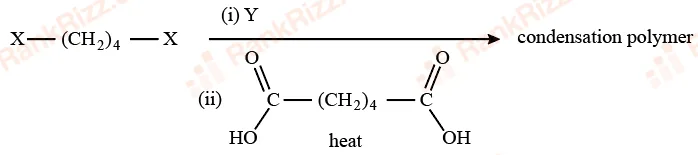
In the following reaction sequence, major products X and Y are acyclic monomers.
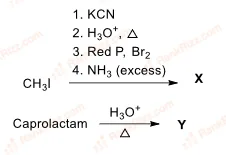
Figure for JEE Advanced 2026 Chemistry question on Important polymers and their monomers

500 mol of X completely reacts with 500 mol of Y to give 1 mol of a single biodegradable acyclic copolymer Z as the only product. The amount of Z formed in grams is ___.

Given: Atomic mass (in amu): H : 1, C : 12, N : 14, O : 16, Br : 80
JEE ADVANCED 2025 · PAPER 1Important polymers and their monomers

The monomer (X) involved in the synthesis of Nylon 6,6 gives positive carbylamine test. If 10 moles of X are analyzed using Dumas method, the amount (in grams) of nitrogen gas evolved is ________.

Use: Atomic mass of N (in amu) = 14

JEE ADVANCED 2022 · PAPER 2Important polymers and their monomers

Among the following, the correct statement(s) about polymers is(are)

  1. A

    The polymerization of chloroprene gives natural rubber.

  2. B

    Teflon is prepared from tetrafluoroethene by heating it with persulphate catalyst at high pressures.

  3. C

    PVC are thermoplastic polymers.

  4. D

    Ethene at 350-570 K temperature and 1000-2000 atm pressure in the presence of a peroxide initiator yields high density polythene.

JEE ADVANCED 2019 · PAPER 2Classification of polymers and types of polymerisation

Choose the correct option(s) from the following

  1. A

    Natural rubber is polyisoprene containing trans alkene units

  2. B

    Nylon-6 has amide linkages

  3. C

    Teflon is prepared by heating tetrafluoroethene in presence of a persulphate catalyst at high pressure

  4. D

    Cellulose has only α\alpha-D-glucose units that are joined by glycosidic linkages

JEE ADVANCED 2016 · PAPER 1Classification of polymers and types of polymerisation

On complete hydrogenation, natural rubber produces

  1. A

    ethylene-propylene copolymer

  2. B

    vulcanised rubber

  3. C

    polypropylene

  4. D

    polybutylene

JEE ADVANCED 2015 · PAPER 2Classification of polymers and types of polymerisation

Under hydrolytic conditions, the compounds used for preparation of linear polymer and for chain termination, respectively, are

  1. A

    CH3SiCl3CH_3SiCl_3 and Si(CH3)4Si(CH_3)_4

  2. B

    (CH3)2SiCl2(CH_3)_2 SiCl_2 and $$(CH_3)_3SiCl

  3. C

    (CH3)2SiCl2(CH_3)_2 SiCl_2 and CH3SiCl3CH_3 SiCl_3

  4. D

    SiCl4SiCl_4 and (CH3)3SiCl(CH_3)_3 SiCl

JEE ADVANCED 2013 · PAPER 1Classification of polymers and types of polymerisation

The total numberof lone-pairs of electrons in melamine is

JEE ADVANCED 2011 · PAPER 2Classification of polymers and types of polymerisation

The correct functional group X and the reagent/reaction conditions Y in the following scheme are

Figure for JEE Advanced 2011 Chemistry question on Classification of polymers and types of polymerisation
  1. A

    X=COOCH3,Y=H2/Ni/heatX = COOCH_3, Y = H_2/Ni/heat

  2. B

    X=CONH2,Y=H2/Ni/heatX = CONH_2, Y = H_2/Ni/heat

  3. C

    X=CONH2,Y=Br2/NaOHX = CONH_2, Y = Br_2/NaOH

  4. D

    X=CN,Y=H2/Ni/heatX = CN, Y = H_2/Ni/heat

JEE ADVANCED 2009 · PAPER 1Classification of polymers and types of polymerisation

Among cellulose, poly(vinyl chloride), nylon and natural rubber, the polymer in which the intermolecular force of attraction is weakest is -

  1. A

    Nylon

  2. B

    Poly(vinyl chloride)

  3. C

    Cellulose

  4. D

    Natural Rubber

JEE ADVANCED 2007 · PAPER 1Classification of polymers and types of polymerisation

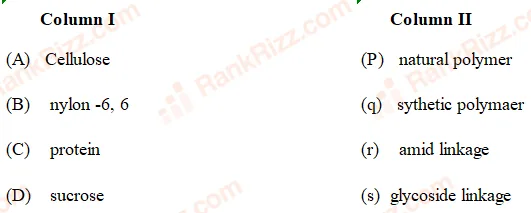
Match the chemical substances in Column I with type of polymers/type of bonds in Column II. Indicate your answer by darkening the appropriate bubbles of the 4×44 \times 4 matrix given in the ORS.

Figure for JEE Advanced 2007 Chemistry question on Classification of polymers and types of polymerisation