General Principles and Processes of Isolation of Metals JEE Advanced PYQs with answer key
CHEMISTRY · 22 PAST QUESTIONS · 3 TOPICS · 2007–2023
HOW TO USE THIS SHEET
Every JEE Advanced General Principles and Processes of Isolation of Metals question we hold, grouped by topic, most-asked topic first and newest first inside each. The answer key is at the end (21 of 22 questions have a checked key); the worked solution is on each question’s page, printed beside it.
Extraction of Fe, Cu, Zn, Al, Ag and Au 17
The correct statement(s) related to processes involved in the extraction of metals is(are)
- (A)
Roasting of Malachite produces Cuprite.
- (B)
Calcination of Calamine produces Zincite.
- (C)
Copper pyrites is heated with silica in a reverberatory furnace to remove iron.
- (D)
Impure silver is treated with aqueous KCN in the presence of oxygen followed by reduction with zinc metal.
rr2.rankrizz.com/jee-advanced/chemistry/metallurgy/q/2023-paper-1-q35
- (A)
The electrochemical extraction of aluminum from bauxite ore involves
- (A)
the reaction of AlO with coke (C) at a temperature > 2500°C.
- (B)
the neutralization of aluminate solution by passing CO gas to precipitate hydrated alumina (AlO.3HO)
- (C)
the dissolution of AlO in hot aqueous NaOH.
- (D)
the electrolysis of AlO mixed with NaAlF to give Al and CO.
rr2.rankrizz.com/jee-advanced/chemistry/metallurgy/q/2022-paper-1-q47
- (A)
The correct option(s) related to the extraction of iron from its ore in the blast furnace operating in the temperature range 900 - 1500 K is(are)
- (A)
Limestone is used to remove silicate impurity.
- (B)
Pig iron obtained from blast furnace contains about 4% carbon.
- (C)
Coke (C) converts CO to CO.
- (D)
Exhaust gases consist of NO and CO.
rr2.rankrizz.com/jee-advanced/chemistry/metallurgy/q/2022-paper-2-q48
- (A)
T he correct statement(s) related to the metal extraction processes is(are)
- (A)
A mixture of PbS and PbO undergoes self-reduction to produce Pb and .
- (B)
In the extraction process of copper from copper pyrites, silica is added to produce copper silicate.
- (C)
Partial oxidation of sulphide ore of copper by roasting, followed by self-reduction produces blister copper.
- (D)
In cyanide process, zinc powder is utilized to precipitate gold from .
rr2.rankrizz.com/jee-advanced/chemistry/metallurgy/q/2021-paper-1-q53
- (A)
Which among the following statement(s) is(are) true for the extraction of aluminium from bauxite?
- (A)
Hydrated precipitates, when is bubbled through a solution of sodium aluminate.
- (B)
Addition of lowers the melting point of alumina.
- (C)
is evolved at the anode during electrolysis.
- (D)
The cathode is a steel vessel with a lining of carbon.
rr2.rankrizz.com/jee-advanced/chemistry/metallurgy/q/2020-paper-2-q27
- (A)
The cyanide process of gold extraction involves leaching out gold from its ore with in the presence of Q in water to form R. Subsequently, R is treated with T to obtain Au and Z. Choose the correct option(s)
- (A)
Q is
- (B)
T is Zn
- (C)
Z is
- (D)
R is
rr2.rankrizz.com/jee-advanced/chemistry/metallurgy/q/2019-paper-2-q19
- (A)
Extraction of copper from copper pyrite involves
- (A)
crushing followed by concentration of the ore by froth-flotation.
- (B)
removal of iron as slag
- (C)
self-reduction step to produce ‘blister copper’following evolution of
- (D)
refining of ‘blister copper’ by carbon reduction
rr2.rankrizz.com/jee-advanced/chemistry/metallurgy/q/2016-paper-2-q28
- (A)
Upon heating with , the reagent(s) that give copper metal is/are
- (A)
- (B)
- (C)
- (D)
rr2.rankrizz.com/jee-advanced/chemistry/metallurgy/q/2014-paper-1-q27
- (A)
The carbon-based reduction method is NOT used for the extraction of
- (A)
tin from
- (B)
iron from
- (C)
aluminium from
- (D)
magnesium from
rr2.rankrizz.com/jee-advanced/chemistry/metallurgy/q/2013-paper-2-q23
- (A)
In the cyanide extraction process of silver from argentite ore, the oxidizing and reducing agents used are
- (A)
and CO respectively
- (B)
and Zn dust respectively
- (C)
and Zn dust respectively
- (D)
and CO respectively
rr2.rankrizz.com/jee-advanced/chemistry/metallurgy/q/2012-paper-2-q23
- (A)
Extraction of metal from the ore cassiterite involves -
- (A)
carbon reduction of an oxide ore
- (B)
self-reduction of a sulphide ore
- (C)
removal of copper impurity
- (D)
removal of iron impurity
rr2.rankrizz.com/jee-advanced/chemistry/metallurgy/q/2011-paper-1-q8
- (A)
Partial roasting of chalcopyrite produces
- (A)
and
- (B)
and
- (C)
and
- (D)
and
rr2.rankrizz.com/jee-advanced/chemistry/metallurgy/q/2010-paper-1-q14
- (A)
Iron is removed from chalcopyrite as
- (A)
- (B)
- (C)
- (D)
rr2.rankrizz.com/jee-advanced/chemistry/metallurgy/q/2010-paper-1-q15
- (A)
In self-reduction, the reducing species is
- (A)
- (B)
- (C)
- (D)
rr2.rankrizz.com/jee-advanced/chemistry/metallurgy/q/2010-paper-1-q16
- (A)
Native silver metal forms a water soluble complex with a dilute aqueous solution of NaCN in the presence of
- (A)
nitrogen
- (B)
oxygen
- (C)
carbon dioxide
- (D)
argon
rr2.rankrizz.com/jee-advanced/chemistry/metallurgy/q/2008-paper-1-q50
- (A)
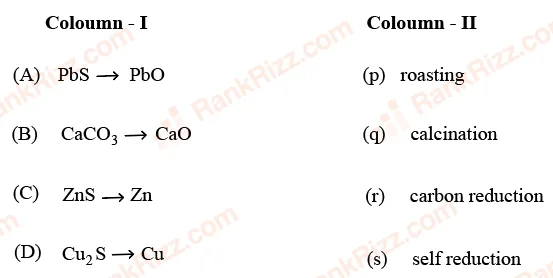
Match the conversions in Column I with the type(s) of reaction(s) given in Column II. Indicate your answer by darkening the appropriate bubbles of the matrix given in the ORS
rr2.rankrizz.com/jee-advanced/chemistry/metallurgy/q/2008-paper-2-q65
Extraction of zinc from zinc blende is achieved by
- (A)
electrolytic reduction
- (B)
roasting followed by reduction with carbon
- (C)
roasting followed by reduction with another metal
- (D)
roasting followed by self-reduction
rr2.rankrizz.com/jee-advanced/chemistry/metallurgy/q/2007-paper-1-q25
- (A)
Occurrence of metals: minerals and ores 4
Calamine, malachite, magnetite and cryolite, respectively, are
- (A)
- (B)
- (C)
- (D)
rr2.rankrizz.com/jee-advanced/chemistry/metallurgy/q/2019-paper-1-q20
- (A)
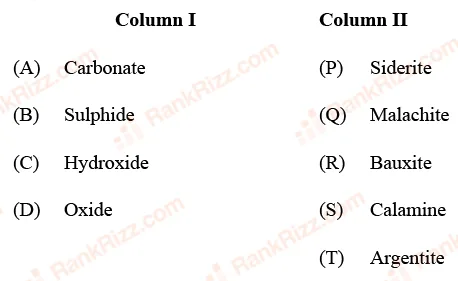
Match the anionic species given in Column I that are present in the ore(s) given in Column II.
rr2.rankrizz.com/jee-advanced/chemistry/metallurgy/q/2015-paper-1-q39
Sulfide ores are common for the metals
- (A)
Ag, Cu and Pb
- (B)
Ag, Cu and Sn
- (C)
Ag, Mg and Pb
- (D)
AL, Cu and Pb
rr2.rankrizz.com/jee-advanced/chemistry/metallurgy/q/2013-paper-1-q24
- (A)
Oxidation states of the metal in the minerals haematite and magnetite, respectively, are
- (A)
II, III in haematite and III in magnetite
- (B)
II, III in haematite and II in magnetite
- (C)
II in haematite and II, III in magnetite
- (D)
III in haematite and II, III in magnetite
rr2.rankrizz.com/jee-advanced/chemistry/metallurgy/q/2011-paper-2-q1
- (A)
Refining of metals 1
Copper is purified by electrolytic refining of blister copper. The correct statement(s) about this process is (are)
- (A)
Impure Cu strip is used as cathode
- (B)
Acidified aqueous is used as electrolyte
- (C)
Pure Cu deposits at cathode
- (D)
Impurities settle as anode-mud
rr2.rankrizz.com/jee-advanced/chemistry/metallurgy/q/2015-paper-1-q35
- (A)
Answer key
- 01 B, C, D
- 02 B, C, D
- 03 A, B, C
- 04 A, C, D
- 05 A, B, C, D
- 06 A, B, C
- 07 A, B, C
- 08 B, C, D
- 09 C, D
- 10 B
- 11 A, D
- 12 A
- 13 D
- 14 C
- 15 B
- 16 —
- 17 B
- 18 D
- 19 A-PQS, B-T, C-QR, D-R
- 20 A
- 21 D
- 22 B, C, D
“—” marks a question whose key we have not checked yet; its page shows the latest on it.
Past questions are reproduced with their sitting. Not affiliated with NTA or the IITs. Every question, online and free: rr2.rankrizz.com/jee-advanced/chemistry/metallurgy