RankRizz

Some Basic Concepts of Chemistry — JEE Advanced Previous Year Questions

Some Basic Concepts of Chemistry has been asked in 9 of the 20 JEE Advanced years from 2007 to 2026: 15 questions in all. It was not set in any of the 2 2026 papers. Across the last 20 papers it carried 2% of Chemistry questions. By type: 12 numerical, 2 single-correct and 1 multiple-correct. Of the 15 with a difficulty tag, 27% are easy, 73% medium and 0% hard. Most asked: Concentration terms and their interconversion (6, 40%), Stoichiometry, limiting reagent and percentage yield (4, 27%) and Units, significant figures and laws of chemical combination (3, 20%).

DATA UPDATED

Questions

15

Distinct ideas

4

Share of marks

2%

Difficulty

EASY

Some Basic Concepts of Chemistry weightage, year by year

The share of each year’s Chemistry questions that came from Some Basic Concepts of Chemistry, counted from the 19 papers we hold for the last 10 years, and paper by paper inside a year.

Falling: 0.0% of Chemistry questions in 2024–2026, down from 3.0% in 2017–2023. Its heaviest year was 2022, at 8.3%. Not asked at all in 2017, 2018, 2021, 2024, 2025, 2026.

Some Basic Concepts of Chemistry questions per year, per paper, and as a share of Chemistry questions
YEARQSPER PAPERSHARE OF CHEMISTRYCHANGE
20260 / 340.00.0%level
20250 / 320.00.0%level
20240 / 340.00.0%−2.9 pts
20231 / 340.52.9%−5.4 pts
20223 / 361.58.3%+8.3 pts
20210 / 380.00.0%−2.8 pts
20201 / 360.52.8%−2.8 pts
20192 / 361.05.6%+5.6 pts
20180 / 180.00.0%level
20170 / 360.00.0%—

“QS” is Some Basic Concepts of Chemistry questions out of all Chemistry questions that year; “per paper” is that count over the year’s papers, and “change” is the share against the year before. A year with more sittings asks more questions, which is why the share, not the count, is the number to compare.

The ideas inside Some Basic Concepts of Chemistry

A chapter is not one subject — it is a handful of procedures the examiner reuses. These are the ones Some Basic Concepts of Chemistry questions actually test.

01Units, significant figures and laws of chemical combinationset 3×
02Mole concept, atomic and molar massset 2×
03Percentage composition, empirical and molecular formulaNot set in Advanced
04Stoichiometry, limiting reagent and percentage yieldset 4×
05Concentration terms and their interconversionset 6×

All 15 Some Basic Concepts of Chemistry questions, by topic

Every JEE Advanced Some Basic Concepts of Chemistry question we hold, newest first inside each topic. Open one for its options, answer key and solution.

FREE PDF

Some Basic Concepts of Chemistry JEE Advanced PYQs with answer key

All 15 questions on A4, by topic, with the answer key at the end. No sign-up, no email: your browser saves it as a PDF.

Download free PDF

UNIQUE CONCEPTS

Some Basic Concepts of Chemistry: one question per idea

5 ideas, each with the latest past question that tested it, drawn from 265 JEE Main and Advanced questions.

Some Basic Concepts of Chemistry Unique Concepts sheet →

JEE MAIN

Some Basic Concepts of Chemistry in JEE Main

JEE Main has set 252 Some Basic Concepts of Chemistry questions, 2004–2026.

Some Basic Concepts of Chemistry JEE Main PYQs →

Some Basic Concepts of Chemistry: quick answers

Is Some Basic Concepts of Chemistry asked every year in JEE Advanced?

Not every year. It has been asked in 9 of the 20 JEE Advanced years from 2007 to 2026; it was missing in 11 of them, most recently 2026.

Which Some Basic Concepts of Chemistry topic is asked most in JEE Advanced?

Concentration terms and their interconversion: 6 of the 15 questions (40%). Next come Stoichiometry, limiting reagent and percentage yield (4) and Units, significant figures and laws of chemical combination (3).

What share of Chemistry questions does Some Basic Concepts of Chemistry carry in JEE Advanced?

About 2% of Chemistry questions across the last 20 papers. In 2026 it was 0.0% (0 of 34 Chemistry questions).

When was Some Basic Concepts of Chemistry last asked in JEE Advanced?

In JEE Advanced 2023 Paper 1, the latest sitting with a Some Basic Concepts of Chemistry question. It has not been set since 2023, though the bank holds JEE Advanced papers up to 2026.

How many Some Basic Concepts of Chemistry questions has JEE Advanced asked?

15 from 2009 to 2023, across 4 topics. Every one is listed on this page by topic and links to its own page, with the answer key and solution wherever we have them. Free, no sign-up.

Every Some Basic Concepts of Chemistry question

1–15 OF 15 · NEWEST FIRST

JEE ADVANCED 2023 · PAPER 1Stoichiometry, limiting reagent and percentage yield

The stoichiometric reaction of 516 g of dimethyldichlorosilane with water results in a tetrameric cyclic product X in 75% yield. The weight (in g) of X obtained is ____.

[Use, molar mass (g mol−1^{-1}): H = 1, C = 12, O = 16, Si = 28, Cl = 35.5]
JEE ADVANCED 2022 · PAPER 1Stoichiometry, limiting reagent and percentage yield

The treatment of an aqueous solution of 3.74 g of Cu(NO3_3)2_2 with excess KI results in a brown solution along with the formation of a precipitate. Passing H2_2S through this brown solution gives another precipitate X. The amount of X (in g) is ______.

[Given : Atomic mass of H = 1, N = 14, O = 16, S = 32, K = 39, Cu = 63, I = 127]

JEE ADVANCED 2022 · PAPER 1Stoichiometry, limiting reagent and percentage yield

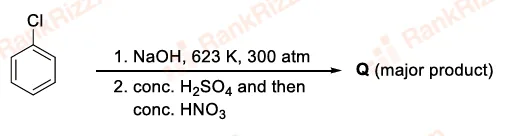
The weight percentage of hydrogen in Q, formed in the following reaction sequence, is ______.

Figure for JEE Advanced 2022 Chemistry question on Stoichiometry, limiting reagent and percentage yield

[Given : Atomic mass of H = 1, C = 12, N = 14, O = 16, S = 32, Cl = 35]

JEE ADVANCED 2022 · PAPER 2Units, significant figures and laws of chemical combination

To check the principle of multiple proportions, a series of pure binary compounds (Pm_mQn_n) were analyzed and their composition is tabulated below. The correct option(s) is(are)

CompoundWeight % of PWeight % of Q
15050
244.455.6
34060
  1. A

    If empirical formula of compound 3 is P3_3Q4_4, then the empirical formula of compound 2 is P3_3Q5_5.

  2. B

    If empirical formula of compound 3 is P3_3Q2_2 and atomic weight of element P is 20, then the atomic weight of Q is 45.

  3. C

    If empirical formula of compound 2 is PQ, then the empirical formula of the compound 1 is P5_5Q4_4.

  4. D

    If atomic weight of P and Q are 70 and 35, respectively, then the empirical formula of compound 1 is P2_2Q.

JEE ADVANCED 2020 · PAPER 1Concentration terms and their interconversion

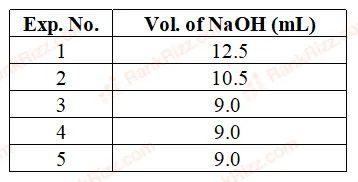
5.00 mL of 0.10 M oxalic acid solution taken in a conical flask is titrated against NaOH from a burette using phenolphthalein indicator. The volume of NaOH required for the appearance of permanent faint pink color is tabulated below for five experiments. What is the concentration, in molarity, of the NaOH solution?

Screenshot_500
JEE ADVANCED 2019 · PAPER 2Stoichiometry, limiting reagent and percentage yield

The amount of water produced (in g) in the oxidation of 1 mole of rhombic sulphur by conc. HNO3HNO_3 to a compound with the highest oxidation state of sulphur is ___________ .
(Given data: Molar mass of water = 18gmol−118 g mol^{-1})

JEE ADVANCED 2019 · PAPER 2Concentration terms and their interconversion

The mole fraction of urea in an aqueous urea solution containing 900 g of water is 0.05. If the density of the solution is 1.2gcm−3,themolarityofureasolutionis<br/>(Givendata:Molarmassesofureaandwaterare1.2 g cm^{-3}, the molarity of urea solution is<br />(Given data: Molar masses of urea and water are60 g mol^{-1}andand18 g mol^{-1},$$ respectively)

JEE ADVANCED 2014 · PAPER 1Units, significant figures and laws of chemical combination

If the value of Avogadro number is 6.023×10²³mol−16.023 \times 10^{23} mol^{-1} and the value of Boltzmann constant is 1.380×10⁻²³JK−11.380 \times 10^{-23} J K^{-1}, then the number of significant digits in the calculated value of the universal gas constant is

JEE ADVANCED 2014 · PAPER 1Concentration terms and their interconversion

A compound H2XH_2X with molar weight of 80 g is dissolved in a solvent having density of 0.4gml−10.4 g ml^{-1}. Assuming no change in volume upon dissolution, the molality of a 3.2 molar solution is

JEE ADVANCED 2012 · PAPER 1Concentration terms and their interconversion

29.2% (w/w) HCI stock solution has a density of 1.25 g mL−1L^{-1}. The molecular weight of HCl is 36.5 g mol−1mol^{-1}. The volume (mL) of stock solution required to prepare a 200 mL solution of 0.4 M HCl is

JEE ADVANCED 2011 · PAPER 1Concentration terms and their interconversion

Dissolving 120 g of urea (mol. wt. 60) in 1000 g of water gave a solution of density 1.15 g/mL. The molarity of the solution is -

  1. A

    1.78 M

  2. B

    2.00 M

  3. C

    2.05 M

  4. D

    2.22 M

JEE ADVANCED 2011 · PAPER 2Concentration terms and their interconversion

The volume (in mL) of 0.1 M AgNO3AgNO_3 required for complete precipitation of chloride ions present in 30 mL of 0.01 M solution of [Cr(H2O)5Cl]Cl2[Cr(H_2O)_5Cl]Cl_2, as silver chloride is close to

JEE ADVANCED 2010 · PAPER 2Mole concept, atomic and molar mass

Silver (atomic weight = 108gmol−1108 g mol^{-1}) has a density of 10.5 g cm−3cm^{-3}. The number of silver atoms on a surface of area 10−12m210^{-12} m^2 can be expressed in scientific notation as y×10xy \times 10^x. The value of x is

JEE ADVANCED 2010 · PAPER 1Units, significant figures and laws of chemical combination

A student performs a titration with different burettes and finds titre values of 25.2 mL, 25.25 mL, and 25.0 mL. The numberof significant figures in the average titre value is

JEE ADVANCED 2009 · PAPER 1Mole concept, atomic and molar mass

Given that the abundances of isotopes 54Fe,56Fe^{54}Fe,^{56}Fe and 57Fe^{57}Fe are 5%,90% and 5% respectively, the atomic mass of Fe is -

  1. A

    55.85

  2. B

    55.95

  3. C

    55.75

  4. D

    56.05