JEE ADVANCED 2025 · PAPER 2Properties and reactions of alcohols
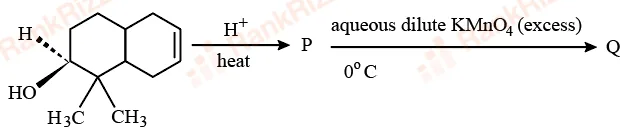
For the reaction sequence given below, the correct statement(s) is(are)
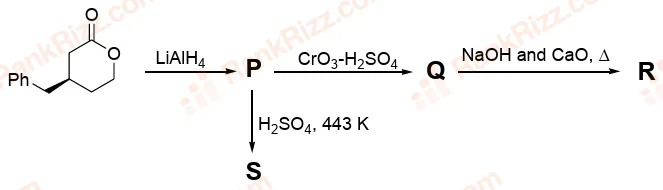
- A
P is optically active.
- B
S gives Bayer's test.
- C
Q gives effervescence with aq. NaHCO.
- D
R is an alkyne.
Alcohols, Phenols and Ethers has been asked in 12 of the 20 JEE Advanced years from 2007 to 2026: 21 questions in all. It was not set in any of the 2 2026 papers, after 3.1% of Chemistry questions in 2025. Across the last 20 papers it carried 1.4% of Chemistry questions. By type: 11 single-correct, 6 multiple-correct, 3 numerical and 1 match-the-list. Of the 21 with a difficulty tag, 24% are easy, 48% medium and 29% hard. Most asked: Reactions of phenols (13, 62%), Properties and reactions of alcohols (6, 29%) and Ethers (2, 10%).
DATA UPDATED
Questions
21
Distinct ideas
3
Share of marks
1.4%
Difficulty
MEDIUM
The share of each year’s Chemistry questions that came from Alcohols, Phenols and Ethers, counted from the 19 papers we hold for the last 10 years, and paper by paper inside a year.
Rising: 2.0% of Chemistry questions in 2024–2026, up from 1.3% in 2017–2023. Its heaviest year was 2018, at 5.6%. Not asked at all in 2017, 2019, 2021, 2022, 2026.
| YEAR | QS | PER PAPER | SHARE OF CHEMISTRY | CHANGE | |
|---|---|---|---|---|---|
| 2026 | 0 / 34 | 0.0 | 0.0% | −3.1 pts | PAPER 1 0.0%PAPER 2 0.0% |
| 2025 | 1 / 32 | 0.5 | 3.1% | +0.2 pts | PAPER 1 0.0%PAPER 2 6.3% |
| 2024 | 1 / 34 | 0.5 | 2.9% | level | PAPER 1 5.9%PAPER 2 0.0% |
| 2023 | 1 / 34 | 0.5 | 2.9% | +2.9 pts | PAPER 1 5.9%PAPER 2 0.0% |
| 2022 | 0 / 36 | 0.0 | 0.0% | level | PAPER 1 0.0%PAPER 2 0.0% |
| 2021 | 0 / 38 | 0.0 | 0.0% | −2.8 pts | PAPER 1 0.0%PAPER 2 0.0% |
| 2020 | 1 / 36 | 0.5 | 2.8% | +2.8 pts | PAPER 1 0.0%PAPER 2 5.6% |
| 2019 | 0 / 36 | 0.0 | 0.0% | −5.6 pts | PAPER 1 0.0%PAPER 2 0.0% |
| 2018 | 1 / 18 | 1.0 | 5.6% | +5.6 pts | 1 PAPER |
| 2017 | 0 / 36 | 0.0 | 0.0% | — | PAPER 1 0.0%PAPER 2 0.0% |
“QS” is Alcohols, Phenols and Ethers questions out of all Chemistry questions that year; “per paper” is that count over the year’s papers, and “change” is the share against the year before. A year with more sittings asks more questions, which is why the share, not the count, is the number to compare.
A chapter is not one subject — it is a handful of procedures the examiner reuses. These are the ones Alcohols, Phenols and Ethers questions actually test.
Every JEE Advanced Alcohols, Phenols and Ethers question we hold, newest first inside each topic. Open one for its options, answer key and solution.
FREE PDF
All 21 questions on A4, by topic, with the answer key at the end. No sign-up, no email: your browser saves it as a PDF.
Download free PDFUNIQUE CONCEPTS
5 ideas, each with the latest past question that tested it, drawn from 202 JEE Main and Advanced questions.
Alcohols, Phenols and Ethers Unique Concepts sheet →JEE MAIN
JEE Main has set 182 Alcohols, Phenols and Ethers questions, 2004–2026.
Alcohols, Phenols and Ethers JEE Main PYQs →Not every year. It has been asked in 12 of the 20 JEE Advanced years from 2007 to 2026; the years without a Alcohols, Phenols and Ethers question were 2009, 2012, 2016, 2017, 2019, 2021, 2022 and 2026.
Reactions of phenols: 13 of the 21 questions (62%). Next come Properties and reactions of alcohols (6) and Ethers (2).
About 1.4% of Chemistry questions across the last 20 papers. In 2026 it was 0.0% (0 of 34 Chemistry questions).
In JEE Advanced 2025 Paper 2, the latest sitting with a Alcohols, Phenols and Ethers question. It has not been set since 2025, though the bank holds JEE Advanced papers up to 2026.
21 from 2007 to 2025, across 3 topics. Every one is listed on this page by topic and links to its own page, with the answer key and solution wherever we have them. Free, no sign-up.
1–20 OF 21 · NEWEST FIRST
For the reaction sequence given below, the correct statement(s) is(are)
P is optically active.
S gives Bayer's test.
Q gives effervescence with aq. NaHCO.
R is an alkyne.
Reaction of iso-propylbenzene with followed by the treatment with forms phenol and a by-product P. Reaction of P with 3 equivalents of gives compound Q. Treatment of Q with produces compound R and calcium salt S.
The correct statement(s) regarding P, Q, R and S is(are)
Reaction of P with R in the presence of KOH followed by acidification gives
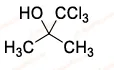
Reaction of R with in the presence of light gives phosgene gas
Q reacts with aqueous NaOH to produce and
S on heating gives P
In the given reaction scheme, P is a phenyl alkyl ether, Q is an aromatic compound; R and S are the major products.
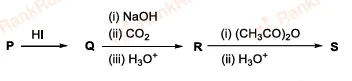
The correct statement about S is
It primarily inhibits noradrenaline degrading enzymes.
It inhibits the synthesis of prostaglandin.
It is a narcotic drug.
It is ortho-acetylbenzoic acid.
An organic compound rotates plane-polarized light. It produces pink color with neutral solution. What is the total number of all the possible isomers for this compound?
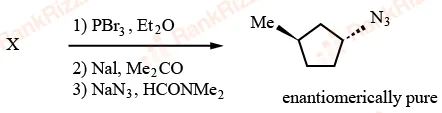
In the following reaction sequence, the correct structure(s) of X is (are)
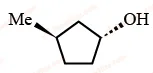
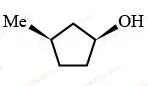
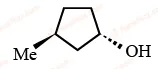
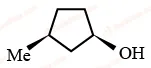
The number of hydroxyl group(s) in Q is
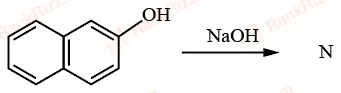
The number of resonance structures for N is
The acidic hydrolysis of ether (X) shown below is fastest when
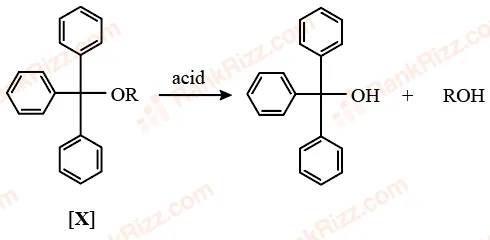
one phenyl group is replaced by a methyl group.
one phenyl group is replaced by a para-methoxyphenyl group.
two phenyl groups are replaced by two para-methoxyphenyl groups.
no structural change is made to X.
he reactivity of compound Z with different halogens under appropriate conditions is given below:
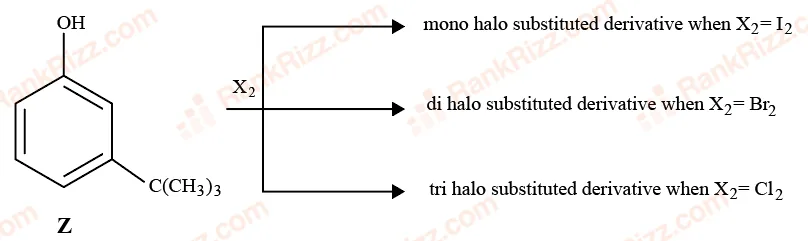
The observed pattern of electrophilic substitution can be explained by
the steric effect of the halogen
the steric effect of the tert-butyl group
the electronic effect of the phenolic group
the electronic effect of the tert-butyl group
For the identification of -naphthol using dye test, it is necessary to use
dichloromethane solution of -naphthol
acidic solution of -naphthol
neutral solution of -naphthol
alkaline solution of -naphthol
The compound that does NOT liberate , on treatment with aqueous sodium bicarbonate solution, is
Benzoic acid
Benzenesulphonic acid
Salicylic acid
Carbolic acid (Phenol)
In the following reaction, the product(s) formed is(are)
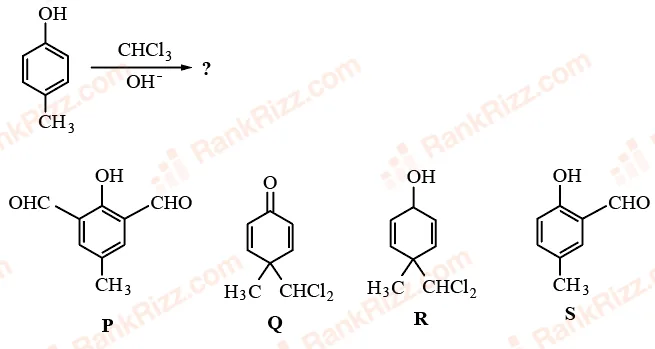
P (major)
Q (minor)
R (minor)
S (major)
The major product(s) of the following reaction is(are)
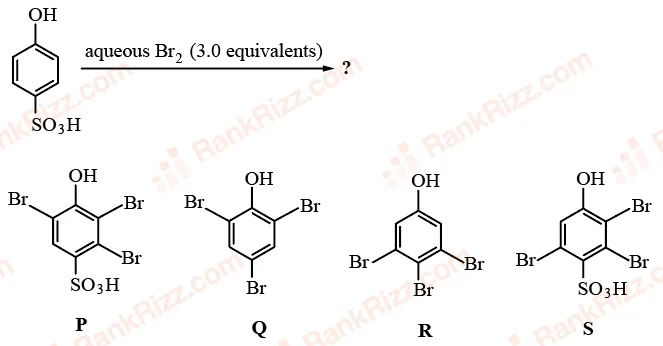
P
Q
R
S
Match the chemical conversions in List I with the appropriate reagents in List II and select the correct answer using the code given below the lists:
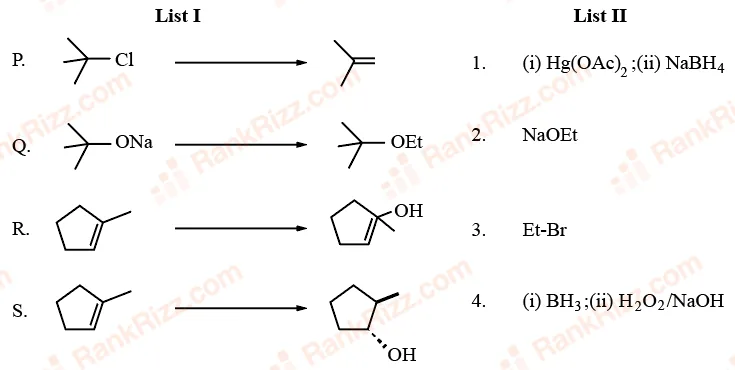
P-2, Q-3, R-1, S-4
P-3, Q-2, R-1, S-4
P-2, Q-3, R-4, S-1
P-3, Q-2, R-4, S-1
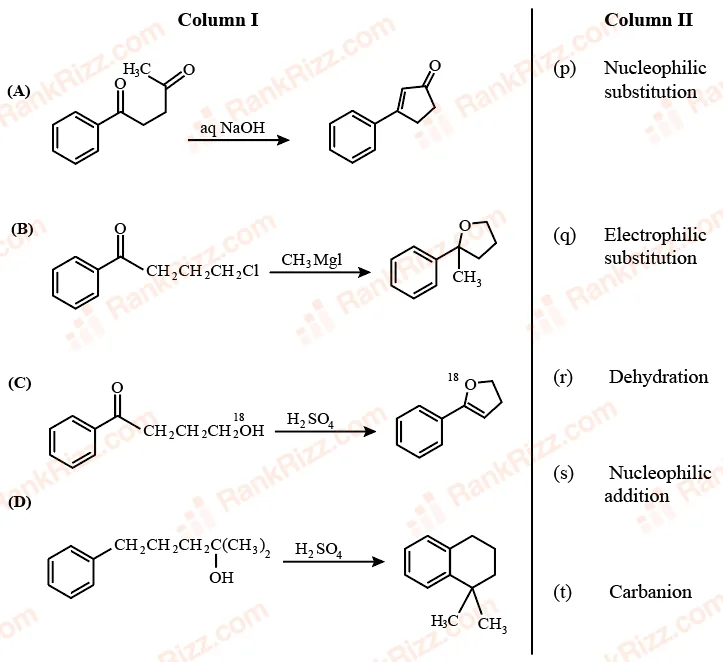
Match the reactions in column I with appropriate types of steps/reactive intermediate involved in these reactions as given in column II
The compounds P, Q and S
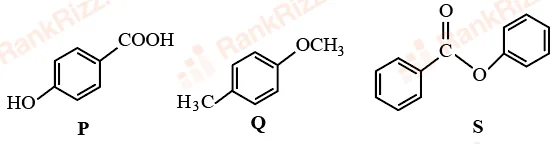
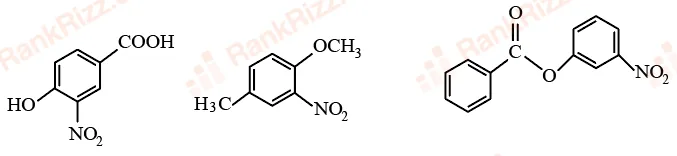
were separately subjected to nitration using mixture. The major product formed in each case respectively, is
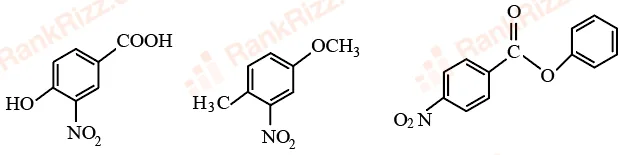
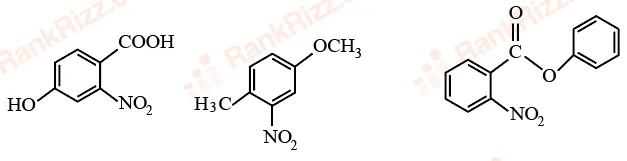
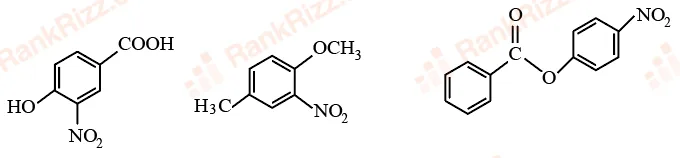
Compound H is formed by the reaction of
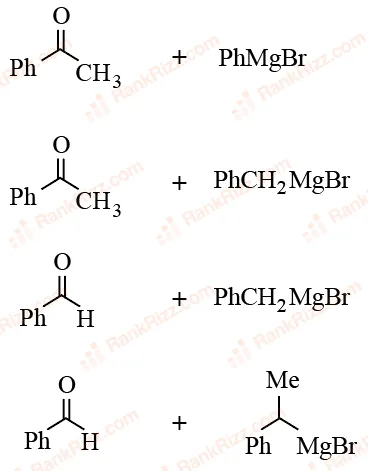
Figure 1
Figure 2
Figure 3
Figure 4
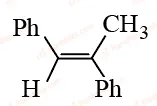
The structure of compound I is
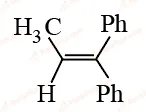
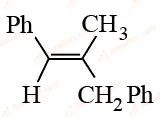
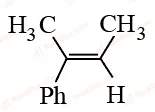
Which one of the following reagents is used in the above reaction?
The electrophile in this reaction is
OTHER CHEMISTRY CHAPTERS