JEE ADVANCED 2025 · PAPER 1Lanthanoids and lanthanoid contraction
The pair(s) of diamagnetic ions is(are)
- A
La, Ce
- B
Yb, Lu
- C
La, Ce
- D
Yb, Lu
d- and f-Block Elements has been asked in 11 of the 20 JEE Advanced years from 2007 to 2026: 13 questions in all. It was not set in any of the 2 2026 papers, after 3.1% of Chemistry questions in 2025. Across the last 20 papers it carried 2.3% of Chemistry questions. By type: 6 multiple-correct, 4 numerical and 3 single-correct. Of the 13 with a difficulty tag, 31% are easy, 31% medium and 38% hard. Most asked: Magnetic moment, colour and catalytic properties of transition metals (5, 38%), Potassium dichromate and potassium permanganate (5, 38%) and Other important compounds of transition metals (2, 15%).
DATA UPDATED
Questions
13
Distinct ideas
4
Share of marks
2.3%
Difficulty
MEDIUM
The share of each year’s Chemistry questions that came from d- and f-Block Elements, counted from the 19 papers we hold for the last 10 years, and paper by paper inside a year.
Falling: 1.0% of Chemistry questions in 2024–2026, down from 3.0% in 2017–2023. Its heaviest year was 2017, at 5.6%. Not asked at all in 2021, 2024, 2026.
| YEAR | QS | PER PAPER | SHARE OF CHEMISTRY | CHANGE | |
|---|---|---|---|---|---|
| 2026 | 0 / 34 | 0.0 | 0.0% | −3.1 pts | PAPER 1 0.0%PAPER 2 0.0% |
| 2025 | 1 / 32 | 0.5 | 3.1% | +3.1 pts | PAPER 1 6.3%PAPER 2 0.0% |
| 2024 | 0 / 34 | 0.0 | 0.0% | −2.9 pts | PAPER 1 0.0%PAPER 2 0.0% |
| 2023 | 1 / 34 | 0.5 | 2.9% | +0.1 pts | PAPER 1 5.9%PAPER 2 0.0% |
| 2022 | 1 / 36 | 0.5 | 2.8% | +2.8 pts | PAPER 1 0.0%PAPER 2 5.6% |
| 2021 | 0 / 38 | 0.0 | 0.0% | −2.8 pts | PAPER 1 0.0%PAPER 2 0.0% |
| 2020 | 1 / 36 | 0.5 | 2.8% | level | PAPER 1 0.0%PAPER 2 5.6% |
| 2019 | 1 / 36 | 0.5 | 2.8% | −2.8 pts | PAPER 1 5.6%PAPER 2 0.0% |
| 2018 | 1 / 18 | 1.0 | 5.6% | level | 1 PAPER |
| 2017 | 2 / 36 | 1.0 | 5.6% | — | PAPER 1 0.0%PAPER 2 11.1% |
“QS” is d- and f-Block Elements questions out of all Chemistry questions that year; “per paper” is that count over the year’s papers, and “change” is the share against the year before. A year with more sittings asks more questions, which is why the share, not the count, is the number to compare.
A chapter is not one subject — it is a handful of procedures the examiner reuses. These are the ones d- and f-Block Elements questions actually test.
Every JEE Advanced d- and f-Block Elements question we hold, newest first inside each topic. Open one for its options, answer key and solution.
FREE PDF
All 13 questions on A4, by topic, with the answer key at the end. No sign-up, no email: your browser saves it as a PDF.
Download free PDFUNIQUE CONCEPTS
7 ideas, each with the latest past question that tested it, drawn from 241 JEE Main and Advanced questions.
d- and f-Block Elements Unique Concepts sheet →JEE MAIN
JEE Main has set 229 d- and f-Block Elements questions, 2004–2026.
d- and f-Block Elements JEE Main PYQs →Not every year. It has been asked in 11 of the 20 JEE Advanced years from 2007 to 2026; it was missing in 9 of them, most recently 2026.
Magnetic moment, colour and catalytic properties of transition metals: 5 of the 13 questions (38%). Next come Potassium dichromate and potassium permanganate (5) and Other important compounds of transition metals (2).
About 2.3% of Chemistry questions across the last 20 papers. In 2026 it was 0.0% (0 of 34 Chemistry questions).
In JEE Advanced 2025 Paper 1, the latest sitting with a d- and f-Block Elements question. It has not been set since 2025, though the bank holds JEE Advanced papers up to 2026.
13 from 2009 to 2025, across 4 topics. Every one is listed on this page by topic and links to its own page, with the answer key and solution wherever we have them. Free, no sign-up.
1–13 OF 13 · NEWEST FIRST
The pair(s) of diamagnetic ions is(are)
La, Ce
Yb, Lu
La, Ce
Yb, Lu
In the scheme given below, X and Y, respectively, are
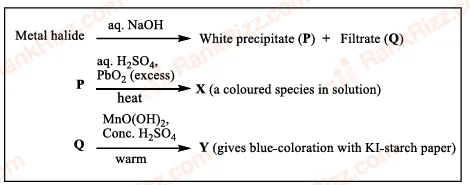
and
and
and
and HOCl
Thermal decomposition of AgNO produces two paramagnetic gases. The total number of electrons present in the antibonding molecular orbitals of the gas that has the higher number of unpaired electrons is _______.
A n acidified solution of potassium chromate was layered with an equal volume of amyl alcohol. When it was shaken after the addition of 1 mL of 3% , a blue alcohol layer was obtained. The blue color is due to the formation of a chromium (VI) compound ‘X’. What is the number of oxygen atoms bonded to chromium through only single bonds in a molecule of X?
Fusion of with KOH in presence of produces a salt W. Alkaline solution of W upon electrolytic oxidation yields another salt X. The manganese containing ions present in W and X, respectively, are Y and Z. Correct statement(s) is (are)
In aqueousacidic solution, Y undergoes disproportionation reaction to give Z and
Both Y and Z are coloured and have tetrahedral shape
Y is diamagnetic in nature while Z is paramagnetic
In both Y and Z, bonding occurs between p-orbitals of oxygen and d-orbitals of manganese
Among the species given below, the total number of diamagnetic species is ___
H atom , manometer, (superoxide),dimeric sulphur in vapour phase ,
Which of the following combination will produce gas?
Fe metal and conc.
Cu metal and conc.
Zn metal and NaOH(aq)
Au metal and NaCN(aq) in the presence of air
The option(s) with only amphoteric oxides is(are)
The correct statement(s) about and is(are)
[Atomic numbers of Cr = 24 and Mn = 25]
is a reducing agent
is an oxidizing agent
Both and exhibit electronic configuration
When is used as a reducing agent, the chromium ion attains electronic configuration
The pair(s) of reagents that yield paramagnetic species is/are
Na and excess of
K and excess of
Cu and dilute
and 2-ethylanthraquinol
The colour oflight absorbed by an aqueous solution of is
orange-red
blue-green
yellow
violet
For the given aqueous reaction which of the statement(s) is (are) true ?
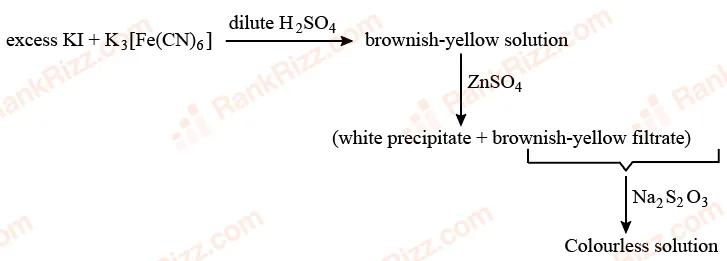
The first reaction is a redox reaction
White precipitate is
Addition of filtrate to starch solution gives blue colour.
White precipitate is soluble in NaOH solution
The oxidation number of Mnin the product of alkaline oxidative fusion of is
OTHER CHEMISTRY CHAPTERS