RankRizz

Redox Reactions — JEE Advanced Previous Year Questions

Redox Reactions has been asked in 11 of the 20 JEE Advanced years from 2007 to 2026: 16 questions in all. In 2026 it averaged 0.5 questions per paper (1 across 2 papers), 2.9% of Chemistry questions, down from 3.1% in 2025. Across the last 20 papers it carried 2.3% of Chemistry questions. By type: 7 numerical, 5 multiple-correct, 3 single-correct and 1 match-the-list. Of the 16 with a difficulty tag, 19% are easy, 69% medium and 13% hard. Most asked: Balancing redox equations (7, 44%), Oxidation number (4, 25%) and Oxidising/reducing agents and types of redox reactions (3, 19%).

DATA UPDATED

Questions

16

Distinct ideas

5

Share of marks

2.3%

Difficulty

MEDIUM

Redox Reactions weightage, year by year

The share of each year’s Chemistry questions that came from Redox Reactions, counted from the 19 papers we hold for the last 10 years, and paper by paper inside a year.

Falling: 2.0% of Chemistry questions in 2024–2026, down from 2.6% in 2017–2023. Its heaviest year was 2023, at 5.9%. Not asked at all in 2018, 2019, 2022, 2024.

Redox Reactions questions per year, per paper, and as a share of Chemistry questions
YEARQSPER PAPERSHARE OF CHEMISTRYCHANGE
20261 / 340.52.9%−0.2 pts
20251 / 320.53.1%+3.1 pts
20240 / 340.00.0%−5.9 pts
20232 / 341.05.9%+5.9 pts
20220 / 360.00.0%−2.6 pts
20211 / 380.52.6%−3.0 pts
20202 / 361.05.6%+5.6 pts
20190 / 360.00.0%level
20180 / 180.00.0%−2.8 pts
20171 / 360.52.8%—

“QS” is Redox Reactions questions out of all Chemistry questions that year; “per paper” is that count over the year’s papers, and “change” is the share against the year before. A year with more sittings asks more questions, which is why the share, not the count, is the number to compare.

The ideas inside Redox Reactions

A chapter is not one subject — it is a handful of procedures the examiner reuses. These are the ones Redox Reactions questions actually test.

01Oxidation numberset 4×
02Oxidising/reducing agents and types of redox reactionsset 3×
03Balancing redox equationsset 7×
04Equivalent weight, n-factor and law of equivalenceset 1×
05Redox titrationsset 1×

All 16 Redox Reactions questions, by topic

Every JEE Advanced Redox Reactions question we hold, newest first inside each topic. Open one for its options, answer key and solution.

FREE PDF

Redox Reactions JEE Advanced PYQs with answer key

All 16 questions on A4, by topic, with the answer key at the end. No sign-up, no email: your browser saves it as a PDF.

Download free PDF

UNIQUE CONCEPTS

Redox Reactions: one question per idea

5 ideas, each with the latest past question that tested it, drawn from 105 JEE Main and Advanced questions.

Redox Reactions Unique Concepts sheet →

JEE MAIN

Redox Reactions in JEE Main

JEE Main has set 89 Redox Reactions questions, 2004–2026.

Redox Reactions JEE Main PYQs →

Redox Reactions: quick answers

Is Redox Reactions asked every year in JEE Advanced?

Not every year. It has been asked in 11 of the 20 JEE Advanced years from 2007 to 2026; it was missing in 9 of them, most recently 2024.

Which Redox Reactions topic is asked most in JEE Advanced?

Balancing redox equations: 7 of the 16 questions (44%). Next come Oxidation number (4) and Oxidising/reducing agents and types of redox reactions (3).

What share of Chemistry questions does Redox Reactions carry in JEE Advanced?

About 2.3% of Chemistry questions across the last 20 papers. In 2026 it was 2.9% (1 of 34 Chemistry questions).

When was Redox Reactions last asked in JEE Advanced?

In JEE Advanced 2026 Paper 1, the latest sitting with a Redox Reactions question.

How many Redox Reactions questions has JEE Advanced asked?

16 from 2007 to 2026, across 5 topics. Every one is listed on this page by topic and links to its own page, with the answer key and solution wherever we have them. Free, no sign-up.

Every Redox Reactions question

1–16 OF 16 · NEWEST FIRST

JEE ADVANCED 2026 · PAPER 1Oxidising/reducing agents and types of redox reactions

Reaction of PtF6PtF_6 with oxygen (O2)(O_2) gas results in the formation of an ionic compound, X+Y−\mathbf{X^{+}Y^{-}}. Correct statement(s) is(are)

  1. A

    The bond order of X+\mathbf{X^{+}} is 1.51.5.

  2. B

    Valence dd-orbitals of the metal ion in X+Y−\mathbf{X^{+}Y^{-}} has 55 electrons.

  3. C

    PtF6PtF_6 acts as an oxidant in this reaction.

  4. D

    PtF6PtF_6 acts as a fluorinating agent in this reaction.
JEE ADVANCED 2025 · PAPER 1Oxidising/reducing agents and types of redox reactions

One of the products formed from the reaction of permanganate ion with iodide ion in neutral aqueous medium is

  1. A

    I2_2

  2. B

    IO3−_3^-

  3. C

    IO4−_4^-

  4. D

    IO2−_2^-

JEE ADVANCED 2023 · PAPER 2Balancing redox equations

H2_2S (5 moles) reacts completely with acidified aqueous potassium permanganate solution. In this reaction, the number of moles of water produced is x, and the number of moles of electrons involved is y. The value of (x + y) is ____.

JEE ADVANCED 2023 · PAPER 2Oxidation number

Consider the following molecules: Br3_3O8_8, F2_2O, H2_2S4_4O6_6, H2_2S5_5O6_6, and C3_3O2_2.

Count the number of atoms existing in their zero oxidation state in each molecule. Their sum is ____.

JEE ADVANCED 2021 · PAPER 2Oxidation number

Ozonolysis of ClO2ClO_2 produces an oxide of chlorine. The average oxidation state of chlorine in this oxide is ___.

JEE ADVANCED 2020 · PAPER 2Equivalent weight, n-factor and law of equivalence

In the chemical reaction between stoichiometric quantities of KMnO4KMnO_4 and KI in weakly basic solution, what is the number of moles of I2I_2 released for 4 moles of KMnO4KMnO_4 consumed?

JEE ADVANCED 2020 · PAPER 2Balancing redox equations

Choose the correct statement(s) among the following.

  1. A

    SnCl2.2H2OSnCl_2.2H_2O is a reducing agent.

  2. B

    SnO2SnO_2 reacts with KOH to form K2[Sn(OH)6]K_2[Sn(OH)_6].

  3. C

    A solution of PbCl2PbCl_2 in HClHCl contains Pb2+Pb^{2+} and Cl−Cl^− ions.

  4. D

    The reaction of Pb3O4Pb_3O_4 with hot dilute nitric acid to give PbO2PbO_2 is a redox reaction.

JEE ADVANCED 2017 · PAPER 2Oxidation number

The order of the oxidation state of the phosphorus atom in H3PO2,H3PO4,H3PO3H_{3}PO_{2},H_{3}PO_{4},H_{3}PO_{3} and H4P2O6H_{4}P_{2}O_{6} is

  1. A

    H3PO3>H3PO2>H3PO4>H4P2O6H_{3}PO_{3}>H_{3}PO_{2}>H_{3}PO_{4}>H_{4}P_{2}O_{6}

  2. B

    H3PO4>H3PO2>H3PO3>H4P2O6H_{3}PO_{4}>H_{3}PO_{2}>H_{3}PO_{3}>H_{4}P_{2}O_{6}

  3. C

    H3PO4>H4P2O6>H3PO3>H3PO2H_{3}PO_{4}>H_{4}P_{2}O_{6}>H_{3}PO_{3}>H_{3}PO_{2}

  4. D

    H3PO2>H3PO3>H4P2O6>H3PO4H_{3}PO_{2}>H_{3}PO_{3}>H_{4}P_{2}O_{6}>H_{3}PO_{4}

JEE ADVANCED 2016 · PAPER 1Balancing redox equations

In neutral or faintly alkaline solution, 8 moles of permanganate anion quantitatively oxidize thiosulphate anions to produce X moles of a sulphur containing product. The magnitude of X is

JEE ADVANCED 2015 · PAPER 1Balancing redox equations

Fe3+Fe^{3+} is reduced to Fe2+Fe^{2+} by using

  1. A

    H2O2H_2O_2 in presence of NaOH

  2. B

    Na2O2Na_2O_2 in water

  3. C

    H2O2H_2O_2 in presence of H2SO4H_2SO_4

  4. D

    Na2O2Na_2O_2 in presence of H2SO4H_2SO_4

JEE ADVANCED 2014 · PAPER 1Balancing redox equations

For the reaction:
I−+ClO3−+H2SO4→Cl−+HSO4−+I2I^- + ClO_3^- + H_2SO_4 \rightarrow Cl^- + HSO_4^- + I_2
The correct statement(s) in the balanced equation is/are:

  1. A

    Stoichiometric coefficient of HSO4−HSO_4^- is 6.

  2. B

    Iodide is oxidized.

  3. C

    Sulphur is reduced.

  4. D

    H2OH_2O is one of the products.

JEE ADVANCED 2014 · PAPER 1Balancing redox equations

Consider the following list of reagents:
Acidified K2Cr2O7K_2Cr_2O_7, alkaline KMnO4,CuSO4,H2O2,Cl2,O3,FeCl3,HNO3KMnO_4, CuSO_4, H_2O_2, Cl_2, O_3, FeCl_3, HNO_3 and Na2S2O3Na_2S_2O_3.
The total number of reagents that can oxidise aqueous iodide to iodine is

JEE ADVANCED 2011 · PAPER 2Balancing redox equations

Reduction of the metal centre in aqueous permanganateion involves

  1. A

    3 electrons in neutral medium

  2. B

    5 electrons in neutral medium

  3. C

    3 electrons in alkaline medium

  4. D

    5 electrons in acidic medium

JEE ADVANCED 2011 · PAPER 1Oxidation number

The difference in the oxidation numbers of the two types of sulphur atoms in Na2S4O6Na_2S_4O_6 is.

JEE ADVANCED 2007 · PAPER 2Redox titrations

Consider a titration of potassium dichromate solution with acidified Mohr’s salt solution using diphenylamine as indicator. The number of moles of Mohr’s salt required per mole of dichromate is

  1. A

    3

  2. B

    4

  3. C

    5

  4. D

    6

JEE ADVANCED 2007 · PAPER 2Oxidising/reducing agents and types of redox reactions

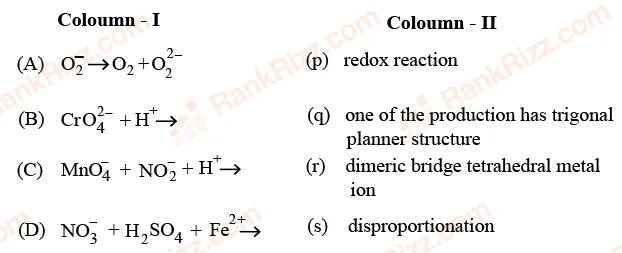
Match the reactions in Column I with nature of the reactions/type of the products in Column II. Indicate your answer by darkening the appropriate bubbles of the 4×44 \times 4 matrix given in the ORS.

Figure for JEE Advanced 2007 Chemistry question on Oxidising/reducing agents and types of redox reactions