Solid State — JEE Advanced Previous Year Questions
Solid State has been asked in 17 of the 20 JEE Advanced years from 2007 to 2026: 20 questions in all. It was not set in any of the 2 2026 papers, after 3.1% of Chemistry questions in 2025. Across the last 20 papers it carried 2.6% of Chemistry questions. By type: 10 single-correct, 5 numerical, 4 multiple-correct and 1 match-the-list. Of the 20 with a difficulty tag, 25% are easy, 60% medium and 15% hard. Most asked: Voids, radius ratio and structures of ionic solids (16, 80%), Crystal lattices, unit cells and density (2, 10%) and Defects in solids (2, 10%).
The share of each year’s Chemistry questions that came from Solid State, counted from the 19 papers we hold for the last 10 years, and paper by paper inside a year.
Falling: 2.0% of Chemistry questions in 2024–2026, down from 2.6% in 2017–2023. Its heaviest year was 2018, at 5.6%. Not asked at all in 2019, 2026.
Solid State questions per year, per paper, and as a share of Chemistry questions
YEAR
QS
PER PAPER
SHARE OF CHEMISTRY
CHANGE
BY PAPER
2026
0 / 34
0.0
0.0%
−3.1 pts
PAPER 1 0.0%PAPER 2 0.0%
2025
1 / 32
0.5
3.1%
+0.2 pts
PAPER 1 0.0%PAPER 2 6.3%
2024
1 / 34
0.5
2.9%
level
PAPER 1 0.0%PAPER 2 5.9%
2023
1 / 34
0.5
2.9%
+0.1 pts
PAPER 1 0.0%PAPER 2 5.9%
2022
1 / 36
0.5
2.8%
+0.2 pts
PAPER 1 0.0%PAPER 2 5.6%
2021
1 / 38
0.5
2.6%
−0.2 pts
PAPER 1 5.3%PAPER 2 0.0%
2020
1 / 36
0.5
2.8%
+2.8 pts
PAPER 1 5.6%PAPER 2 0.0%
2019
0 / 36
0.0
0.0%
−5.6 pts
PAPER 1 0.0%PAPER 2 0.0%
2018
1 / 18
1.0
5.6%
+2.8 pts
1 PAPER
2017
1 / 36
0.5
2.8%
—
PAPER 1 5.6%PAPER 2 0.0%
“QS” is Solid State questions out of all Chemistry questions that year; “per paper” is that count over the year’s papers, and “change” is the share against the year before. A year with more sittings asks more questions, which is why the share, not the count, is the number to compare.
The ideas inside Solid State
A chapter is not one subject — it is a handful of procedures the examiner reuses. These are the ones Solid State questions actually test.
01Classification of solidsNot set in Advanced
02Crystal lattices, unit cells and densityset 2×
03Close packing and packing efficiencyNot set in Advanced
04Voids, radius ratio and structures of ionic solidsset 16×
05Defects in solidsset 2×
06Electrical and magnetic properties of solidsNot set in Advanced
All 20 Solid State questions, by topic
Every JEE Advanced Solid State question we hold, newest first inside each topic. Open one for its options, answer key and solution.
Voids, radius ratio and structures of ionic solids16 QUESTIONS
Not every year. It has been asked in 17 of the 20 JEE Advanced years from 2007 to 2026; the years without a Solid State question were 2014, 2019 and 2026.
Which Solid State topic is asked most in JEE Advanced?+
Voids, radius ratio and structures of ionic solids: 16 of the 20 questions (80%). Next come Crystal lattices, unit cells and density (2) and Defects in solids (2).
What share of Chemistry questions does Solid State carry in JEE Advanced?+
About 2.6% of Chemistry questions across the last 20 papers. In 2026 it was 0.0% (0 of 34 Chemistry questions).
When was Solid State last asked in JEE Advanced?+
In JEE Advanced 2025 Paper 2, the latest sitting with a Solid State question. It has not been set since 2025, though the bank holds JEE Advanced papers up to 2026.
How many Solid State questions has JEE Advanced asked?+
20 from 2007 to 2025, across 3 topics. Every one is listed on this page by topic and links to its own page, with the answer key and solution wherever we have them. Free, no sign-up.
Every Solid State question
1–20 OF 20 · NEWEST FIRST
JEE ADVANCED 2025 · PAPER 2Crystal lattices, unit cells and density
The density (in g cm−3) of the metal which forms a cubic close packed (ccp) lattice with an axial distance (edge length) equal to 400 pm is ______.
Use: Atomic mass of metal = 105.6 amu and Avogadro's constant = 6×10²³ mol−1
In a metal deficient oxide sample, MXY2O4 (M and Y are metals), M is present in both +2 and +3 oxidation states and Y is in +3 oxidation state. If the fraction of M2+ ions present in M is 31, the value of X is ______.
JEE ADVANCED 2023 · PAPER 2Crystal lattices, unit cells and density
Atoms of metals x, y, and z form face-centred cubic (fcc) unit cell of edge length Lx, body-centred cubic (bcc) unit cell of edge length Ly, and simple cubic unit cell of edge length Lz, respectively.
If rz=23ry; ry=38rx; Mz=23My and Mz=3Mx, then the correct statement(s) is (are)
[Given: Mx, My, and Mz are molar masses of metals x, y, and z, respectively. rx, ry, and rz are atomic radii of metals x, y, and z, respectively.]
A
Packing efficiency of unit cell of x > Packing efficiency of unit cell of y > Packing efficiency of unit cell of z
JEE ADVANCED 2022 · PAPER 2Voids, radius ratio and structures of ionic solids
Atom X occupies the fcc lattice sites as well as alternate tetrahedral voids of the same lattice. The packing efficiency (in %) of the resultant solid is closest to
JEE ADVANCED 2021 · PAPER 1Voids, radius ratio and structures of ionic solids
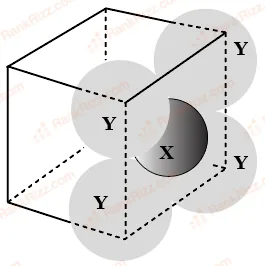
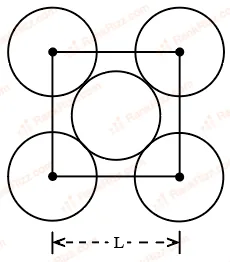
For the given close packed structure of a salt made of cation X and anion Y shown below (ions of only one face are shown for clarity), the packing fraction is approximately (packingfraction=100packingefficiency)
JEE ADVANCED 2020 · PAPER 1Voids, radius ratio and structures of ionic solids
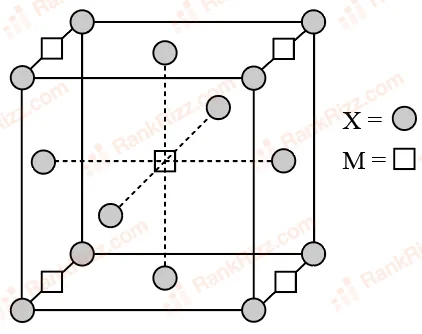
The cubic unit cell structure of a compound containing cation M and anion X is shown below. When compared to the anion, the cation has smaller ionic radius. Choose the correct statement(s).
A
The empirical formula of the compound is MX.
B
The cation M and anion X have different coordination geometries.
C
The ratio of M-X bond length to the cubic unit cell edge length is 0.866.
D
The ratio of the ionic radii of cation M to anion X is 0.414.
JEE ADVANCED 2018 · PAPER 1Voids, radius ratio and structures of ionic solids
Consider an ionic solid MX with NaCl structure. Construct a new structure (Z) whose unit cell is constructed from the unit cell of MX following the sequential instructions given below. Neglect the charge balance. (i) Remove all the anions (X) except the central one (ii) Replace all the face centered cations (M) by anions (X) (iii) Remove all the corner cations (M) (iv) Replace the central anion (X) with cation (M) The value of (numberofcationsnumberofanions) in Z is ..........
JEE ADVANCED 2017 · PAPER 1Voids, radius ratio and structures of ionic solids
A crystalline solid of a pure substance has a face-centred cubic structure with a cell edge of 400 pm. If the density of the substance in the crystal is 8 g cm−3, then the number of atoms present in 256 g of the crystal is N×1024. The value of N is
JEE ADVANCED 2015 · PAPER 1Voids, radius ratio and structures of ionic solids
If the unit cell of a mineral has cubic close packed (ccp) array of oxygen atoms with m fraction of octahedral holes occupied by aluminium ions and n fraction of tetrahedral holes occupied by magnesium ions, m and n, respectively, are
JEE ADVANCED 2007 · PAPER 2Voids, radius ratio and structures of ionic solids
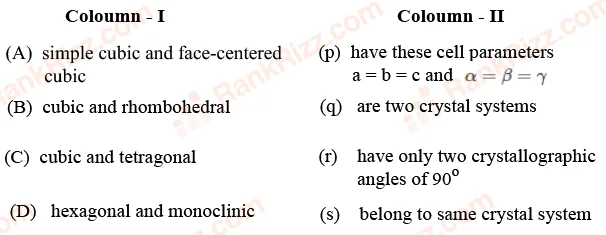
Match the crystal system/unit cells mentioned in Column I with their characteristic features mentioned in Column II. Indicate your answer by darkening the appropriate bubbles of the 4×4 matrix given in the ORS.