Chemical Thermodynamics JEE Advanced PYQs with answer key
CHEMISTRY · 40 PAST QUESTIONS · 6 TOPICS · 2007–2026
HOW TO USE THIS SHEET
Every JEE Advanced Chemical Thermodynamics question we hold, grouped by topic, most-asked topic first and newest first inside each. The answer key is at the end (33 of 40 questions have a checked key); the worked solution is on each question’s page, printed beside it.
First law: work, heat and internal energy 13
An ideal gas , initially at bar pressure, is compressed at a constant temperature of in two steps: first, against a constant external pressure of bar , and then against constant external pressure of bar. At each step, the compression is stopped only when the pressure of the gas becomes equal to the external pressure. The total work done on the gas in these steps is . Considering all possible values of and taking the gas constant as (in ), the minimum value of (in ) is
- (A)
- (B)
- (C)
- (D)
rr2.rankrizz.com/jee-advanced/chemistry/chemical-thermodynamics/q/2026-paper-1-q17
- (A)
Consider the following volume-temperature (V-T) diagram for the expansion of 5 moles of an ideal monoatomic gas.
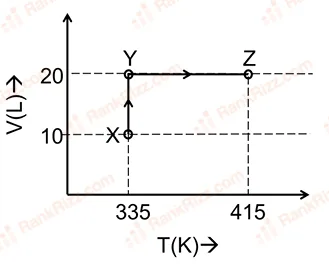
Considering only P-V work is involved, the total change in enthalpy (in Joule) for the transformation of state in the sequence is ______.
[Use the given data: Molar heat capacity of the gas for the given temperature range, J and gas constant, J ]
Answer: ____________
rr2.rankrizz.com/jee-advanced/chemistry/chemical-thermodynamics/q/2024-paper-1-q42
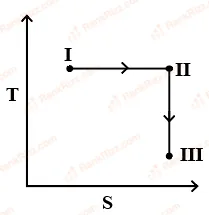
An ideal gas undergoes a reversible isothermal expansion from state I to state II followed by a reversible adiabatic expansion from state II to state III. The correct plot(s) representing the changes from state I to state III is(are)
(p: pressure, V: volume, T: temperature, H: enthalpy, S: entropy)- (A)
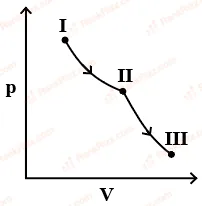
- (B)
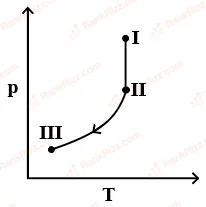
- (C)
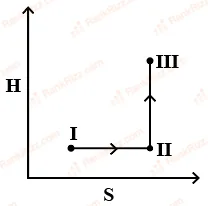
- (D)
rr2.rankrizz.com/jee-advanced/chemistry/chemical-thermodynamics/q/2021-paper-1-q52
- (A)
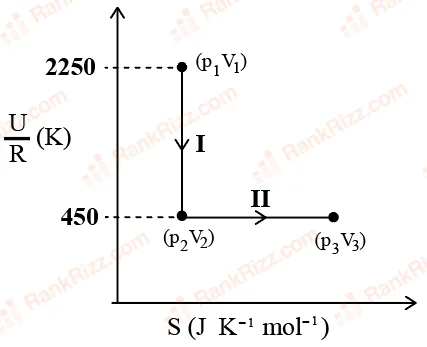
One mole of an ideal gas at 900 K, undergoes two reversible processes, I followed by II, as shown below. If the work done by the gas in the two processes are same, the value of is ___.
(U: internal energy, S: entropy, p: pressure, V: volume, R: gas constant)
(Given: molar heat capacity at constant volume, of the gas is )Answer: ____________
rr2.rankrizz.com/jee-advanced/chemistry/chemical-thermodynamics/q/2021-paper-2-q55
In thermodynamics, the 𝑃 − 𝑉 work done is given by
.
For a system undergoing a particular process, the work done is,
This equation is applicable to a- (A)
system that satisfies the van der Waals equation of state.
- (B)
process that is reversible and isothermal.
- (C)
process that is reversible and adiabatic.
- (D)
process that is irreversible and at constant pressure
rr2.rankrizz.com/jee-advanced/chemistry/chemical-thermodynamics/q/2020-paper-1-q25
- (A)
A reversible cyclic process for an ideal gas is shown below. Here, P, V, and T are pressure, volume and temperature, respectively. The thermodynamic parameters q, w, H and U are heat, work, enthalpy and internal energy, respectively.
The correct options(s) is (are)- (A)
and
- (B)
and
- (C)
and
- (D)
and
rr2.rankrizz.com/jee-advanced/chemistry/chemical-thermodynamics/q/2018-paper-1-q24
- (A)
An ideal gas is expanded from to under different conditions. The correct statement(s) among the following is(are)
- (A)
The work done on the gas is maximum when it is compressed irreversibly from to against constant pressure
- (B)
If the expansion is carried out freely, it is simultaneously both isothermal as well as adiabatic
- (C)
The work done by the gas is less when it is expanded reversibly from to under adiabatic conditions as compared to that when expanded reversibly from to under isothermal conditions
- (D)
The change in internal energy of the gas is (i) zero, if it is expanded reversibly with , and (ii) positive, if it is expanded reversibly under adiabatic conditions with
rr2.rankrizz.com/jee-advanced/chemistry/chemical-thermodynamics/q/2017-paper-1-q19
- (A)
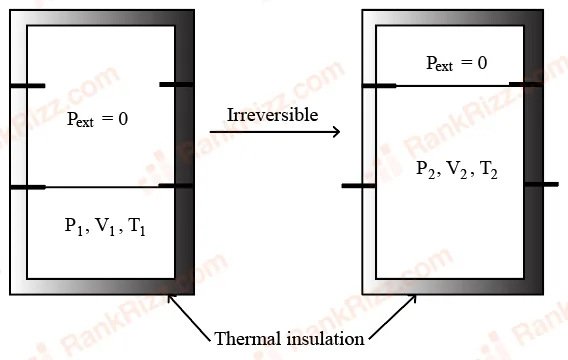
An ideal gas in a thermally insulated vessel at internal pressure = , volume = and absolute temperature = expands irreversibly against zero external pressure, as shown in the diagram. The final internal pressure, volume and absolute temperature of the gas are and , respectively. For this expansion,
- (A)
- (B)
- (C)
- (D)
rr2.rankrizz.com/jee-advanced/chemistry/chemical-thermodynamics/q/2014-paper-1-q24
- (A)
The succeeding operations that enable this transformation of states are
- (A)
Heating, cooling, heating, cooling
- (B)
Cooling, heating, cooling, heating
- (C)
Heating, cooling, cooling, heating
- (D)
Cooling, heating, heating, cooling
rr2.rankrizz.com/jee-advanced/chemistry/chemical-thermodynamics/q/2013-paper-2-q29
- (A)
The reversible expansion of an ideal gas under adiabatic and isothermal conditions is shown in the figure. Which of the following statement(s) is (are) correct ?
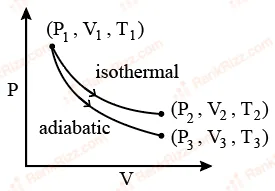
- (A)
- (B)
- (C)
- (D)
rr2.rankrizz.com/jee-advanced/chemistry/chemical-thermodynamics/q/2012-paper-2-q37
- (A)
The species which by definition has ZERO standard molar enthalpy of formation at 298 K is
- (A)
- (B)
- (C)
- (D)
rr2.rankrizz.com/jee-advanced/chemistry/chemical-thermodynamics/q/2010-paper-1-q7
- (A)
One mole of an ideal gas is taken from a to b along two paths denoted bythe solid and the dashed lines as shownin the graph below. If the work done along the solid line path is and that along the dotted line path is , then the integer closest to the ratio is
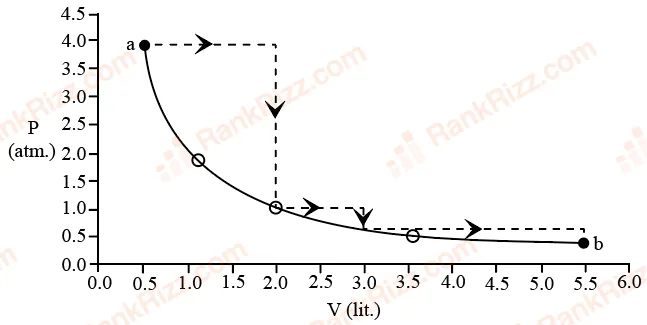
Answer: ____________
rr2.rankrizz.com/jee-advanced/chemistry/chemical-thermodynamics/q/2010-paper-2-q11
For the process (1 bar, 373 K) (1 bar, 373 K), the correct set of thermodynamic parameters is
- (A)
- (B)
- (C)
- (D)
rr2.rankrizz.com/jee-advanced/chemistry/chemical-thermodynamics/q/2007-paper-2-q30
- (A)
Gibbs energy and spontaneity 12
List-I contains various physical/chemical processes, and List-II contains combinations of changes in enthalpy and entropy . Match each entry in List-I to the appropriate entry in List-II, and choose the correct option.
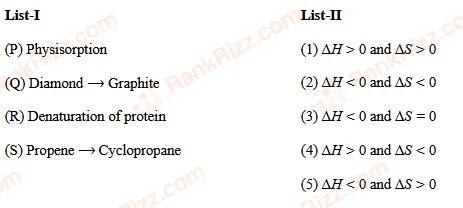
- (A)
(P)(2), (Q)(3), (R)(5), (S)(4)
- (B)
(P)(4), (Q)(3), (R)(5), (S)(1)
- (C)
(P)(2), (Q)(5), (R)(1), (S)(4)
- (D)
(P)(2), (Q)(5), (R)(1), (S)(3)
rr2.rankrizz.com/jee-advanced/chemistry/chemical-thermodynamics/q/2026-paper-1-q29
- (A)
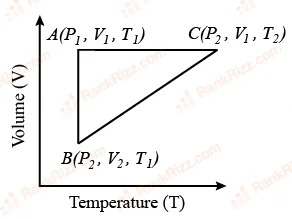
One mole of an ideal monoatomic gas undergoes two reversible processes (A B and B C) as shown in the given figure:
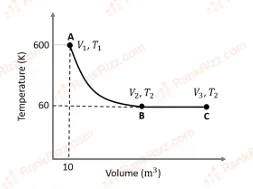
A B is an adiabatic process. If the total heat absorbed in the entire process (A B and B C) is , the value of is ________.
[Use, molar heat capacity of the gas at constant pressure, ]
Answer: ____________
rr2.rankrizz.com/jee-advanced/chemistry/chemical-thermodynamics/q/2023-paper-1-q45
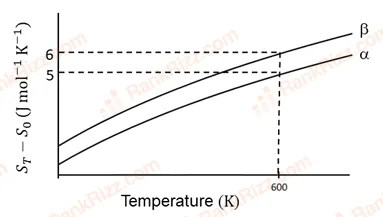
The value of entropy change, (in J mol K), at 300 K is ____.
[Use: ln 2 = 0.69]
[Given: at 0 K]
Answer: ____________
rr2.rankrizz.com/jee-advanced/chemistry/chemical-thermodynamics/q/2023-paper-2-q48
The correct option(s) about entropy (S) is(are)
[R = gas constant, F = Faraday constant, T = Temperature]
- (A)
For the reaction, M(s) + 2H(aq) H(g) + M(aq), if , then the entropy change of the reaction is R (assume that entropy and internal energy changes are temperature independent).
- (B)
The cell reaction, Pt(s) | H(g, 1bar) | H(aq, 0.01M) || H(aq, 0.1M) | H(g, 1bar) | Pt(s), is an entropy driven process.
- (C)
For racemization of an optically active compound, S > 0.
- (D)
S > 0, for [Ni(HO)] + 3 en [Ni(en)] + 6HO (where en = ethylenediamine).
rr2.rankrizz.com/jee-advanced/chemistry/chemical-thermodynamics/q/2022-paper-2-q46
- (A)
The value of (in JK mol) for the given reaction, at 1000 K is ___.
Answer: ____________
rr2.rankrizz.com/jee-advanced/chemistry/chemical-thermodynamics/q/2021-paper-1-q46
Tin is obtained from cassiterite by reduction with coke. Use the data given below to determine the minimum temperature (in K) at which the reduction of cassiterite by coke would take place.
At KJ mol, KJ mol, , , , .
Assume that the enthalpies and the entropies are temperature independent.Answer: ____________
rr2.rankrizz.com/jee-advanced/chemistry/chemical-thermodynamics/q/2020-paper-2-q35
The standard state Gibbs free energies of formation of C(graphite) and C(diamond) at T = 298 K are
The standard state means that the pressure should be 1 bar, and substance should be pure at a given temperature. The conversion of graphite [C(graphite)] to diamond [C(diamond)] reduces its volume by If C(graphite) is converted to C(diamond) isothermally at T = 298 K, the pressure at which C(graphite) is in equilibrium with
[Useful information: 1 J = 1 kg ;1 Pa=1kg ; ] C(diamond), is- (A)
14501 bar
- (B)
58001 bar
- (C)
1450 bar
- (D)
29001 bar
rr2.rankrizz.com/jee-advanced/chemistry/chemical-thermodynamics/q/2017-paper-2-q21
- (A)
For a reaction taking place in a container in equilibrium with its surroundings, the effect of temperature on its equilibrium constant K in terms of change in entropy is described by
- (A)
With increase in temperature, the value of K for exothermic reaction decreases because the entropy change of the system is positive
- (B)
With increase in temperature, the value of K for endothermic reaction increases because unfavourable change in entropy of the surroundings decreases
- (C)
With increase in temperature, the value of K for endothermic reaction increases because the entropy change of the system is negative
- (D)
With increase in temperature, the value of K for exothermic reaction decreases because favourable change in entropy of the surroundings decreases
rr2.rankrizz.com/jee-advanced/chemistry/chemical-thermodynamics/q/2017-paper-2-q27
- (A)
One mole of an ideal gas at 300 K in thermal contact with surroundings expands isothermally from 1.0 L to 2.0 L against a constant pressure of 3.0 atm. In this process, the
changein entropy of surroundings in is (1 Latm = 101.3 d)- (A)
5.763
- (B)
1.013
- (C)
-1.013
- (D)
-5.763
rr2.rankrizz.com/jee-advanced/chemistry/chemical-thermodynamics/q/2016-paper-1-q20
- (A)
For the process
at and 1 atmosphere pressure, the correct choice is- (A)
and
- (B)
and
- (C)
and
- (D)
and
rr2.rankrizz.com/jee-advanced/chemistry/chemical-thermodynamics/q/2014-paper-2-q29
- (A)
Benzene and naphthalene form an ideal solution at room temperature. For this process, the true statement(s) is(are)
- (A)
is positive
- (B)
is positive
- (C)
- (D)
rr2.rankrizz.com/jee-advanced/chemistry/chemical-thermodynamics/q/2013-paper-1-q34
- (A)
The value of for a reaction is
(Given : = -54.07 kJ mol, = 10 JK mol and R = 8.314 JK mol; )- (A)
5
- (B)
10
- (C)
95
- (D)
100
rr2.rankrizz.com/jee-advanced/chemistry/chemical-thermodynamics/q/2007-paper-1-q31
- (A)
Enthalpies of reaction and Hess's law 9
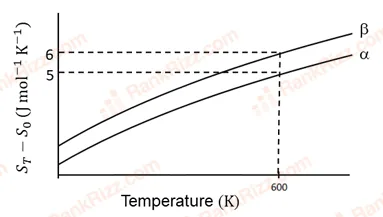
The value of enthalpy change, (in J mol), at 300 K is ____.
Answer: ____________
rr2.rankrizz.com/jee-advanced/chemistry/chemical-thermodynamics/q/2023-paper-2-q49
2 mol of Hg(g) is combusted in a fixed volume bomb calorimeter with excess of at 298 K and 1 atm into HgO(s). During the reaction, temperature increases from 298.0 K to 312.8 K. If heat capacity of the bomb calorimeter and enthalpy of formation of Hg(g) are 20.00 kJ K and 61.32 kJ mol at 298 K, respectively, the calculated standard molar enthalpy of formation of HgO(s) at 298 K is X kJ mol. The value of |X| is ______.
[Given : Gas constant R = 8.3 J K mol]
Answer: ____________
rr2.rankrizz.com/jee-advanced/chemistry/chemical-thermodynamics/q/2022-paper-1-q37
The value of standard enthalpy, (in kJ mol) for the given reaction is ___.
Answer: ____________
rr2.rankrizz.com/jee-advanced/chemistry/chemical-thermodynamics/q/2021-paper-1-q45
Choose the reaction(s) from the following options, for which the standard enthalpy of reaction is equal to the standard enthalpy of formation.
- (A)
- (B)
- (C)
- (D)
rr2.rankrizz.com/jee-advanced/chemistry/chemical-thermodynamics/q/2019-paper-1-q25
- (A)
The standard enthalpies of formation of and glucose(s) at are -400 kJ/mol, -300 kJ/mol and -1300 kJ/mol, respectively. The standard enthalpy of combustion per gram of glucoseat is
- (A)
+2900 kJ
- (B)
-2900 kJ
- (C)
-16.11 kJ
- (D)
+16.11 kJ
rr2.rankrizz.com/jee-advanced/chemistry/chemical-thermodynamics/q/2013-paper-1-q27
- (A)
Using the data provided, calculate the multiple bond energy of a bond . That energy is (take the bond energy of a C-H bond as 350 kJ )
- (A)
1165
- (B)
837
- (C)
865
- (D)
815
rr2.rankrizz.com/jee-advanced/chemistry/chemical-thermodynamics/q/2012-paper-2-q25
- (A)
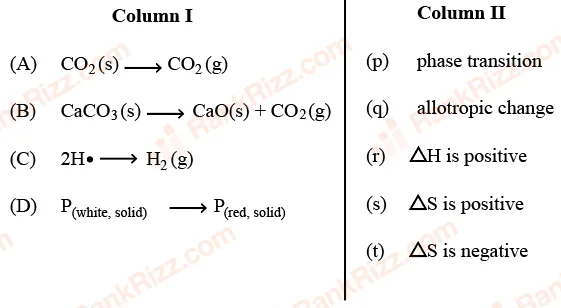
Match the transformations in column I with appropriate options in column II
rr2.rankrizz.com/jee-advanced/chemistry/chemical-thermodynamics/q/2011-paper-2-q19
The bond energy (in kcal ) of a C-C single bond is approximately
- (A)
1
- (B)
10
- (C)
100
- (D)
1000
rr2.rankrizz.com/jee-advanced/chemistry/chemical-thermodynamics/q/2010-paper-1-q8
- (A)
In a constant volume calorimeter, 3.5 g of a gas with molecular weight 28 was burnt in excess oxygen at 298.0 K. The temperature of the calorimeter was found to increase from 298.0 K to 298.45 K due to the combustion process. Given that the heat capacity of the calorimeteris 2.5 kJ K, the numerical value for the enthalpy of combustion of the gas in kJ mol is
Answer: ____________
rr2.rankrizz.com/jee-advanced/chemistry/chemical-thermodynamics/q/2009-paper-2-q12
System, surroundings and state functions 3
The pair of isochoric processes among the transformation of states is
- (A)
K to L and L to M
- (B)
L to M and N to K
- (C)
L to M and M to N
- (D)
M to N and N to K
rr2.rankrizz.com/jee-advanced/chemistry/chemical-thermodynamics/q/2013-paper-2-q30
- (A)
Among the following, the intensive property is (properties are)
- (A)
molar conductivity
- (B)
electromotive force
- (C)
resistance
- (D)
heat capacity
rr2.rankrizz.com/jee-advanced/chemistry/chemical-thermodynamics/q/2010-paper-1-q12
- (A)
Among the following, the state function(s) is(are)
- (A)
Internal energy
- (B)
Irreversible expansion work
- (C)
Reversible expansion work
- (D)
Molarenthalpy
rr2.rankrizz.com/jee-advanced/chemistry/chemical-thermodynamics/q/2009-paper-2-q6
- (A)
Entropy and the second law 2
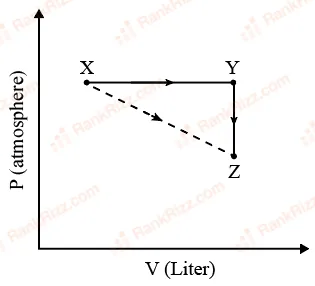
For an ideal gas, consider only P-V work in going from an initial state X to the final state Z. The final state Z can be reached by either of the two paths shown in the figure. Which of the following choice(s) is (are) correct ? [take as change in entropy and w as work done]
- (A)
- (B)
- (C)
- (D)
rr2.rankrizz.com/jee-advanced/chemistry/chemical-thermodynamics/q/2012-paper-1-q35
- (A)
STATEMENT-1: There is a natural asymmetry between converting work to heat and converting heat to work.
and
STATEMENT-2: Noprocessis possible in which the sole result is the absorption of heat from a reservoir and its complete conversion into work.- (A)
STATEMENT-1 is True, STATEMENT-2 is True; STATEMENT-2 is a correct explanation for STATEMENT-1
- (B)
STATEMENT-1 is True, STATEMENT-2 is True; STATEMENT-2 is NOT a correct explanation for STATEMENT-1
- (C)
STATEMENT-1 is True, STATEMENT-2 is False
- (D)
STATEMENT-1 is False, STATEMENT-2 is True
rr2.rankrizz.com/jee-advanced/chemistry/chemical-thermodynamics/q/2008-paper-2-q57
- (A)
Heat capacity and calorimetry 1
Considering ideal gas behavior, the expansion work done (in kJ) when 144 g of water is electrolyzed completely under constant pressure at 300 K is ________.
Use: Universal gas constant (R) = 8.3 J K mol; Atomic mass (in amu): H = 1, O = 16
Answer: ____________
rr2.rankrizz.com/jee-advanced/chemistry/chemical-thermodynamics/q/2025-paper-1-q43
Answer key
- 01 B
- 02 8120
- 03 —
- 04 10
- 05 A, B, C
- 06 B, C
- 07 A, B, C
- 08 A, B, C
- 09 C
- 10 A, C, D
- 11 B
- 12 2
- 13 A
- 14 C
- 15 7
- 16 0.31
- 17 B, C, D
- 18 —
- 19 —
- 20 A
- 21 B, D
- 22 C
- 23 B
- 24 B, C, D
- 25 B
- 26 300
- 27 —
- 28 —
- 29 C, D
- 30 C
- 31 D
- 32 A-PRS, B-RS, C-T, D-PQT
- 33 C
- 34 —
- 35 B
- 36 A, B
- 37 A
- 38 A, C
- 39 A
- 40 —
“—” marks a question whose key we have not checked yet; its page shows the latest on it.
Past questions are reproduced with their sitting. Not affiliated with NTA or the IITs. Every question, online and free: rr2.rankrizz.com/jee-advanced/chemistry/chemical-thermodynamics