Chemical Bonding and Molecular Structure JEE Advanced PYQs with answer key
CHEMISTRY · 33 PAST QUESTIONS · 7 TOPICS · 2007–2026
HOW TO USE THIS SHEET
Every JEE Advanced Chemical Bonding and Molecular Structure question we hold, grouped by topic, most-asked topic first and newest first inside each. The answer key is at the end (30 of 33 questions have a checked key); the worked solution is on each question’s page, printed beside it.
VSEPR theory and shapes of molecules and ions 13
The correct order of ONO bond angle in the given species is
- (A)
- (B)
- (C)
- (D)
rr2.rankrizz.com/jee-advanced/chemistry/chemical-bonding-and-molecular-structure/q/2026-paper-2-q20
- (A)
Consider the following species:
, , , , , , ,
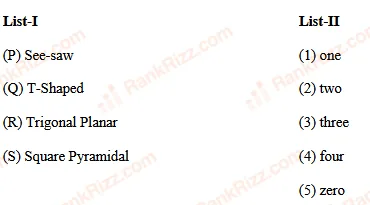
List-I contains different molecular shapes and List-II contains total number of species with the same molecular shapes from the given species. Match each entry in List-I with the appropriate entry in List-II and choose the correct option.
- (A)
(P)(1), (Q)(2), (R)(5), (S)(3)
- (B)
(P)(5), (Q)(4), (R)(2), (S)(3)
- (C)
(P)(3), (Q)(2), (R)(1), (S)(4)
- (D)
(P)(1), (Q)(3), (R)(5), (S)(4)
rr2.rankrizz.com/jee-advanced/chemistry/chemical-bonding-and-molecular-structure/q/2026-paper-1-q30
- (A)
Based on VSEPR model, match the xenon compounds given in List-I with the corresponding geometries and the number of lone pairs on xenon given in List-II and choose the correct option.
List-I List-II (P) (1) Trigonal bipyramidal and two lone pair of electrons (Q) (2) Tetrahedral and one lone pair of electrons (R) (3) Octahedral and two lone pair of electrons (S) (4) Trigonal bipyramidal and no lone pair of electrons (5) Trigonal bipyramidal and three lone pair of electrons - (A)
P-5, Q-2, R-3, S-1
- (B)
P-5, Q-3, R-2, S-4
- (C)
P-4, Q-3, R-2, S-1
- (D)
P-4, Q-2, R-5, S-3
rr2.rankrizz.com/jee-advanced/chemistry/chemical-bonding-and-molecular-structure/q/2024-paper-1-q49
- (A)
Among [I], [SiO], SOCl, XeF, SF, ClF, Ni(CO), XeOF, [PtCl], XeF, and SOCl, the total number of species having hybridised central atom is ____.
Answer: ____________
rr2.rankrizz.com/jee-advanced/chemistry/chemical-bonding-and-molecular-structure/q/2023-paper-2-q43
The sum of the number of lone pairs of electrons on each central atom in the following species is
, and
(Atomic numbers: N = 7, F = 9, S = 16, Br = 35, Te = 52, Xe = 54)Answer: ____________
rr2.rankrizz.com/jee-advanced/chemistry/chemical-bonding-and-molecular-structure/q/2017-paper-1-q28
The geometries of the ammonia complexes of and , respectively, are
- (A)
octahedral, square planar and tetrahedral
- (B)
square planar, octahedral and tetrahedral
- (C)
tetrahedral, square planar and octahedral
- (D)
octahedral, tetrahedral and square planar
rr2.rankrizz.com/jee-advanced/chemistry/chemical-bonding-and-molecular-structure/q/2016-paper-2-q22
- (A)
The compound(s) with TWO lonepairs of electrons on the central atom is(are)
- (A)
- (B)
- (C)
- (D)
rr2.rankrizz.com/jee-advanced/chemistry/chemical-bonding-and-molecular-structure/q/2016-paper-1-q27
- (A)
Among the triatomic molecules/ions, and , the total number of linear molecule(s)/ion(s) where the hybridization of the central atom does not have contribution from the d-orbital(s) is [Atomic number: S = 16, Cl= 17, 1=53 and Xe = 54]
Answer: ____________
rr2.rankrizz.com/jee-advanced/chemistry/chemical-bonding-and-molecular-structure/q/2015-paper-1-q25
A list of species having the formula is given below.
and .
Defining shape on the basis of the location of X and Z atoms, the total number of species having a square planar shape isAnswer: ____________
rr2.rankrizz.com/jee-advanced/chemistry/chemical-bonding-and-molecular-structure/q/2014-paper-1-q32
The shape of molecule is
- (A)
trigonal bipyramidal
- (B)
square plannar
- (C)
tetrahedral
- (D)
see-saw
rr2.rankrizz.com/jee-advanced/chemistry/chemical-bonding-and-molecular-structure/q/2012-paper-2-q26
- (A)
Geometrical shapes of the complexes formed by the reaction of with ans , respectively, are
- (A)
octahedral, tetrahedral and square planar
- (B)
tetrahedral, square planar and octahedral
- (C)
square planar, tetrahedral and octahedral
- (D)
octahedral, square planar and octahedral
rr2.rankrizz.com/jee-advanced/chemistry/chemical-bonding-and-molecular-structure/q/2011-paper-1-q1
- (A)
The species having pyramidal shape is
- (A)
- (B)
- (C)
- (D)
rr2.rankrizz.com/jee-advanced/chemistry/chemical-bonding-and-molecular-structure/q/2010-paper-2-q2
- (A)
Based on VSEPR theory, the number of 90 degree F-Br-F angles in is
Answer: ____________
rr2.rankrizz.com/jee-advanced/chemistry/chemical-bonding-and-molecular-structure/q/2010-paper-1-q24
Molecular orbital theory of diatomic species 10
Regarding the molecular orbital (MO) energy levels for homonuclear diatomic molecules, the INCORRECT statement(s) is(are)
- (A)
Bond order of Ne is zero.
- (B)
The highest occupied molecular orbital (HOMO) of F is -type.
- (C)
Bond energy of O is smaller than the bond energy of O.
- (D)
Bond length of Li is larger than the bond length of B.
rr2.rankrizz.com/jee-advanced/chemistry/chemical-bonding-and-molecular-structure/q/2025-paper-1-q37
- (A)
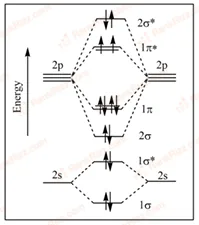
The correct molecular orbital diagram for F molecule in the ground state is
- (A)
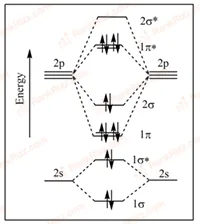
- (B)
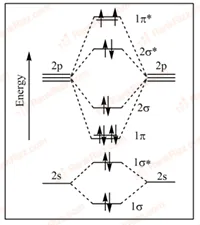
- (C)
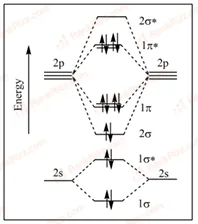
- (D)
rr2.rankrizz.com/jee-advanced/chemistry/chemical-bonding-and-molecular-structure/q/2023-paper-2-q35
- (A)
For diatomic molecules, the correct statement(s) about the molecular orbitals formed by the overlap of two 2 orbitals is(are)
- (A)
orbital has a total of two nodal planes.
- (B)
orbital has one node in the -plane containing the molecular axis.
- (C)
orbital has one node in the plane which is perpendicular to the molecular axis and goes through the center of the molecule.
- (D)
orbital has one node in the -plane containing the molecular axis.
rr2.rankrizz.com/jee-advanced/chemistry/chemical-bonding-and-molecular-structure/q/2022-paper-1-q45
- (A)
Among , and , the number of diamagnetic species is
(Atomic numbers: H = 1, He = 2, Li = 3, Be = 4, B = 5, C = 6, N = 7, O = 8, F = 9)Answer: ____________
rr2.rankrizz.com/jee-advanced/chemistry/chemical-bonding-and-molecular-structure/q/2017-paper-1-q29
According to Molecular Orbital Theory,
- (A)
is expected to be diamagnetic
- (B)
is expected to have a longer bond length than
- (C)
and have the same bond order
- (D)
has the same energy as two isolated He atoms
rr2.rankrizz.com/jee-advanced/chemistry/chemical-bonding-and-molecular-structure/q/2016-paper-2-q25
- (A)
Assuming 2s-2p mixing is NOT operative, the paramagnetic species among the following is
- (A)
- (B)
- (C)
- (D)
rr2.rankrizz.com/jee-advanced/chemistry/chemical-bonding-and-molecular-structure/q/2014-paper-2-q30
- (A)
Assuming that Hund's rule is violated, the bond order and magnetic nature of the diatomic molecule is
- (A)
1 and diamagnetic
- (B)
1 and paramagnetic
- (C)
O and diamagnetic
- (D)
O and paramagnetic
rr2.rankrizz.com/jee-advanced/chemistry/chemical-bonding-and-molecular-structure/q/2010-paper-2-q6
- (A)
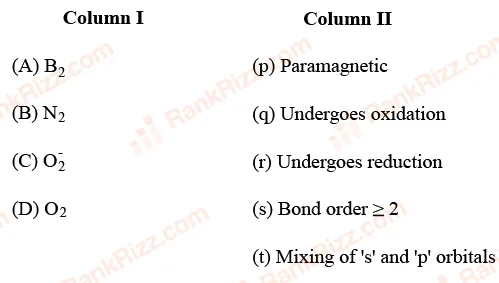
Match each of the diatomic molecules in Column I with its property/properties in Column II
rr2.rankrizz.com/jee-advanced/chemistry/chemical-bonding-and-molecular-structure/q/2009-paper-1-q19
The species having bond order different from that in CO is
- (A)
- (B)
- (C)
- (D)
rr2.rankrizz.com/jee-advanced/chemistry/chemical-bonding-and-molecular-structure/q/2007-paper-1-q23
- (A)
Among the following, the paramagnetic compound is
- (A)
- (B)
- (C)
- (D)
rr2.rankrizz.com/jee-advanced/chemistry/chemical-bonding-and-molecular-structure/q/2007-paper-1-q24
- (A)
Hydrogen bonding and intermolecular forces 4
The correct statement(s) about intermolecular forces is(are)
- (A)
The potential energy between two point charges approaches zero more rapidly than the potential energy between a point dipole and a point charge as the distance between them approaches infinity.
- (B)
The average potential energy of two rotating polar molecules that are separated by a distance has dependence.
- (C)
The dipole-induced dipole average interaction energy is independent of temperature.
- (D)
Nonpolar molecules attract one another even though neither has a permanent dipole moment.
rr2.rankrizz.com/jee-advanced/chemistry/chemical-bonding-and-molecular-structure/q/2025-paper-2-q37
- (A)
In the following reactions, P, Q, R, and S are the major products.
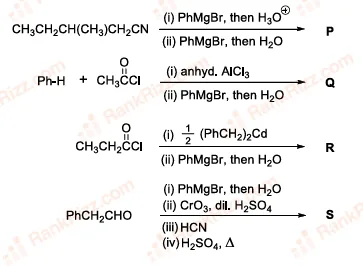
The correct statement(s) about P, Q, R, and S is(are)
- (A)
Both P and Q have asymmetric carbon(s).
- (B)
Both Q and R have asymmetric carbon(s).
- (C)
Both P and R have asymmetric carbon(s).
- (D)
P has asymmetric carbon(s), S does not have any asymmetric carbon.
rr2.rankrizz.com/jee-advanced/chemistry/chemical-bonding-and-molecular-structure/q/2023-paper-1-q36
- (A)
Consider the following reaction scheme and choose the correct option(s) for the major products Q, R and S.
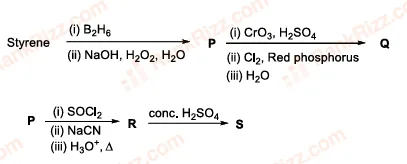
- (A)
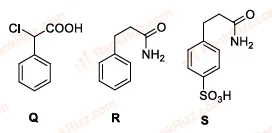
- (B)
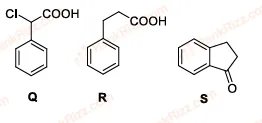
- (C)
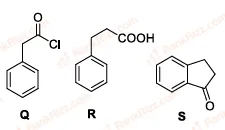
- (D)
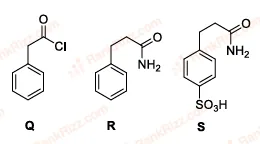
rr2.rankrizz.com/jee-advanced/chemistry/chemical-bonding-and-molecular-structure/q/2023-paper-1-q37
- (A)
Hydrogen bonding plays a central role in the following phenomena:
- (A)
Ice floats in water.
- (B)
Higher Lewis basicity of primary amines than tertiary amines in aqueous solutions.
- (C)
Formic acid is more acidic than acetic acid.
- (D)
Dimerisation of acetic acid in benzene.
rr2.rankrizz.com/jee-advanced/chemistry/chemical-bonding-and-molecular-structure/q/2014-paper-1-q25
- (A)
Dipole moment and molecular polarity 3
The correct order of dipole moments for the given species is
- (A)
- (B)
- (C)
- (D)
rr2.rankrizz.com/jee-advanced/chemistry/chemical-bonding-and-molecular-structure/q/2026-paper-1-q19
- (A)
Consider the following compounds in the liquid form:
.
When a charged comb is brought near their flowing stream, how many of them show deflection as per the following figure?
Answer: ____________
rr2.rankrizz.com/jee-advanced/chemistry/chemical-bonding-and-molecular-structure/q/2020-paper-2-q20
Each of the following options contains a set of four molecules. Identify the option(s) where all four molecules possess permanent dipole moment at room temperature.
- (A)
- (B)
- (C)
- (D)
rr2.rankrizz.com/jee-advanced/chemistry/chemical-bonding-and-molecular-structure/q/2019-paper-1-q27
- (A)
Fajans' rules, polarisation and covalent character 1
The option(s) in which at least three molecules follow Octet Rule is(are)
- (A)
, , and
- (B)
, , and
- (C)
, , and
- (D)
, , and
rr2.rankrizz.com/jee-advanced/chemistry/chemical-bonding-and-molecular-structure/q/2024-paper-1-q41
- (A)
Resonance and bond parameters 1
STATEMENT-1 : Boron always forms covalent bond.
because
STATEMENT-2: The small size of favours formation of covalent bond.- (A)
Statement-1 is True, Statement-2 is True; Statement-2 is a correct explanation for Statement-1
- (B)
Statement-1 is True, Statement-2 is True; Statement-2 is NOT a correct explanation for Statement-1
- (C)
Statement-1 is True, Statement-2 is False
- (D)
Statement-1 is False, Statement-2 is True
rr2.rankrizz.com/jee-advanced/chemistry/chemical-bonding-and-molecular-structure/q/2007-paper-1-q32
- (A)
Valence bond theory, orbital overlap and sigma/pi bonds 1
Match the orbital overlap figures shown in List-I with the description given in List-II and select the correct answer using the code given below the lists.
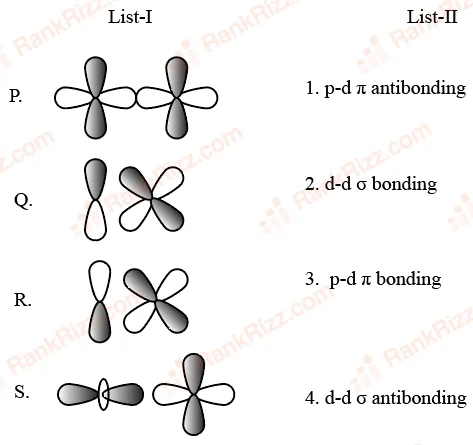
- (A)
P - 2, Q - 1, R - 3, S - 4
- (B)
P - 4, Q - 3, R - 1, S - 2
- (C)
P - 2, Q - 3, R - 1, S - 4
- (D)
P - 4, Q - 1, R - 3, S - 2
rr2.rankrizz.com/jee-advanced/chemistry/chemical-bonding-and-molecular-structure/q/2014-paper-2-q40
- (A)
Answer key
- 01 B
- 02 A
- 03 B
- 04 5
- 05 6
- 06 A
- 07 B, C
- 08 4
- 09 4
- 10 D
- 11 B
- 12 D
- 13 0 or 8
- 14 B, C
- 15 C
- 16 A, D
- 17 —
- 18 A, C
- 19 C
- 20 A
- 21 —
- 22 A
- 23 D
- 24 C, D
- 25 C, D
- 26 B
- 27 A, B, D
- 28 A
- 29 —
- 30 A, C
- 31 A, D
- 32 A
- 33 C
“—” marks a question whose key we have not checked yet; its page shows the latest on it.
Past questions are reproduced with their sitting. Not affiliated with NTA or the IITs. Every question, online and free: rr2.rankrizz.com/jee-advanced/chemistry/chemical-bonding-and-molecular-structure