JEE ADVANCED 2015 · PAPER 2+4MEDIUM
JEE Advanced 2015 Chemistry question — Properties and reactions of alcohols
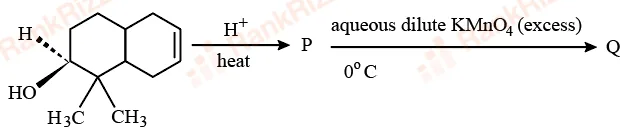
The number of hydroxyl group(s) in Q is
SOLUTION
Key idea: Acid dehydration goes through a carbocation that rearranges (1,2-methyl shift) to a more stable tertiary cation and gives a second C=C. Cold, dilute, excess then adds two OH groups across each C=C.
- /heat: the 2° alcohol loses water to give a 2° carbocation next to the carbon.
- A 1,2-methyl shift gives a 3° carbocation. Losing a proton from the ring-junction carbon gives a tetrasubstituted ring alkene. So P has two C=C bonds (this new one and the original ring CH=CH).
- Cold dilute alkaline (Baeyer's reagent, excess) gives syn dihydroxylation of both alkenes: 2 OH + 2 OH.
So Q has 4 hydroxyl groups.
Answer: 4
Topic: Properties and reactions of alcohols