JEE MAIN 2019 · 10 JAN S2Kinetic interpretation of pressure and temperature
2 kg of a monoatomic gas is at a pressure of N m. The density of the gas is 8 kg m. What is the order of energy of the gas due to its thermal motion?
- A
J
- B
J
- C
J
- D
J
Every Kinetic Theory of Gases question JEE Main has set from 2004–2026, grouped by the idea it tests rather than the order of the syllabus. 191 questions across 6 distinct ideas. Free to read, answer key on every one.
DATA UPDATED
Questions
191
Distinct ideas
6
Share of marks
3%
Difficulty
EASY
A chapter is not one subject — it is a handful of procedures the examiner reuses. These are the ones Kinetic Theory of Gases questions actually test.
161–180 OF 191 · NEWEST FIRST
2 kg of a monoatomic gas is at a pressure of N m. The density of the gas is 8 kg m. What is the order of energy of the gas due to its thermal motion?
J
J
J
J
A mixture of 2 moles of helium gas (atomic mass = 4u), and 1 mole of argon gas (atomic mass = 40 u) is kept at 300 K in a container. The ratio of their rms speeds , is close to:
0.45
2.24
0.32
3.16
A 15 g mass of nitrogen gas is enclosed in a vessel at a temperature, 27C. The amount of heat transferred to the gas, so that R.M.S. velocity of molecules is doubled, is about. [ J (K mole)]
14 kJ
10 kJ
6 kJ
0.9 kJ
Two moles of helium are mixed with n moles of hydrogen. If for the mixture then the value of n is:
1
3
2
The value closest to the thermal velocity of a Helium atom at room temperature (300 K) in ms is: [k = 1.4 10 J/K; m = 7 10 kg]
moles of diatomic gas in a cylinder is at a temperature . Heat is supplied to the cylinder such that the temperature remains constant but moles of the diatomic gas get converted into monoatomic gas. The change in the total kinetic energy of the gas is
0
An ideal gas has molecules with 5 degrees of freedom. The ratio of specific heats at constant pressure () and at constant volume () is:
6
and are specific heats at constant pressure and constant volume respectively. It is observed that, for hydrogen gas and for nitrogen gas. The correct relation between and is:
The temperature of an open room of volume 30 m increases from 17°C to 27°C due to the sunshine. The atmospheric pressure in the room remains Pa. If and are the number of molecules in the room before and after heating, then will be:
Which of the following shows the correct relationship between the pressure and density of an ideal gas at constant temperature?
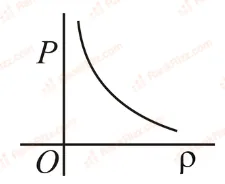
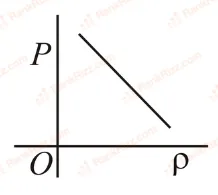
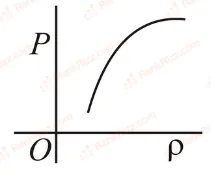
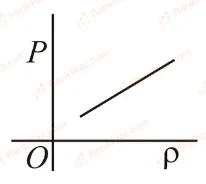
The ratio of work done by an ideal monoatomic gas to the heat supplied to it in an isobaric process is
Using equipartition of energy, the specific heat (in J kg K) of Aluminium at high temperature can be estimated to be (atomic weight of Aluminium = 27)
25
1850
410
925
In an ideal gas at temperature T, the average force that a molecule applies on the walls of a closed container depends on as . A good estimate for is:
2
1
Consider an ideal gas confined in an isolated closed chamber. As the gas undergoes an adiabatic expansion, the average time of collision between molecules increases as , where is the volume of the gas. The value of is
A gas molecule of mass M at the surface of the earth has kinetic energy equivalent to 0 °C. If it were to go up straight without colliding with any other molecules, how high it would rise? Assume that the height attained is much less than the radius of the earth. (k is Boltzmann constant)
0
At room temperature a diatomic gas is found to have an r.m.s. speed of 1930 ms. The gas is:
H
Cl
O
F
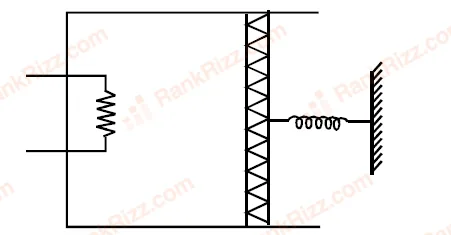
An ideal monoatomic gas is confined in a cylinder by a spring loaded piston of cross section m. Initially the gas is at 300 K and occupies a volume of m and the spring is in its relaxed state as shown in figure. The gas is heated by a small heater until the piston moves out slowly by 0.1 m. The force constant of the spring is 8000 N/m and the atmospheric pressure is N/m. The cylinder and the piston are thermally insulated. The piston and the spring are massless and there is no friction between the piston and the cylinder. The final temperature of the gas will be: (Neglect the heat loss through the lead wires of the heater. The heat capacity of the heater coil is also negligible).
300 K
800 K
500 K
1000 K
Modern vacuum pumps can evacuate a vessel down to a pressure of atm. at room temperature (300 K). Taking R = 8.3 JK mole, 1 atm = Pa and mole, the mean distance between molecules of gas in an evacuated vessel will be of the order of:
0.2 m
0.2 mm
0.2 cm
0.2 nm
In the isothermal expansion of 10 g of gas from volume V to 2V the work done by the gas is 575 J. What is the root mean square speed of the molecules of the gas at that temperature?
398 m/s
520 m/s
499 m/s
532 m/s
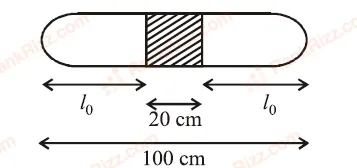
A thin tube sealed at both ends is 100 cm long. It lies horizontally, the middle 20 cm containing mercury and two equal ends containing air at standard atmospheric pressure. If the tube is now turned to a vertical position, by what amount will the mercury be displaced?
(Given : cross-section of the tube can be assumed to be uniform)
2.95 cm
5.18 cm
8.65 cm
0.0 cm
JEE Advanced has set 15 Kinetic Theory of Gases questions too. Kinetic Theory of Gases JEE Advanced PYQs →
OTHER PHYSICS CHAPTERS