Kinetic Theory of Gases JEE Main PYQs with answer key
PHYSICS · 191 PAST QUESTIONS · 6 TOPICS · 2004–2026
HOW TO USE THIS SHEET
Every JEE Main Kinetic Theory of Gases question we hold, grouped by topic, most-asked topic first and newest first inside each. The answer key is at the end (189 of 191 questions have a checked key); the worked solution is on each question’s page, printed beside it.
Molar specific heats of gases, Mayer's relation and gas mixtures 60
Given below are two statements: one is labelled as Assertion A and the other is labelled as Reason R.
Statement I: Change in internal energy of a system containing mole of ideal gas can be written as , where , = initial temperature, = final temperature.
Statement II: Relation between degree of freedom and (= ) is .
Choose the correct answer from the options given below- (A)
Both A and R are true, and R is the correct explanation of A
- (B)
Both A and R are true, but R is not the correct explanation of A
- (C)
A is true but R is false
- (D)
A is false but R is true
rr2.rankrizz.com/jee-main/physics/kinetic-theory-of-gases/q/5-apr-2026-s1-q32
- (A)
Heat is supplied to a diatomic gas at constant pressure. Then the ratio of is __________.
- (A)
- (B)
- (C)
- (D)
rr2.rankrizz.com/jee-main/physics/kinetic-theory-of-gases/q/2-apr-2026-s1-q33
- (A)
When 300 J of heat given to an ideal gas with its temperature raises from to keeping its volume constant. The millimoles of the gas is (approximately) __ . (R = 8.314 J/mol.K)
Answer: ____________
rr2.rankrizz.com/jee-main/physics/kinetic-theory-of-gases/q/24-jan-2026-s2-q46
10 mole of oxygen is heated at constant volume from . The change in the internal energy of the gas is ____ cal (the molecular specific heat of oxygen at constant pressure,
Answer: ____________
rr2.rankrizz.com/jee-main/physics/kinetic-theory-of-gases/q/21-jan-2026-s1-q47
A diatomic gas ( y= 1.4) does 100 J of work when it is expanded isobarically. Then the heat given to the gas ____ J.
Answer: ____________
rr2.rankrizz.com/jee-main/physics/kinetic-theory-of-gases/q/21-jan-2026-s2-physics-q22
Match the List-I with List-II.
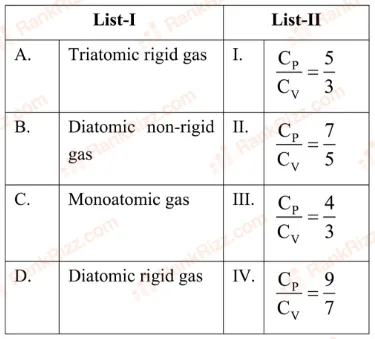
Choose the correct answer from the options given below :
- (A)
A-III, B-IV, C-I, D-II
- (B)
A-III, B-II, C-IV, D-I
- (C)
A-II, B-IV, C-I, D-II
- (D)
A-IV, B-II, C-III, D-I
rr2.rankrizz.com/jee-main/physics/kinetic-theory-of-gases/q/2025-apr-7-s1-q38
- (A)
is the specific heat ratio of monoatomic gas A having 3 translational degrees of freedom. is the specific heat ratio of polyatomic gas B having 3 translational, 3 rotational degrees of freedom and 1 vibrational mode. If , then the value of n is ______.
Answer: ____________
rr2.rankrizz.com/jee-main/physics/kinetic-theory-of-gases/q/2025-apr-02-s1-q49
The temperature of 1 mole of an ideal monoatomic gas is increased by at constant pressure. The total heat added and change in internal energy are and respectively. If then the value of x is
Answer: ____________
rr2.rankrizz.com/jee-main/physics/kinetic-theory-of-gases/q/24-jan-2025-s1-q48
For a diatomic gas, if for rigid molecules and for another diatomic molecules, but also having vibrational modes. Then, which one of the following options is correct ? (Cp and Cv are specific heats of the gas at constant pressure and volume)
- (A)
- (B)
- (C)
- (D)
rr2.rankrizz.com/jee-main/physics/kinetic-theory-of-gases/q/22-jan-2025-s2-q44
- (A)
A mixture of one mole of monoatomic gas and one mole of a diatomic gas (rigid) are kept at room temperature . The ratio of specific heat of gases at constant volume respectively is:
- (A)
- (B)
- (C)
- (D)
rr2.rankrizz.com/jee-main/physics/kinetic-theory-of-gases/q/8-apr-2024-s1-q10
- (A)
A diatomic gas () does 100 J of work in an isobaric expansion. The heat given to the gas is :
- (A)
250 J
- (B)
150 J
- (C)
350 J
- (D)
490 J
rr2.rankrizz.com/jee-main/physics/kinetic-theory-of-gases/q/8-apr-2024-s2-q8
- (A)
The specific heat at constant pressure of a real gas obeying equation is:
- (A)
- (B)
- (C)
- (D)
rr2.rankrizz.com/jee-main/physics/kinetic-theory-of-gases/q/6-apr-2024-s1-q10
- (A)
Two moles of a monoatomic gas is mixed with six moles of a diatomic gas. The molar specific heat of the mixture at constant volume is :
- (A)
- (B)
- (C)
- (D)
rr2.rankrizz.com/jee-main/physics/kinetic-theory-of-gases/q/01-feb-2024-s1-q10
- (A)
A diatomic gas does 200 J of work when it is expanded isobarically. The heat given to the gas in the process is:
- (A)
850 J
- (B)
800 J
- (C)
600 J
- (D)
700 J
rr2.rankrizz.com/jee-main/physics/kinetic-theory-of-gases/q/01-feb-2024-s2-q8
- (A)
If three moles of monoatomic gas is mixed with two moles of a diatomic gas , the value of adiabatic exponent for the mixture is:
- (A)
1.75
- (B)
1.40
- (C)
1.52
- (D)
1.35
rr2.rankrizz.com/jee-main/physics/kinetic-theory-of-gases/q/30-jan-2024-s2-q9
- (A)
moles of a polyatomic gas must be mixed with two moles of a monoatomic gas so that the mixture behaves as a diatomic gas. The value of is:
- (A)
- (B)
- (C)
- (D)
rr2.rankrizz.com/jee-main/physics/kinetic-theory-of-gases/q/29-jan-2024-s2-q10
- (A)
kg air is heated at constant volume through . The specific heat of air at constant volume is and . The change in its internal energy is approximately.
- (A)
J
- (B)
J
- (C)
J
- (D)
J
rr2.rankrizz.com/jee-main/physics/kinetic-theory-of-gases/q/27-jan-2024-s1-q8
- (A)
The correct relation between and temperature is:
- (A)
- (B)
- (C)
- (D)
rr2.rankrizz.com/jee-main/physics/kinetic-theory-of-gases/q/31-jan-2023-s1-q9
- (A)
Heat energy of 735 J is given to a diatomic gas allowing the gas to expand at constant pressure. Each gas molecule rotates around an internal axis but do not oscillate. The increase in the internal energy of the gas will be:
- (A)
525 J
- (B)
441 J
- (C)
572 J
- (D)
735 J
rr2.rankrizz.com/jee-main/physics/kinetic-theory-of-gases/q/31-jan-2023-s2-q7
- (A)
According to law of equipartition of energy the molar specific heat of a diatomic gas at constant volume where the molecule has one additional vibrational mode is:-
- (A)
- (B)
- (C)
- (D)
rr2.rankrizz.com/jee-main/physics/kinetic-theory-of-gases/q/25-jan-2023-s2-q7
- (A)
Let be the ratio of molar specific heat at constant pressure and molar specific heat at constant volume of a monoatomic gas and be the similar ratio of diatomic gas. Considering the diatomic gas molecule as a rigid rotator, the ratio is:
- (A)
- (B)
- (C)
- (D)
rr2.rankrizz.com/jee-main/physics/kinetic-theory-of-gases/q/24-jan-2023-s2-q10
- (A)
One mole of a monoatomic gas is mixed with three moles of a diatomic gas. The molecular specific heat of mixture at constant volume is J mol K; then the value of will be _____. (Assume that the given diatomic gas has no vibrational mode.)
Answer: ____________
rr2.rankrizz.com/jee-main/physics/kinetic-theory-of-gases/q/29-jul-2022-s1-q24
A vessel contains 14 g of nitrogen gas at a temperature of . The amount of heat to be transferred to the gas to double the r.m.s. speed of its molecules will be: (Take J mol K)
- (A)
2229 J
- (B)
5616 J
- (C)
9360 J
- (D)
13,104 J
rr2.rankrizz.com/jee-main/physics/kinetic-theory-of-gases/q/28-jul-2022-s2-q8
- (A)
At a certain temperature, the degrees of freedom per molecule for gas is 8. The gas performs 150 J of work when it expands under constant pressure. The amount of heat absorbed by the gas will be _____ J.
Answer: ____________
rr2.rankrizz.com/jee-main/physics/kinetic-theory-of-gases/q/28-jul-2022-s2-q25
A gas has degrees of freedom. The ratio of specific heat of gas at constant volume to the specific heat of gas at constant pressure will be
- (A)
- (B)
- (C)
- (D)
rr2.rankrizz.com/jee-main/physics/kinetic-theory-of-gases/q/26-jul-2022-s2-q8
- (A)
Sound travels in a mixture of two moles of helium and moles of hydrogen. If rms speed of gas molecules in the mixture is times the speed of sound, then the value of will be
- (A)
- (B)
- (C)
- (D)
rr2.rankrizz.com/jee-main/physics/kinetic-theory-of-gases/q/25-jul-2022-s2-q10
- (A)
A cylinder of fixed capacity of 44.8 litres contains helium gas at standard temperature and pressure. The amount of heat needed to raise the temperature of gas in the cylinder by 20.0°C will be (Given gas constant R = 8.3 J K mol)
- (A)
249 J
- (B)
415 J
- (C)
498 J
- (D)
830 J
rr2.rankrizz.com/jee-main/physics/kinetic-theory-of-gases/q/29-jun-2022-s1-q10
- (A)
A diatomic gas does J of work when it is expanded isobarically. The heat given to the gas in the process is ______ J.
Answer: ____________
rr2.rankrizz.com/jee-main/physics/kinetic-theory-of-gases/q/27-jun-2022-s2-q23
A thermally insulated vessel contains an ideal gas of molecular mass and ratio of specific heats . Vessel is moving with speed and is suddenly brought to rest. Assuming no heat is lost to the surrounding and vessel temperature of the gas increases by :
( = universal gas constant)- (A)
- (B)
- (C)
- (D)
rr2.rankrizz.com/jee-main/physics/kinetic-theory-of-gases/q/26-jun-2022-s1-q8
- (A)
The ratio of specific heats in terms of degree of freedom is given by :
- (A)
- (B)
- (C)
- (D)
rr2.rankrizz.com/jee-main/physics/kinetic-theory-of-gases/q/25-jun-2022-s2-q7
- (A)
kg of Nitrogen is enclosed in a vessel at a temperature of C. The amount of heat required to double the speed of its molecules is ______ kcal.
(Take cal mole K)Answer: ____________
rr2.rankrizz.com/jee-main/physics/kinetic-theory-of-gases/q/24-jun-2022-s1-q24
For a gas in a state P and in a state Q. and are the temperatures in two different states P and Q, respectively. Then
- (A)
- (B)
- (C)
- (D)
rr2.rankrizz.com/jee-main/physics/kinetic-theory-of-gases/q/25-jul-2021-s1-q9
- (A)
The amount of heat needed to raise the temperature of 4 moles of a rigid diatomic gas from 0 C to 50 C when no work is done is ( is the universal gas constant)
- (A)
250
- (B)
750
- (C)
175
- (D)
500
rr2.rankrizz.com/jee-main/physics/kinetic-theory-of-gases/q/20-jul-2021-s1-q7
- (A)
The correct relation between the degrees of freedom and the ratio of specific heat is:
- (A)
- (B)
- (C)
- (D)
rr2.rankrizz.com/jee-main/physics/kinetic-theory-of-gases/q/20-jul-2021-s2-q12
- (A)
A polyatomic ideal gas has 24 vibrational modes. What is the value of ?
- (A)
1.03
- (B)
1.30
- (C)
1.37
- (D)
10.3
rr2.rankrizz.com/jee-main/physics/kinetic-theory-of-gases/q/17-mar-2021-s1-q9
- (A)
If one mole of the polyatomic gas is having two vibrational modes and is the ratio of molar specific heats for polyatomic gas then the value of is:
- (A)
1.02
- (B)
1.2
- (C)
1.25
- (D)
1.35
rr2.rankrizz.com/jee-main/physics/kinetic-theory-of-gases/q/17-mar-2021-s2-q8
- (A)
A diatomic gas, having and , is heated at constant pressure. The ratio dU : dQ : dW
- (A)
3 : 5 : 2
- (B)
5 : 7 : 3
- (C)
5 : 7 : 2
- (D)
3 : 7 : 2
rr2.rankrizz.com/jee-main/physics/kinetic-theory-of-gases/q/25-feb-2021-s1-q8
- (A)
Molecules of an ideal gas are known to have three translational degrees of freedom. The gas is maintained at a temperature of T. The total internal energy, U of a mole of this gas, and the value of are given, respectively, by:
- (A)
and
- (B)
and
- (C)
and
- (D)
and
rr2.rankrizz.com/jee-main/physics/kinetic-theory-of-gases/q/6-sep-2020-s1-q7
- (A)
Match the ratio for ideal gases with different type of molecules:
Molecule Type
(A) Monoatomic (I) 7/5
(B) Diatomic rigid molecules (II) 9/7
(C) Diatomic non-rigid molecules (III) 4/3
(D) Triatomic rigid molecules (IV) 5/3- (A)
(A) - (IV), (B) - (II), (C) - (I), (D) - (III)
- (B)
(A) - (III), (B) - (IV), (C) - (II), (D) - (I)
- (C)
(A) - (IV), (B) - (I), (C) - (II), (D) - (III)
- (D)
(A) - (II), (B) - (III), (C) - (I), (D) - (IV)
rr2.rankrizz.com/jee-main/physics/kinetic-theory-of-gases/q/4-sep-2020-s1-q8
- (A)
To raise the temperature of a certain mass of gas by 50°C at a constant pressure, 160 calories of heat is required. When the same mass of gas is cooled by 100°C at constant volume, 240 calories of heat is released. How many degrees of freedom does each molecule of this gas have (assume gas to be ideal)?
- (A)
5
- (B)
6
- (C)
3
- (D)
7
rr2.rankrizz.com/jee-main/physics/kinetic-theory-of-gases/q/3-sep-2020-s2-q9
- (A)
Consider two ideal diatomic gases and at some temperature . Molecules of the gas are rigid, and have a mass . Molecules of the gas have an additional vibrational mode and have a mass . The ratio of the specific heats and of gas and , respectively is:
- (A)
7 : 9
- (B)
5 : 9
- (C)
3 : 5
- (D)
5 : 7
rr2.rankrizz.com/jee-main/physics/kinetic-theory-of-gases/q/9-jan-2020-s1-q8
- (A)
Consider a mixture of moles of helium gas and moles of oxygen gas (molecules taken to be rigid) as an ideal gas. Its value will be:
- (A)
- (B)
- (C)
- (D)
rr2.rankrizz.com/jee-main/physics/kinetic-theory-of-gases/q/8-jan-2020-s2-q9
- (A)
Two moles of an ideal gas, with , are mixed with three moles of another ideal gas . The value of for the mixture is
- (A)
1.45
- (B)
1.50
- (C)
1.47
- (D)
1.42
rr2.rankrizz.com/jee-main/physics/kinetic-theory-of-gases/q/7-jan-2020-s1-q8
- (A)
Two moles of helium gas is mixed with three moles of hydrogen molecules (taken to be rigid). What is the molar specific heat of mixture at constant volume? R = 8.3 J/mol K
- (A)
17.4 J/mol K
- (B)
19.7 J/mol K
- (C)
15.7 J/mol K
- (D)
21.6 J/mol K
rr2.rankrizz.com/jee-main/physics/kinetic-theory-of-gases/q/12-apr-2019-s1-q11
- (A)
A diatomic gas with rigid molecules does 10 J of work when expanded at constant pressure. What would be the heat energy absorbed by the gas, in this process?
- (A)
40 J
- (B)
35 J
- (C)
25 J
- (D)
30 J
rr2.rankrizz.com/jee-main/physics/kinetic-theory-of-gases/q/12-apr-2019-s2-q12
- (A)
n moles of an ideal gas with constant volume heat capacity undergo an isobaric expansion by certain volume. The ratio of the work done in the process, to the heat supplied is:
- (A)
- (B)
- (C)
- (D)
rr2.rankrizz.com/jee-main/physics/kinetic-theory-of-gases/q/10-apr-2019-s1-q8
- (A)
A cylinder with fixed capacity of 67.2 litre contains helium gas at STP. The amount of heat needed to raise the temperature of the gas by 20°C is:
[Given that R = 8.31 J mol K]- (A)
748 J
- (B)
700 J
- (C)
350 J
- (D)
374 J
rr2.rankrizz.com/jee-main/physics/kinetic-theory-of-gases/q/10-apr-2019-s1-q9
- (A)
When heat Q is supplied to a diatomic gas of rigid molecules, at constant volume its temperature increases by . The heat required to produce the same change in temperature, at a constant pressure is:
- (A)
- (B)
- (C)
- (D)
rr2.rankrizz.com/jee-main/physics/kinetic-theory-of-gases/q/10-apr-2019-s2-q15
- (A)
The specific heats, C and C of a gas of diatomic molecules, A, are given (in units of J mol K) by 29 and 22, respectively. Another gas of diatomic molecules, B, has the corresponding values 30 and 21. If they are treated as ideal gases, then:
- (A)
A has one vibrational mode and B has two
- (B)
A has a vibrational mode but B has none.
- (C)
Both A and B have a vibrational mode each.
- (D)
A is rigid but B has a vibrational mode.
rr2.rankrizz.com/jee-main/physics/kinetic-theory-of-gases/q/9-apr-2019-s2-q11
- (A)
A 15 g mass of nitrogen gas is enclosed in a vessel at a temperature, 27C. The amount of heat transferred to the gas, so that R.M.S. velocity of molecules is doubled, is about. [ J (K mole)]
- (A)
14 kJ
- (B)
10 kJ
- (C)
6 kJ
- (D)
0.9 kJ
rr2.rankrizz.com/jee-main/physics/kinetic-theory-of-gases/q/9-jan-2019-s2-q10
- (A)
Two moles of helium are mixed with n moles of hydrogen. If for the mixture then the value of n is:
- (A)
1
- (B)
3
- (C)
2
- (D)
rr2.rankrizz.com/jee-main/physics/kinetic-theory-of-gases/q/16-apr-2018-online-q10
- (A)
An ideal gas has molecules with 5 degrees of freedom. The ratio of specific heats at constant pressure () and at constant volume () is:
- (A)
- (B)
6
- (C)
- (D)
rr2.rankrizz.com/jee-main/physics/kinetic-theory-of-gases/q/8-apr-2017-online-q11
- (A)
and are specific heats at constant pressure and constant volume respectively. It is observed that, for hydrogen gas and for nitrogen gas. The correct relation between and is:
- (A)
- (B)
- (C)
- (D)
rr2.rankrizz.com/jee-main/physics/kinetic-theory-of-gases/q/2-apr-2017-offline-q11
- (A)
The ratio of work done by an ideal monoatomic gas to the heat supplied to it in an isobaric process is
- (A)
- (B)
- (C)
- (D)
rr2.rankrizz.com/jee-main/physics/kinetic-theory-of-gases/q/9-apr-2016-online-q10
- (A)
Using equipartition of energy, the specific heat (in J kg K) of Aluminium at high temperature can be estimated to be (atomic weight of Aluminium = 27)
- (A)
25
- (B)
1850
- (C)
410
- (D)
925
rr2.rankrizz.com/jee-main/physics/kinetic-theory-of-gases/q/11-apr-2015-online-q11
- (A)
This question has Statement-1 and Statement-2. Of the four choices given after the Statements, choose the one that best describes the two Statements.
Statement 1: The internal energy of a perfect gas is entirely kinetic and depends only on absolute temperature of the gas and not on its pressure or volume.
Statement 2: A perfect gas is heated keeping pressure constant and later at constant volume. For the same amount of heat the temperature of the gas at constant pressure is lower than that at constant volume.- (A)
Statement-1 is true, Statement-2 is true and Statement-2 is the correct explanation of Statement-1.
- (B)
Statement-1 is true, Statement-2 is false.
- (C)
Statement-1 is true, Statement-2 is true but Statement-2 is not the correct explanation of Statement-1.
- (D)
Statement-1 is false, Statement-2 is true.
rr2.rankrizz.com/jee-main/physics/kinetic-theory-of-gases/q/23-apr-2013-online-q12
- (A)
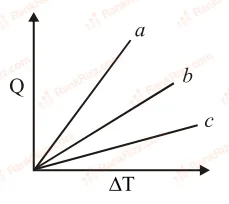
Figure shows the variation in temperature () with the amount of heat supplied (Q) in an isobaric process corresponding to a monoatomic (M), diatomic (D) and a polyatomic (P) gas. The initial state of all the gases are the same and the scales for the two axes coincide. Ignoring vibrational degrees of freedom, the lines a, b and c respectively correspond to :
- (A)
P, M and D
- (B)
M, D and P
- (C)
P, D and M
- (D)
D, M and P
rr2.rankrizz.com/jee-main/physics/kinetic-theory-of-gases/q/9-apr-2013-online-q9
- (A)
If and denote the specific heats of nitrogen per unit mass at constant pressure and constant volume respectively, then
- (A)
- (B)
- (C)
- (D)
rr2.rankrizz.com/jee-main/physics/kinetic-theory-of-gases/q/2007-physics-499753
- (A)
A gaseous mixture consists of g of helium and g of oxygen. The ratio of the mixture is
- (A)
- (B)
- (C)
- (D)
rr2.rankrizz.com/jee-main/physics/kinetic-theory-of-gases/q/2005-physics-500162
- (A)
One mole of ideal monoatomic gas is mixed with one mole of diatomic gas . What is for the mixture? denotes the ratio of specific heat at constant pressure, to that at constant volume.
- (A)
- (B)
- (C)
- (D)
rr2.rankrizz.com/jee-main/physics/kinetic-theory-of-gases/q/2004-physics-500201
- (A)
Ideal gas equation and gas laws 38
Two closed vessels of same volume are joined through a narrow tube and both vessels are filled with air of pressure 90 kPa and temperature 400 K. Keeping the temperature of one vessel constant at 400 K the second vessel temperature is raised to 500 K. The final pressure in the vessels is _______ kPa.
- (A)
100
- (B)
120
- (C)
90
- (D)
105
rr2.rankrizz.com/jee-main/physics/kinetic-theory-of-gases/q/6-apr-2026-s1-q35
- (A)
One gas of mole of molecules at temperature , volume , and pressure , and another gas of mole of molecules at temperature , volume , and pressure , are mixed resulting in pressure and volume of the mixture. The temperature of the mixture is :
- (A)
- (B)
- (C)
- (D)
rr2.rankrizz.com/jee-main/physics/kinetic-theory-of-gases/q/4-apr-2026-s1-q35
- (A)
A mixture of carbon dioxide and oxygen has volume 8310 cm, temperature 300 K, pressure 100 kPa and mass 13.2 g. The number of moles of carbon dioxide and oxygen gases in the mixture respectively are _____.
(Assume both gases behave like ideal gases) [ J/mol.K]- (A)
and
- (B)
and
- (C)
and
- (D)
and
rr2.rankrizz.com/jee-main/physics/kinetic-theory-of-gases/q/2-apr-2026-s2-q34
- (A)
A gas of certain mass filled in a closed cylinder at a pressure of 3.23 kPa has temperature 50 °C. The gas is now heated to double its temperature. The modified pressure is __ Pa.
Answer: ____________
rr2.rankrizz.com/jee-main/physics/kinetic-theory-of-gases/q/24-jan-2026-s1-q47
An insulated cylinder of volume is filled with a gas at and 2 atmospheric pressure. Then the gas is compressed making the final volume as while allowing the temperature to rise to . The final pressure is ___________ atmospheric pressure.
Answer: ____________
rr2.rankrizz.com/jee-main/physics/kinetic-theory-of-gases/q/22-jan-2026-s2-q47
There are two vessels filled with an ideal gas where volume of one is double the volume of other. The large vessel contains the gas at 8 kPa at 1000 K while the smaller vessel contains the gas at 7 kPa at 500 K. If the vessels are connected to each other by a thin tube allowing the gas to flow and the temperature of both vessels is maintained at 600 K, at steady state the pressure in the vessels will be (in kPa).
- (A)
4.4
- (B)
6
- (C)
24
- (D)
18
rr2.rankrizz.com/jee-main/physics/kinetic-theory-of-gases/q/2025-apr-4-s2-q33
- (A)
Pressure of an ideal gas, contained in a closed vessel, is increased by 0.4% when heated by 1°C. Its initial temperature must be:
- (A)
25°C
- (B)
2500 K
- (C)
250 K
- (D)
250°C
rr2.rankrizz.com/jee-main/physics/kinetic-theory-of-gases/q/2025-apr-3-s2-q42
- (A)
A container of fixed volume contains a gas at . To double the pressure of the gas, the temperature of gas should be raised to ______ .
Answer: ____________
rr2.rankrizz.com/jee-main/physics/kinetic-theory-of-gases/q/29-jan-2025-s1-q49
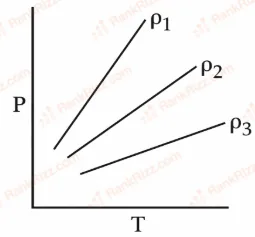
P-T diagram of an ideal gas having three different densities (in three different cases) is shown in the figure. Which of the following is correct:
- (A)
- (B)
- (C)
- (D)
rr2.rankrizz.com/jee-main/physics/kinetic-theory-of-gases/q/04-apr-2024-s1-q11
- (A)
Two vessels and are of the same size and are at same temperature. contains g of hydrogen and contains g of oxygen. and are the pressures of the gases in and respectively, then is :
- (A)
- (B)
- (C)
- (D)
rr2.rankrizz.com/jee-main/physics/kinetic-theory-of-gases/q/29-jan-2024-s1-q9
- (A)
The temperature of a gas having molecules per cubic meter at atm (Given, ) is:
- (A)
K
- (B)
K
- (C)
K
- (D)
K
rr2.rankrizz.com/jee-main/physics/kinetic-theory-of-gases/q/29-jan-2024-s2-q9
- (A)
For three low density gases , , pressure versus temperature graphs are plotted while keeping them at constant volume, as shown in the figure.
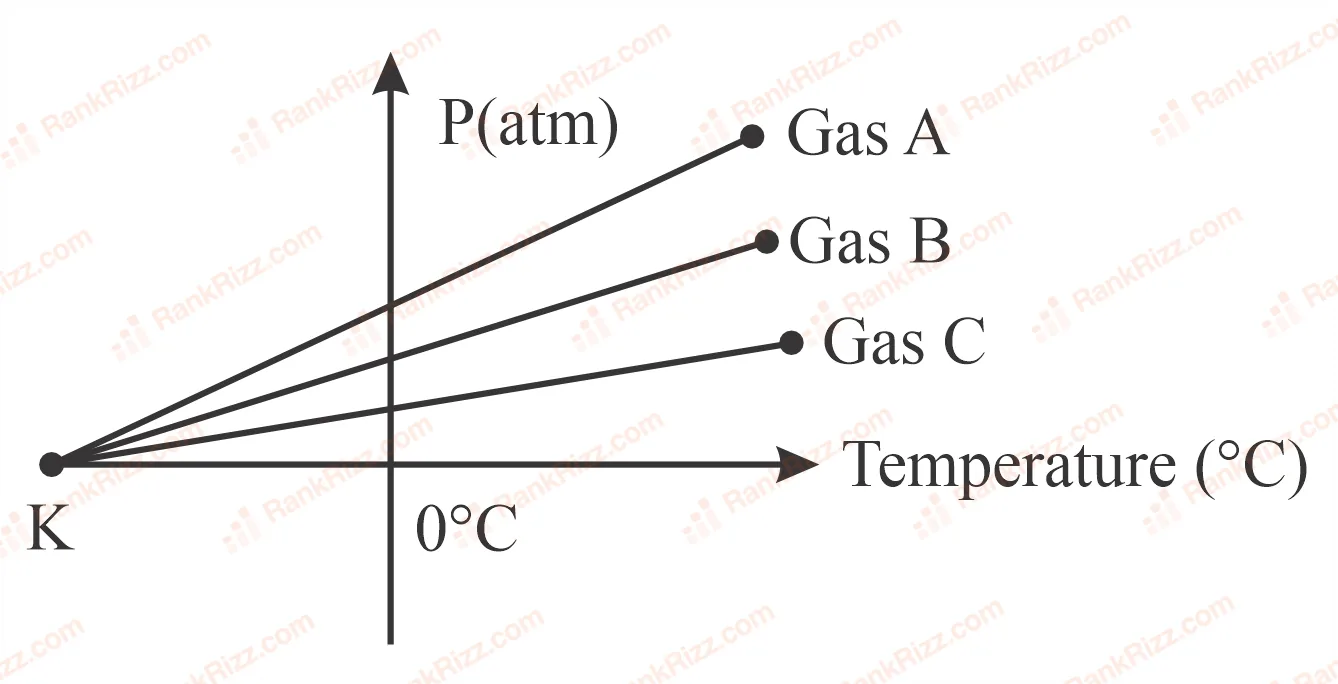
The temperature corresponding to the point 'K' is:- (A)
C
- (B)
C
- (C)
C
- (D)
C
rr2.rankrizz.com/jee-main/physics/kinetic-theory-of-gases/q/01-feb-2023-s2-q7
- (A)
The pressure and temperature relationship of an ideal gas obeys the equation constant. The volume expansion coefficient of the gas will be:
- (A)
- (B)
- (C)
- (D)
rr2.rankrizz.com/jee-main/physics/kinetic-theory-of-gases/q/30-jan-2023-s1-q10
- (A)
A bicycle tyre is filled with air having pressure of kPa at C. The approximate pressure of the air in the tyre when the temperature increases to C is
- (A)
kPa
- (B)
kPa
- (C)
kPa
- (D)
kPa
rr2.rankrizz.com/jee-main/physics/kinetic-theory-of-gases/q/29-jan-2023-s1-q8
- (A)
Same gas is filled in two vessels of the same volume at the same temperature. If the ratio of the number of molecules is , then
A. The r.m.s. velocity of gas molecules in two vessels will be the same.
B. The ratio of pressure in these vessels will be .
C. The ratio of pressure will be .
D. The r.m.s. velocity of gas molecules in two vessels will be in the ratio of .- (A)
A and C only
- (B)
B and D only
- (C)
A and B only
- (D)
C and D only
rr2.rankrizz.com/jee-main/physics/kinetic-theory-of-gases/q/27-jul-2022-s1-q9
- (A)
A vessel contains 16 g of hydrogen and 128 g of oxygen at standard temperature and pressure. The volume of the vessel in cm is:
- (A)
- (B)
- (C)
- (D)
rr2.rankrizz.com/jee-main/physics/kinetic-theory-of-gases/q/29-jun-2022-s2-q9
- (A)
A mixture of hydrogen and oxygen has volume cm, temperature K, pressure kPa and mass g. The ratio of number of moles of hydrogen to number of moles of oxygen in the mixture will be
[Take gas constant J K mol]- (A)
- (B)
- (C)
- (D)
rr2.rankrizz.com/jee-main/physics/kinetic-theory-of-gases/q/27-jun-2022-s1-q9
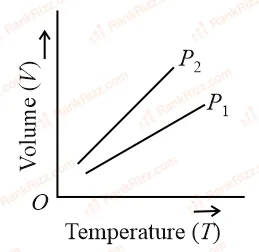
- (A)
For a perfect gas, two pressures and are shown in figure. The graph shows
- (A)
- (B)
- (C)
- (D)
Insufficient data to draw any conclusion
rr2.rankrizz.com/jee-main/physics/kinetic-theory-of-gases/q/27-jun-2022-s2-q9
- (A)
When a gas filled in a closed vessel is heated by raising the temperature by C, its pressure increases by . The initial temperature of the gas is ______ K.
Answer: ____________
rr2.rankrizz.com/jee-main/physics/kinetic-theory-of-gases/q/25-jun-2022-s2-q26
A mixture of hydrogen and oxygen has volume 500 cm, temperature 300 K, pressure 400 kPa and mass 0.76 g. The ratio of masses of oxygen to hydrogen will be:
- (A)
16 : 3
- (B)
3 : 8
- (C)
8 : 3
- (D)
3 : 16
rr2.rankrizz.com/jee-main/physics/kinetic-theory-of-gases/q/31-aug-2021-s2-q9
- (A)
An ideal gas is expanding such that = constant. The coefficient of volume expansion of the gas is:
- (A)
- (B)
- (C)
- (D)
rr2.rankrizz.com/jee-main/physics/kinetic-theory-of-gases/q/27-aug-2021-s1-q7
- (A)
A balloon carries a total load of 185 kg at normal pressure and temperature of 27°C. What load will the balloon carry on rising to a height at which the barometric pressure is 45 cm of Hg and the temperature is -7°C. Assuming the volume constant?
- (A)
214.15 kg
- (B)
123.54 kg
- (C)
219.07 kg
- (D)
181.46 kg
rr2.rankrizz.com/jee-main/physics/kinetic-theory-of-gases/q/27-aug-2021-s1-q8
- (A)
A cylindrical container of volume m contains one mole of hydrogen and two moles of carbon dioxide. Assume the temperature of the mixture is 400 K. The pressure of the mixture of gases is:
[Take gas constant as 8.3 J mol K]- (A)
Pa
- (B)
Pa
- (C)
Pa
- (D)
24.9 Pa
rr2.rankrizz.com/jee-main/physics/kinetic-theory-of-gases/q/26-aug-2021-s2-q10
- (A)
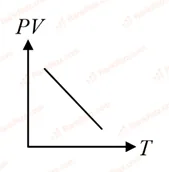
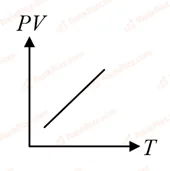
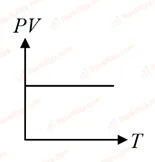
Which of the following graphs represent the behaviour of an ideal gas? Symbols have their usual meaning.
- (A)
- (B)
- (C)
- (D)
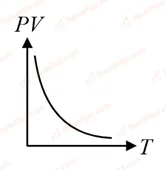
rr2.rankrizz.com/jee-main/physics/kinetic-theory-of-gases/q/20-jul-2021-s2-q11
- (A)
The volume of an enclosure contains a mixture of three gases, 16 g of oxygen, 28 g of nitrogen and 44 g of carbon dioxide at absolute temperature . Consider as universal gas constant. The pressure of the mixture of gases is:
- (A)
- (B)
- (C)
- (D)
rr2.rankrizz.com/jee-main/physics/kinetic-theory-of-gases/q/16-mar-2021-s1-q8
- (A)
Initially a gas of diatomic molecules is contained in a cylinder of volume at a pressure and temperature . Assuming that of the molecules get dissociated causing a change in number of moles. The pressure of the resulting gas at temperature , when contained in a volume is given by . The ratio is ___
Answer: ____________
rr2.rankrizz.com/jee-main/physics/kinetic-theory-of-gases/q/6-sep-2020-s1-q23
A closed vessel contains 0.1 mole of a monoatomic ideal gas at 200 K. If 0.05 mole of the same gas at 400 K is added to it, the final equilibrium temperature (in K) of the gas in the vessel will be close to __________
Answer: ____________
rr2.rankrizz.com/jee-main/physics/kinetic-theory-of-gases/q/4-sep-2020-s1-q23
The change in the magnitude of the volume of an ideal gas when a small additional pressure is applied at a constant temperature, is the same as the change when the temperature is reduced by a small quantity at constant pressure. The initial temperature and pressure of the gas were 300 K and 2 atm respectively. If then value of C in (K/atm) is __________
Answer: ____________
rr2.rankrizz.com/jee-main/physics/kinetic-theory-of-gases/q/4-sep-2020-s2-q22
The number density of molecules of a gas depends on their distance r from the origin as, . Then the numer of molecules is proportional to:
- (A)
- (B)
- (C)
- (D)
rr2.rankrizz.com/jee-main/physics/kinetic-theory-of-gases/q/12-apr-2019-s2-q13
- (A)
A vertical closed cylinder is separated into two parts by a frictionless piston of mass m and of negligible thickness. The piston is free to move along the length of the cylinder. The length of the cylinder above piston is , and that below the piston is , such that . Each part of the cylinder contains n moles of an ideal gas at equal temperature T. If the piston is stationary, its mass m will be given by: (R is universal gas constant and g is the acceleration due to gravity)
- (A)
- (B)
- (C)
- (D)
rr2.rankrizz.com/jee-main/physics/kinetic-theory-of-gases/q/12-jan-2019-s2-q4
- (A)
The temperature of an open room of volume 30 m increases from 17°C to 27°C due to the sunshine. The atmospheric pressure in the room remains Pa. If and are the number of molecules in the room before and after heating, then will be:
- (A)
- (B)
- (C)
- (D)
rr2.rankrizz.com/jee-main/physics/kinetic-theory-of-gases/q/2-apr-2017-offline-q12
- (A)
Which of the following shows the correct relationship between the pressure and density of an ideal gas at constant temperature?
- (A)
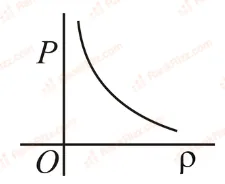
- (B)
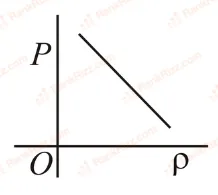
- (C)
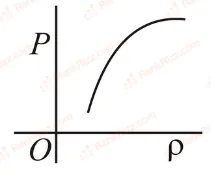
- (D)
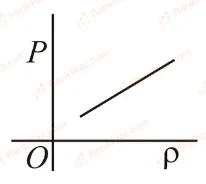
rr2.rankrizz.com/jee-main/physics/kinetic-theory-of-gases/q/10-apr-2016-online-q11
- (A)
An ideal monoatomic gas is confined in a cylinder by a spring loaded piston of cross section m. Initially the gas is at 300 K and occupies a volume of m and the spring is in its relaxed state as shown in figure. The gas is heated by a small heater until the piston moves out slowly by 0.1 m. The force constant of the spring is 8000 N/m and the atmospheric pressure is N/m. The cylinder and the piston are thermally insulated. The piston and the spring are massless and there is no friction between the piston and the cylinder. The final temperature of the gas will be: (Neglect the heat loss through the lead wires of the heater. The heat capacity of the heater coil is also negligible).

- (A)
300 K
- (B)
800 K
- (C)
500 K
- (D)
1000 K
rr2.rankrizz.com/jee-main/physics/kinetic-theory-of-gases/q/11-apr-2014-online-q13
- (A)
Modern vacuum pumps can evacuate a vessel down to a pressure of atm. at room temperature (300 K). Taking R = 8.3 JK mole, 1 atm = Pa and mole, the mean distance between molecules of gas in an evacuated vessel will be of the order of:
- (A)
0.2 m
- (B)
0.2 mm
- (C)
0.2 cm
- (D)
0.2 nm
rr2.rankrizz.com/jee-main/physics/kinetic-theory-of-gases/q/9-apr-2014-online-q11
- (A)
A thin tube sealed at both ends is 100 cm long. It lies horizontally, the middle 20 cm containing mercury and two equal ends containing air at standard atmospheric pressure. If the tube is now turned to a vertical position, by what amount will the mercury be displaced?
(Given : cross-section of the tube can be assumed to be uniform)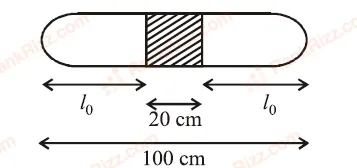
- (A)
2.95 cm
- (B)
5.18 cm
- (C)
8.65 cm
- (D)
0.0 cm
rr2.rankrizz.com/jee-main/physics/kinetic-theory-of-gases/q/23-apr-2013-online-q9
- (A)
A perfect gas at C is heated at constant pressure so as to double its volume. The final temperature of the gas will be, close to
- (A)
C
- (B)
C
- (C)
C
- (D)
C
rr2.rankrizz.com/jee-main/physics/kinetic-theory-of-gases/q/2012-physics-499121
- (A)
An insulated container of gas has two chambers separated by an insulating partition. One of the chambers has volume and contains ideal gas at pressure and temperature . The other chamber has volume and contains ideal gas at pressure and temperature . If the partition is removed without doing any work on the gas, the final equilibrium temperature of the gas in the container will be
- (A)
- (B)
- (C)
- (D)
rr2.rankrizz.com/jee-main/physics/kinetic-theory-of-gases/q/2008-physics-499875
- (A)
Two thermally insulated vessels 1 and 2 are filled with air at temperatures , volume and pressure respectively. If the valve joining two vessels is opened, the temperature inside the vessel at equilibrium will be
- (A)
- (B)
- (C)
- (D)
rr2.rankrizz.com/jee-main/physics/kinetic-theory-of-gases/q/2004-physics-500203
- (A)
RMS, average and most probable speeds of gas molecules 29
The r.m.s. speed of oxygen molecules at is equal to that of the hydrogen molecules kept at ________ . (Mass of oxygen molecule/mass of hydrogen molecule = 32/2)
- (A)
-235
- (B)
-20
- (C)
-253
- (D)
-100
rr2.rankrizz.com/jee-main/physics/kinetic-theory-of-gases/q/21-jan-2026-s2-q35
- (A)
For a particular ideal gas which of the following graphs represents the variation of mean squared velocity of the gas molecules with temperature?
- (A)
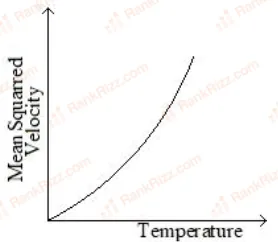
- (B)
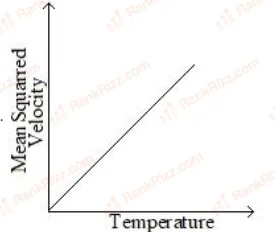
- (C)
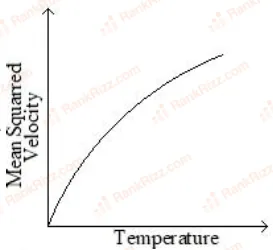
- (D)
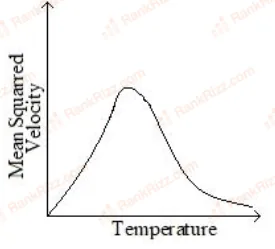
rr2.rankrizz.com/jee-main/physics/kinetic-theory-of-gases/q/28-jan-2025-s1-q44
- (A)
The ratio of vapour densities of two gases at the same temperature is , then the ratio of r.m.s. velocities will be :
- (A)
- (B)
- (C)
- (D)
rr2.rankrizz.com/jee-main/physics/kinetic-theory-of-gases/q/28-jan-2025-s2-q42
- (A)
A sample contains mixture of helium and oxygen gas. The ratio of root mean square speed of helium and oxygen in the sample, is:
- (A)
- (B)
- (C)
- (D)
rr2.rankrizz.com/jee-main/physics/kinetic-theory-of-gases/q/6-apr-2024-s1-q9
- (A)
If the root mean square velocity of hydrogen molecule at a given temperature and pressure is , the root mean square velocity of oxygen at the same condition in is:
- (A)
2.0
- (B)
0.5
- (C)
1.5
- (D)
1.0
rr2.rankrizz.com/jee-main/physics/kinetic-theory-of-gases/q/01-feb-2024-s2-q9
- (A)
At which temperature the r.m.s. velocity of a hydrogen molecule equal to that of an oxygen molecule at ?
- (A)
- (B)
- (C)
- (D)
rr2.rankrizz.com/jee-main/physics/kinetic-theory-of-gases/q/30-jan-2024-s1-q8
- (A)
The rms speed of oxygen molecule in a vessel at particular temperature is , when is the average speed of the molecule. The value of will be:
(take )- (A)
- (B)
- (C)
- (D)
rr2.rankrizz.com/jee-main/physics/kinetic-theory-of-gases/q/13-apr-2023-s1-q10
- (A)
If the r.m.s speed of chlorine molecule is m s at C, the r.m.s speed of argon molecules at the same temperature will be (Atomic mass of argon u, molecular mass of chlorine u)
- (A)
m s
- (B)
m s
- (C)
m s
- (D)
m s
rr2.rankrizz.com/jee-main/physics/kinetic-theory-of-gases/q/12-apr-2023-s1-q9
- (A)
Three vessels of equal volume contain gases at the same temperature and pressure. The first vessel contains neon (monoatomic), the second contains chlorine (diatomic) and third contains uranium hexafluoride (polyatomic). Arrange these on the basis of their root mean square speed and choose the correct answer from the options given below:
- (A)
(mono) > (dia) > (poly)
- (B)
(mono) = (dia) = (poly)
- (C)
(mono) < (dia) < (poly)
- (D)
(dia) < (poly) < (mono)
rr2.rankrizz.com/jee-main/physics/kinetic-theory-of-gases/q/11-apr-2023-s1-q8
- (A)
The root mean square speed of molecules of nitrogen gas at 27C is approximately: (Given mass of a nitrogen molecule kg and take Boltzmann constant J K)
- (A)
27.4 m s
- (B)
91 m s
- (C)
1260 m s
- (D)
523 m s
rr2.rankrizz.com/jee-main/physics/kinetic-theory-of-gases/q/11-apr-2023-s2-q8
- (A)
The temperature of an ideal gas is increased from 200 K to 800 K. If r.m.s. speed of gas at 200 K is . Then, r.m.s. speed of the gas at 800 K will be:
- (A)
- (B)
- (C)
- (D)
rr2.rankrizz.com/jee-main/physics/kinetic-theory-of-gases/q/6-apr-2023-s2-q9
- (A)
At K, the rms speed of oxygen molecules is times to that of its average speed in the gas. Then, the value of will be (use )
- (A)
- (B)
- (C)
- (D)
rr2.rankrizz.com/jee-main/physics/kinetic-theory-of-gases/q/29-jan-2023-s2-q9
- (A)
The root mean square velocity of molecules of gas is
- (A)
Proportional to square of temperature ().
- (B)
Inversely proportional to square root of temperature ().
- (C)
Proportional to square root of temperature .
- (D)
Proportional to temperature ().
rr2.rankrizz.com/jee-main/physics/kinetic-theory-of-gases/q/25-jan-2023-s1-q9
- (A)
The root mean square speed of smoke particles of mass kg in their Brownian motion in air at NTP is approximately. [Given J K]
- (A)
60 mm s
- (B)
12 mm s
- (C)
15 mm s
- (D)
36 mm s
rr2.rankrizz.com/jee-main/physics/kinetic-theory-of-gases/q/29-jul-2022-s2-q9
- (A)
Given below are two statements:
Statement I: The average momentum of a molecule in a sample of an ideal gas depends on temperature.
Statement II: The rms speed of oxygen molecules in a gas is . If the temperature is doubled and the oxygen molecules dissociate into oxygen atoms, the rms speed will become .
In the light of the above statements, choose the correct answer from the options given below:- (A)
Both Statement I and Statement II are true
- (B)
Both Statement I and Statement II are false
- (C)
Statement I is true but Statement II is false
- (D)
Statement I is false but Statement II is true
rr2.rankrizz.com/jee-main/physics/kinetic-theory-of-gases/q/28-jul-2022-s1-q8
- (A)
What will be the effect on the root mean square velocity of oxygen molecules if the temperature is doubled and oxygen molecule dissociates into atomic oxygen?
- (A)
The velocity of atomic oxygen remains same
- (B)
The velocity of atomic oxygen doubles
- (C)
The velocity of atomic oxygen becomes half
- (D)
The velocity of atomic oxygen becomes four times
rr2.rankrizz.com/jee-main/physics/kinetic-theory-of-gases/q/28-jun-2022-s2-q10
- (A)
The relation between root mean square speed and most probable speed for the molar mass of oxygen gas molecule at the temperature of K will be
- (A)
- (B)
- (C)
- (D)
rr2.rankrizz.com/jee-main/physics/kinetic-theory-of-gases/q/25-jun-2022-s1-q7
- (A)
If the R.M.S. speed of oxygen molecules at 0°C is 160 m s. Find the R.M.S. speed of hydrogen molecules at 0°C.
- (A)
40 m s
- (B)
80 m s
- (C)
640 m s
- (D)
332 m s
rr2.rankrizz.com/jee-main/physics/kinetic-theory-of-gases/q/27-aug-2021-s2-q9
- (A)
The R.M.S. speeds of the molecules of Hydrogen, Oxygen, and Carbon dioxide at the same temperature are , and respectively, then:
- (A)
- (B)
- (C)
- (D)
rr2.rankrizz.com/jee-main/physics/kinetic-theory-of-gases/q/26-aug-2021-s1-q7
- (A)
Consider a mixture of gas molecules of types A, B and C having masses . The ratio of their root mean square speeds at normal temperature and pressure is:
- (A)
- (B)
- (C)
- (D)
rr2.rankrizz.com/jee-main/physics/kinetic-theory-of-gases/q/20-jul-2021-s1-q9
- (A)
Consider a sample of oxygen behaving like an ideal gas. At 300 K, the ratio of root-mean-square (RMS) velocity to the average velocity of the gas molecule would be :
(Molecular weight of oxygen is 32 g mol; J K mol)- (A)
- (B)
- (C)
- (D)
rr2.rankrizz.com/jee-main/physics/kinetic-theory-of-gases/q/18-mar-2021-s2-q10
- (A)
The root-mean-square speed of molecules of a given mass of a gas at 27°C and 1 atmosphere pressure is 200 m s. The root-mean-square speed of molecules of the gas at 127°C and 2 atmosphere pressure is m s. The value of will be ______.
Answer: ____________
rr2.rankrizz.com/jee-main/physics/kinetic-theory-of-gases/q/24-feb-2021-s2-q24
Nitrogen gas is at temperature. The temperature (in K) at which the rms speed of a molecule would be equal to the rms speed of a nitrogen molecule, is........... (Molar mass of gas 28 g).
Answer: ____________
rr2.rankrizz.com/jee-main/physics/kinetic-theory-of-gases/q/5-sep-2020-s2-q23
For given gas at 1 atm pressure, rms speed of the molecules is 200 m/s at 127°C. At 2 atm pressure and at 227°C, the rms speed of the molecules will be:
- (A)
100 m/s
- (B)
80 m/s
- (C)
m/s
- (D)
m/s
rr2.rankrizz.com/jee-main/physics/kinetic-theory-of-gases/q/9-apr-2019-s1-q11
- (A)
The temperature, at which the root mean square velocity of hydrogen molecules equals their escape velocity from the earth, is closest to:
[Boltzmann Constant J/K, Avogadro number /kg, Radius of Earth: m, Gravitational acceleration on Earth = 10 ms]- (A)
K
- (B)
650 K
- (C)
800 K
- (D)
K
rr2.rankrizz.com/jee-main/physics/kinetic-theory-of-gases/q/8-apr-2019-s2-q12
- (A)
A mixture of 2 moles of helium gas (atomic mass = 4u), and 1 mole of argon gas (atomic mass = 40 u) is kept at 300 K in a container. The ratio of their rms speeds , is close to:
- (A)
0.45
- (B)
2.24
- (C)
0.32
- (D)
3.16
rr2.rankrizz.com/jee-main/physics/kinetic-theory-of-gases/q/9-jan-2019-s1-q13
- (A)
The value closest to the thermal velocity of a Helium atom at room temperature (300 K) in ms is: [k = 1.4 10 J/K; m = 7 10 kg]
- (A)
- (B)
- (C)
- (D)
rr2.rankrizz.com/jee-main/physics/kinetic-theory-of-gases/q/15-apr-2018-s2-q12
- (A)
At room temperature a diatomic gas is found to have an r.m.s. speed of 1930 ms. The gas is:
- (A)
H
- (B)
Cl
- (C)
O
- (D)
F
rr2.rankrizz.com/jee-main/physics/kinetic-theory-of-gases/q/12-apr-2014-online-q13
- (A)
In the isothermal expansion of 10 g of gas from volume V to 2V the work done by the gas is 575 J. What is the root mean square speed of the molecules of the gas at that temperature?
- (A)
398 m/s
- (B)
520 m/s
- (C)
499 m/s
- (D)
532 m/s
rr2.rankrizz.com/jee-main/physics/kinetic-theory-of-gases/q/25-apr-2013-online-q9
- (A)
Kinetic interpretation of pressure and temperature 23
Given below are two statements: one is labelled as Assertion A and the other is labelled as Reason R
Assertion A: If the average kinetic energy of H and O molecules, kept in two different sized containers are same, then their temperatures will be same.
Reason R: The r.m.s. speed of H and O molecules are same at same temperature.
Choose the correct answer from the options given below :- (A)
Both A and R are true, and R is the correct explanation of A
- (B)
Both A and R are true, but R is NOT the correct explanation of A
- (C)
A is true but R is false
- (D)
A is false but R is true
rr2.rankrizz.com/jee-main/physics/kinetic-theory-of-gases/q/4-apr-2026-s2-q33
- (A)
The helium and argon are put in the flask at the same room temperature (300 K). The ratio of average kinetic energies (per molecule) of helium and argon is : (Molar mass of helium = 4 g/mol, Molar mass of argon = 40 g/mol)
- (A)
1 : 10
- (B)
10 : 1
- (C)
- (D)
1 : 1
rr2.rankrizz.com/jee-main/physics/kinetic-theory-of-gases/q/2025-apr-7-s2-q31
- (A)
The kinetic energy of translation of the molecules in 50 g of gas at is
- (A)
4205.5 J
- (B)
4102.8 J
- (C)
3582.7 J
- (D)
3986.3 J
rr2.rankrizz.com/jee-main/physics/kinetic-theory-of-gases/q/28-jan-2025-s2-q39
- (A)
The temperature of a gas is and the average translational kinetic energy of its molecules is . The temperature at which the average translational kinetic energy of the molecules of the same gas becomes is :
- (A)
- (B)
- (C)
- (D)
rr2.rankrizz.com/jee-main/physics/kinetic-theory-of-gases/q/9-apr-2024-s2-q8
- (A)
The parameter that remains the same for molecules of all gases at a given temperature is :
- (A)
kinetic energy
- (B)
momentum
- (C)
mass
- (D)
speed
rr2.rankrizz.com/jee-main/physics/kinetic-theory-of-gases/q/31-jan-2024-s1-q11
- (A)
The average kinetic energy of a monatomic molecule is eV at temperature: (Use )
- (A)
K
- (B)
K
- (C)
K
- (D)
K
rr2.rankrizz.com/jee-main/physics/kinetic-theory-of-gases/q/27-jan-2024-s1-q9
- (A)
A flask contains Hydrogen and Argon in the ratio by mass. The temperature of the mixture is C. The ratio of average kinetic energy per molecule of the two gases is: (Given : Atomic Weight of Ar )
- (A)
- (B)
- (C)
- (D)
rr2.rankrizz.com/jee-main/physics/kinetic-theory-of-gases/q/15-apr-2023-s1-q9
- (A)
The temperature at which the kinetic energy of oxygen molecules becomes double than its value at 27C is
- (A)
927C
- (B)
327C
- (C)
1227C
- (D)
627C
rr2.rankrizz.com/jee-main/physics/kinetic-theory-of-gases/q/08-apr-2023-s2-q9
- (A)
The average kinetic energy of a molecule of the gas is
- (A)
proportional to absolute temperature
- (B)
proportional to volume
- (C)
proportional to pressure
- (D)
dependent on the nature of the gas
rr2.rankrizz.com/jee-main/physics/kinetic-theory-of-gases/q/01-feb-2023-s1-q9
- (A)
A flask contains hydrogen and oxygen in the ratio of by mass at temperature C. The ratio of average kinetic energy per molecule of hydrogen and oxygen respectively is:
- (A)
- (B)
- (C)
- (D)
rr2.rankrizz.com/jee-main/physics/kinetic-theory-of-gases/q/30-jan-2023-s2-q8
- (A)
Given below are two statements:
Statement I: The temperature of a gas is -73 °C. When the gas is heated to 527 °C, the root mean square speed of the molecules is doubled.
Statement II: The product of pressure and volume of an ideal gas will be equal to translational kinetic energy of the molecules.
In the light of the above statements, choose the correct answer from the options given below:- (A)
Both Statement I and Statement II are true
- (B)
Statement I is true but Statement II is false
- (C)
Both Statement I and Statement II are false
- (D)
Statement I is false but Statement II is true
rr2.rankrizz.com/jee-main/physics/kinetic-theory-of-gases/q/24-jan-2023-s1-q8
- (A)
Given below are two statements:
Statement I: The temperature of a gas is -73 °C. When the gas is heated to 527 °C, the root mean square speed of the molecules is doubled.
Statement II: The product of pressure and volume of an ideal gas will be equal to translational kinetic energy of the molecules.
In the light of the above statements, choose the correct answer from the options given below:- (A)
Both Statement I and Statement II are true
- (B)
Statement I is true but Statement II is false
- (C)
Both Statement I and Statement II are false
- (D)
Statement I is false but Statement II is true
rr2.rankrizz.com/jee-main/physics/kinetic-theory-of-gases/q/24-jan-2023-s1-q8-494023
- (A)
Following statements are given:
(1) The average kinetic energy of a gas molecule decreases when the temperature is reduced.
(2) The average kinetic energy of a gas molecule increases with increase in pressure at constant temperature.
(3) The average kinetic energy of a gas molecule decreases with increase in volume.
(4) Pressure of a gas increases with increase in temperature at constant volume.
(5) The volume of gas decreases with increase in temperature.
Choose the correct answer from the options given below:- (A)
(1) and (4) only
- (B)
(1), (2) and (4) only
- (C)
(2) and (4) only
- (D)
(1), (2) and (5) only
rr2.rankrizz.com/jee-main/physics/kinetic-theory-of-gases/q/25-jul-2022-s1-q8
- (A)
A flask contains argon and oxygen in the ratio of in mass and the mixture is kept at C. The ratio of their average kinetic energy per molecule respectively
- (A)
- (B)
- (C)
- (D)
rr2.rankrizz.com/jee-main/physics/kinetic-theory-of-gases/q/26-jun-2022-s2-q7
- (A)
The average translational kinetic energy of gas molecules at _________ °C becomes equal to the K.E. of an electron accelerated from rest through a potential difference of 0.1 volt.
(Given J K) (Fill the nearest integer).Answer: ____________
rr2.rankrizz.com/jee-main/physics/kinetic-theory-of-gases/q/1-sep-2021-s2-q21
The number of molecules in one litre of an ideal gas at 300 K and 2 atmospheric pressure with mean kinetic energy J per molecule is:
- (A)
- (B)
- (C)
- (D)
rr2.rankrizz.com/jee-main/physics/kinetic-theory-of-gases/q/27-jul-2021-s1-q9
- (A)
What will be the average value of energy for a monoatomic gas in thermal equilibrium at temperature ?
- (A)
- (B)
- (C)
- (D)
rr2.rankrizz.com/jee-main/physics/kinetic-theory-of-gases/q/22-jul-2021-s1-q7
- (A)
On the basis of kinetic theory of gases, the gas exerts pressure because its molecules:
- (A)
continuously stick to the walls of container.
- (B)
suffer change in momentum when impinge on the walls of container.
- (C)
continuously lose their energy till it reaches wall.
- (D)
are attracted by the walls of container.
rr2.rankrizz.com/jee-main/physics/kinetic-theory-of-gases/q/24-feb-2021-s2-q6
- (A)
Number of molecules in a volume of of a perfect monoatomic gas at some temperature T and at a pressure of of mercury is close to? (Given, mean kinetic energy of a molecule (at T) is , , density of mercury )
- (A)
- (B)
- (C)
- (D)
rr2.rankrizz.com/jee-main/physics/kinetic-theory-of-gases/q/5-sep-2020-s1-q8
- (A)
If gas molecules each of mass kg collides with a surface (perpendicular to it) elastically per second over an area 1 m with a speed m/s, the pressure exerted by the gas molecules will be of the order of:
- (A)
2 Pa
- (B)
4 Pa
- (C)
6 Pa
- (D)
8 Pa
rr2.rankrizz.com/jee-main/physics/kinetic-theory-of-gases/q/8-apr-2019-s1-q4
- (A)
2 kg of a monoatomic gas is at a pressure of N m. The density of the gas is 8 kg m. What is the order of energy of the gas due to its thermal motion?
- (A)
J
- (B)
J
- (C)
J
- (D)
J
rr2.rankrizz.com/jee-main/physics/kinetic-theory-of-gases/q/10-jan-2019-s2-q11
- (A)
In an ideal gas at temperature T, the average force that a molecule applies on the walls of a closed container depends on as . A good estimate for is:
- (A)
2
- (B)
- (C)
1
- (D)
rr2.rankrizz.com/jee-main/physics/kinetic-theory-of-gases/q/10-apr-2015-online-q11
- (A)
A gas molecule of mass M at the surface of the earth has kinetic energy equivalent to 0 °C. If it were to go up straight without colliding with any other molecules, how high it would rise? Assume that the height attained is much less than the radius of the earth. (k is Boltzmann constant)
- (A)
- (B)
- (C)
0
- (D)
rr2.rankrizz.com/jee-main/physics/kinetic-theory-of-gases/q/19-apr-2014-online-q13
- (A)
Degrees of freedom, equipartition of energy and internal energy 22
If 2 mole of an ideal monoatomic gas at temperature , is mixed with 6 mole of another ideal monoatomic gas at temperature then the temperature of mixture is :
- (A)
- (B)
- (C)
- (D)
rr2.rankrizz.com/jee-main/physics/kinetic-theory-of-gases/q/6-apr-2026-s2-q35
- (A)
The internal energy of air in a sized room at 1 atmospheric pressure will be _________ J.
(Consider air as diatomic molecule)Answer: ____________
rr2.rankrizz.com/jee-main/physics/kinetic-theory-of-gases/q/2025-apr-02-s2-q47
Energy of 10 non rigid diatomic molecules at temperature is :
- (A)
- (B)
- (C)
- (D)
rr2.rankrizz.com/jee-main/physics/kinetic-theory-of-gases/q/6-apr-2024-s2-q9
- (A)
The translational degrees of freedom and rotational degrees of freedom of molecule are:
- (A)
and
- (B)
and
- (C)
and
- (D)
and
rr2.rankrizz.com/jee-main/physics/kinetic-theory-of-gases/q/04-apr-2024-s2-q9
- (A)
A gas mixture consists of 8 moles of argon and 6 moles of oxygen at temperature . Neglecting all vibrational modes, the total internal energy of the system is
- (A)
- (B)
- (C)
- (D)
rr2.rankrizz.com/jee-main/physics/kinetic-theory-of-gases/q/31-jan-2024-s2-q8
- (A)
The total kinetic energy of 1 mole of oxygen at 27°C is :
[Use universal gas constant (R) = 8.31 J mol K]- (A)
6845.5 J
- (B)
5942.0 J
- (C)
6232.5 J
- (D)
5670.5 J
rr2.rankrizz.com/jee-main/physics/kinetic-theory-of-gases/q/27-jan-2024-s2-q9
- (A)
Match List I with List II:
List I List II (A) 3 Translational degrees of freedom (I) Monoatomic gases (B) 3 Translational, 2 rotational degrees of freedom (II) Polyatomic gases (C) 3 Translational, 2 rotational and 1 vibrational degrees of freedom (III) Rigid diatomic gases (D) 3 Translational, 3 rotational and more than one vibrational degrees of freedom (IV) Nonrigid diatomic gases
Choose the correct answer from the options below:- (A)
A-I, B-III, C-IV, D-II
- (B)
A-IV, B-III, C-II, D-I
- (C)
A-IV, B-II, C-I, D-III
- (D)
A-I, B-IV, C-III, D-II
rr2.rankrizz.com/jee-main/physics/kinetic-theory-of-gases/q/10-apr-2023-s1-q9
- (A)
A gas mixture consists of 2 moles of oxygen and 4 moles of neon at temperature . Neglecting all vibrational modes, the total internal energy of the system will be:
- (A)
11RT
- (B)
8RT
- (C)
4RT
- (D)
16RT
rr2.rankrizz.com/jee-main/physics/kinetic-theory-of-gases/q/10-apr-2023-s2-q8
- (A)
Which statements are correct about degrees of freedom?
A. A molecule with degrees of freedom has different ways of storing energy.
B. Each degree of freedom is associated with average energy per mole.
C. A monoatomic gas molecule has 1 rotational degree of freedom whereas diatomic molecule has 2 rotational degrees of freedom.
D. has a total of 6 degrees of freedom.
Choose the correct answer from the options given below:- (A)
B and C only
- (B)
B and D only
- (C)
A and B only
- (D)
C and D only
rr2.rankrizz.com/jee-main/physics/kinetic-theory-of-gases/q/27-jul-2022-s2-q9
- (A)
The total internal energy of two mole monoatomic ideal gas at temperature K will be ______ J. (Given J mol K)
Answer: ____________
rr2.rankrizz.com/jee-main/physics/kinetic-theory-of-gases/q/28-jun-2022-s1-q25
Two ideal polyatomic gases at temperatures and are mixed so that there is no loss of energy. If and , and , and be the degrees of freedom, masses, number of molecules of the first and second gas respectively, the temperature of mixture of these two gases is:
- (A)
- (B)
- (C)
- (D)
rr2.rankrizz.com/jee-main/physics/kinetic-theory-of-gases/q/17-mar-2021-s1-q10
- (A)
The internal energy (U), pressure (P) and volume (V) of an ideal gas are related as . The gas is
- (A)
either monoatomic or diatomic
- (B)
polyatomic only
- (C)
monoatomic only
- (D)
diatomic only
rr2.rankrizz.com/jee-main/physics/kinetic-theory-of-gases/q/26-feb-2021-s2-q9
- (A)
Given below are two statements:
Statement I: In a diatomic molecule, the rotational energy at a given temperature obeys Maxwell's distribution.
Statement II: In a diatomic molecule, the rotational energy at a given temperature equals the translational kinetic energy for each molecule.
In the light of the above statements, choose the correct answer from the options given below:- (A)
Statement I is false but Statement II is true.
- (B)
Statement I is true but Statement II is false.
- (C)
Both Statement I and Statement II are true.
- (D)
Both Statement I and Statement II are false.
rr2.rankrizz.com/jee-main/physics/kinetic-theory-of-gases/q/25-feb-2021-s2-q5
- (A)
Consider a gas of triatomic molecules. The molecules are assumed to be triangular and made of massless rigid rods whose vertices are occupied by atoms. The internal energy of a mole of the gas at temperature T is:

- (A)
- (B)
- (C)
- (D)
rr2.rankrizz.com/jee-main/physics/kinetic-theory-of-gases/q/3-sep-2020-s1-q6
- (A)
A gas mixture consists of 3 moles of oxygen and 5 moles of argon at temperature T. Assuming the gases to be ideal and the oxygen bond to be rigid, the total internal energy (in units of RT) of the mixture is:
- (A)
15
- (B)
13
- (C)
20
- (D)
11
rr2.rankrizz.com/jee-main/physics/kinetic-theory-of-gases/q/2-sep-2020-s1-q10
- (A)
An HCl molecule has rotational, translational and vibrational motions. If the rms velocity of HCl molecules in its gaseous phase is , m is its mass and k is Boltzmann's constant, then its temperature will be:
- (A)
- (B)
- (C)
- (D)
rr2.rankrizz.com/jee-main/physics/kinetic-theory-of-gases/q/9-apr-2019-s1-q12
- (A)
An ideal gas occupies a volume of at a pressure of . The energy of the gas is:
- (A)
- (B)
- (C)
- (D)
rr2.rankrizz.com/jee-main/physics/kinetic-theory-of-gases/q/12-jan-2019-s1-q10
- (A)
A gas mixture consists of 3 moles of oxygen and 5 moles of argon at temperature T. Considering only translational and rotational modes, the total internal energy of the system is
- (A)
15RT
- (B)
12RT
- (C)
4RT
- (D)
20RT
rr2.rankrizz.com/jee-main/physics/kinetic-theory-of-gases/q/11-jan-2019-s1-q11
- (A)
moles of diatomic gas in a cylinder is at a temperature . Heat is supplied to the cylinder such that the temperature remains constant but moles of the diatomic gas get converted into monoatomic gas. The change in the total kinetic energy of the gas is
- (A)
0
- (B)
- (C)
- (D)
rr2.rankrizz.com/jee-main/physics/kinetic-theory-of-gases/q/9-apr-2017-online-q11
- (A)
Three perfect gases at absolute temperatures and are mixed. The masses of molecules are and and the number of molecules are and respectively. Assuming no loss of energy, the final temperature of the mixture is:
- (A)
- (B)
- (C)
- (D)
rr2.rankrizz.com/jee-main/physics/kinetic-theory-of-gases/q/2011-physics-499481
- (A)
One kg of a diatomic gas is at a pressure of N/m. The density of the gas is kg/m. What is the energy of the gas due to its thermal motion?
- (A)
J
- (B)
J
- (C)
J
- (D)
J
rr2.rankrizz.com/jee-main/physics/kinetic-theory-of-gases/q/2009-physics-499568
- (A)
Two rigid boxes containing different ideal gases are placed on a table. Box A contains one mole of nitrogen at temperature , while Box contains one mole of helium at temperature . The boxes are then put into thermal contact with each other and heat flows between them until the gases reach a common final temperature. (Ignore the heat capacity of boxes). Then, the final temperature of the gases, , in terms of is
- (A)
- (B)
- (C)
- (D)
rr2.rankrizz.com/jee-main/physics/kinetic-theory-of-gases/q/2006-physics-499985
- (A)
Mean free path 19
The mean free path of a molecule of diameter at the temperature 41 °C and pressure , is given as ___ m (Given .)
- (A)
- (B)
- (C)
- (D)
rr2.rankrizz.com/jee-main/physics/kinetic-theory-of-gases/q/28-jan-2026-s2-q44
- (A)
Consider two boxes containing ideal gases A and B such that their temperatures, pressures and number densities are same. The molecular size of A is half of that of B and mass of molecule A is four times that of B. If the collision frequency in gas B is then collision frequency in gas A is _____________/s.
- (A)
- (B)
- (C)
- (D)
rr2.rankrizz.com/jee-main/physics/kinetic-theory-of-gases/q/22-jan-2026-s2-q30
- (A)
The mean free path and the average speed of oxygen molecules at 300 K and 1 atm are m and 600 m/s, respectively. Find the frequency of its collisions.
- (A)
/s
- (B)
/s
- (C)
/s
- (D)
/s
rr2.rankrizz.com/jee-main/physics/kinetic-theory-of-gases/q/2025-apr-4-s1-q26
- (A)
Given below are two statements : Statement (I) : The mean free path of gas molecules is inversely proportional to square of molecular diameter. Statement (II) : Average kinetic energy of gas molecules is directly proportional to absolute temperature of gas. In the light of the above statements, choose the correct answer from the options given below :
- (A)
Statement I is true but Statement II is false
- (B)
Both Statement I and Statement II are false
- (C)
Both Statement I and Statement II are true
- (D)
Statement I is false but Statement II is true
rr2.rankrizz.com/jee-main/physics/kinetic-theory-of-gases/q/8-apr-2024-s2-q9
- (A)
If the collision frequency of hydrogen molecules in a closed chamber at is , then the collision frequency of the same system at is :
- (A)
- (B)
- (C)
- (D)
rr2.rankrizz.com/jee-main/physics/kinetic-theory-of-gases/q/5-apr-2024-s1-q12
- (A)
If is the number density and is the diameter of the molecule, then the average distance covered by a molecule between two successive collisions (i.e. mean free path) is represented by :
- (A)
- (B)
- (C)
- (D)
rr2.rankrizz.com/jee-main/physics/kinetic-theory-of-gases/q/05-apr-2024-s2-q9
- (A)
The mean free path of molecules of a certain gas at STP is , where is the diameter of the gas molecules. While maintaining the standard pressure, the mean free path of the molecules at K is approximately:
- (A)
- (B)
- (C)
- (D)
rr2.rankrizz.com/jee-main/physics/kinetic-theory-of-gases/q/13-apr-2023-s2-q9
- (A)
The number of air molecules per cm is increased from to . The ratio of collision frequency of air molecules before and after the increase in number respectively is:
- (A)
0.75
- (B)
1.25
- (C)
0.50
- (D)
0.25
rr2.rankrizz.com/jee-main/physics/kinetic-theory-of-gases/q/6-apr-2023-s1-q10
- (A)
According to kinetic theory of gases,
A. The motion of the gas molecules freezes at C.
B. The mean free path of gas molecules decreases if the density of molecules is increased.
C. The mean free path of gas molecules increases if temperature is increased keeping pressure constant.
D. Average kinetic energy per molecule per degree of freedom is (for monoatomic gases).
Choose the most appropriate answer from the options given below- (A)
A and C only
- (B)
B and C only
- (C)
A and B only
- (D)
C and D only
rr2.rankrizz.com/jee-main/physics/kinetic-theory-of-gases/q/27-jun-2022-s2-q10
- (A)
A system consists of two types of gas molecules and having the same number density m. The diameter of and are 10A and 5A respectively. They suffer collisions at room temperature. The ratio of average distance covered by the molecule to that of between two successive collisions is _________
Answer: ____________
rr2.rankrizz.com/jee-main/physics/kinetic-theory-of-gases/q/25-jul-2021-s2-q23
Calculate the value of the mean free path () for oxygen molecules at temperature 27°C and pressure Pa. Assume the molecular diameter 0.3 nm and the gas is ideal. ( J K)
- (A)
58 nm
- (B)
32 nm
- (C)
86 nm
- (D)
102 nm
rr2.rankrizz.com/jee-main/physics/kinetic-theory-of-gases/q/16-mar-2021-s2-q7
- (A)
In a dilute gas at pressure P and temperature T, the time between successive collision of a molecule varies with T as:
- (A)
T
- (B)
- (C)
- (D)
rr2.rankrizz.com/jee-main/physics/kinetic-theory-of-gases/q/6-sep-2020-s2-q8
- (A)
An ideal gas in a closed container is slowly heated. As its temperature increases, which of the following statements are true?
(A) the mean free path of the molecules decreases
(B) the mean collision time between the molecules decreases.
(C) the mean free path remains unchanged.
(D) the mean collision time relations unchanged.- (A)
(B) and (C)
- (B)
(A) and (B)
- (C)
(C) and (D)
- (D)
(A) and (D)
rr2.rankrizz.com/jee-main/physics/kinetic-theory-of-gases/q/2-sep-2020-s2-q7
- (A)
Two gases - argon (atomic radius 0.07 nm, atomic weight 40) and xenon (atomic radius 0.1 nm, atomic weight 140) have the same number density and are at the same temperature. The ratio of their respective mean free times is closest to:
- (A)
3.67
- (B)
1.83
- (C)
2.3
- (D)
1.09
rr2.rankrizz.com/jee-main/physics/kinetic-theory-of-gases/q/9-jan-2020-s2-q10
- (A)
The plot that depicts the behavior of the mean free time (time between two successive collisions) for the molecules of an ideal gas, as a function of temperature (T), qualitatively, is: (Graphs are schematic and not drawn to scale)
- (A)
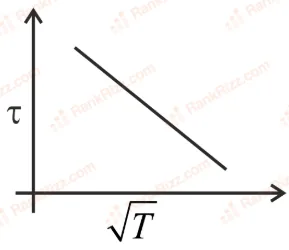
- (B)
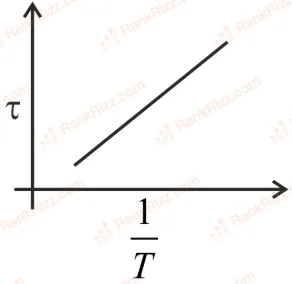
- (C)
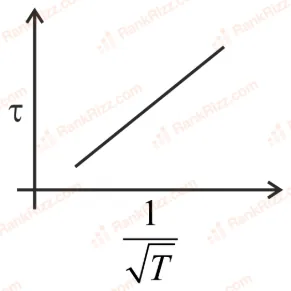
- (D)
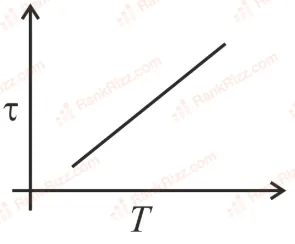
rr2.rankrizz.com/jee-main/physics/kinetic-theory-of-gases/q/8-jan-2020-s1-q9
- (A)
Under an adiabatic process, the volume of an ideal gas gets doubled. Consequently, the mean collision time between the gas molecules changes from to . If for this gas then a good estimate for is given by
- (A)
2
- (B)
- (C)
- (D)
rr2.rankrizz.com/jee-main/physics/kinetic-theory-of-gases/q/7-jan-2020-s2-q7
- (A)
A m volume cylinder is filled with 1 mol of O gas at room temperature (300 K). The molecular diameter of O, and its root mean square speed, are found to be 0.3 nm and 200 m/s, respectively. What is the average collision rate (per second) for an O molecule?
- (A)
~10
- (B)
~10
- (C)
~10
- (D)
~10
rr2.rankrizz.com/jee-main/physics/kinetic-theory-of-gases/q/10-apr-2019-s1-q10
- (A)
An ideal gas is enclosed in a cylinder at pressure of 2 atm and temperature, 300 K. The mean time between two successive collisions is s. If the pressure is doubled and temperature is increased to 500 K, the mean time between two successive collisions will be close to:
- (A)
s
- (B)
s
- (C)
s
- (D)
s
rr2.rankrizz.com/jee-main/physics/kinetic-theory-of-gases/q/12-jan-2019-s2-q11
- (A)
Consider an ideal gas confined in an isolated closed chamber. As the gas undergoes an adiabatic expansion, the average time of collision between molecules increases as , where is the volume of the gas. The value of is
- (A)
- (B)
- (C)
- (D)
rr2.rankrizz.com/jee-main/physics/kinetic-theory-of-gases/q/4-apr-2015-offline-q9
- (A)
Answer key
- 01 A
- 02 D
- 03 481
- 04 500
- 05 350
- 06 A
- 07 3
- 08 15
- 09 C
- 10 B
- 11 C
- 12 C
- 13 A
- 14 D
- 15 C
- 16 C
- 17 C
- 18 B
- 19 A
- 20 D
- 21 C
- 22 3
- 23 C
- 24 750
- 25 A
- 26 B
- 27 C
- 28 1400
- 29 B
- 30 B
- 31 12
- 32 D
- 33 D
- 34 A
- 35 A
- 36 B
- 37 C
- 38 C
- 39 C
- 40 B
- 41 D
- 42 A
- 43 D
- 44 A
- 45 B
- 46 C
- 47 A
- 48 B
- 49 B
- 50 B
- 51 C
- 52 A
- 53 D
- 54 A
- 55 D
- 56 C
- 57 —
- 58 A
- 59 B
- 60 A
- 61 A
- 62 B
- 63 C
- 64 3730
- 65 7
- 66 B
- 67 C
- 68 327
- 69 A
- 70 A
- 71 A
- 72 A
- 73 D
- 74 C
- 75 C
- 76 C
- 77 B
- 78 A
- 79 250
- 80 A
- 81 D
- 82 B
- 83 C
- 84 B
- 85 C
- 86 5
- 87 —
- 88 150
- 89 C
- 90 B
- 91 A
- 92 D
- 93 B
- 94 B
- 95 B
- 96 A
- 97 A
- 98 C
- 99 C
- 100 B
- 101 C
- 102 B
- 103 B
- 104 D
- 105 C
- 106 B
- 107 A
- 108 D
- 109 D
- 110 B
- 111 C
- 112 C
- 113 D
- 114 B
- 115 C
- 116 C
- 117 C
- 118 D
- 119 C
- 120 400
- 121 41
- 122 D
- 123 D
- 124 D
- 125 D
- 126 A
- 127 C
- 128 C
- 129 D
- 130 B
- 131 B
- 132 A
- 133 B
- 134 B
- 135 B
- 136 A
- 137 D
- 138 B
- 139 B
- 140 A
- 141 A
- 142 500
- 143 C
- 144 C
- 145 B
- 146 B
- 147 A
- 148 C
- 149 C
- 150 B
- 151 D
- 152 12
- 153 B
- 154 B
- 155 C
- 156 C
- 157 A
- 158 A
- 159 B
- 160 7479
- 161 B
- 162 B
- 163 B
- 164 D
- 165 A
- 166 C
- 167 B
- 168 A
- 169 D
- 170 A
- 171 B
- 172 D
- 173 C
- 174 D
- 175 C
- 176 C
- 177 B
- 178 C
- 179 C
- 180 D
- 181 B
- 182 25
- 183 D
- 184 B
- 185 A
- 186 D
- 187 C
- 188 D
- 189 C
- 190 D
- 191 D
“—” marks a question whose key we have not checked yet; its page shows the latest on it.
Past questions are reproduced with their sitting. Not affiliated with NTA or the IITs. Every question, online and free: rr2.rankrizz.com/jee-main/physics/kinetic-theory-of-gases