JEE MAIN 2026 · 28 JAN S2Mean free path
The mean free path of a molecule of diameter at the temperature 41 °C and pressure , is given as ___ m (Given .)
- A
- B
- C
- D
Mean free path has been asked 19 times in JEE Main, in 9 different years between 2015 and 2026, and in all of the last five exam years (2022–2026), 9 questions in all. That is 10% of Kinetic Theory of Gases. Last asked in JEE Main 28 Jan 2026, Shift 2. 18 are multiple choice and 1 numerical-value; 6 easy and 13 medium by our difficulty labels. All of them are below, newest first, free to read.
Questions
19
Years asked
9
Since
2015
Of the chapter
10%
Questions on Mean free path in every year it was asked, newest first.
| Year | Relative frequency | Questions |
|---|---|---|
| 2026 | 2 | |
| 2025 | 1 | |
| 2024 | 3 | |
| 2023 | 2 | |
| 2022 | 1 | |
| 2021 | 2 | |
| 2020 | 5 | |
| 2019 | 2 | |
| 2015 | 1 | |
| Total | 19 |
1–19 OF 19 · NEWEST FIRST
The mean free path of a molecule of diameter at the temperature 41 °C and pressure , is given as ___ m (Given .)
Consider two boxes containing ideal gases A and B such that their temperatures, pressures and number densities are same. The molecular size of A is half of that of B and mass of molecule A is four times that of B. If the collision frequency in gas B is then collision frequency in gas A is _____________/s.
The mean free path and the average speed of oxygen molecules at 300 K and 1 atm are m and 600 m/s, respectively. Find the frequency of its collisions.
/s
/s
/s
/s
Given below are two statements : Statement (I) : The mean free path of gas molecules is inversely proportional to square of molecular diameter. Statement (II) : Average kinetic energy of gas molecules is directly proportional to absolute temperature of gas. In the light of the above statements, choose the correct answer from the options given below :
Statement I is true but Statement II is false
Both Statement I and Statement II are false
Both Statement I and Statement II are true
Statement I is false but Statement II is true
If the collision frequency of hydrogen molecules in a closed chamber at is , then the collision frequency of the same system at is :
If is the number density and is the diameter of the molecule, then the average distance covered by a molecule between two successive collisions (i.e. mean free path) is represented by :
The mean free path of molecules of a certain gas at STP is , where is the diameter of the gas molecules. While maintaining the standard pressure, the mean free path of the molecules at K is approximately:
The number of air molecules per cm is increased from to . The ratio of collision frequency of air molecules before and after the increase in number respectively is:
0.75
1.25
0.50
0.25
According to kinetic theory of gases,
A. The motion of the gas molecules freezes at C.
B. The mean free path of gas molecules decreases if the density of molecules is increased.
C. The mean free path of gas molecules increases if temperature is increased keeping pressure constant.
D. Average kinetic energy per molecule per degree of freedom is (for monoatomic gases).
Choose the most appropriate answer from the options given below
A and C only
B and C only
A and B only
C and D only
A system consists of two types of gas molecules and having the same number density m. The diameter of and are 10A and 5A respectively. They suffer collisions at room temperature. The ratio of average distance covered by the molecule to that of between two successive collisions is _________
Calculate the value of the mean free path () for oxygen molecules at temperature 27°C and pressure Pa. Assume the molecular diameter 0.3 nm and the gas is ideal. ( J K)
58 nm
32 nm
86 nm
102 nm
In a dilute gas at pressure P and temperature T, the time between successive collision of a molecule varies with T as:
T
An ideal gas in a closed container is slowly heated. As its temperature increases, which of the following statements are true?
(A) the mean free path of the molecules decreases
(B) the mean collision time between the molecules decreases.
(C) the mean free path remains unchanged.
(D) the mean collision time relations unchanged.
(B) and (C)
(A) and (B)
(C) and (D)
(A) and (D)
Two gases - argon (atomic radius 0.07 nm, atomic weight 40) and xenon (atomic radius 0.1 nm, atomic weight 140) have the same number density and are at the same temperature. The ratio of their respective mean free times is closest to:
3.67
1.83
2.3
1.09
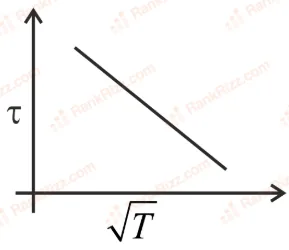
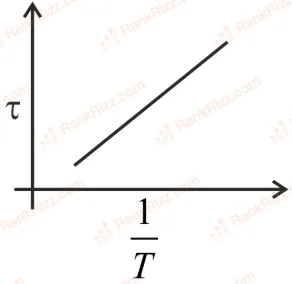
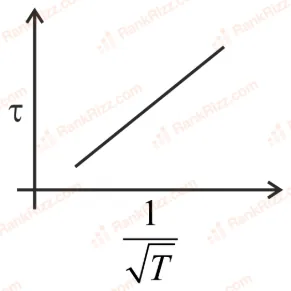
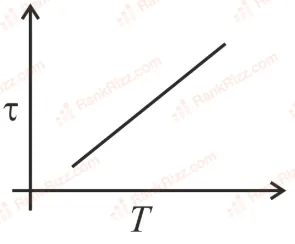
The plot that depicts the behavior of the mean free time (time between two successive collisions) for the molecules of an ideal gas, as a function of temperature (T), qualitatively, is: (Graphs are schematic and not drawn to scale)
Under an adiabatic process, the volume of an ideal gas gets doubled. Consequently, the mean collision time between the gas molecules changes from to . If for this gas then a good estimate for is given by
2
A m volume cylinder is filled with 1 mol of O gas at room temperature (300 K). The molecular diameter of O, and its root mean square speed, are found to be 0.3 nm and 200 m/s, respectively. What is the average collision rate (per second) for an O molecule?
~10
~10
~10
~10
An ideal gas is enclosed in a cylinder at pressure of 2 atm and temperature, 300 K. The mean time between two successive collisions is s. If the pressure is doubled and temperature is increased to 500 K, the mean time between two successive collisions will be close to:
s
s
s
s
Consider an ideal gas confined in an isolated closed chamber. As the gas undergoes an adiabatic expansion, the average time of collision between molecules increases as , where is the volume of the gas. The value of is
RELATED KINETIC THEORY OF GASES TOPICS