RankRizz

Kinetic Theory of Gases — JEE Main Previous Year Questions

Every Kinetic Theory of Gases question JEE Main has set from 2004–2026, grouped by the idea it tests rather than the order of the syllabus. 191 questions across 6 distinct ideas. Free to read, answer key on every one.

DATA UPDATED

Questions

191

Distinct ideas

6

Share of marks

3%

Difficulty

EASY

The ideas inside Kinetic Theory of Gases

A chapter is not one subject — it is a handful of procedures the examiner reuses. These are the ones Kinetic Theory of Gases questions actually test.

Every Kinetic Theory of Gases question

101–120 OF 191 · NEWEST FIRST

JEE MAIN 2021 · 01 SEP S2Kinetic interpretation of pressure and temperature

The average translational kinetic energy of N2N_2 gas molecules at _________ °C becomes equal to the K.E. of an electron accelerated from rest through a potential difference of 0.1 volt.
(Given kB=1.38×10⁻²³k_B = 1.38 \times 10^{-23} J K−1^{-1}) (Fill the nearest integer).

JEE MAIN 2021 · 31 AUG S2Ideal gas equation and gas laws

A mixture of hydrogen and oxygen has volume 500 cm3^3, temperature 300 K, pressure 400 kPa and mass 0.76 g. The ratio of masses of oxygen to hydrogen will be:

  1. A

    16 : 3

  2. B

    3 : 8

  3. C

    8 : 3

  4. D

    3 : 16

JEE MAIN 2021 · 27 AUG S1Ideal gas equation and gas laws

An ideal gas is expanding such that PT3PT^3 = constant. The coefficient of volume expansion of the gas is:

  1. A

    2T\frac{2}{T}

  2. B

    3T\frac{3}{T}

  3. C

    1T\frac{1}{T}

  4. D

    4T\frac{4}{T}

JEE MAIN 2021 · 27 AUG S1Ideal gas equation and gas laws

A balloon carries a total load of 185 kg at normal pressure and temperature of 27°C. What load will the balloon carry on rising to a height at which the barometric pressure is 45 cm of Hg and the temperature is -7°C. Assuming the volume constant?

  1. A

    214.15 kg

  2. B

    123.54 kg

  3. C

    219.07 kg

  4. D

    181.46 kg

JEE MAIN 2021 · 27 AUG S2RMS, average and most probable speeds of gas molecules

If the R.M.S. speed of oxygen molecules at 0°C is 160 m s−1^{-1}. Find the R.M.S. speed of hydrogen molecules at 0°C.

  1. A

    40 m s−1^{-1}

  2. B

    80 m s−1^{-1}

  3. C

    640 m s−1^{-1}

  4. D

    332 m s−1^{-1}

JEE MAIN 2021 · 26 AUG S1RMS, average and most probable speeds of gas molecules

The R.M.S. speeds of the molecules of Hydrogen, Oxygen, and Carbon dioxide at the same temperature are vHv_H, vOv_O and vCv_C respectively, then:

  1. A

    vC>vO>vHv_C > v_O > v_H

  2. B

    vH=vO>vCv_H = v_O > v_C

  3. C

    vH>vO>vCv_H > v_O > v_C

  4. D

    vH=vO=vCv_H = v_O = v_C

JEE MAIN 2021 · 26 AUG S2Ideal gas equation and gas laws

A cylindrical container of volume 4.0×10−34.0 \times 10^{-3} m3^3 contains one mole of hydrogen and two moles of carbon dioxide. Assume the temperature of the mixture is 400 K. The pressure of the mixture of gases is:
[Take gas constant as 8.3 J mol−1^{-1} K−1^{-1}]

  1. A

    24.9×10324.9 \times 10^3 Pa

  2. B

    249×101249 \times 10^1 Pa

  3. C

    24.9×10524.9 \times 10^5 Pa

  4. D

    24.9 Pa

JEE MAIN 2021 · 27 JUL S1Kinetic interpretation of pressure and temperature

The number of molecules in one litre of an ideal gas at 300 K and 2 atmospheric pressure with mean kinetic energy 2×10−92 \times 10^{-9} J per molecule is:

  1. A

    0.75×10110.75 \times 10^{11}

  2. B

    3×10113 \times 10^{11}

  3. C

    1.5×10111.5 \times 10^{11}

  4. D

    6×10116 \times 10^{11}

JEE MAIN 2021 · 25 JUL S1Molar specific heats of gases, Mayer's relation and gas mixtures

For a gas CP−CV=RC_P - C_V = R in a state P and CP−CV=1.10RC_P - C_V = 1.10R in a state Q. TPT_P and TQT_Q are the temperatures in two different states P and Q, respectively. Then

  1. A

    TP=TQT_P = T_Q

  2. B

    TP<TQT_P < T_Q

  3. C

    TP=0.9TQT_P = 0.9T_Q

  4. D

    TP>TQT_P > T_Q

JEE MAIN 2021 · 25 JUL S2Mean free path

A system consists of two types of gas molecules AA and BB having the same number density 2×10252 \times 10^{25} m−3^{-3}. The diameter of AA and BB are 10A and 5A respectively. They suffer collisions at room temperature. The ratio of average distance covered by the molecule AA to that of BB between two successive collisions is _________ ×10−2\times 10^{-2}

JEE MAIN 2021 · 22 JUL S1Kinetic interpretation of pressure and temperature

What will be the average value of energy for a monoatomic gas in thermal equilibrium at temperature TT?

  1. A

    23kBT\frac{2}{3}k_BT

  2. B

    kBTk_BT

  3. C

    32kBT\frac{3}{2}k_BT

  4. D

    12kBT\frac{1}{2}k_BT

JEE MAIN 2021 · 20 JUL S1Molar specific heats of gases, Mayer's relation and gas mixtures

The amount of heat needed to raise the temperature of 4 moles of a rigid diatomic gas from 0 ∘^\circC to 50 ∘^\circC when no work is done is (RR is the universal gas constant)

  1. A

    250RR

  2. B

    750RR

  3. C

    175RR

  4. D

    500RR

JEE MAIN 2021 · 20 JUL S1RMS, average and most probable speeds of gas molecules

Consider a mixture of gas molecules of types A, B and C having masses mA<mB<mCm_A < m_B < m_C. The ratio of their root mean square speeds at normal temperature and pressure is:

  1. A

    vA=vB=vC=0v_A = v_B = v_C = 0

  2. B

    1vA>1vB>1vC\frac{1}{v_A} > \frac{1}{v_B} > \frac{1}{v_C}

  3. C

    vA=vB≠vCv_A = v_B \neq v_C

  4. D

    1vA<1vB<1vC\frac{1}{v_A} < \frac{1}{v_B} < \frac{1}{v_C}

JEE MAIN 2021 · 20 JUL S2Ideal gas equation and gas laws

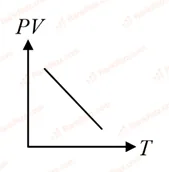
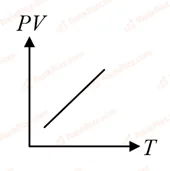
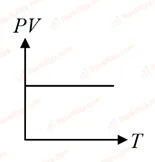
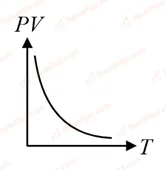
Which of the following graphs represent the behaviour of an ideal gas? Symbols have their usual meaning.

  1. A
    Figure for JEE Main 2021 Physics question on Ideal gas equation and gas laws
  2. B
    Figure for JEE Main 2021 Physics question on Ideal gas equation and gas laws
  3. C
    Figure for JEE Main 2021 Physics question on Ideal gas equation and gas laws
  4. D
    Figure for JEE Main 2021 Physics question on Ideal gas equation and gas laws
JEE MAIN 2021 · 20 JUL S2Molar specific heats of gases, Mayer's relation and gas mixtures

The correct relation between the degrees of freedom ff and the ratio of specific heat γ\gamma is:

  1. A

    f=2γ−1f = \frac{2}{\gamma - 1}

  2. B

    f=2γ+1f = \frac{2}{\gamma + 1}

  3. C

    f=γ+12f = \frac{\gamma + 1}{2}

  4. D

    f=1γ+1f = \frac{1}{\gamma + 1}

JEE MAIN 2021 · 18 MAR S2RMS, average and most probable speeds of gas molecules

Consider a sample of oxygen behaving like an ideal gas. At 300 K, the ratio of root-mean-square (RMS) velocity to the average velocity of the gas molecule would be :
(Molecular weight of oxygen is 32 g mol−1^{-1}; R=8.3R = 8.3 J K−1^{-1} mol−1^{-1})

  1. A

    33\sqrt{\frac{3}{3}}

  2. B

    83\sqrt{\frac{8}{3}}

  3. C

    3π8\sqrt{\frac{3\pi}{8}}

  4. D

    8π3\sqrt{\frac{8\pi}{3}}

JEE MAIN 2021 · 17 MAR S1Molar specific heats of gases, Mayer's relation and gas mixtures

A polyatomic ideal gas has 24 vibrational modes. What is the value of γ\gamma?

  1. A

    1.03

  2. B

    1.30

  3. C

    1.37

  4. D

    10.3

JEE MAIN 2021 · 17 MAR S1Degrees of freedom, equipartition of energy and internal energy

Two ideal polyatomic gases at temperatures T1T_1 and T2T_2 are mixed so that there is no loss of energy. If F1F_1 and F2F_2, m1m_1 and m2m_2, n1n_1 and n2n_2 be the degrees of freedom, masses, number of molecules of the first and second gas respectively, the temperature of mixture of these two gases is:

  1. A

    n1T1+n2T2n1+n2\frac{n_1 T_1 + n_2 T_2}{n_1 + n_2}

  2. B

    n1F1T1+n2F2T2n1F1+n2F2\frac{n_1 F_1 T_1 + n_2 F_2 T_2}{n_1 F_1 + n_2 F_2}

  3. C

    n1F1T1+n2F2T2F1+F2\frac{n_1 F_1 T_1 + n_2 F_2 T_2}{F_1 + F_2}

  4. D

    n1F1T1+n2F2T2n1+n2\frac{n_1 F_1 T_1 + n_2 F_2 T_2}{n_1 + n_2}

JEE MAIN 2021 · 17 MAR S2Molar specific heats of gases, Mayer's relation and gas mixtures

If one mole of the polyatomic gas is having two vibrational modes and β\beta is the ratio of molar specific heats for polyatomic gas (β=CpCv)\left(\beta = \frac{C_p}{C_v}\right) then the value of β\beta is:

  1. A

    1.02

  2. B

    1.2

  3. C

    1.25

  4. D

    1.35

JEE MAIN 2021 · 16 MAR S1Ideal gas equation and gas laws

The volume VV of an enclosure contains a mixture of three gases, 16 g of oxygen, 28 g of nitrogen and 44 g of carbon dioxide at absolute temperature TT. Consider RR as universal gas constant. The pressure of the mixture of gases is:

  1. A

    88RTV\frac{88RT}{V}

  2. B

    3RTV\frac{3RT}{V}

  3. C

    52RTV\frac{5}{2}\frac{RT}{V}

  4. D

    4RTV\frac{4RT}{V}