At a certain temperature, the degrees of freedom per molecule for gas is 8. The gas performs 150 J of work when it expands under constant pressure. The amount of heat absorbed by the gas will be _____ J.
Every Kinetic Theory of Gases question JEE Main has set from 2004–2026, grouped by the idea it tests rather than the order of the syllabus. 191 questions across 6 distinct ideas. Free to read, answer key on every one.
DATA UPDATED
Questions
191
Distinct ideas
6
Share of marks
3%
Difficulty
EASY
A chapter is not one subject — it is a handful of procedures the examiner reuses. These are the ones Kinetic Theory of Gases questions actually test.
81–100 OF 191 · NEWEST FIRST
At a certain temperature, the degrees of freedom per molecule for gas is 8. The gas performs 150 J of work when it expands under constant pressure. The amount of heat absorbed by the gas will be _____ J.
Same gas is filled in two vessels of the same volume at the same temperature. If the ratio of the number of molecules is , then
A. The r.m.s. velocity of gas molecules in two vessels will be the same.
B. The ratio of pressure in these vessels will be .
C. The ratio of pressure will be .
D. The r.m.s. velocity of gas molecules in two vessels will be in the ratio of .
A and C only
B and D only
A and B only
C and D only
Which statements are correct about degrees of freedom?
A. A molecule with degrees of freedom has different ways of storing energy.
B. Each degree of freedom is associated with average energy per mole.
C. A monoatomic gas molecule has 1 rotational degree of freedom whereas diatomic molecule has 2 rotational degrees of freedom.
D. has a total of 6 degrees of freedom.
Choose the correct answer from the options given below:
B and C only
B and D only
A and B only
C and D only
A gas has degrees of freedom. The ratio of specific heat of gas at constant volume to the specific heat of gas at constant pressure will be
Following statements are given:
(1) The average kinetic energy of a gas molecule decreases when the temperature is reduced.
(2) The average kinetic energy of a gas molecule increases with increase in pressure at constant temperature.
(3) The average kinetic energy of a gas molecule decreases with increase in volume.
(4) Pressure of a gas increases with increase in temperature at constant volume.
(5) The volume of gas decreases with increase in temperature.
Choose the correct answer from the options given below:
(1) and (4) only
(1), (2) and (4) only
(2) and (4) only
(1), (2) and (5) only
Sound travels in a mixture of two moles of helium and moles of hydrogen. If rms speed of gas molecules in the mixture is times the speed of sound, then the value of will be
A cylinder of fixed capacity of 44.8 litres contains helium gas at standard temperature and pressure. The amount of heat needed to raise the temperature of gas in the cylinder by 20.0°C will be (Given gas constant R = 8.3 J K mol)
249 J
415 J
498 J
830 J
A vessel contains 16 g of hydrogen and 128 g of oxygen at standard temperature and pressure. The volume of the vessel in cm is:
The total internal energy of two mole monoatomic ideal gas at temperature K will be ______ J. (Given J mol K)
What will be the effect on the root mean square velocity of oxygen molecules if the temperature is doubled and oxygen molecule dissociates into atomic oxygen?
The velocity of atomic oxygen remains same
The velocity of atomic oxygen doubles
The velocity of atomic oxygen becomes half
The velocity of atomic oxygen becomes four times
A mixture of hydrogen and oxygen has volume cm, temperature K, pressure kPa and mass g. The ratio of number of moles of hydrogen to number of moles of oxygen in the mixture will be
[Take gas constant J K mol]
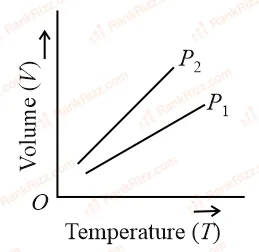
For a perfect gas, two pressures and are shown in figure. The graph shows

Insufficient data to draw any conclusion
According to kinetic theory of gases,
A. The motion of the gas molecules freezes at C.
B. The mean free path of gas molecules decreases if the density of molecules is increased.
C. The mean free path of gas molecules increases if temperature is increased keeping pressure constant.
D. Average kinetic energy per molecule per degree of freedom is (for monoatomic gases).
Choose the most appropriate answer from the options given below
A and C only
B and C only
A and B only
C and D only
A diatomic gas does J of work when it is expanded isobarically. The heat given to the gas in the process is ______ J.
A thermally insulated vessel contains an ideal gas of molecular mass and ratio of specific heats . Vessel is moving with speed and is suddenly brought to rest. Assuming no heat is lost to the surrounding and vessel temperature of the gas increases by :
( = universal gas constant)
A flask contains argon and oxygen in the ratio of in mass and the mixture is kept at C. The ratio of their average kinetic energy per molecule respectively
The relation between root mean square speed and most probable speed for the molar mass of oxygen gas molecule at the temperature of K will be
The ratio of specific heats in terms of degree of freedom is given by :
When a gas filled in a closed vessel is heated by raising the temperature by C, its pressure increases by . The initial temperature of the gas is ______ K.
kg of Nitrogen is enclosed in a vessel at a temperature of C. The amount of heat required to double the speed of its molecules is ______ kcal.
(Take cal mole K)
JEE Advanced has set 15 Kinetic Theory of Gases questions too. Kinetic Theory of Gases JEE Advanced PYQs →
OTHER PHYSICS CHAPTERS