JEE MAIN 2023 · 08 APR S2Kinetic interpretation of pressure and temperature
The temperature at which the kinetic energy of oxygen molecules becomes double than its value at 27C is
- A
927C
- B
327C
- C
1227C
- D
627C
Every Kinetic Theory of Gases question JEE Main has set from 2004–2026, grouped by the idea it tests rather than the order of the syllabus. 191 questions across 6 distinct ideas. Free to read, answer key on every one.
DATA UPDATED
Questions
191
Distinct ideas
6
Share of marks
3%
Difficulty
EASY
A chapter is not one subject — it is a handful of procedures the examiner reuses. These are the ones Kinetic Theory of Gases questions actually test.
61–80 OF 191 · NEWEST FIRST
The temperature at which the kinetic energy of oxygen molecules becomes double than its value at 27C is
927C
327C
1227C
627C
The number of air molecules per cm is increased from to . The ratio of collision frequency of air molecules before and after the increase in number respectively is:
0.75
1.25
0.50
0.25
The temperature of an ideal gas is increased from 200 K to 800 K. If r.m.s. speed of gas at 200 K is . Then, r.m.s. speed of the gas at 800 K will be:
The average kinetic energy of a molecule of the gas is
proportional to absolute temperature
proportional to volume
proportional to pressure
dependent on the nature of the gas
For three low density gases , , pressure versus temperature graphs are plotted while keeping them at constant volume, as shown in the figure.
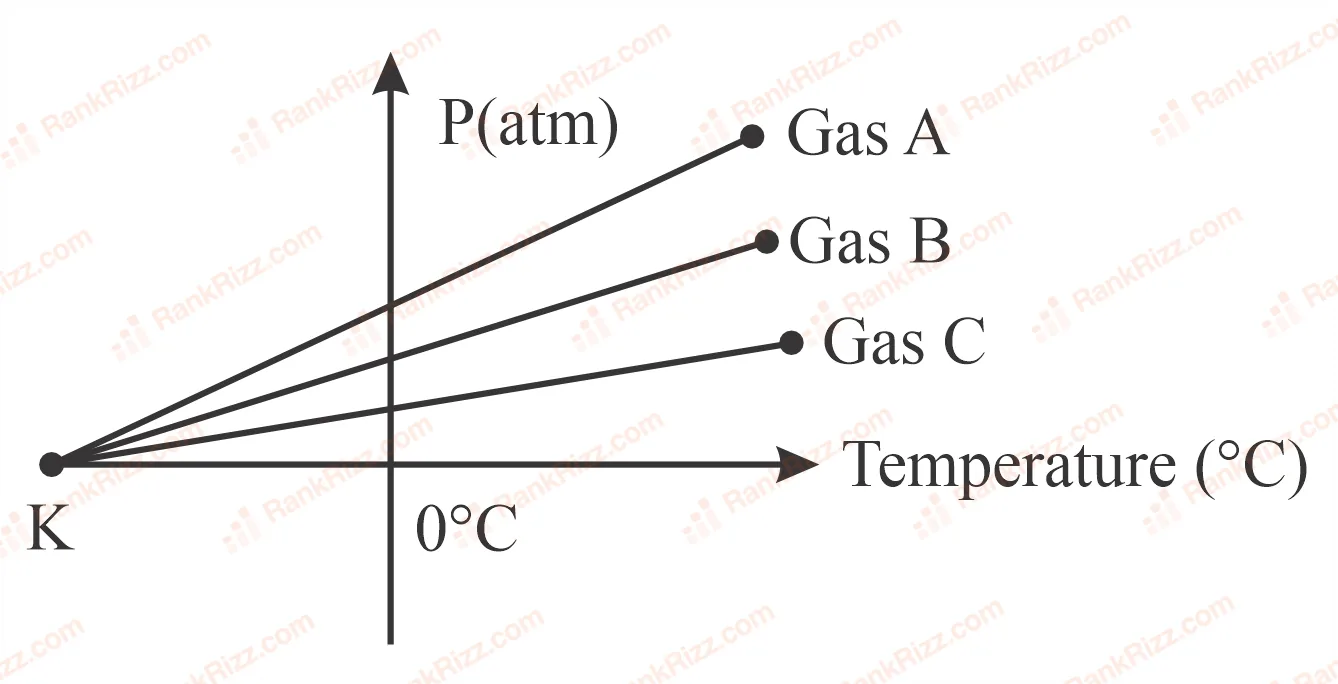
The temperature corresponding to the point 'K' is:
C
C
C
C
The correct relation between and temperature is:
Heat energy of 735 J is given to a diatomic gas allowing the gas to expand at constant pressure. Each gas molecule rotates around an internal axis but do not oscillate. The increase in the internal energy of the gas will be:
525 J
441 J
572 J
735 J
The pressure and temperature relationship of an ideal gas obeys the equation constant. The volume expansion coefficient of the gas will be:
A flask contains hydrogen and oxygen in the ratio of by mass at temperature C. The ratio of average kinetic energy per molecule of hydrogen and oxygen respectively is:
A bicycle tyre is filled with air having pressure of kPa at C. The approximate pressure of the air in the tyre when the temperature increases to C is
kPa
kPa
kPa
kPa
At K, the rms speed of oxygen molecules is times to that of its average speed in the gas. Then, the value of will be (use )
The root mean square velocity of molecules of gas is
Proportional to square of temperature ().
Inversely proportional to square root of temperature ().
Proportional to square root of temperature .
Proportional to temperature ().
According to law of equipartition of energy the molar specific heat of a diatomic gas at constant volume where the molecule has one additional vibrational mode is:-
Given below are two statements:
Statement I: The temperature of a gas is -73 °C. When the gas is heated to 527 °C, the root mean square speed of the molecules is doubled.
Statement II: The product of pressure and volume of an ideal gas will be equal to translational kinetic energy of the molecules.
In the light of the above statements, choose the correct answer from the options given below:
Both Statement I and Statement II are true
Statement I is true but Statement II is false
Both Statement I and Statement II are false
Statement I is false but Statement II is true
Let be the ratio of molar specific heat at constant pressure and molar specific heat at constant volume of a monoatomic gas and be the similar ratio of diatomic gas. Considering the diatomic gas molecule as a rigid rotator, the ratio is:
One mole of a monoatomic gas is mixed with three moles of a diatomic gas. The molecular specific heat of mixture at constant volume is J mol K; then the value of will be _____. (Assume that the given diatomic gas has no vibrational mode.)
The root mean square speed of smoke particles of mass kg in their Brownian motion in air at NTP is approximately. [Given J K]
60 mm s
12 mm s
15 mm s
36 mm s
Given below are two statements:
Statement I: The average momentum of a molecule in a sample of an ideal gas depends on temperature.
Statement II: The rms speed of oxygen molecules in a gas is . If the temperature is doubled and the oxygen molecules dissociate into oxygen atoms, the rms speed will become .
In the light of the above statements, choose the correct answer from the options given below:
Both Statement I and Statement II are true
Both Statement I and Statement II are false
Statement I is true but Statement II is false
Statement I is false but Statement II is true
A vessel contains 14 g of nitrogen gas at a temperature of . The amount of heat to be transferred to the gas to double the r.m.s. speed of its molecules will be: (Take J mol K)
2229 J
5616 J
9360 J
13,104 J
JEE Advanced has set 15 Kinetic Theory of Gases questions too. Kinetic Theory of Gases JEE Advanced PYQs →
OTHER PHYSICS CHAPTERS